Author Archive

Stars, by Emily Brontë

Posted in Poetry with tags , , on July 30, 2020 by telescoper

Ah! why, because the dazzling sun
Restored our Earth to joy,
Have you departed, every one,
And left a desert sky?

All through the night, your glorious eyes
Were gazing down in mine,
And, with a full heart’s thankful sighs,
I blessed that watch divine.

I was at peace, and drank your beams
As they were life to me;
And revelled in my changeful dreams,
Like petrel on the sea.

Thought followed thought, star followed star,
Through boundless regions, on;
While one sweet influence, near and far,
Thrilled through, and proved us one!

Why did the morning dawn to break
So great, so pure, a spell;
And scorch with fire the tranquil cheek,
Where your cool radiance fell?

Blood-red, he rose, and, arrow-straight,
His fierce beams struck my brow;
The soul of nature sprang, elate,
But mine sank sad and low!

My lids closed down, yet through their veil
I saw him, blazing, still,
And steep in gold the misty dale,
And flash upon the hill.

I turned me to the pillow, then,
To call back night, and see
Your worlds of solemn light, again,
Throb with my heart, and me!

It would not do—the pillow glowed,
And glowed both roof and floor;
And birds sang loudly in the wood,
And fresh winds shook the door;

The curtains waved, the wakened flies
Were murmuring round my room,
Imprisoned there, till I should rise,
And give them leave to roam.

Oh, stars, and dreams, and gentle night;
Oh, night and stars, return!
And hide me from the hostile light
That does not warm, but burn;

That drains the blood of suffering men;
Drinks tears, instead of dew;
Let me sleep through his blinding reign,
And only wake with you!

by Emily Brontë (1818-1848; she was born on 30th July)

On the Coronavirus and the Cricket

Posted in Covid-19, Cricket with tags , , on July 29, 2020 by telescoper

Yesterday the UK Government reported that there were 119 Covid-19 related deaths in the United Kingdom:

Between

In other news, it was also announced yesterday that Stuart Broad and I have now taken 500 Test wickets between us…

New Publication at the Open Journal of Astrophysics!

Posted in OJAp Papers, Uncategorized with tags , , , , on July 29, 2020 by telescoper

To celebrate yesterday’s news, I have great pleasure today in publishing another paper in The Open Journal of Astrophysics.

A reason to be especially pleased with this article is that this is our first publication in the Solar and Stellar Astrophysics category of astro-ph. It’s good to be spreading out beyond cosmology and extragalactic astrophysics which is where most of our papers appear.

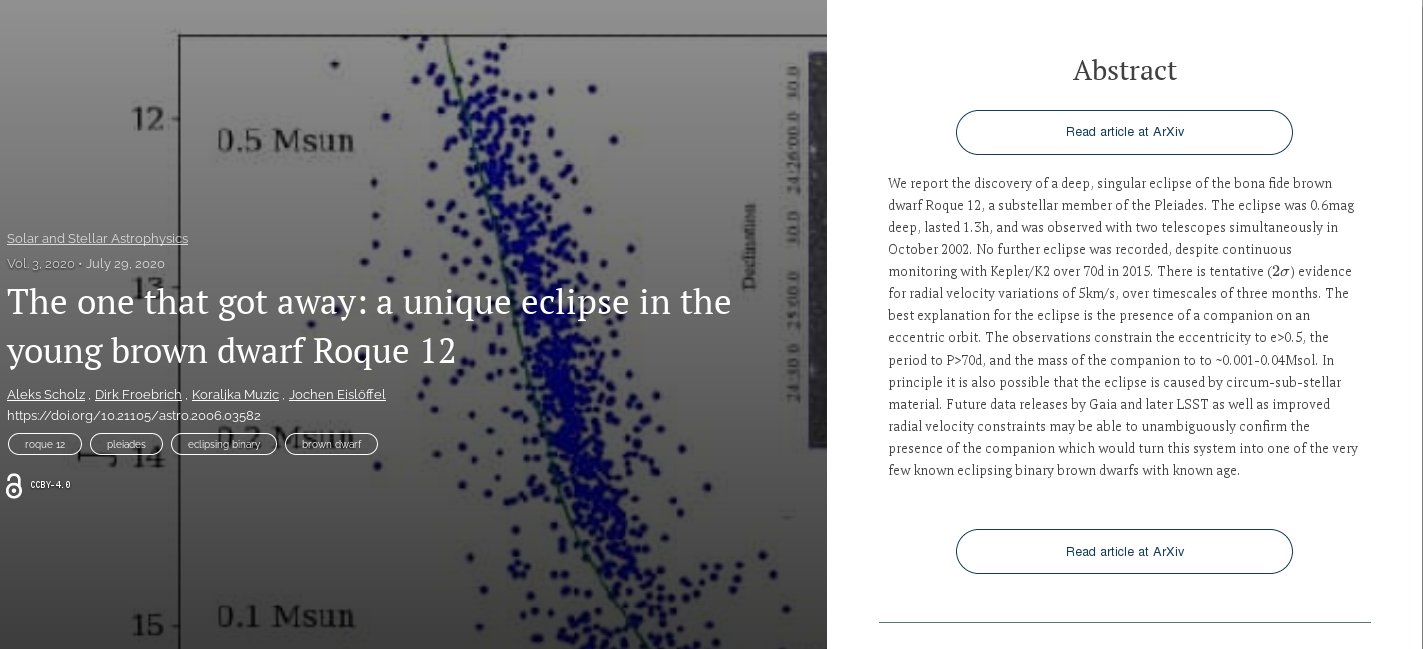
The intriguing title of the latest paper is The one that got away: a unique eclipse in the young brown dwarf Roque 12. There’s also a blog post by one of the authors that tells the fascinating behind-the-scenes story of this paper.

The authors of the paper are Aleks Scholz (University of St Andrews, UK), Dirk Froebrich (University of Kent, Canterbury, UK); Koraljka Muzic (University of Lisbon, Portugal) and Jochen Eislöffel (TLS Tautenburg, Germany).

Here is a screen grab of the overlay:

You might notice that we now have the volume number appearing on the overlay, a change we requested recently from Scholastica.

You can find the arXiv version of the paper here.

The Open Journal of Astrophysics is now in the Directory of Open Access Journals!

Posted in Open Access with tags , , on July 28, 2020 by telescoper

One of the things I did during the recent Covid-19 campus closure was to complete an application for the Open Journal of Astrophysics to be indexed in the Directory of Open Access Journals (DOJA).

I did apply late last year but there was an issue with the registration of the ISSN (International Standard Serial Number) which had not been done correctly when it was issued by the National Library of Ireland. That was easily fixed but DOAJ requires unsuccessful applicants to wait six months before applying again.

Getting listed on DOAJ is by no means trivial. The criteria are rather strict and the application form rather lengthy. All of which means that I was delighted to learn today that my application was successful this time, and we’re now listed.

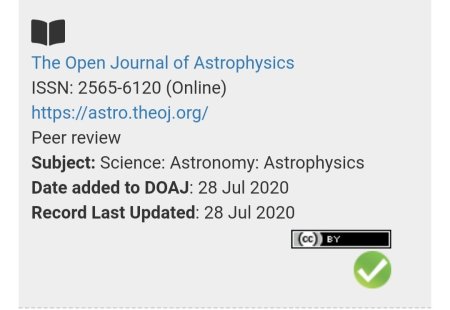
To prove it here is our entry:

Apart from the intrinsic usefulness of being indexed, being listed on DOAJ is one of the criteria for being an acceptable Open Access publisher for some funding agencies, including those who have signed up for Plan S.

I also imagine that our being on DOAJ might convince new authors to submit to us!

All I have to do now is figure out how to add our papers and metadata to the DOAJ and find the time to do it.

P. S. The Directory of Open Access Journals also has a WordPress blog which you can find here!

More Lockdown Perspectives on the Hubble Tension and thoughts on the future of scientific publications

Posted in Open Access, The Universe and Stuff with tags , , , , on July 28, 2020 by telescoper

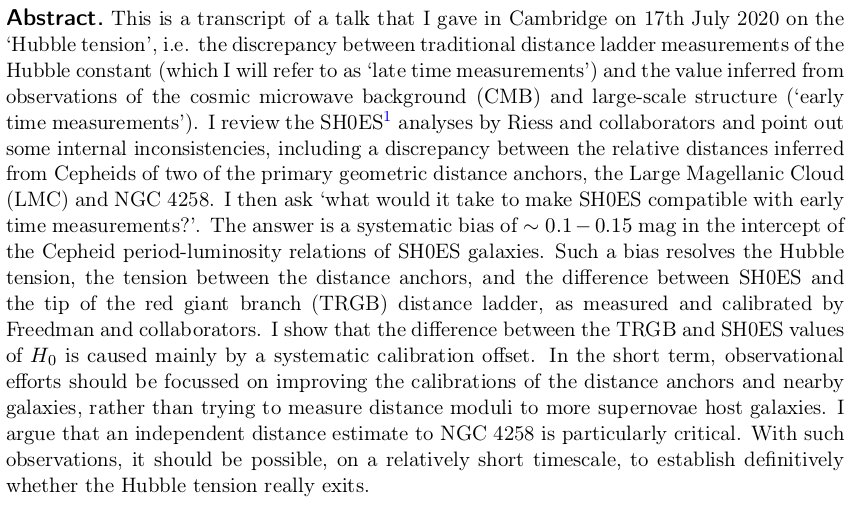
This is interesting. Remember last week when I posted about a paper by George Efstathiou on the Hubble Constant controversy. This is the abstract.

Well, a new version of the paper has just appeared on the arXiv that includes some comments in response from the SH0ES team.

It is of course interesting in itself to see the cut and thrust of scientific debate on a live topic such as this, but in my mind at least it raises interesting questions about the nature of scientific publication. To repeat something I wrote a a while ago, it seems  to me that the scientific paper published in an academic journal is an anachronism. Digital technology enables us to communicate ideas far more rapidly than in the past and allows much greater levels of interaction between researchers. I agree with Daniel Shanahan that the future for many fields will be defined not in terms of “papers” which purport to represent “final” research outcomes, but by living documents continuously updated in response to open scrutiny by the research community.

The Open Journal of Astrophysics is innovative in some ways but remains wedded to the paper as its fundamental object, and the platform is not able to facilitate interaction with readers. Of course one of the worries is that the comment facilities on many websites tend to get clogged up with mindless abuse, but I think that is manageable. I have some ideas on this, but for the time being I’m afraid all my energies are taken up with other things so this is for the future.

I’ve long argued that the modern academic publishing industry is not facilitating but hindering the communication of research. The arXiv has already made academic journals virtually redundant in many of branches of  physics and astronomy; other disciplines will inevitably follow. The age of the academic journal is drawing to a close, and it is consequently time to rethink the concept of a paper.

Time, Money and Guidance in Higher Education

Posted in Covid-19, Education, Maynooth with tags , , , , on July 27, 2020 by telescoper

There was a welcome announcement last week of a package of supports for further and higher education institutions and students in Ireland to cover costs incurred by third level institutions during the Covid-19 pandemic and enable further and higher education students to return to college this September.

There wasn’t much sign of any help at all coming under the previous Government, so this is perhaps a sign that the new Department of Further and Higher Education, Research, Innovation and Science might be a force to be reckoned with in the new administration.

If this funding is to achieve its aim, however, it will have to reach its targets very quickly. The new academic year is to commence at the end of September, which is just two months away. The slice that is intended to go directly to students to help them buy laptops or tablets can probably be spent quite quickly, but the money intended for colleges and universities to buy equipment will take much longer to filter through.

Speaking for myself, as Head of a Department of Theoretical Physics I’d say we desperately need better video equipment for both live and recorded material. At present we have no lecture capture facilities at all in any lecture theatres. We also need graphics tablets to help lecturers show mathematical working via remote means. There is likely to be a big rush for this sort of thing between now and September, and no guarantee we will have it in time for the start of lectures.

You might well ask `why don’t you buy this stuff now?’. The answer is simple: I haven’t got the money!

Things are even tougher for schools. Here there is another big support package on the way, this time of €350 million to allow them to open at the end of August. Getting kids back to school is obviously important not only for their education but also to allow their parents to return to work. However, the time available to prepare all the things necessary is just a month, even shorter than it is at third level.

Among the funds being made available is €75 million for `building works’. I’m sure that investment is very welcome, but can it do anything between now and the end of August? It’s actually rather difficult to spend money that quickly if due process is followed. Just look at how the UK government has squandered tens of millions on phony contracts, such as the £12 million it blew on a Covid-19 tracing app that never worked.

On top of that 1000 new schoolteachers are going to be provided. Will they be recruited in time?

Another announcement to appear last week contained guidance for further and higher education on returning to on-site activity in 2020. This guidance has been interpreted in the media in a rather unhelpful way, causing many of my colleagues to go into a panic. This, for example, from the Irish Times:

Physical distancing rules of two metres will apply on college campuses from September in a move which will severely limit the ability of universities to hold lectures and graduation ceremonies.

A strict requirement of 2 metre distancing at all times would indeed severely reduce the capacity of lecture theatres, but if you look at the guidance it is considerably more nuanced than this. The real problem with this guidance is that it is so vague. We can only hope we get something a bit more concrete soon so we can plan for September. Alternatively we could just wing it. All of it. At the moment this seems the only viable strategy.

No Azed celebration…

Posted in Biographical, Crosswords with tags , on July 26, 2020 by telescoper

I heard today that the special lunch that had been planned to celebrate the 2500th Azed crossword puzzle has been cancelled. It was first planned to take place in May (to coincide roughly with the publication of the 2500th puzzle), then postponed to September and now cancelled altogether. The venue, Wadham College Oxford, is not hosting any large events for the foreseeable future.

I wasn’t surprised by this news, but it is a shame. I was looking forward to using the event as an excuse for a break. I wouldn’t have gone just for the lunch, obviously, but would have stayed for some time either side.

On the other hand, travelling from Ireland to England and back in September would have been difficult, not least because I might have had to quarantine for 14 days in both ditections! Even without that it would have been a disruption to the preparations for the new academic year.

So I guess I’ll be staying here for the rest of the summer, though I might taje a short break somewhere in Ireland if I can.

Anyway, going back to the crosswords I got an HC (highly commended) in the latest Azed Competition (No. 2508). That was a first for me as it is the first entry I have sent in by email rather than in the post. At least I know it arrived safely. As usual I enjoyed solving the puzzle much more than composing a clue. I’m definitely a solver rather than a setter. Next Sunday will be another competition puzzle so I’ll see if I can do better in that.

Endgames

Posted in Football with tags , , , , , on July 26, 2020 by telescoper

Today sees the last round of games in this year’s strange Premiership season. All ten games kick off at 4pm.

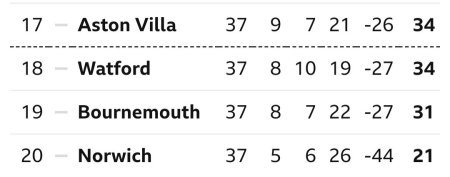
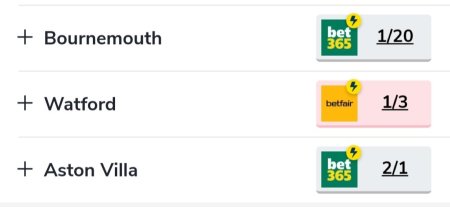
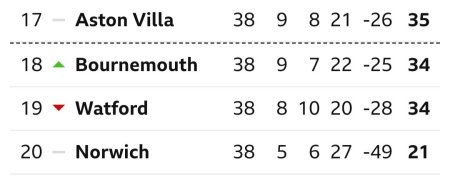
I last commented on the relegation situation when there were six games to play. Now, with one game left to play the bottom of the table looks like this:

Norwich City are already relegated and all the teams above these four, including Newcastle United, are safe; Brighton are in 16th place on 38 points.

It is possible for any two of Aston Villa, Watford and Bournemouth to go down though Bournemouth have to win and hope both Villa and Watford lose. Bournemouth are playing Everton away from home. I’d say the combination of them winning and other two relegation candidates both losing is rather improbable, but you never know.

One of either Watford or Aston Villa must get relegated. The team that gets the better result of the two will stay up.

If all three of these teams lose (which is by no means unlikely) whoever goes down with Bournemouth and Norwich will be determined by goal difference. Villa have a cushion of only one goal which means that if Villa and Watford both draw then Villa stay up. If they both win then the survivor will be determined by goal difference.

Aston Villa are away at West Ham and Watford are away at Arsenal. I’d say Watford has the tougher game so I’d say they were favourites to go down with Bournemouth.

The bookies seem to agree with me. Here are the best odds on teams to be relegated:

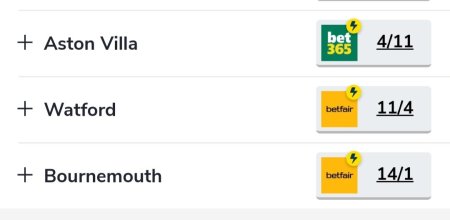
These are the odds on survival:

Bournemouth’s odds look a bit miserly to me, so the best price is Watford to stay up at 11/4 although even that isn’t enough to tempt me to have a flutter.

Of course these odds will change during the course of the games.

Half-time Update:

The key scores at half time are:

  • Arsenal 3 Watford 1
  • Everton 1 Bournemouth 2
  • West Ham 0 Aston Villa 0

As things stand, Villa stay up; Bournemouth and Watford go down. That will change if Villa concede a goal.

Full-time Update:

  • Arsenal 3 Watford 2
  • Everton 1 Bournemouth 3
  • West Ham 1 Aston Villa 1

Bournemouth did what they needed to do but despite their efforts that draw for Villa sends them down along with Watford.

Newcastle United unsurprisingly lost their final match against Liverpool and finished in 13th place, 10 points above the relegation zone.

Reading Finnegans Wake

Posted in Literature, Maynooth with tags , on July 25, 2020 by telescoper

Doing my bit to support local businesses as they come out of lockdown I decided to order a book from the excellent independent bookshop on Main Street. You can’t browse there yet but you can order books for collection.

I went to collect my order yesterday. I was worried that they might be struggling for business but the place was chock-a-block with packs of school books ready for collection ahead of the new school year.

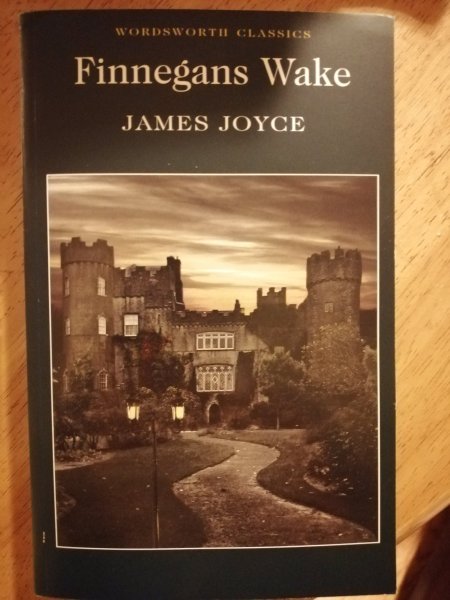
I picked up this bit of light reading:

I disagree with people who say that Ulysses is a difficult read, but Finnegans Wake is certainly a challenge. The lady in the bookshop said “Good luck with it!” as she handed it to me…

Alfred Hitchcock once claimed that “puns are the highest form of literature” and one of the features of Finnegans Wake is the constant stream of puns (in different languages). It seems that almost every sentence contains some form of double meaning too. Finnegans Wake may be hard going but it’s very playful, not only with linguistic meaning but with the sounds that words make, which can be delightful in itself independently of what they’re supposed to mean.

I’ve always thought of Finnegans Wake not so much as a novel but as as a very long poem to be read out loud. Indeed here is a strange but fascinating clip of Joyce himself reading an excerpt. Note the attention he pays to the rhythm:

I’ve set myself the target of reading 10 pages a day, which means it will take me a couple of months to finish it. I’ll try reading some bits out to myself, though I can’t do the accent…

On Grinds

Posted in Literature, mathematics with tags , , , , on July 24, 2020 by telescoper

When I moved to Ireland a couple of years ago, one of the words I discovered had a usage with which I was unfamiliar was grind. My first encounter with this word was after a lecture on vector calculus when a student asked if I knew of anyone who could offer him grinds. I didn’t know what he meant but was sure it wasn’t the meaning that sprang first into my mind so I just said no, I had just arrived in Ireland so didn’t know of anyone. I resisted the temptation to suggest he try finding an appropriate person via Grindr.

I only found out later that grinds are a form of private tuition and they are quite a big industry in Ireland, particularly at secondary school level. School students whose parents can afford it often take grinds in particular subjects to improve their performance on the Leaving Certificate. It seems to be less common for third level students to pay for grinds, but it does happen. More frequently university students actually offer grinds to local schoolkids as a kind of part-time employment to help them through college.

The word grind can also refer to a private tutor, i.e. you can have a maths grind. It can also be used as a verb, in which sense it means `to instil or teach by persistent repetition’.

This sense of the word grind may be in use in the United Kingdom but I have never come across it before, and it seems to me to be specific to Ireland.

All of which brings me back to vector calculus, via Charles Dickens.

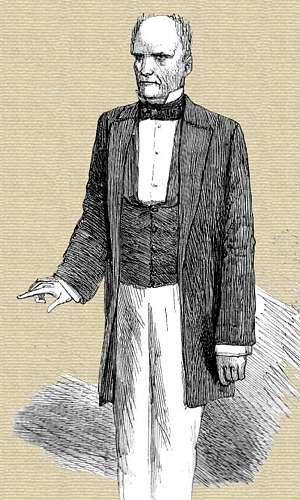
In Hard Times by Charles Dickens there is a character by the name of Mr Thomas Gradgrind, a grimly utilitarain school superintendent who insisted on teaching only facts.

Thomas Gradgrind (engraving by Sol Eytinge, 1867).

If there is a Mr Gradgrind, why is there neither a Mr Divgrind nor a Mr Curlgrind?