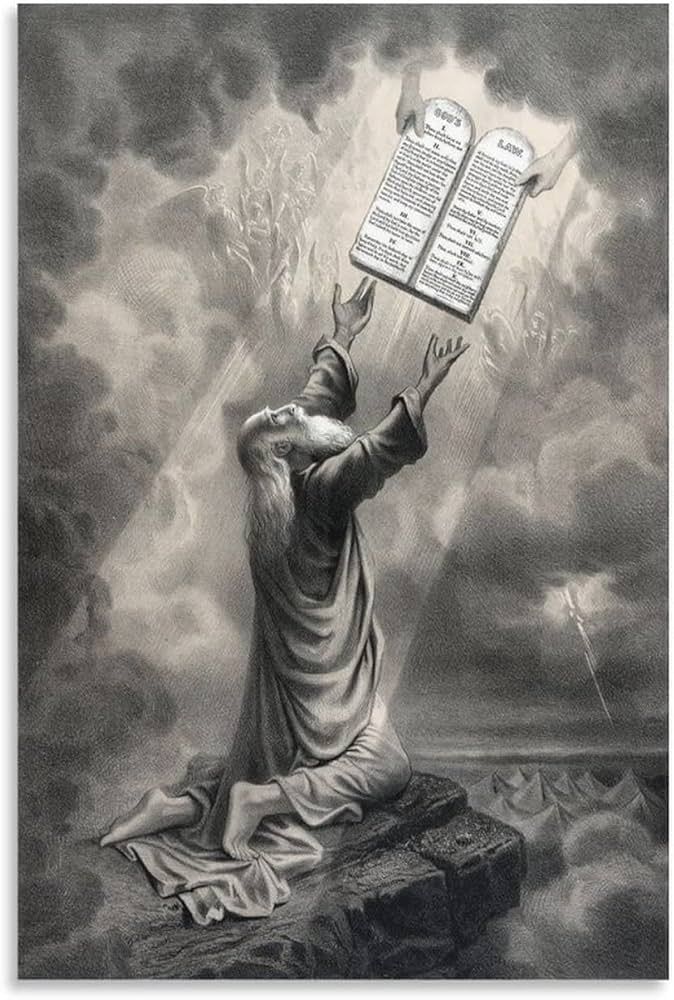
It seems that after Donald Trump shared an image of himself as Jesus on social media, ridiculous pictures of oneself in biblical settings have become all the rage. In that vein here is a picture of me downloading a paper from arXiv to read on my tablet:
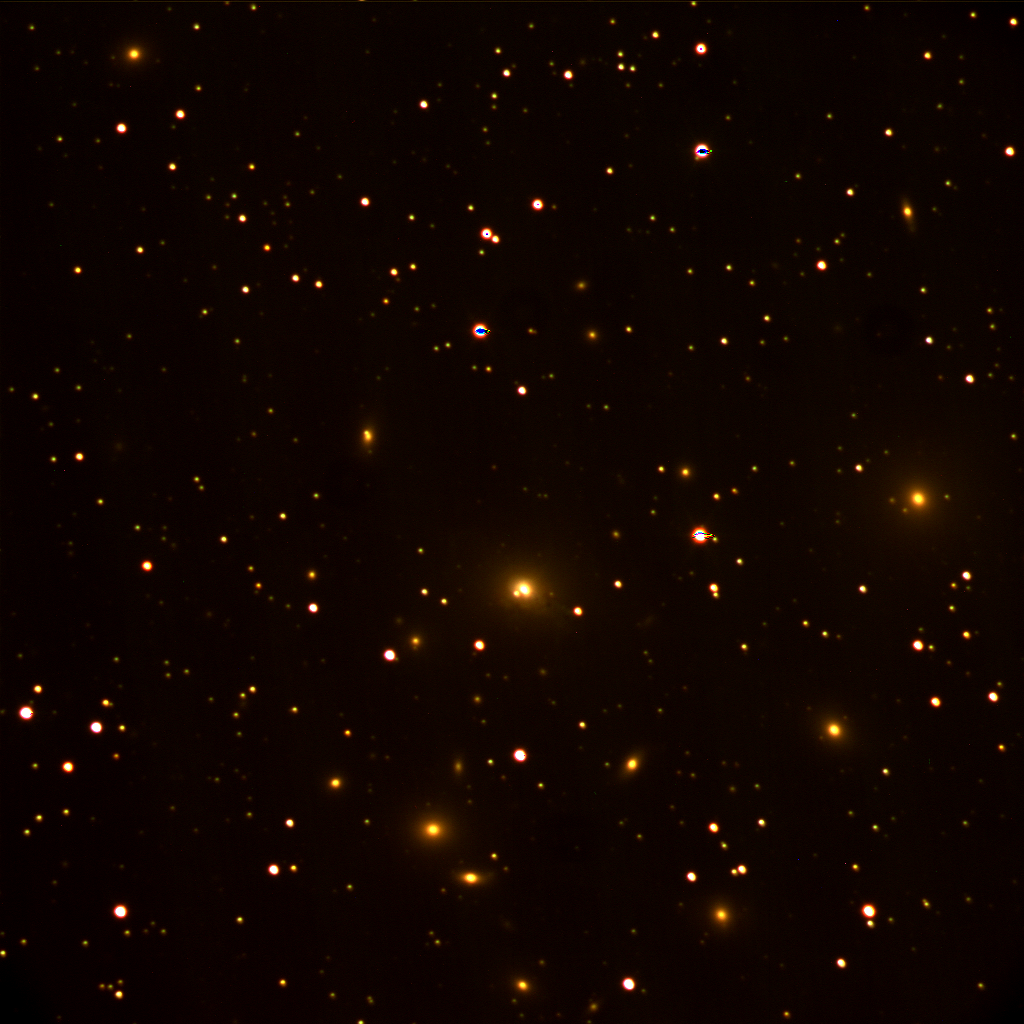
In a vain attempt to convince my readership that I know anything about observational astronomy, I thought I’d share this image of the central regions of the Perseus Cluster (also known as Abell 426) made by my final-year project students:
Picture Credit: Ben Doyle
The image was taken last November using the 1.20m reflecting telescope at the Observatoire de Haute-Provence where the final-year astrophysics students from Maynooth spent a week last November on a field trip taking various observations. The exposure was 240 seconds and the field of view is about 15 arcminutes on a side. Most of the objects in the image are galaxies, rather than stars.
I asked my students to look at this cluster (which is about 10 degrees across), partly because it appears near the Zenith in November so would be a good target, partly because it is nearby so the galaxies in it are therefore quite bright, and partly because it was observed by Euclid and featured among the Early Release Observations. The Euclid telescope is also 1.20m in diameter, but because it has a very fancy camera and is in space, Euclid reveals far more galaxies but I was nevertheless impressed at how well this turned out!
I’ve been greatly enjoying the boxed set of six seasons of Peaky Blinders that I received as a gift recently. I may do a sort of review when I get to the end, but until then I thought I’d throw in a few tangential things. This post is an example. Here’s another one. This clip is from Episode 2 of Series 1, when the Shelby family are celebrating the reopening of the Garrison pub after it was destroyed by a firebomb earlier on. Listen to the background music at the start.
The music being played is Livery Stable Blues by the Original Dixieland Jazz Band, a record I blogged about here. Released in 1917, it is no exaggeration to say that this was the first every commercial jazz record; I blogged about the 100th anniversary of its release.
The band was originally called the “Original Dixieland Jass Band“. A few months later they changed the “Jass” to “Jazz” – it is claimed because people kept defacing their posters by removing the letter “J” – and the new name stuck. The Original Dixieland Jazz Band is usually referred by Jazz buffs as the ODJB.
Led by cornettist Nick LaRocca and clarinettist Larry Shields, the ODJB was a group of white musicians from in and around New Orleans who had picked up their musical ideas from listening to musicians there, including playing for the pioneering mixed-race band led by Papa Laine, before moving to Chicago which is where they were spotted by representatives of the Victor label. Although the sound quality isn’t great, it gives a good insight to what ealy jazz drummers were like – thumping bass and tom-toms but little use of the cymbals – and shows Larry Shields was a dab hand at glissandi…
Series 1 of Peaky Blinders is set in 1919 (mainly in Birmingham but also with scenes in London). Not a lot of people know that the ODJB actually visited England in 1919. They performed in review at the Hammersmith Palais and then did a command performance in front of King George V, who (apparently) particularly enjoyed their version of Tiger Rag. There is no evidence that they visited Birmingham, but we get a glimpse before the above clip of a band decked out to look like them, playing live in the Garrison pub. I very much enjoy little details like that!
Most readers of this blog will be aware of the existence of Venn Diagrams, but not a lot of people know that their creator, John Venn, invented a mechanical bowling machine for use by cricketers in batting practice. Recently some folks at Cambridge University built a replica of this machine, presumably with the aid of some sort of diagram, and here’s a fascinating video about it.
Modern bowling machines fire the ball at you like a cannon, but this machine has the virtue of the batter being able to see the arm coming over which must help a little. This creation is also able to impart quite a bit of spin, in either direction but it looks like it should be quite easy to pick. The examples shown in the video also demonstratte that batting is only partly about hand-eye coordination – a key element is how to move your feet!
So the Easter break is over and I was back to campus today armed with a very long to-do list. I’m pleased to say I’ve ticked all the items off except the last, which was to prepare my lecture for 9am tomorrow. I’ll do that after supper.
I was very tired this morning after doing a bit of gallivanting for a couple of days. Am I too old to be carrying on like that? Yes. Do I intend to stop? No. Although I had a lot to do I didn’t have any lectures or tutorials so I was able to knuckle down and get on with things, interrupted only by an obligatory telecon.
We have four weeks left until the end of lectures for Semester 2. To be precise it’s four weeks minus one Bank Holiday (on Monday 4th May) which makes it 3.8 (working) weeks, but I don’t have lectures on Mondays so this isn’t very relevant to me. My Particle Physics module will continue in the same vein until the end of teaching but Computational Physics changes after this week, with lectures and formal lab sessions ending allowing the students time to do their mini-projects (which they have already started). They will still have access to the labs and be able to consult the demonstrators for help on their projects, though they can work at home (or somewhere else) instead if they prefer.
Other signs of the approaching end of term is that the May Examination timetable has been published, the required papers are being printed, schedules of student presentations are being circulated, and arrangements being made to mark projects.
When teaching is over for the academic year , and before exam marking starts, assuming a whole day of decent weather arrives, I plan to walk from Maynooth into Dublin along the Royal Canal. That’s a distance of 27 km. I do intend to walk the length of the National Famine Way later this year, but I was convinced to do one stage first to see if my knees can take it. The final leg of the Famine Way is from Maynooth to Dublin, which is convenient because if I’m forced to give up I can easily get the bus or train home, as I can if I reach the end.
Now for a quick supper, write my lecture for tomorrow morning, and have an early night!
I’m not sure of the recording date, but it was made in Hungary (when Hungary was still behind the Iron Curtain) so it would have to be before 1956, as Cziffra escaped to Vienna then and eventually took up French citizenship.
With permission, I have time for yet another Saturday morning update of activity at the Open Journal of Astrophysics. Since the last update we have published a further five papers, bringing the number in Volume 9 (2026) to 76 and the total so far published by OJAp up to 524.
I will continue to include the posts made on our Mastodon account (on Fediscience) to encourage you to visit it. Mastodon is a really excellent service, and a more than adequate replacement for X/Twitter (which nobody should be using); these announcements also show the DOI for each paper.
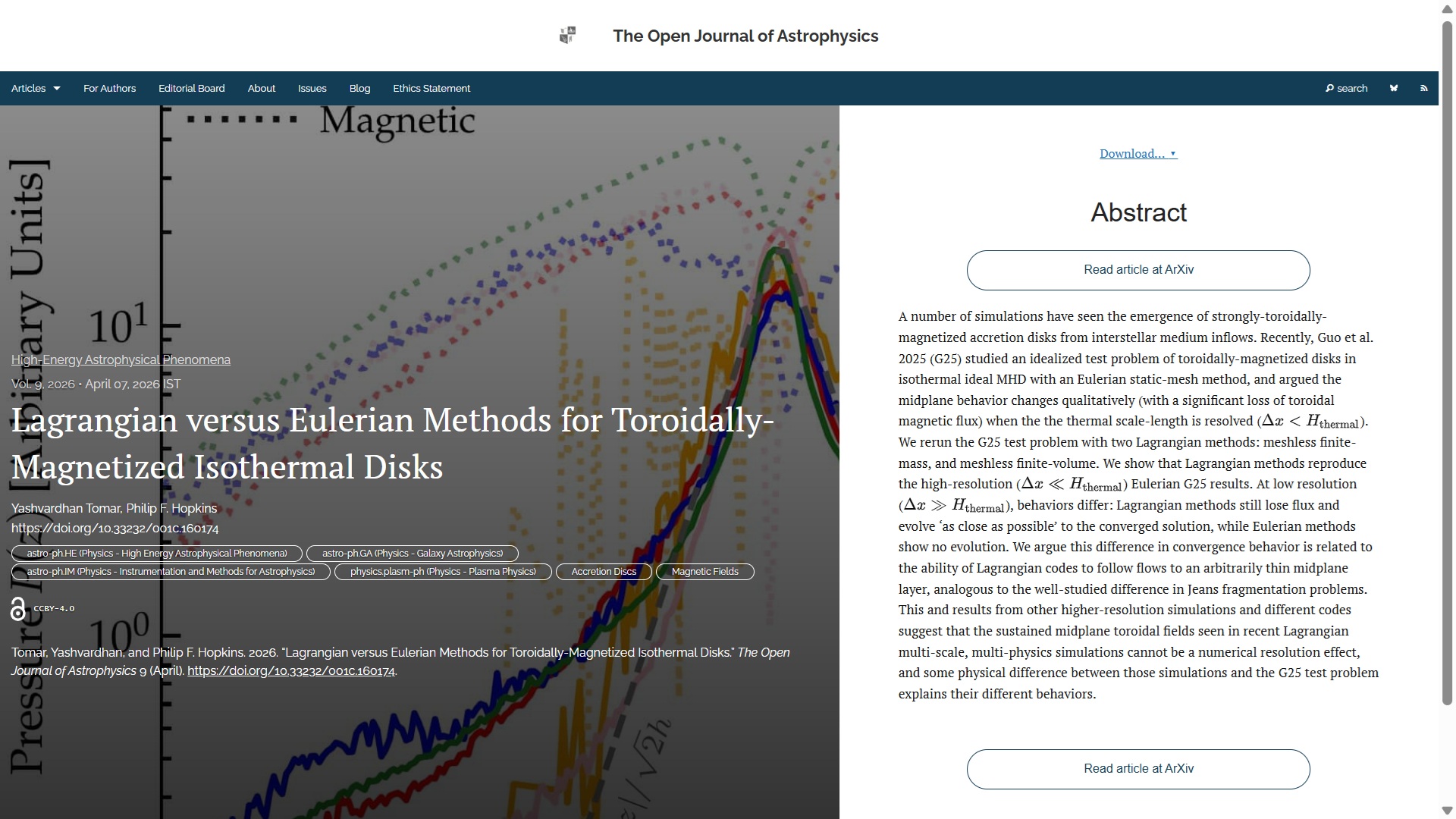
The first paper to report this week is “Lagrangian versus Eulerian Methods for Toroidally-Magnetized Isothermal Disks” by Yashvardhan Tomar and Philip F. Hopkins (California Institute of Technology, USA). This study re-evaluates previous research on toroidally-magnetized disks, using two Lagrangian methods. The results suggest that sustained midplane toroidal fields in recent simulations are not a numerical artefact. It was published on Tuesday April 7th 2026 in the folder High-Energy Astrophysical Phenomena.
The overlay is here:
You can find the officially accepted version on arXiv here and the announcement on Fediverse here:
New Publication at the Open Journal of Astrophysics: "Lagrangian versus Eulerian Methods for Toroidally-Magnetized Isothermal Disks" by Yashvardhan Tomar and Philip F. Hopkins (Caltech, USA)
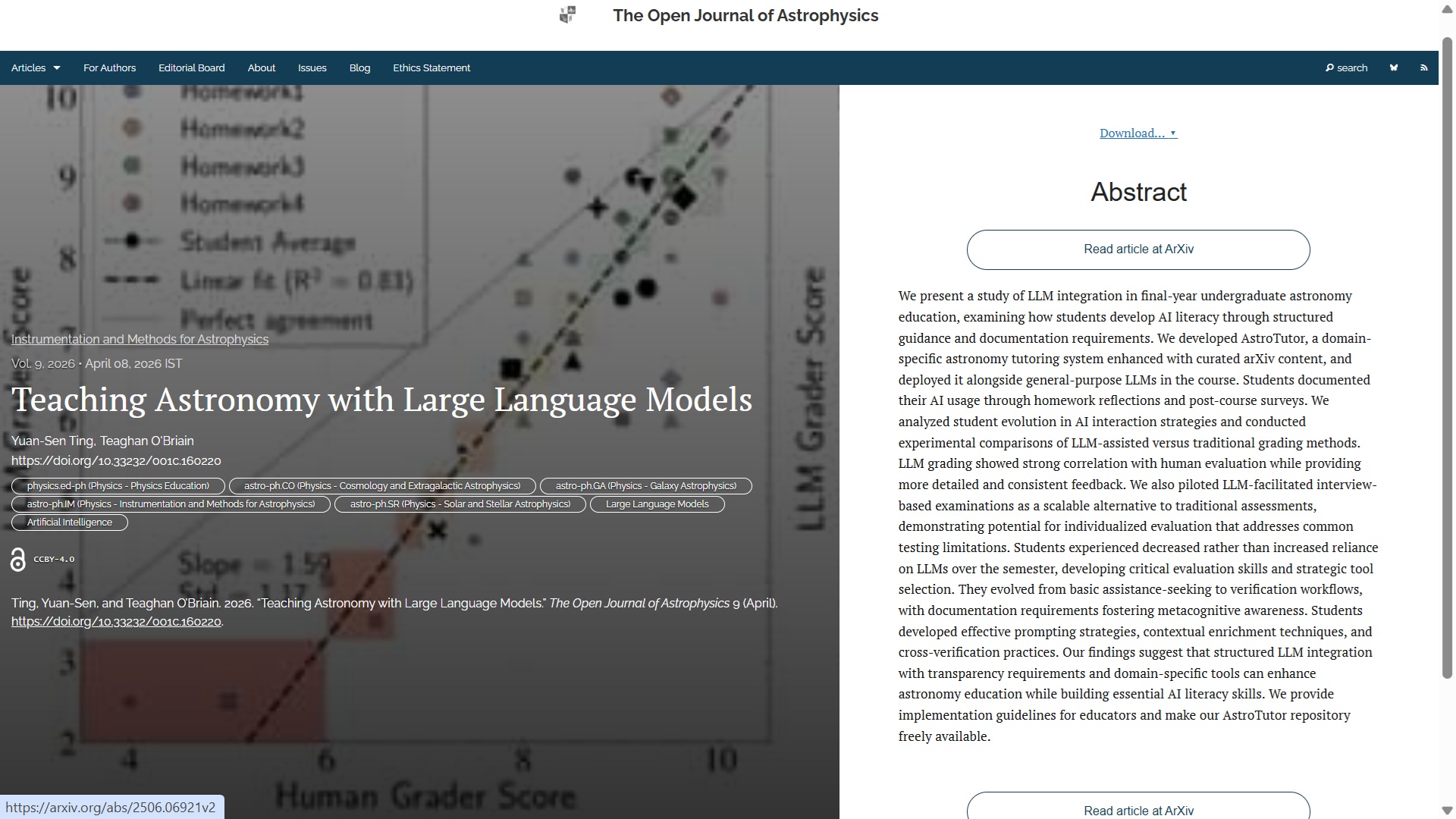
The second paper for this week, published on Wednesday 8th Apil in the folder Instrumentation and Methods for Astrophysics, is “Teaching Astronomy with Large Language Models” by Yuan-Sen Ting and Teaghan O’Briain (Ohio State University, USA). The paper introduces AstroTutor, an AI-enhanced astronomy tutoring system, to improve undergraduate astronomy education and AI literacy. It found that structured AI integration can enhance learning and critical evaluation skills. The primary classification on arXiv for this paper is physics.ed-ph but it is cross-listed on astro-ph which qualifies it for consideration.
The overlay for this one is here:
The official version of the paper can be found on arXiv here and the Fediverse announcement here:
New Publication at the Open Journal of Astrophysics: "Teaching Astronomy with Large Language Models" by Yuan-Sen Ting and Teaghan O'Briain (Ohio State University, USA)
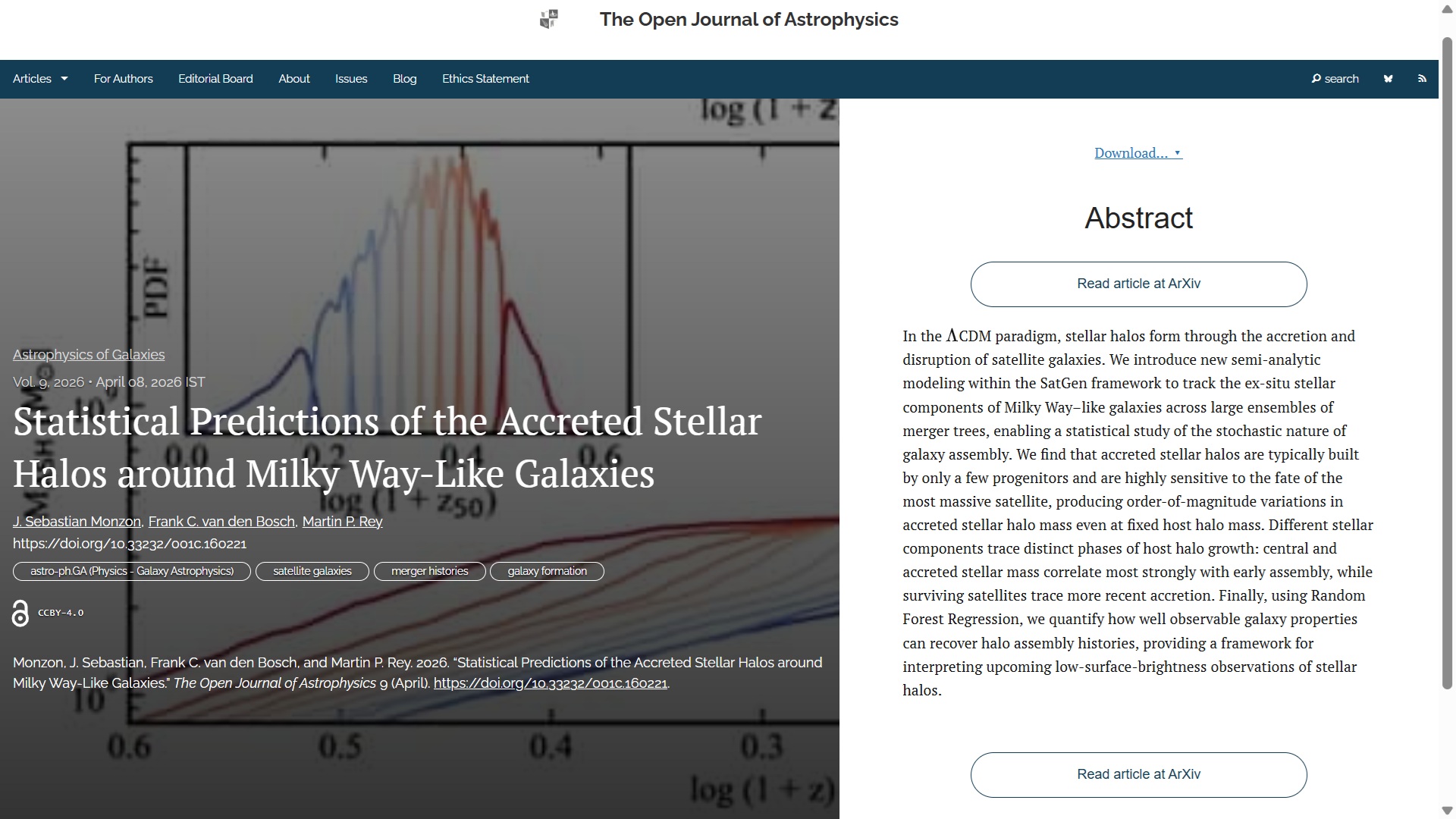
Next one up, the third paper of the week, also published on Wednesday 8th April, is “Statistical Predictions of the Accreted Stellar Halos around Milky Way-Like Galaxies” by J. Sebastian Monzon & Frank C. van den Bosch (Yale University, USA) and Martin P. Rey (University of Bath, UK). This one was published in the section Astrophysics of Galaxies; it describes new model to track formation of stellar halos in Milky Way-like galaxies, revealing their sensitivity to the fate of the largest satellite and whether accretion is early or late.
The overlay for this one is here:
The final, accepted version can be found on arXiv here and the Mastodon announcement is here:
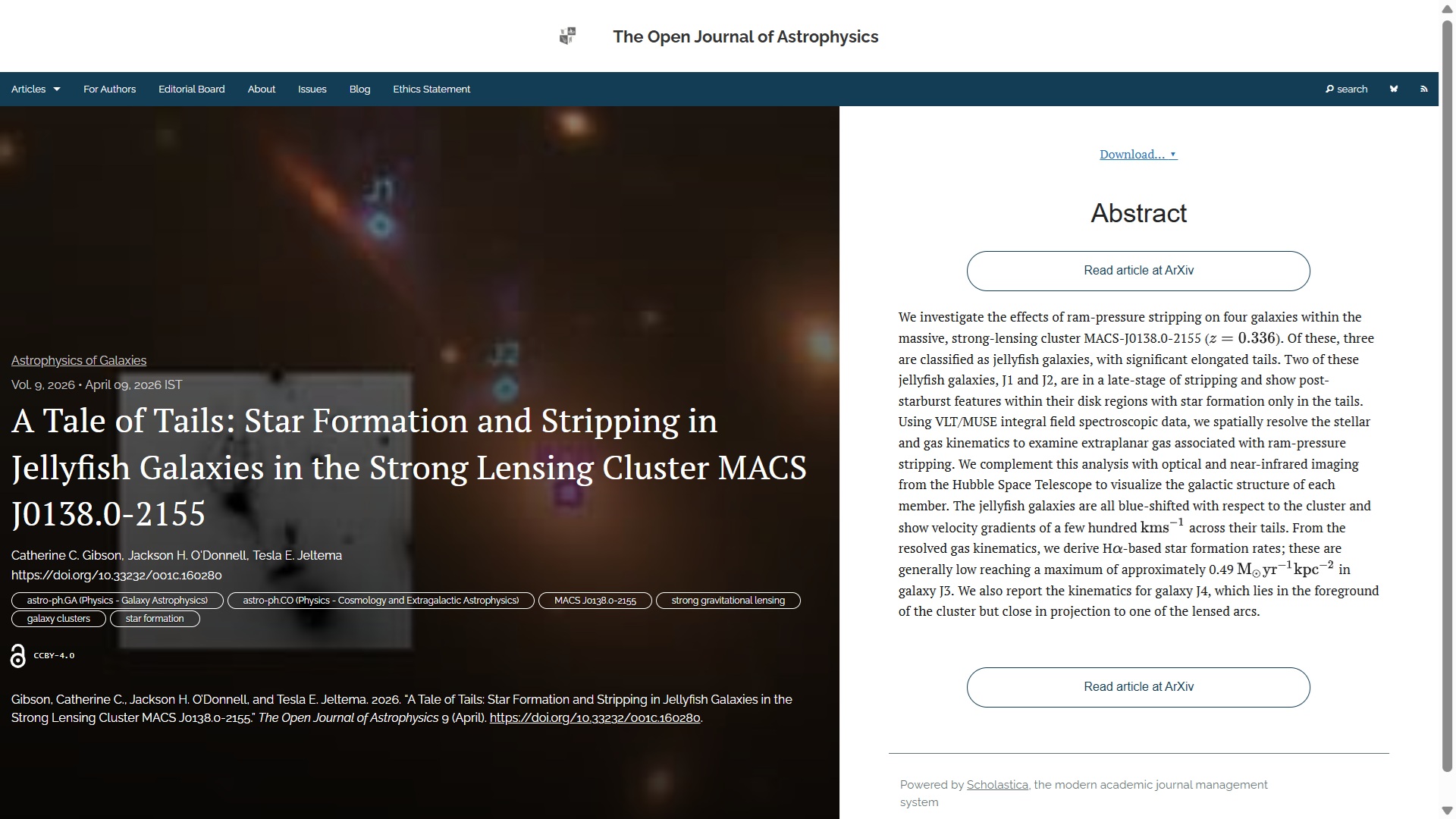
New Publication at the Open Journal of Astrophysics: "A Tale of Tails: Star Formation and Stripping in Jellyfish Galaxies in the Strong Lensing Cluster MACS J0138.0-2155" by Catherine C. Gibson, Jackson H. O'Donnell and Tesla E. Jeltema (UC Santa Cruz, USA)
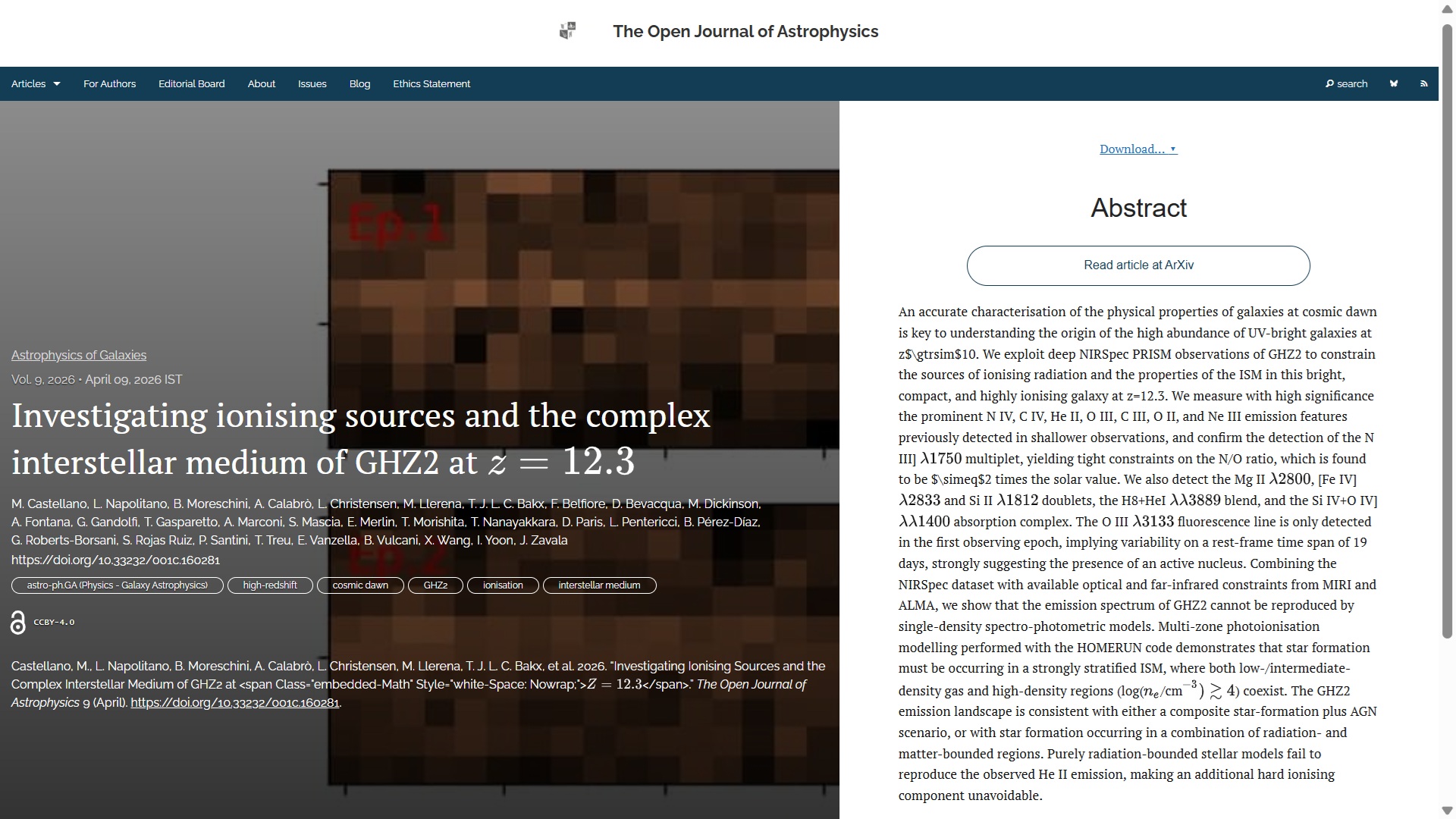
The fifth and final paper for this week is “Investigating ionising sources and the complex interstellar medium of GHZ2 at z=12.3” by M. Castellano (INAF Osservatorio Astronomico di Roma, Italy) and 29 others based all around the world. This was also published on Thursday 9th April in the folder Astrophysics of Galaxies. The paper uses deep observations of galaxy GHZ2 to explore the sources of ionising radiation and interstellar medium properties at cosmic dawn. Findings suggest a stratified environment and a hard ionising radiation component.
The overlay for this one is here:
The officially-accepted version of this one can be found on arXiv here and the Mastodon announcement is here
New Publication at the Open Journal of Astrophysics: "Investigating ionising sources and the complex interstellar medium of GHZ2 at z=12.3" by M. Castellano (INAF Osservatorio Astronomico di Roma, Italy) and 29 others based around the world.
I suppose I should comment on the ongoing disruption to road transport in Ireland as a result of “fuel protests”. I put that in quotes because from what I’ve seen many of the protestors are the usual far-right anti-everything troublemakers who have latched onto the fact that some hauliers and farmers are struggling with the increased fuel prices arising from Donald Trump’s stupid-headed war agains Iran.
The first thing to say is that I haven’t been directly affected by any of this yet. Although the roads in Dublin have been gridlocked for four days, I don’t live there and don’t have to commute. If and when I do have to go into Dublin from Maynooth, I usually take the train and then walk. Moreover, if I did plan to travel somewhere else – purely hypothetically, you understand – to spend a couple of days away at the end of the Easter break, perhaps with another person, then there are alternatives to flying from Dublin Airport…
I say I haven’t been directly affected by any of this, but in due course there may be shortages in the shops owing to disruption to deliveries. More importantly the congestion is causing difficulties for the emergency services too. All this is reminiscent of the fuel protests in the UK in 2000, which I remember very well because they happened when we were trying to organize the annual summer school for new PhD students at Nottingham, which we almost had to abandon because of interruptions to food supplies.
I’ll just make a couple of comments on these protests before going out for dinner at an unspecified location.
One is that the Road Traffic Act 1961 states:
98.—(1) A person shall not do any act (whether of commission or omission) which causes or is likely to cause traffic through any public place to be obstructed.
(2) A person who contravenes subsection (1) of this section shall be guilty of an offence.
Parking on a motorway in Ireland is also serious offence under the Road Traffic (Traffic and Parking) Regulations 1997.
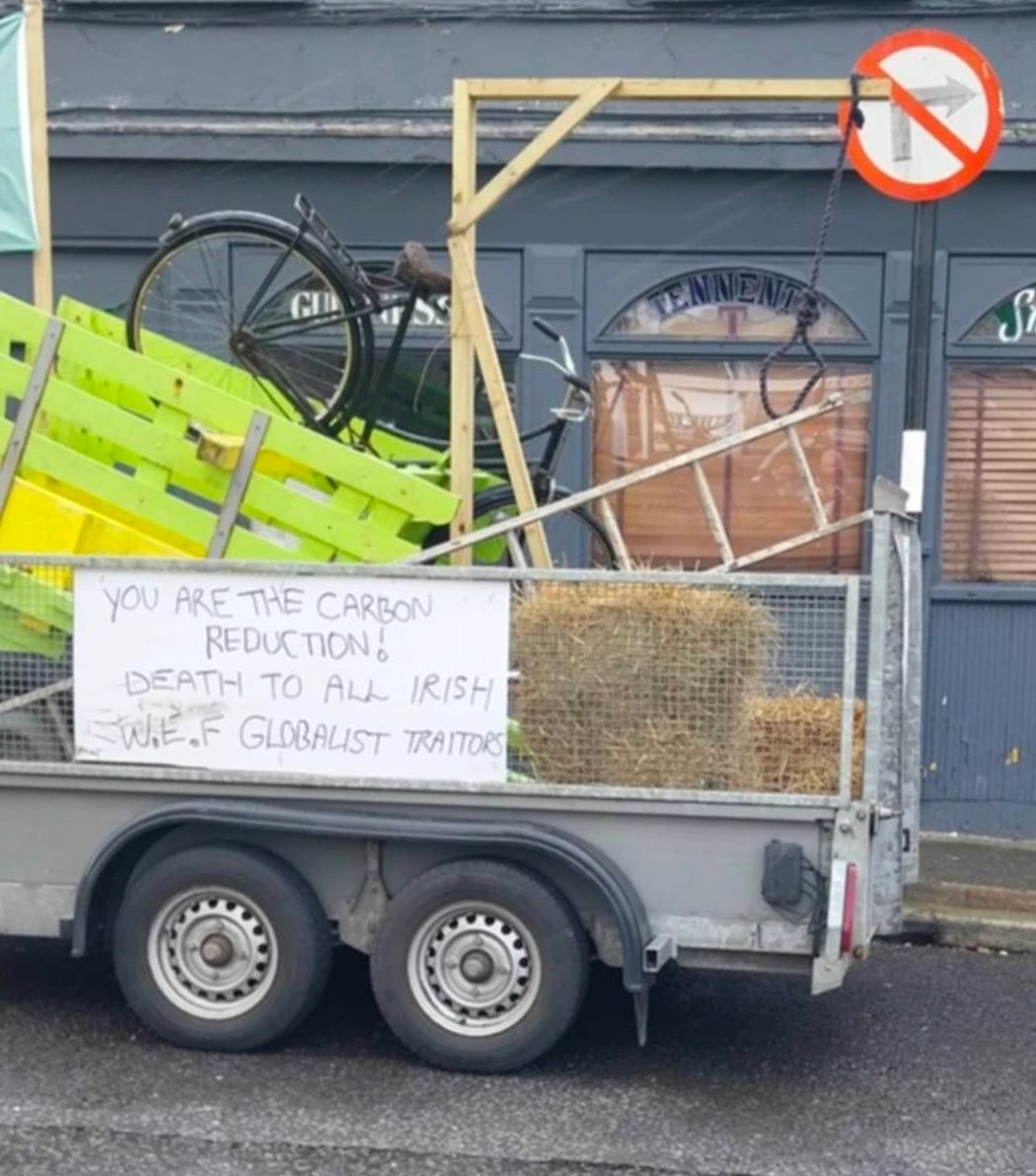
Here is a trailer with a scaffold with a posting containing an incitement to murder (from here):
Picture Credit: Dean Buckley
(I’m reliably informed that “globalist” means Jewish to these people.)
There have been four days of obvious offences like these being continually committed and the Gardaí haven’t once even tried to enforce the law of the land. They come down like a ton of bricks on, e.g., climate change protestors, but the far-right are always treated with kid gloves. Double standards or what?
I can think of two possibilities: (i) that the Gardaí are sympathetic to the Far Right or (ii) that they are scared of them. Both could be true. Either way, it is very disappointing to us ordinary law-abiding folk to find that the rules applied to the fash are not the same as those applied to the rest of us.
I’ll end with a comment about one of the ringleaders of the unlawful roadhogs. James Geoghegan is a “farm contractor” who passes himself off as an upstanding fellow but it turns out he has numerous judgements against him for non-payment of tax and cruelty to animals. He chose to put himself forward as the “PRO” of the protestors, which doesn’t seem very wise given that it was inevitable his substantial sack of dirty laundry would get a very public airing. I saw him on TV last night in an interview in which he gave every appearance of being a complete idiot, which is at least consistent.
I don’t want to tar all farmers with the same brush, but Mr Geoghegan is of an identifiable type: he hates the idea of paying his tax but is simultaneously more than happy to accept state subsidies paid for people who pay theirs. He probably hates VAT and excise duty because he can’t avoind paying them. He claims to be among the downtrodden poor but owns a fleet of vehicles. His performance in the role of victim is not exactly convincing. If he’s looking for sympathy then he’ll find it in a dictionary.
Farming is obviously an important part of Ireland’s economy and social infrastructure, but so are many other activities.
Anyway the “protestors” say that they will stay in Dublin for “up to a month”. They must be pretty well off if they can afford to take such long holidays!
I’m a bit late passing this news on, but a few weeks ago arXiv announced that from 1st July 2026 it will be establishing itself as an “independent nonprofit organization”. It has been hosted for many years by Cornell University. You can read here about the reasons for this and how it will work, and there is a lengthier article in Science magazine, but the quick summary is
This transition allows for faster technological development, greater organizational flexibility, expanded partnerships, and long-term financial sustainability. A platform built by scientists for scientists, the new arXiv will continue to serve researchers worldwide with the same dedication to free and open scientific discovery.
Such a move creates opportunities, but also carries risks. The sustainability of the new-look arXiv will depend on finding appropriate sources of income, for example. I wish arXiv well in this move. There’s an advertisement for the post of Chief Executive, if anyone fancies the job!
One possible future model for the Open Journal of Astrophysics is as a standalone non-profit organization of some sort, funded also by donations. Currently we are funded by the Library at Maynooth University, where I am based. Having made the decision not to charge fees of any kind, we lack any source of income other than the University. I am very grateful for that support, but we are run on a very tight budget. We keep costs to an absolute minimum, but are not free.
I have written before about what I think the future of Diamond Open Access could look like. I would like to see a range of Diamond Open Access journals offering a choice for authors and serving different sub-disciplines. Most universities nowadays have publishing operations so there could be network of federated journals, some based on arXiv and some based on other repositories and others with different models, such as SciPost. Perhaps institutions are worried about the expense but, as we have shown the actual cost, is far less than they are wasting on Article Processing Charges.
Everything is working well right now at OJAp, but it is not reasonable that the expense of running a journal that serves the global astrophysics community should fall entirely on one small University in Ireland. It won’t be sustainable in the long run, either, if we continue to grow at the present rate. Compare us with the Diamond Open Access publisher SCIPOST, which has a long list of sponsors covering its costs; we have none. My only hope at the moment of turning OJAp into an independent organization is to win the lottery!
Another thing makes me nervous. Many modern universities, which are nominally non-profit institutions, are managed by people who care far more about revenue generation than about academic scholarship and research. I worry that someone upstairs might pressurize us to introduce charges to generate income by threatening to close us down.
I know that money is very tight in astrophysics these days but if you have access to any potential sources of funding – then please consider supporting OJAp!
The views presented here are personal and not necessarily those of my employer (or anyone else for that matter).
Feel free to comment on any of the posts on this blog but comments may be moderated; anonymous comments and any considered by me to be vexatious and/or abusive and/or defamatory will not be accepted. I do not necessarily endorse, support, sanction, encourage, verify or agree with the opinions or statements of any information or other content in the comments on this site and do not in any way guarantee their accuracy or reliability.



 In the Dark