The Universe through a lens, darkly…
Just time to post this neat picture I found on the BBC Website this morning:
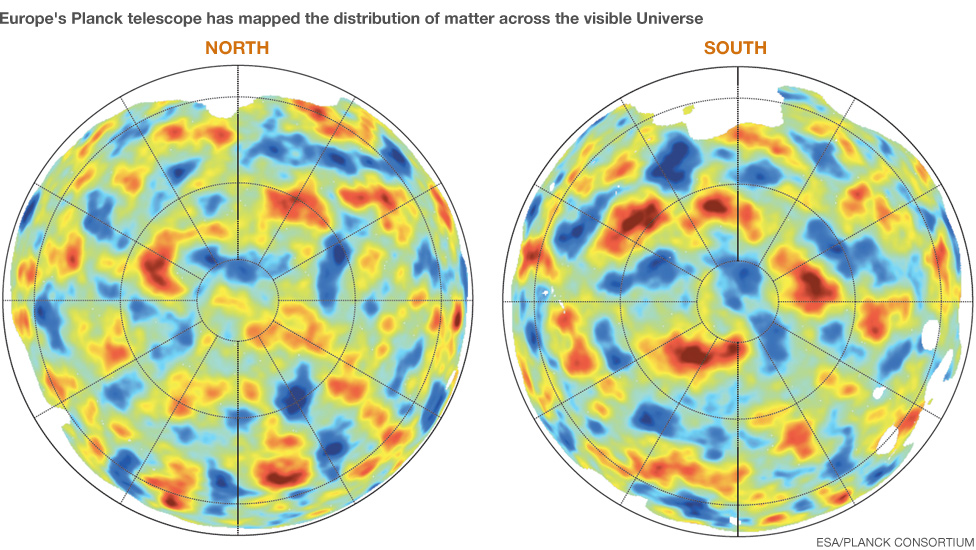
Although these images were obtained using measurements of the cosmic microwave background made by Planck, they are not themselves maps of the radiation field itself. As photons produced in the early Universe travel through the Universe towards the observer, they are deflected by the gravitational field of intervening clumps of matter; this is called gravitational lensing. With a bit of effort this effect can be “inverted” to reveal the distribution of matter traversed by CMB photons, or at least a projection of that distribution along the line of sight. The good thing about this is that the maps show all the matter (through its gravitational effects) not just the luminous part that might be seen in a galaxy surveys, so they might provide more direct ways of testing cosmological theories.
Follow @telescoper In the Dark
March 27, 2013 at 1:46 pm
How do we say CMB at three kelvin when after bang it is transition from plasma to early atoms. What is the calculation if we can understand.
March 27, 2013 at 1:51 pm
Expansion. Redshift.
March 27, 2013 at 2:07 pm
Expansion is less than speed of light ,where as photons travel at speed of light. How we understand this. What actually expands exponentially before CMB . Nothing to give gravitional lensing.
March 27, 2013 at 2:52 pm
Read a cosmology textbook.
March 27, 2013 at 3:56 pm
We believe the Universe has expanded by a factor of 1,000 since the CMB was produced. This shifts the peak of the blackbody distribution from about 3,000K to the current 3K. It is *very* basic physics…….
March 27, 2013 at 4:59 pm
A factor of few trlillions before CMB we call exponential inflation–a few times speed of light and may be a factor of 1000 since CMB , and a clear violation of conservation of energy and relativity and the mechanism is unknown. The blackbody distribution from 3000k to 3k can not be very basic physics. We have to study in details. How it is 3000k is not clear but may be some more thinking on basic physics may be necessary. Anyway I may not be aware. But I am looking into some materials in the internet . Thanks.
March 27, 2013 at 5:28 pm
Here are a couple of arxiv articles that may be of use in you research:
http://arxiv.org/abs/astro-ph/0310808
http://arxiv.org/abs/astro-ph/0305179
March 28, 2013 at 5:11 am
It can be cold big bounce instead of hot big bang.
March 28, 2013 at 7:31 am
My balloon inside balloon theory of matter and antimatter universe on opposite entropy path predicts cold big bounce at tends to zero kelvin of matter universe and tends to zero entropy of antimatter universe due to un equilibrium causing the bounce and huge force of entropy of the matter universe will be the mechanism of Dr.Guth exponential inflation with a break at CMB at three kelvin with normal dark energy expansion etc. So I was intersested to see a report on cold big bounce instead of hot big bang.
March 28, 2013 at 7:54 am
…true – but that stop Omega=1 CDM models (at least for ~20 years?)
March 28, 2013 at 9:19 am
Yes, Cold Big Bounce can not be ruled out.
March 28, 2013 at 11:49 am
Dr.Roger Penrose declared physics wrong and searching the bounce circles and found some . So my theory is being taken a possibility.
March 28, 2013 at 1:04 pm
That paper was completely wrong.
March 28, 2013 at 3:09 pm
Yes, his considerations was a BIG RIP idea and I told him long back to see if my theory is more appropriate . Dr,Stephen Hawking is now advising to look into M-theory ideas in Planck map. My theory of course little different from M-theory . It is better to look into various possibilities and nothing is declared absolute wrong but there are many opinions.
March 28, 2013 at 7:40 pm
Phillip, what is Eds?
March 29, 2013 at 1:57 pm
Einstein-de-Sitter model (Omega_M = 1, Omega_Lambda = 0, zero pressure). I had to think about what the acronym meant for a moment too.
April 2, 2013 at 8:31 am
EdS is clear to cosmologists; but as someone with a background in extragalactic astrophysics, not cosmology, I had to think about it for a few seconds!
June 6, 2013 at 5:48 am
[…] Fuente: Telescoper […]