December 31st – Richard Hoffman

Posted in Art, Poetry with tags , , , , , , on December 31, 2025 by telescoper
All my undone actions wander
naked across the calendar,

a band of skinny hunter-gatherers,
blown snow scattered here and there,

stumbling toward a future
folded in the New Year I secure

with a pushpin: January’s picture
a painting from the 17th century,

a still life: Skull and mirror,
spilled coin purse and a flower.

by Richard Hofmann (b. 1949) from his collection Emblem.

I don’t know precisely which picture the poet is referring to for January in his calendar, nor which artist, but it it is undoubtedly an example of a Vanitas or Memento Mori, a genre symbolizing the transience of life, the futility of pleasure, and the certainty of death, and thus the vanity of ambition and all worldly desires. The paintings involved still life imagery of items suggessting the transitory nature of life.

A couple of examples are here:

Between them you find all the elements mentioned in the poem: the skull represents death, the flowers impermanence, the coins personal wealth and the other items worldly knowledge and pleasure. There’s an interesting WordPress blog about the symbolism this genre here:

P.S. My own calendar has pictures of tractors in it.

Lick Observatory Damaged

Posted in The Universe and Stuff with tags , , on December 30, 2025 by telescoper

I missed, until now, the news that on Christmas Day, high winds accompanying a violent storm seriously damaged the historic Lick Observatory.

The gales were strong enough to rip one of the shutters from the dome of the 36″ refracting telescope and send it crashing onto the roof of the adjacent building.

The Observatory remains closed to the public while the structural damage is assessed and repairs made. Fortunately it seems nobody was hurt and no instruments were affected.

Here’s a video of the detached shutter being removed

The Lick Observatory is located on Mount Hamilton near San Jose in California. A donation by San Francisco millionaire James Lick enabled the construction of the 36” (diameter) refractor, the most powerful telescope in the world at the time.  The Observatory was almost destroyed in 2020 by a wildfire, but the new incident is the most serious damage in its 137-year history.

As I blogged about here, the Lick Observatory played an important role in the development of our understanding of the large-scale structure of the Universe, specifically with the creation of the Lick galaxy survey prepared by Charles Donald Shane and Carl Alvar Wirtanen and published in 1967 (Publ. Lick. Observatory 22, Part 1). In my more poetic moments, the image on the left puts me in mind of W.B. Yeats: Had I the heavens’ embroidered cloths.

That catalogue was still proving a useful resource well into the 1990s; I was part of various analyses of it myself, starting with this paper from 1991. It was eventually superceded by the arrival of large-scale galaxy redshift surveys, but it remaining an amazing achievement.

The Lick Galaxy survey was not performed with the 36″ refractor mentioned above, however, but by twin 20″ Carnegie astrographic telescopes housed in a different dome. As far as I know, these were not damaged in the storm.

Alegoría del Invierno – Remedios Varo

Posted in Art with tags , , , , , on December 29, 2025 by telescoper

Alegoría del Invierno (Allegory of Winter) by Remedios Varo Uranga, 1948, gouache on paper, 44 ×44 cm, Museo Nacional Centro de Arte Reina Sofía, Madrid, Spain.

The Voice of Niels Bohr

Posted in History, The Universe and Stuff with tags , , on December 28, 2025 by telescoper

The other night I watched the 2023 film Oppenheimer on TV. I had seen it before, on a plane flight, and enjoyed it, though I thought it was overlong. Fortunately it was a long flight. Watching it again a couple of days ago reminded me of something that struck me first time, and that was the cameo performance by Kenneth Branagh as Niels Bohr. You can see him at the start of the trailer here:

Niels Bohr was born in Copenhagen, a place I visited many times in the past and can recognize the local accent, though had never heard the speaking voice of Niels Bohr himself. I was a underwhelmed by Branagh’s rendition because he doesn’t sound very Danish to me. I assumed that because it was a relatively small part, Branagh didn’t put much effort into it. He doesn’t look like Niels Bohr, either.

But what did Niels Bohr actually sound like? Here is a lecture by him given in 1957 so you can decide for yourself.

Having heard this recording I think Kenneth Branagh’s version is not too far off, in fairness, though there are clear vocal mannerisms he did not capture.

The thing that strikes me most about the lecture, however, is that his delivery is very pedestrian, not to say rambling. People say he was like that in ordinary conversation too…

Weekly Update from the Open Journal of Astrophysics – 27/12/2025

Posted in OJAp Papers, Open Access, The Universe and Stuff with tags , , , , , , , , , , , , , , , , , , , on December 27, 2025 by telescoper

I wasn’t planning to do another update this week but I thought it would be best to complete the publications for 2025  at the Open Journal of Astrophysics, so that I don’t have to do a bigger update in the new year, and I have a bit of time this morning, so here we go.

Since the last update we have published four papers which brings the number in Volume 8 (2025) up to 201. Adding the 12 papers in the Supplement, this brings the final total for the year up to 213, and the total so far published by OJAp up to 448. In 2023 we published just 50 papers, so we have more than quadrupled in two years.

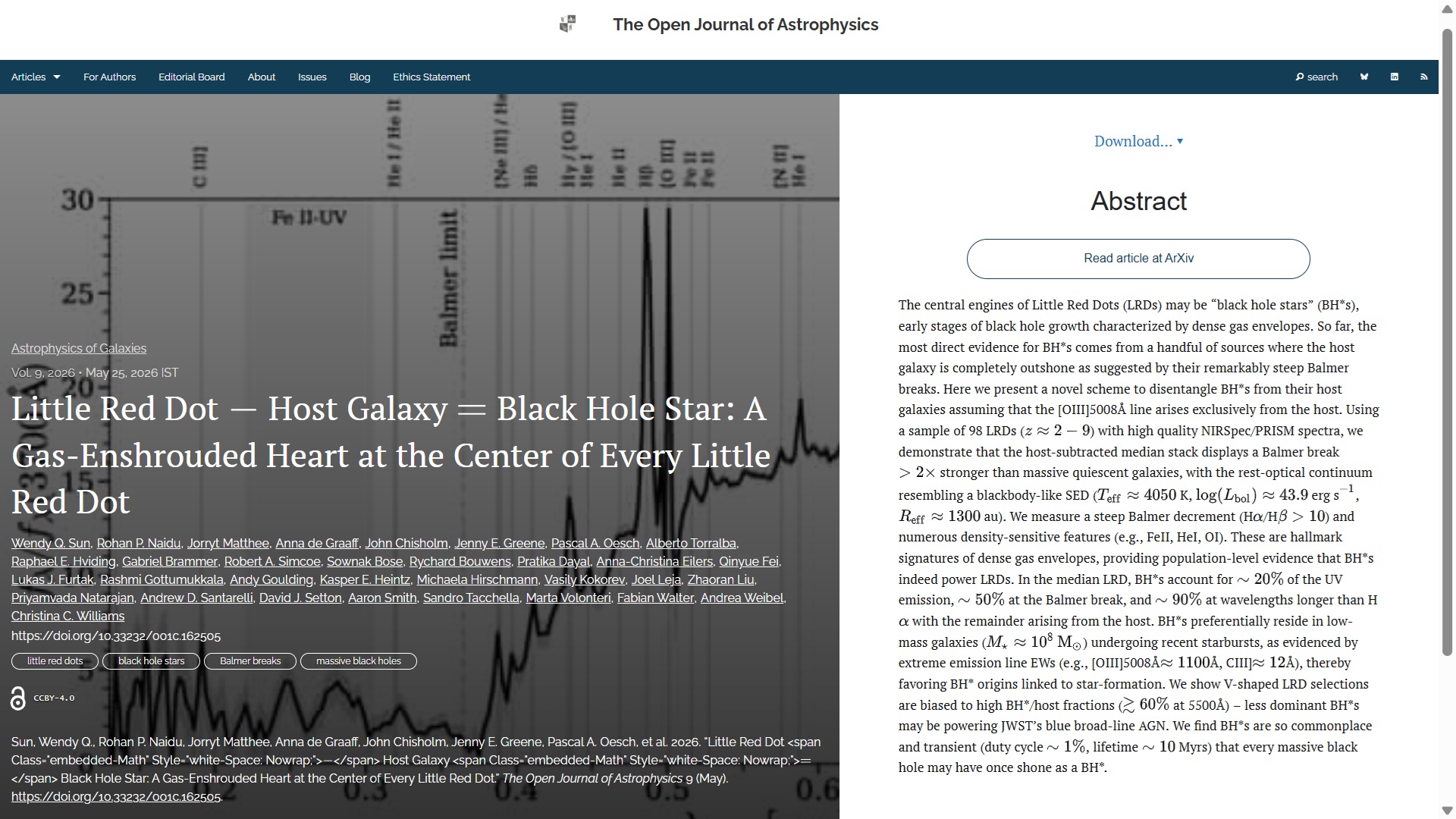
The first paper this week is “Transverse Velocities in Real-Time Cosmology: Position Drift in Relativistic N-Body Simulations” by Alexander Oestreicher (University of Southern Denmark), Chris Clarkson (QMUL, UK), Julian Adamek (Universität Zürich, CH) and Sofie Marie Koksbang (U. Southern Denmark). This study uses a general relativistic N-body simulation code to explore how cosmological structures affect position drift measurements, a new method for studying cosmic structure formation and velocity fields. This was published on Tuesday 23rd December 2025 in the folder Cosmology and Nongalactic Astrophysics.

The overlay is here:


You can find the officially accepted version on arXiv here and this is the announcement on Mastodon (Fediscience):

Open Journal of Astrophysics

New Publication at the Open Journal of Astrophysics: "Transverse Velocities in Real-Time Cosmology: Position Drift in Relativistic N-Body Simulations" by Alexander Oestreicher (University of Southern Denmark), Chris Clarkson (QMUL, UK), Julian Adamek (Universität Zürich, CH) and Sofie Marie Koksbang (U. Southern Denmark)

doi.org/10.33232/001c.154744

December 23, 2025, 9:33 am 1 boosts 0 favorites


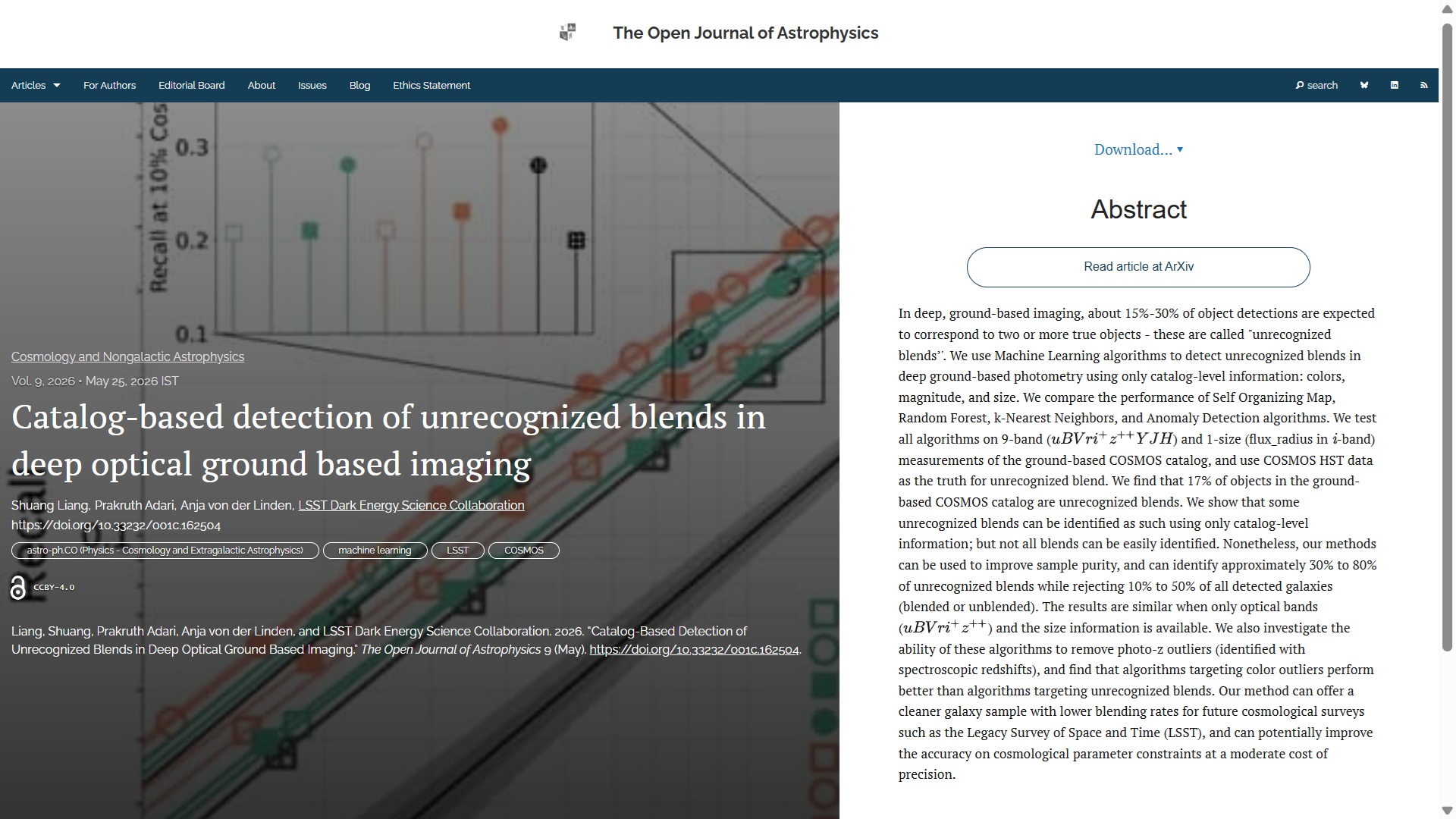
The second paper of the week is “On the statistical convergence of N-body simulations of the Solar System” by Hanno Rein, Garett Brown and Mei Kanda (U. Toronto, Canada). This study presents numerical experiments to determine the minimum timestep for long-term simulations of the Solar System, finding that timesteps up to 32 days yield physical results.  It was published on Tuesday December 23rd in the folder Earth and Planetary Astrophysics.

The overlay is here:


You can find the official version of this one on arXiv here. The federated announcement on Mastodon is here:

Open Journal of Astrophysics

New Publication at the Open Journal of Astrophysics: "On the statistical convergence of N-body simulations of the Solar System" by Hanno Rein, Garett Brown and Mei Kanda (U. Toronto, Canada)

doi.org/10.33232/001c.154745

December 23, 2025, 9:50 am 6 boosts 9 favorites

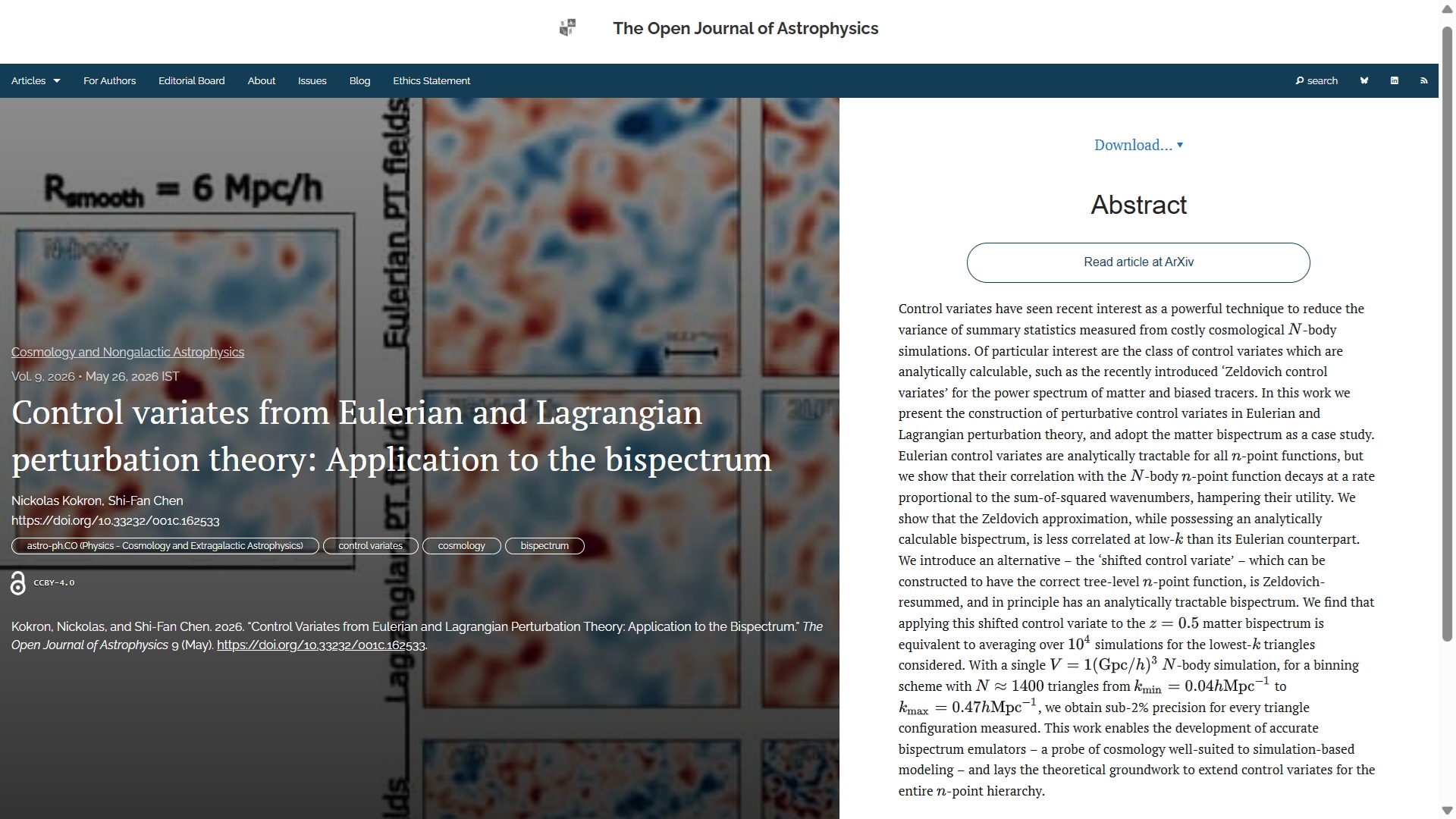
Next, published on 24th December 2025 in the folder High-Energy Astrophysical Phenomena, we have “The explosion jets of the core-collapse supernova remnant Circinus X-1” by Noam Soker and Muhammad Akashi (Technion, Haifa, Israel). This paper suggests that the rings in the Circinus X-1 supernova remnant resulted from jet-driven explosions, supporting the jittering-jets explosion mechanism theory for core collapse supernovae.

The overlay is here:

The officially accepted paper can be found on arXiv here and the announcement on Mastodon is here

Open Journal of Astrophysics

New Publication at the Open Journal of Astrophysics: "The explosion jets of the core-collapse supernova remnant Circinus X-1" by Noam Soker and Muhammad Akashi (Technion, Haifa, Israel)

doi.org/10.33232/001c.154770

December 24, 2025, 9:15 am 2 boosts 1 favorites

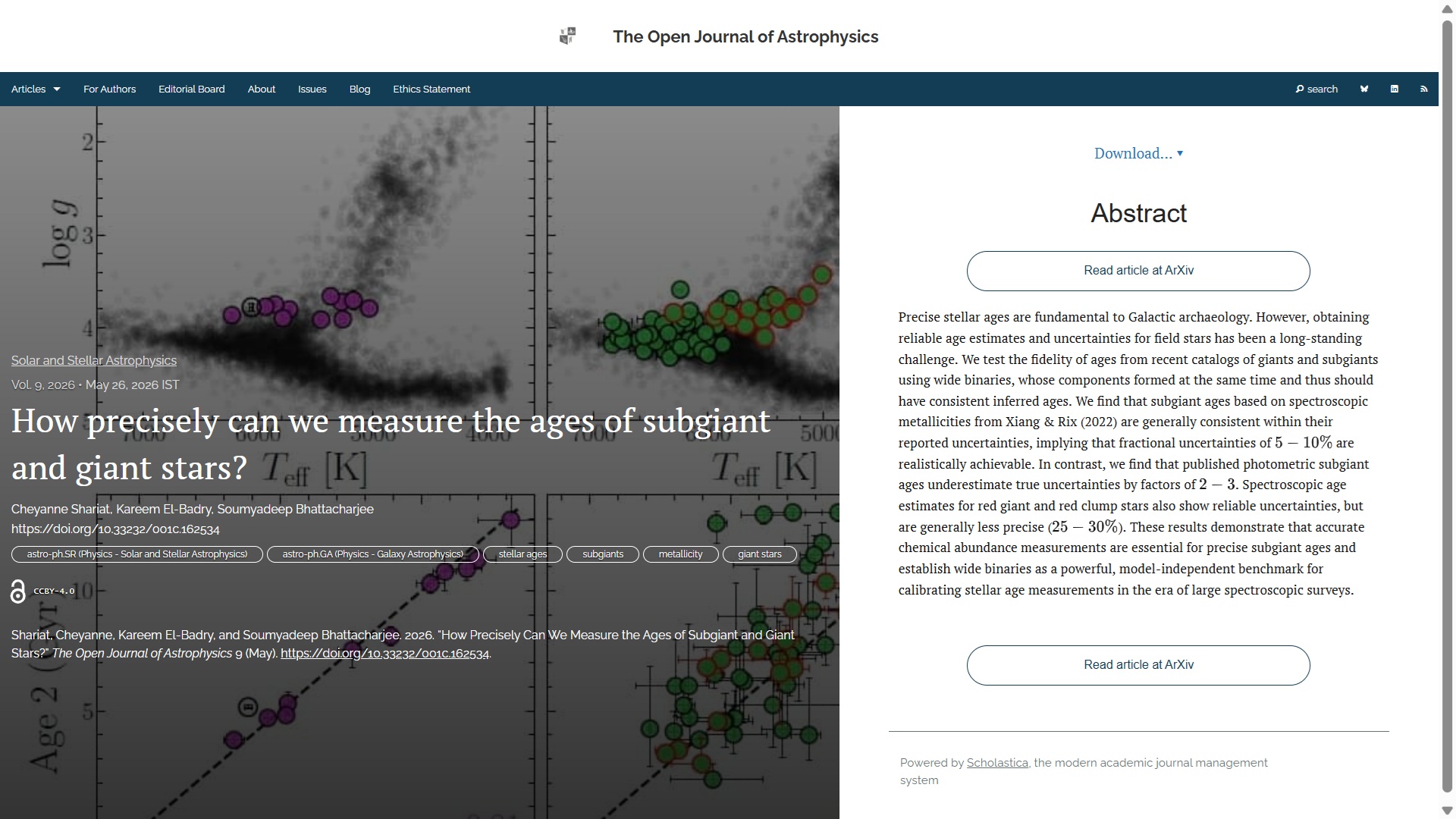
Finally for 2025 we have “Quantifying the Fermi paradox via passive SETI: a general framework” by Matthew Civiletti (City University of New York, USA). This was published on Wednesday 24th December in the folder Instrumentation and Methods for Astrophysics. The author uses SETI observations and the Drake Equation to calculate the probability of detecting at least one extraterrestrial signal, highlighting the model’s limitations and potential improvements. The overlay is here:

The officially accepted version can be found on arXiv here and the Mastodon announcement here:

Open Journal of Astrophysics

New Publication at the Open Journal of Astrophysics: "Quantifying the Fermi paradox via passive SETI: a general framework" by Matthew Civiletti (City University of New York, USA)

doi.org/10.33232/001c.154771

December 24, 2025, 9:27 am 1 boosts 1 favorites

And that concludes the updates for 2025. I’ll be back in a week with the first update of 2026, which will include the first paper(s) of Volume 9.

I’d like to thank everyone who has supported the Open Journal of Astrophysics this year – Editors, Reviewers, Authors and the excellent Library staff at Maynooth – and who have made it such a bumper year. In 2023 we published just 50 papers, so we have more than quadrupled in two years. How many will we publish in 2026?

Nollaig shona daoibh go léir!

Posted in Uncategorized on December 25, 2025 by telescoper

Here we are then, Christmas Day. I thought I’d do a quick yule blog in between finishing a rather late breakfast and starting the preparations for dinner*.

Let me just wish you all a Merry Christmas, Nollaig Shona, Nadolig Llawen, Fröhliche Weihnachten, Joyeux Noël, Buon Natale, Feliz Navidad, Feliç Nadal, Glædelig Jul, etc…

And in the words of a traditional Irish toast:

Go mbeirimid beo ar an am seo arís!

(“May we live to see this time next year”)

*Roast beef Chateaubriand, with red wine gravy, honey-roast carrots and parsnips, sprouts, and roast potatoes. Preceded by smoked salmon with asparagus and followed by Christmas pudding and, later on, cheese and port.

Update:  et voilà

P.S. I couldn’t resist sharing this cartoon from the Christmas issue of Private Eye:

P.P.S. I find it interesting, from a linguistic point of view, how the French “Noel” (or “Noël”) and Irish “Nollaig” evolved from the Latin “Natalis”.

The spelling of “Noël” with a diaeresis over the “e” indicates that the two vowels are pronounced separately rather than as a diphthong. This may be a relic of the missing consonant in “Natalis”.

Perhaps the Welsh “Nadolig” is some sort of Celtic missing link…

A Christmas Eve Message

Posted in Uncategorized on December 24, 2025 by telescoper

Since Christmas Eve – Oíche Nollag in Ireland and variously known elsewhere in Europe as Nochebuena, HeiligabendVeille de NoëlVigilia di Natale, Juleaften, etc – is upon us, I wonder if I might crave the momentary indulgence of all readers of this weblog, in order to discharge a by no means disagreeable obligation which has, over the years, become more or less established practice as we approach the terminal period of the year — calendar, of course, not financial, nor indeed academic — in fact, not to put too fine a point on it, the interregnum between the First Semester Teaching Block and the First Examination Period — and submit to you, with all appropriate deference, for your consideration at a convenient juncture, a sincere and sanguine expectation — perhaps even confidence — indeed one might go so far as to say hope — that the aforementioned period may be, at the end of the day, when all relevant factors have been taken into consideration, susceptible to being deemed to be such as to merit a final verdict of having been by no means unsatisfactory in its overall outcome and, in the final analysis, to give grounds for being judged, on mature reflection, to have been conducive to generating a degree of gratification which will be seen in retrospect to have been significantly higher than the general average. I hope this clarifies the situation.

The Counties of the United Kingdom (according to ChatGPT)

Posted in Artificial Intelligence with tags , , , , on December 23, 2025 by telescoper

Regular readers will know that I sometimes use this blog to educate the Great Unwashed about the facts of British geography (including where the North begins). I have decided to enlist the help of Generative AI to support me with this task so, with a little help from social media, here is a response from ChatGPT to a prompt requesting a map showing all the counties of the United Kingdom with their names. The result, as you can see, is truly spectacular:

I began my research career at the University of Bulgaria, by the way.

O Tannenbaum – Vince Guaraldi Trio

Posted in Jazz, Television with tags , , , on December 22, 2025 by telescoper

A jazz version of an old song from an album called A Charlie Brown Christmas may not seem a very promising concept but I like it, so there. The original lyrics of O Tannenbaum don’t refer to Christmas at all, incidentally, but it has become a Christmas standard. This version is by the Vince Guaraldi Trio and it was recorded 60 years ago in 1965. Vince Guaraldi was a fine jazz pianist who had an interesting solo career as well as playing with bands led by Woody Herman and Carl Tjader, among others. He is best remembered, however, for composing the music that went with TV adaptations of the Peanuts cartoons written and illustrated by Charles M. Schulz of which this is a nice example.

The Winter Solstice 2025

Posted in Maynooth, The Universe and Stuff with tags , , , , on December 21, 2025 by telescoper
Sunlight at dawn on the Winter Solstice at Newgrange

Just a quick note to point out that the Winter Solstice in the Northern hemisphere happens today, Sunday 21st December 2025, at 15.03 UT (GMT).

In Dublin, sunrise yesterday (20th December) was at 8.37 am and sunset at 4.07 pm, while today the sunrise was at 8.38 am and sunset at 4.08 pm. Both sunrise and sunset happen later tomorrow than today, so the Solstice marks neither the latest sunrise nor the earliest sunset. We have to wait until January for the latest sunrise (8.40am) and the earliest sunset (4.06pm) actually happened over a week ago. The interval between the two events will, however, be about 2 seconds longer tomorrow than today; and yesterday the gap was about 4 seconds longer than today. Taking a day to be the interval between sunrise and sunset, today is the shortest.

For a full explanation of this, see this older Winter Solstice post.

P.S. In the Southern Hemisphere this is of course the summer solstice. In Australia it was marked by the ritual of a victory in the Ashes against England.