Cute Nuclear Physics Problem
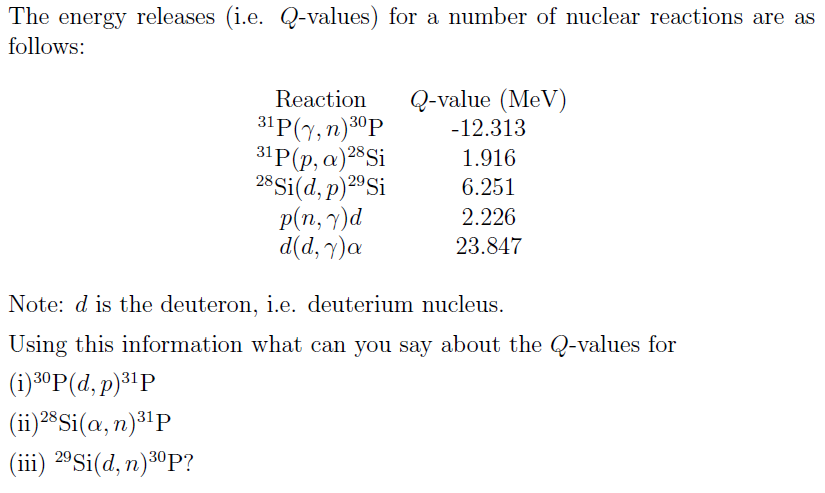
It’s been quite a while since I posted anything in the cute physics problems folder – mostly because the problems I’m generally dealing with these days are neither cute nor related to physics – but here’s one from an old course I used to teach on Nuclear and Particle Physics.
In the following the notation A(a,b)B means the reaction a+A→b+B and the you might want to look here for a definition of what a Q-value is. The Atomic Number of Phosphorus (P) is 15, and that of Silicon (Si) is 14. The question doesn’t require any complicated mathematics, or any knowledge of physics beyond A-level; the rest is up to your little grey cells!
 In the Dark
May 3, 2013 at 11:29 am
(i) Reversing ³¹P(ɣ,n)³⁰P gives +12.313 MeV and is almost what we want, except in the given reaction we have the cost of breaking up the deuteron at the same time, so we must subtract 2.226 MeV to get +10.087 MeV Q-value.
(ii) Doesn’t conserve charge. Does that make the Q value infinite?
(iii) Like case (i), but more complicated. Taking the first reaction from the list and the next two reversed gives the right sequence for the silicon and phosphorus isotopes (and adds up to -20.480 MeV), but our given reaction has the extra cost of breaking up a deuteron (-2.226), but then the energy liberated by making an alpha, and the deuteron creation energy cancels since in the d+d→ɑ is given in terms of two deuterons fusing. If I’ve kept track of everything, the answer is -12.313-1.916-6.251+23.847 = +3.367 MeV
May 3, 2013 at 11:44 am
Yes, (ii) is a trick question. They were quite common in examinations but are frowned upon nowadays. In fact this question is slightly amended from a Cambridge Scholarship Examination, i.e. pre-University level.