Fracking Confusion
The news on the radio this morning featured a story about the Prime Minister wanting the UK to “get behind” hydraulic fracturing (or “fracking” as it is known for short) , a means of liberating shale gas that offers the prospect of boosting the UK’s energy supply.
There’s not much sign any “getting behind” happening up the road from here in Balcombe, where a sizable anti-fracking protest has been going on for some time. There’s actually no fracking going on in Balcombe at the moment; the company involved, Cuadrilla Resources, is doing exploratory drilling to look for oil but may apply for a licence to pursue hydraulic fracturing if that is unsuccessful.
There’s a simple graphic on the BBC website that illustrates how fracking works:
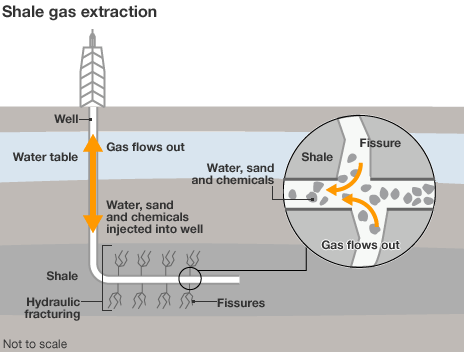
In simple terms it involves pumping a mixture of water, sand and chemicals into a deposit of shale ato fracture the solid material contained therein and thus liberate the gas. Environmentalists argue that this technique might cause earth tremors and/or contamination of the water supply; advocates of fracking dispute these claims. I’m not sufficiently expert to be able to comment usefully on the arguments about the possible environmental dangers associated with it, so I’d be glad to receive comments via the box below.
One thing I will comment on, though, is the very poor quality of the media reporting on this issue. I’ve yet to see any meaningful attempt to comment on the science involved when surely that’s the key to whether we should “get behind” fracking or not? It struck me that quite a few readers might also be interested but ill-informed about this issue to, so for them I’d recommend reading the Beddington Report, the key findings of which were:
- The health, safety and environmental risks can be managed effectively in the UK. Operational best practices must be implemented and enforced through strong regulation. Fracture propagation is an unlikely cause of contamination.
- The risk of fractures propagating to reach overlying aquifers is very low provided that shale gas extraction takes place at depths of many hundreds of metres or several kilometres. Even if fractures reached overlying aquifers, the necessary pressure conditions for contaminants to flow are very unlikely to be met given the UK’s shale gas hydrogeological environments.
- Well integrity is the highest priority. More likely causes of possible contamination include faulty wells. The UK’s unique well examination scheme was set up so that independent, specialist experts could review the design of every offshore well. This scheme must be made fit for purpose for onshore activities.
- Robust monitoring is vital. Monitoring should be carried out before, during and after shale gas operations to detect methane and other contaminants in groundwater and potential leakages of methane and other gases into the atmosphere.
- An Environmental Risk Assessment (ERA) should be mandatory. Every shale gas operation should assess risks across the entire lifecycle of operations, from water use through to the disposal of wastes and the abandonment of wells.
- Seismic risks are low. Seismicity should be included in the ERA.Seismicity induced by hydraulic fracturing is likely to be of smaller magnitude than the UK’s largest natural seismic events and those induced by coal mining.
- Water requirements can be managed sustainably. Water use is already regulated by the Environment Agency. Integrated operational practices, such as recycling and reusing wastewaters where possible, would help to minimise water requirements further. Options for disposing of wastes should be planned from the outset. Should any onshore disposal wells be necessary in the UK, their construction, regulation and siting would need further consideration.
- Regulation must be fit for purpose. Attention must be paid to the way in which risks scale up should a future shale gas industry develop nationwide. Regulatory co-ordination and capacity must be maintained.
- Policymaking would benefit from further research. The carbon footprint of shale gas extraction needs further research. Further benefit would also be derived from research into the public acceptability of shale gas extraction and use in the context of the UK’s energy, climate and economic policies.
I’m not sure how many anti-fracking activists, or others involved in the Balcombe protest, have read this report.
Anyway, in an attempt to gauge the mood of my totally unrepresentative readership, I thought I’d try a little poll:
And if you have strong opinions, please feel free to use the comments box.
Follow @telescoper In the Dark
August 12, 2013 at 3:58 pm
I tried looking into this subject a few weeks back in order to bring a reasoned response to anyone who might ask me about it. One thing which dismayed me about the report was the lack of numbers.
“The risk of fractures propagating to reach overlying aquifers is very low provided that shale gas extraction takes place at depths of many hundreds of metres or several kilometres. Even if fractures reached overlying aquifers, the necessary pressure conditions for contaminants to flow are very unlikely to be met given the UK’s shale gas hydrogeological environments.”
The scientist in me reads this and asks how low the “very low” risk is. As the designers at the LHC discovered with their coolant system, a failure rate of 0.001% sounds great until you have 10,000 of said element in the system, making failure profoundly likely. Similarly, if the “low risk” of fracture propagation is hypothetically 0.1% per operation then I wouldn’t be keen to drink water from a reservoir located near 100 fracking sites.
Without greater clarity I do not think that anyone can make an educated decision to “get behind” or oppose fracking regulation.
August 12, 2013 at 4:44 pm
Indeed, geology seems to be much less quantitative than one might expect…
August 12, 2013 at 4:20 pm
Yes, I’ve seen such videos. This is due to gas getting into the water supply which, presumably, can happen if the fracking is carried out too close to the water table. It can also occur without fracking, if there is a lot of gas in the groundwater.
August 12, 2013 at 6:57 pm
That’s what you get when you pay cash to a plumber who doesn’t understand English…
August 13, 2013 at 7:50 am
Fortunately I don’t live in Wales anymore..
August 12, 2013 at 7:46 pm
Another point to consider is why invest all this money and effort into extracting methane to burn when what is really needed in an alternative way to power our energy hungry activities. There isn’t a shortage of oil/coal/gas etc, if we burn what is currently available then we will exceed the CO2 levels thought by most scientists to be ‘safe’ wrt climate change. Surely this is the bigger question, not whether fracking is a safe/not safe method of extracting a very unsafe source of energy in the long run.
August 12, 2013 at 10:14 pm
Loretta,
I think the immediate problem is that the UK is so dependent on imported gas, especially from Russia. That places a very big question mark over our energy security in the short-term. There is no viable solution in terms of renewable or nuclear that can be deployed in time to achieve this on the timescale of a few years even if we manage to improve energy efficiency. As long as it is recognised as a stop-gap, there may therefore be a sensible role for fracking if it can be shown to be safe..
Peter
August 13, 2013 at 8:51 am
Peter, immediately after I voted I was shown what the score was in your poll. how can I do that without trying to vote again?
August 13, 2013 at 12:41 pm
You can click where it says “View Results” at the bottom of the embedded poll…
August 13, 2013 at 3:56 pm
It’s interesting that out of the hundreds of people who have visited this page, only 50 have responded to the poll!
August 14, 2013 at 10:55 am
I predict that the “Frack off” fraction will go down as electricity bills and landscape-wrecking wind turbines continue to go up; certainly if there are power cuts. Nuclear fusion is the longterm solution and I am not worried about CO2 levels in the interim as it hasn’t got warmer in the last 15 years, taken globally, although China and India have continued to open a coal-fired power station every week on average during that time.
August 14, 2013 at 5:36 pm
I regard the satellite data as by far the most reliable as they truly represent a global measurement. And if you eyeball the satellite data for the last 15 years as presented by tamino, without including the previous years to skew the eye, it doesn’t look like an increase to me. As for advanced statistical techniques supposedly extracting juice from the data that the eye cannot see – I’m a Bayesian and have seen disturbingly large amounts of rubbish on the basis of sampling-theoretical techniques. Ed Jaynes has given copious examples of that. Even the UK Met Office model reckons it’s not going to get warmer for the next 5 years despite continuing Far Eastern industrialisation:
http://joannenova.com.au/2013/01/skeptic-win-uk-met-office-quietly-drops-prediction-by-20-hopes-no-one-notices/
August 14, 2013 at 3:44 pm
There was an interesting letter published in the FT on this issue today. The article is here and the first few comments on it seem to offer some reasonable counter-points: http://liberalconspiracy.org/2013/08/12/banker-destroys-argument-for-shale-gas-in-a-short-letter/
August 14, 2013 at 10:16 pm
I simply don’t believe in an effect which causes the standard deviation to increase but not the mean.
August 16, 2013 at 9:41 am
AFAIK fracking requires much more wells that tradidional oil/gas drills. If so, then additional resources are needed for establishing them on the developement stage and for gas transport. Only relativelly small amouts of wells give economic profit.
The whole bussines may be not so big success as it looks like…
Take a loook here: http://www.nytimes.com/interactive/us/natural-gas-drilling-down-documents-4.html#document/p1/a22779
August 19, 2013 at 12:43 pm
[…] And it’s not behind a paywall! The abstract of the paper, which I’m passing (as with my earlier post) on in the (probably forlorn) hope that it will introduce some rationality into the so-called […]