Science, Fracking and the Balcombization of the Left
Well, here’s a find. A rare, peer-reviewed scientific article about hydraulic fracturing. And it’s not behind a paywall! The abstract of the paper, which I’m passing (as with my earlier post) on in the (probably forlorn) hope that it will introduce some rationality into the so-called “fracking” debate, reads:
The widespread use of hydraulic fracturing (HF) has raised concerns about potential upward migration of HF fluid and brine via induced fractures and faults. We developed a relationship that predicts maximum fracture height as a function of HF fluid volume. These predictions generally bound the vertical extent of microseismicity from over 12,000 HF stimulations across North America. All microseismic events were less than 600 m above well perforations, although most were much closer. Areas of shear displacement (including faults) estimated from microseismic data were comparatively small (radii on the order of 10 m or less). These findings suggest that fracture heights are limited by HF fluid volume regardless of whether the fluid interacts with faults. Direct hydraulic communication between tight formations and shallow groundwater via induced fractures and faults is not a realistic expectation based on the limitations on fracture height growth and potential fault slip.
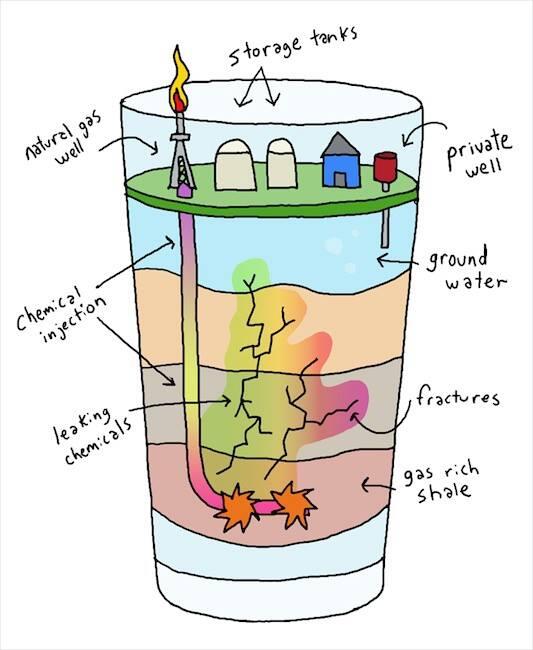
It would be nice if either the media or the protestors at Balcombe made some attempt to discuss the actual science behind fracking, but that seems a forlorn hope. The best I could come up with from the latter is this picture, offered by someone who thinks that anyone in possession of a set of crayons is qualified as a geologist:
In the interest of balance, here is a link to a blog post on fracking in the USA, the first paragraph of which reads:
For some time now, proponents of the controversial practice of hydraulic fracturing or “fracking” have claimed there was little or no evidence of real risk to groundwater. But as the classic saying goes: “the absence of evidence is not evidence of absence” of a problem. And the evidence that fracking can contaminate groundwater and drinking water wells is growing stronger with every new study.
I encourage you to read it, but if you do please carry on to the comments where you will see detailed counter-arguments.
I do not have a strong opinion either way on fracking. I’d prefer to make a decision as a result of an informed debate based on evidence, but there are clearly people who don’t want that to happen and are instead intent on scaremongering to suit their own ends. It seems to me that the legitimate concerns of sensible people have yet again been hijacked by the small but vociferous mob of “against everything” anarchists who see protest as an end in itself. It’s all so depressingly puerile. There’s no fracking going on in Balcombe anyway!
Why does the Green movement – and the left generally for that matter – have to be so comprehensively anti-scientific? As long as it remains that way it will never be taken seriously.
Follow @telescoper In the Dark
August 19, 2013 at 1:19 pm
The Left used not to be anti-scientific; indeed communism in its heyday was very supportive of science and technology – dialectical *materialism*. Things changed when the hippie generation reached positions of influence, because their worldview is fundamentally New Age rather than secular. (I call it a change from secular humanism to occult humanism – still humanism because the person is sovereign to pick and mix in the supermarket of spirituality.) You could see the change quite abruptly in the late 1970s when certain shelves in bookshops changed from science fiction to sword-and-sorcery. It is also known as the change from modernism to postmodernism.
I suspect that companies that do fracking know a lot more about it than gets published in peer-reviewed journals. They are not under any duty to publish everything they know.
This open letter from the chairperson of Balcombe Parish Council is relevant:
August 20, 2013 at 8:58 am
Phillip, I inherited a copy of Lila (and was of course aware of his earlier book) but didn’t get on with it at all. If it is about the transition from modernism to postmodernism, please could you say a little more about how? I’d give it another go.
August 19, 2013 at 1:23 pm
Coincidentally, I found this interesting post by Alice Bell on the Grauniad website
http://www.theguardian.com/science/political-science/2013/jul/18/beneath-white-coat-radical-science-movement
August 19, 2013 at 1:43 pm
You say the left is anti-scientific, but you could equally well (on any of a very large number of important topics) have said that the right was anti-scientific and could not be taken seriously. So I don’t see why it is useful to make this a comment about left vs. right.
Better to ask the more general question: why are people in general so anti-scientific – specifically, why do they ignore any evidence or arguments that contradict their pre-conceived beliefs, but give undue weight to arguments they already agree with?
August 19, 2013 at 1:53 pm
Two questions there Sesh, and I suggest in answer to why people generally are increasingly anti-scientific that the transition from modernism to postmodernism (see above) is responsible and runs across the Left-Right divide. As for why people find it hard to change their minds, that is a more general question still and the answer is correspondingly more general: pride.
August 19, 2013 at 1:54 pm
I wrote that because I would very much like to see a meaningful political movement on the left. The current political parties offer such a restricted range of policies and priorities. In particular, I think there is room for a scientifically informed Green movement. I’d probably vote for such a party. Unfortunately, the current Green party lacks any form of credibilty.
And as for the others, I’ve come to the conclusion that there are few protest movements, however cogent and well-intentioned, that can’t be rendered unsupportable when infiltrated by the sort of nihilist extremists who time and time again have proved to be the right’s trump card.
August 19, 2013 at 3:37 pm
Yes, I agree that anti-science opinions and campaigns exist across the political spectrum, left, right and centre. Indeed, climate-change denial seems a particularly right-wing activity.
I, a left-wing liberal who has strong concerns about human impact on the environment, gave up listening to hard-green campaign groups about twenty years ago because of their anti-scientific sacremongering.
It should be said that there are legitimate, rational, reasons to be concerned about a rapid expansion of gas production using hydraulic fracturing. In particular, there is the danger of increased emissions of greenhouse gases. However, the situation is complex because an increased availability of cheap gas (if hydraulic fracturing is indeed capable of providing cheap gas) could displace coal burning, and therefore might reduce carbon dioxide emissions in the medium term.
August 19, 2013 at 6:02 pm
Bryn, I agree with you. It’s just a shame that there is so little meaningful scientific information available….this is one area where the science is very far from open.
August 19, 2013 at 5:56 pm
I think that there is a strong anti-science component within the political left, as well as the political right. I also don’t think that this is anything new.
As for the use of hydraulic fracturing, I think the jury is still out. The problem is not an easy one to resolve, largely because a) there is little to no baseline data to compare before and after drilling situations and b) large amounts of existing data that are maintained by the drilling companies who are generally reluctant to release them.
With regards the GRL paper that Peter references, a quick look at the Acknowledgments was interesting. Engleder has gone head-to-head with others in PNAS over the last couple of years, particularly those (like Osborn) who use isotopes to examine connectivity etc.
So I would say that there is a vigorous scientific discussion underway, but it is hampered by lack of data, particularly baseline data.
August 19, 2013 at 6:04 pm
I can understand companies wanted to keep commercially sensitive information secret, but if as in the UK a government licence is needed for fracking then companies applying for one should be compelled to make their data public, just as if they should if they are funded by the taxpayer.
August 19, 2013 at 9:07 pm
Agreed – but not necessarily their techniques.
August 19, 2013 at 6:52 pm
I do think that anti-science on both left and right is a new (meaning since the 1970s) phenomenon. Before that the idea at both ends of the political spectrum was to get science working for them.
August 19, 2013 at 6:54 pm
I’m far too young to remember that far back…
August 19, 2013 at 8:22 pm
Anti-science on the left isn’t new — Leonid, I remember, did a discussion on Lysenkoism, which wrecked Soviet agriculture, during one of the Physics & Philosophy cafes a few years back, and Lysenkoism dates back to the 1930s. Nor is it new on the right: pro-slavery advocates before the American Civil War attempted to use the nascent discipline of biology to prove Africans were a separate species and therefore other than human.
And it’s ironically for this reason, the distortion of science for political ends, that inspires at least some of the anti-science perspective on the left. Something Marx talks about — and Marx was an avid fan of popular science — is the character of objective reality: while Marxism asserts that such a reality exists, it also recognizes that humans are flawed interpreters not just subject to but enslaved by outside influences. All science, Marxism says, should be examined critically and contextualized.
Where the problem starts is where people on the left begin to regard themselves as the only group sufficiently conscious to overcome the dialectical problem. (This mistake is of course not restricted to the left.) Any fact determined by capitalism is treated as tainted — I’ve heard people claim the dialectic can even overcome science, which is basically Aristotelianism advanced 2,000 years.
August 19, 2013 at 9:01 pm
Lysenko and the eugenicists were not anti-science. They believed in doing science, but their science was crap because they let political factors get in the way of scientific method.
The character of objective reality is a relevant underpinning. The monist view espoused in Indian philosophies holds that all differentiation is illusion if only we could see deeply enough. The Western view in the era the West gave birth to science is that we are capable of perceiving the world as it is because we are in the image of its creator. We see differentiation and study how the things that we see as separate interact. This view motivated science.
What about the fashionable view that quantum theory and Buddhism go well together? Everything I have read on the subject – quite a large amount – has been trendy trash in my opinion. BUT Bell’s theorem does imply nonlocality/acausality, which means that all is interconnected at the next ontological level down – the so-called hidden variables – which is… a monist view of the universe!
August 20, 2013 at 10:34 am
Anton, Bell’s Theorem rules out hidden variables that ‘explain away’ quantum weirdness. That was the whole point of the the theorem.
August 20, 2013 at 10:38 am
Actually, as there’s not edit, let me be clearer. Bell’s Theorem makes three assumptions: locality, realism, and the predictions of quantum theory. It then shows a contradiction results, and that therefore one of the assumptions must therefore be false.
It explicitly shows that even allowing ‘hidden variables’ cannot save all three assumptions, because only the predictions of quantum mechanics, not the theory itself, are required.
Most people drop realism when confronted by this (i.e. the properties of a particle are not part of reality). Some people drop locality (contradicting relativity). Some people drop quantum mechanics (contradicting…well, quantum mechanics).
August 20, 2013 at 10:44 am
I’ll go with non-local…
August 20, 2013 at 11:04 am
Brendan, Bell’s theorem makes the (provisional) assumption that the result of a spin measurement on a particle is governed by the instantaneous value (hence causal) of some ‘hidden’ variable that is internal to the particle (hence local). It is then possible to derive an inequality which is violated by the observations (which are correctly predicted by quantum mechanics). So if you are going to suppose that the probabilistic predictive formalism of quantum theory is some kind of average over a deterministic hidden variable theory, then that hidden variable theory has to be nonlocal and acausal.
You can see every step in the reasoning in Bell’s theorem if you rephrase it using Bayesian probabilistic inference: from making a spin measurement on the first particle, which tells us something about its presumed internal variable, which via particle correlation tells us something about the presumed internal variable of the second particle, which constrains the spin measurement on the second particle – more tightly than is consistent with the observations, in fact. Bell’s theorem is recast in this way in a paper of mine in Foundations of Physics (vol 20 pp1475-1512; 1990), called “Bell’s theorem and Bayes’ theorem”. Once again the Bayesian view of probability clarifies things.
Of course, you can deny that predictive formalism of quantum theory is some kind of average over a deterministic hidden variable theory. But then you are stuck forever – if you are wrong then you will never know it, and never be able to improve testable prediction, which is the job of a scientist.
August 19, 2013 at 8:31 pm
As I understand it (i.e. anecdotal gossip based entirely on unrefereed newspaper articles) 100% of the Chinese politburo have engineering or scientific qualifications, whereas only one UK MP has a science degree – I think the latter depends on whether economics is counted as science or a black art.
I’m not sure whether I want to draw any conclusions, though.
Chris
August 19, 2013 at 9:04 pm
Economics was referred to as the “dismal science” by Carlyle. (He was contrasting it with the “gay science”…)
http://en.wikipedia.org/wiki/The_dismal_science
August 19, 2013 at 9:44 pm
Air guitar is ecologically sound and furthermore you never play a bad chord.