Scholarly publishers and their high profits
Lest we forget the Great Academic Publishing Ripoff…

I recently published the below chart to document the outrageous profit margins of scholarly publishers in the sciences.
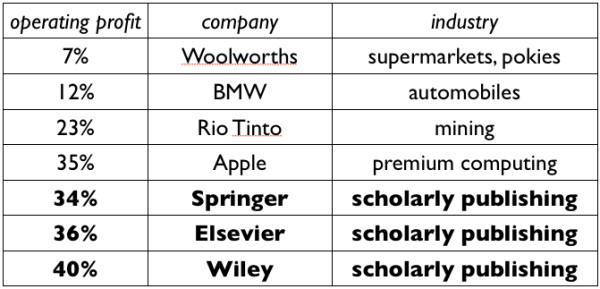
This post is to provide the sources for the numbers in the chart.
The Woolworths number comes from their website, where they write “As a group, Woolworths Limited makes less than seven cents in the dollar before we then pay interest and tax”.
The Rio Tinto figure of 23% is based on the operating profit they report divided by the consolidated sales revenue in their 2011 financial summary.
Apple’s profit of 35% is based on these numbers, dividing their operating income for the year ending September 2012 of 55.2 billion by the revenue for the same period of 156.5 billion.
The 34% number for Springer comes from Heather Morrison’s PhD thesis, in which she writes that “Springer’s Science + Business Media (2010) reported a return on sales (operating profit)…
View original post 66 more words
 In the Dark
March 25, 2014 at 1:04 pm
Students are easy prey for books and tuition increases.
March 25, 2014 at 1:06 pm
Most of their profits actually come from journal subscriptions not textbooks…
March 25, 2014 at 3:49 pm
I am thinking, when I see the data, that there could be a cartel.
The trade agreement are hidden (between Universities and Companies), the profits are too high, and there is not competition; the European Union forbid the cartels, and the European Union forbid monopoly, and there are many national laws that forbid these practices.
The Apple example is not important, there are competitors in the market; are there competitors in the Academic publishing?
March 25, 2014 at 4:06 pm
Well found Peter. The (online) revolution cannot come too soon.