The truth is out there
So here I am, then, sitting in my hotel room in Copenhagen and drinking coffee, filling in time before I check out and travel to the airport for the journey home. I don’t have to be there until this afternoon so today is going to be a bit more leisurely than the rest of the week has been. It’s nice to get a couple of hours to myself.
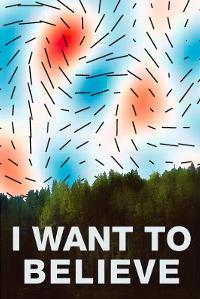
It was an interesting little workshop, with lots of time for discussions, but lurking in the background of course was the question mark over BICEP2. Many theorists have clearly been beavering away on models which assume that BICEP2 has measured primordial gravitational waves and I suspect most of them really want the result to be correct. When I posted a message on Twitter about this, Ian Harrison posted this homage to a famous poster for the TV series The X-files. There’s more than a little truth in the comparison!
Whatever the truth about the BICEP2 measurements there’s no question that it’s a brilliant experiment, with exquisite sensitivity. There is no question that it has detected something so faint that it boggles the mind. Here is a slide from Phil Lubin’s talk at the meeting, which shows the unbelievably rapid improvement in sensitivity of microwave detectors:

I don’t think cosmologists ever pay enough credit to the people behind these technological developments, as it is really they who have driven the subject forward. In the case of BICEP2 the only issue is whether it has picked up a cosmological signal or something from our own Galaxy. Whatever it is, it’s an achievement that deserves to be recognized.
And as for the claims of the person responsible for the post I reblogged yesterday that the cosmic microwave background is a fraud, well I can assure you it is not. Any scientific result is open to discussion and debate, but the ultimate arbiter is experimental test. Several independent teams are working in competition on CMB physics and any fraud would be easily exposed. The cosmic microwave background is out there.
And so is the truth.
Follow @telescoper In the Dark
August 23, 2014 at 11:03 am
I’ve spoken to many theorists over the past few months, most of whom have been working on models that might be ruled out if BICEP were correct. Despite that, almost all of them would still like the result to be true. Physics is more interesting when you have a genuine unexpected experimental result to drive theory in new directions.
August 23, 2014 at 12:30 pm
Of course I understand that, and of course to some extent it’s necessary to believe in something, even just as a working hypothesis. The final word, though, belongs to the data..
August 23, 2014 at 12:31 pm
Yes, we need theorists to be optimists and observers to be cynics!
August 23, 2014 at 1:59 pm
I’d say we should be radical when it comes to theory creation but conservative when it comes to data.
These days the division between theory and observation is quite blurred: many people work at the interface. In this region you perhaps need to be some sort of linear combination of optimist and cynic…
August 23, 2014 at 3:20 pm
Peter, please would you clarify “These days the division between theory and observation is quite blurred”? A century ago the guy who had the idea generally also did the experiment to test it, but I think you mean something else?
August 25, 2014 at 4:06 pm
I just meant that not long ago there were observational cosmologists and theoretical cosmologists and few people worked on both aspects. Now the big observational teams generally have people who work on theory too, largely though not exclusively doing simulation work. Very few jobs nowadays are in pure theory or pure observation. That’s a good thing, of course.
August 25, 2014 at 8:09 pm
Argent also had a track about the Coming of Cohomet Kohoutek.
August 23, 2014 at 2:30 pm
Surely the least expected result would be no gravitational waves at all, cosmological or otherwise? That would demonstrate that we’ve misunderstood gravity at a very basic level…