Science, Poetry and Romanticism
I listened to a very interesting programme on BBC Radio 3 on Sunday evening, part of which was a documentary about science and poetry presented by Gregory Tate. Given that both these subjects feature heavily on this blog I couldn’t resist a quick post about it.
The feature explored why so many scientists have been inspired to write poetry, and the nature of the relationship between their artistic work and their science.
Among the famous scientists included in the programme was chemist and inventor Humphry Davy who, inspired by his friendship with the poets Wordsworth and Coleridge, wrote poems throughout his life. Others to do likewise were: physician Eramus Darwin; mathematician William Rowan Hamilton; astronomer William Herschel (who was also a noted musician and composer); J. Robert Oppenheimer; and Erwin Schrödinger.
Doing a quick google about after the programme I came across this example by Hamilton, which I searched for because he is the scientist from the list above with whose mathematical work I am most familiar because of its huge influence on physics, and because he seems to have been a very colourful character as well as a superb mathematician. Interestingly, he too was a very close friend of Wordsworth, to whom he often sent poems with requests for comments and feedback. In the subsequent correspondence, Wordsworth was usually not very complimentary even to the extent of telling Hamilton to stick to his day job (or words to that effect). What I didn’t know was that Hamilton regarded himself as a poet first and a mathematician second. That just goes to show you shouldn’t necessarily trust a man’s judgement when he applies it to himself.
Here’s an example of Hamilton’s verse – a poem written to honour Joseph Fourier:
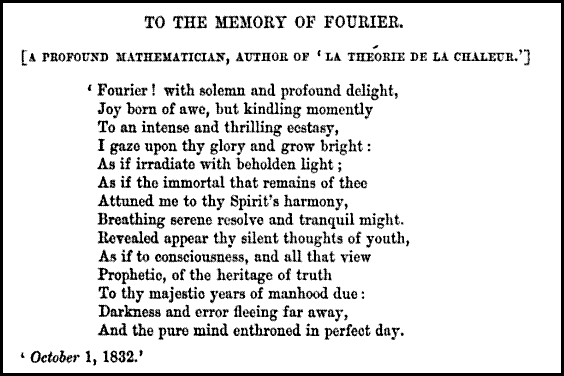
If that’s one of his better poems, then I think Wordsworth may have had a point!
The serious thing that struck me about this programme though was how many scientists of the 19th Century, Hamilton included, saw their scientific interrogation of Nature as a manifestation of the human condition just as the romantic poets saw their artistic contemplation. It is often argued that romanticism is responsible for the rise of antiscience. I’m not really qualified to comment on that but I don’t see any conflict at all between science and romanticism. I certainly don’t see Wordsworth’s poetry as antiscientific. I just find it inspirational:
I HAVE seen
A curious child, who dwelt upon a tract
Of inland ground, applying to his ear
The convolutions of a smooth-lipped shell;
To which, in silence hushed, his very soul
Listened intensely; and his countenance soon
Brightened with joy; for from within were heard
Murmurings, whereby the monitor expressed
Mysterious union with its native sea.
Even such a shell the universe itself
Is to the ear of Faith; and there are times,
I doubt not, when to you it doth impart
Authentic tidings of invisible things;
Of ebb and flow, and ever-during power;
And central peace, subsisting at the heart
Of endless agitation.
 In the Dark
November 4, 2014 at 3:33 pm
Interesting thoughts. I’m sure many scientists mundane and famous enjoy poetry and music, for those two have something to say about the world unspoken by science.
They are creative arts and to be good you must be gifted. We do not know what the gift of composition is for it defies training.
You can train a concert pianist but not a Beethoven or a Wordsworth.
November 4, 2014 at 4:54 pm
yes, you can train people to be competent in science or music or visual arts or poetry, but some people have that extraordinary creative spark within, and some don’t. I don’t think that can be taught…
November 5, 2014 at 9:33 pm
I’m sure you are right but such statements are not considered to be scientific , they border on the concept of a gift of God.
November 5, 2014 at 9:56 pm
I don’t think so – more to do with the balance between nature and nurture..
November 6, 2014 at 5:18 pm
Science– A random and very rare sprinkling of some change in the DNA to very few humans. Brought about by the Blind Watchmaker inadvertantly.
Poetry– A gift of God.
November 12, 2014 at 2:23 pm
Was that in The Man Who Mistook his Wife for a Hat? I don’t recall it, but it’s the sort of thing that would appear there and it’s a long time since I read it.
Of course plenty of people are struck by lightning and don’t gain musical talent. I don’t recommend it as a career move.
November 4, 2014 at 5:27 pm
I also had a suggestion via Twitter to read that book. I remember it being well received when it came out, but I never actually bought it.
November 4, 2014 at 5:42 pm
Of course I hope readers of this blog will rush out and buy my forthcoming book “On the Transformative Nature of Fourier Analysis”…
November 4, 2014 at 7:24 pm
Phillip, I remember discussing that book with you here very soon after Peter started his blog. It’s a fine read.
November 5, 2014 at 9:53 am
I’d love to get one. May I ask for the one with your signature ))
March 19, 2024 at 2:14 pm
“Science-v-Poetry” or Big Bang” according to the 19th century romantic poet :
Polish poet Juliusz Słowacki [1809-1849] wrote (between 1843/4-1846 – i.e.a few years before Poe’s ‘Eureka’) a mystical prose poem entitled ”Genesis from the Spirit” . If we omit the mystical parts in the poem, we ended up with the following description of the creation of the world:
“…The Spirit… turned one point… of invisible space into a flash of Magnetic-Attractive Forces. And these turned into electric and lightning bolds – And they warmed up in the Spirit… You, Lord, forced him… to flash with destructive fire… You turned the Spirit… into a ball of fire and hung him on the abysses… And here… a circle spirits… he grabbed one handful of globes and swirled them around like a fiery rainbow… “
(see: « big-bang-according-to-the-19th-century-polish-poet-j-slowacki » at salon24.pl for more details and references)
Best regards,
P.S.
well-known Italian astronomer A.Cappi, author of a paper on Poe’s ‘Eureka’ about ”Genesis from the Spirit” : « It’s a fascinating case of cosmology in literature »)