R.I.P. Charles Townes, the physicist whose work touched all our lives
Just a short post to mark the passing of a truly great physicist, Charles H. Townes, who died yesterday at the age of 99.
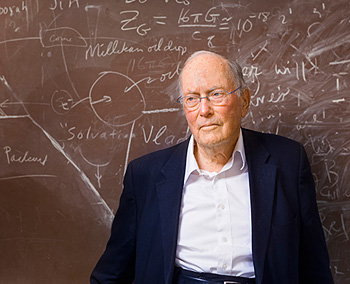
Charles Townes, pictured in 2013
Townes came to fame for his pioneering work on the theory and applications of the maser , which he then followed up by designing the first laser. Lasers are used in many common consumer devices such as optical disk drives, laser printers, barcode scanners and fibre-optic cables. They are also used in medicine for laser surgery and various skin treatments, and in industry for cutting and welding materials.
The work of Charles Townes in physics has thus had an enormous impact on everyday life; he was awarded the Nobel Prize for is his work on quantum electronics, especially lasers and masers.
It’s very sad that he didn’t quite make his century, especially because this year is the International Year of Light, which will involve many activities and celebrations relating to his work on lasers. Much of our experimental work in Physics here in the Department of Physics and Astronomy at the University of Sussex involves lasers in various ways, and we will find an appropriate occasion to celebrate the life and achievements of a truly great physicist. Until then let me just express my condolences to the friends, family and colleagues of Charles Townes on the loss not only of an eminent scientist but of an extremely nice man.
R.I.P. Charles Townes, physicist and gentleman (1915-2015).
Follow @telescoper In the Dark
January 29, 2015 at 10:33 am
99, wow! Have any prominent physicists made the ton?
January 30, 2015 at 1:58 pm
Thanks Phillip; I didn’t know that Hund made the ton, and I can’t think of any unit that 100th part of either the imperial, American or metric ton corresponds to; good question. I first heard of it as a child as someone exceeding 100mph on the road “doing the ton”.
January 30, 2015 at 2:57 pm
The word “ton” has various meanings in English apart from the unit of weight. It can mean, colloquially, “a large quantity” but does have the specific meaning of 100 of something, e.g. pounds sterling. In sport it’s most often used in darts and cricket.
January 30, 2015 at 5:33 pm
Presumably, Peter, because those are sports where a score of 100 is attainable. Any others?
January 30, 2015 at 5:34 pm
Golf?
January 30, 2015 at 11:49 pm
A sad day. My father worked with him on lasers in around 1960.