The Price of Jackson
The chance conjunction on this blog of a post about the death of Professor J.D. Jackson with another about the greed of academic publishers caught the attention of one Ian Jackson (son of the aforementioned Professor) and prompted him to forward me some correspondence between his father and the publisher of the famous textbook, Classical Electrodynamics (published by John Wiley & Sons).
I won’t copy it all here, but here is an excerpt:
The Letter of Agreement of 1996 stipulates that Wiley should not increase the net price more than 5% in any two year period with the author’s permission. A month or so ago I found out from the physics Editor that the US net price was $87, a big jump from the last number I knew. By knowing that the list price is closely 1.3 times the net, I could look at my records of the single copy list price on Wiley’s web site to find that they had increased the price by 5% at least once and probably twice beyond what was permitted by our agreement. I wrote a strong letter, citing chapter and verse about their obvious violation.
John David Jackson was obviously a generous man: the royalties for this book were divided among his four children (including my correspondent Ian). He goes on to add in a letter to all four of them, after the publishers agreed to reduce the list price:
Sorry to be keeping your royalties in check, but I was thinking of the poor students who are paying 1.3 x $82 = $106.60.
They do keep the book for the rest of their lives, so perhaps it is an OK investment.
I don’t remember how much I paid for my copy, but I don’t begrudge the amount because it’s an excellent book. You should always remember, however, that the author of a textbook typically only gets a small percentage (usually~10% ) of the net receipts.
The correspondence sent by Ian includes this hand-drawn graph by the late Professor Jackson:
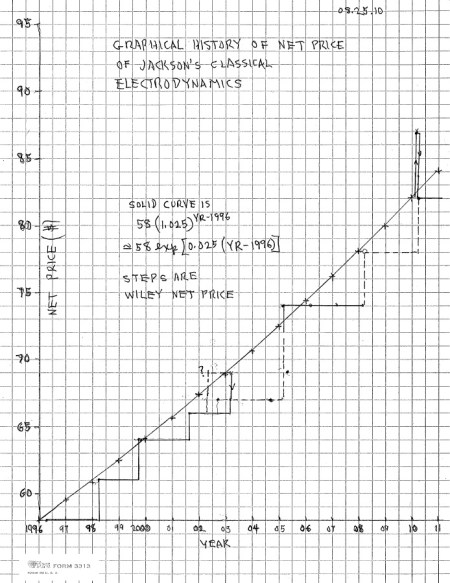
It seems Professor Jackson shared my (low) opinion of academic publishers!
For the record, my textbook on Cosmology (co-authored with Francesco Lucchin) was also published by Wiley. A representative of the publisher explained to me that their pricing strategy involved trying to keep the revenue constant in time, so that as sales went down the price went up. My book is now very much out of date so I can understand why the sales have fallen off, but I find it hard to believe that the same is true of an enduring classic. Professor Jackson seems to have agreed; he described Wiley’s pricing strategy as “gouging”…
Follow @telescoper In the Dark
May 25, 2016 at 2:24 pm
I paid 17.25 pounds for my copy of the 2nd edition (red) sometime around 1980. That sum was written in pencil at the top of the first right-hand page, and I did not erase it.
May 25, 2016 at 2:26 pm
Not £17 5s? 😉
May 25, 2016 at 3:44 pm
I still have my copy of Atkins, actually..
May 25, 2016 at 4:29 pm
It was Atkins or Moore, and I opted for Moore.
May 25, 2016 at 4:30 pm
JDJ was optimistic re inflation…
May 26, 2016 at 10:23 am
I bought a red copy of Jackson in the late 1980s. My guess is that it cost about CDN$60. At that time textbooks were much cheaper in the UK than in North America — I remember buying a (softcover) copy of Goldstein in London for half the price I would pay in Canada.
May 26, 2016 at 3:07 pm
If ever a book went downhill between first and second edition it was Goldstein’s Classical Mechanics.
May 26, 2016 at 12:30 pm
In Blackwell’s in Oxford about a month ago, I chanced to pick the copy of Jackson that they had off the shelf to check the price. They were selling it for the UK list price of >£200. Ugh.
May 26, 2016 at 12:43 pm
Blimey.
May 26, 2016 at 1:22 pm
yep! and £219 from Waterstones online. Something to be thankful to Amazon for, I suppose.
May 26, 2016 at 1:27 pm
Perhaps I should put my copy up for auction…