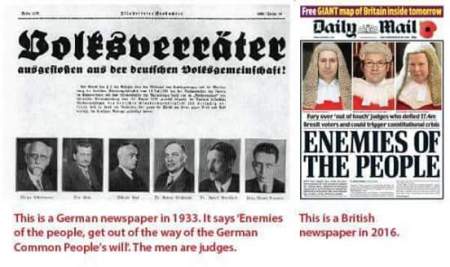
I found this on Facebook and I think I’ll just leave it here…
This entry was posted on November 6, 2016 at 9:21 pm and is filed under Uncategorized. You can follow any responses to this entry through the RSS 2.0 feed.
You can leave a response, or trackback from your own site.
 In the Dark
November 7, 2016 at 11:00 am
‘The British people have made their decision. We must respect that result and Article 50 has to be invoked now.’ – Jeremy Corbyn, the morning after the Referendum.
During campaigning, David Cameron stated that if Brexit was the people’s choice, he would ‘trigger Article 50 straight away’.
November 7, 2016 at 12:11 pm
Yes, politicians aren’t very good at law, it turns out.
November 7, 2016 at 12:36 pm
And people who bring cases are solely interested in constitutional rectitude and wholly uninterested in the matter of whether Britain remains in the EU.
November 7, 2016 at 1:43 pm
I think they’re interested in both.
It is in the Leave camp’s interest to ensure that whatever is done is done lawfully so there can no risk of it being overthrown.
I do not understand the leave side’s response to the judgement. It merely asserts Parliamentary sovereignty.
Although a majority of MPs were in favour of remain, I think many who did support remain will vote for Article 50 if an Act of Parliament is needed. Nevertheless it is an important point of principle that Parliament should decide.
The only reason I can think of for the government to want to rush ahead in secrecy is that they don’t want people to find out what they’re up to until it’s too late.
November 7, 2016 at 1:40 pm
That seems irrelevant here. Of course people bring cases because they feel wronged. The bottom line is whether something is lawful or not. Should people be denied access to the law because they hold the ‘wrong’ opinion? And who decides what is ‘wrong’ and who is allowed to be above the law? The law applies to, and protects, majorities and minorities alike.
November 7, 2016 at 1:44 pm
Particularly not the Attorney General. One can assume that the Appeal to the Supreme Court will be handled by someone more competent.
November 7, 2016 at 5:49 pm
This is a grey area, which is why the personal opinions of judges are relevant. And, while I disapprove of verbal abuse, it is vital that people be free to verbally abuse judges.
November 7, 2016 at 1:47 pm
In that case one wonders why Theresa May has not triggered Article 50 already…..
November 7, 2016 at 5:51 pm
The delay is plausibly while she assembles a team to work on Brexit, given that Cameron’s government expected to Remain.
November 8, 2016 at 7:47 am
She does not have the authority to do so, as the court has found.
November 8, 2016 at 7:48 am
Anton, she has assembled Johnson, Fox, Davis, Priti Patel and others. How much deeper in the bottom of the barrel do you want her to scrape?
November 8, 2016 at 8:41 am
Of course she has the authority to assemble a team. All that is in question in the Supreme Court is whether parliament must get a vote on triggering Article 50. Disentangling 40 years of legislation and getting negotiators on top of the details is a big job which takes time.
November 8, 2016 at 10:20 am
Actually I -am- starting to wonder why May has not taken it to the Commons. Presumably she would still maintain she would be unable to ‘reveal her hand’.
Does she think she’d lose?
November 7, 2016 at 1:54 pm
ps. The Article 50 judgment says nothing about whether or not Article 50 can or cannot be invoked, just that Parliament must be consulted before it is.
Here is a quote from the judgment:
“It deserves emphasis at the outset that the court in these proceedings is only dealing with a pure question of law. Nothing we say has any bearing on the question of the merits or demerits of a withdrawal by the United Kingdom from the European Union; nor does it have any bearing on government policy, because government policy is not law. The policy to be applied by the executive government and the merits or demerits of withdrawal are matters of political judgement to be resolved through the political process.~
November 8, 2016 at 7:45 am
A soundbite from a politician does not constitute law, or even government policy. And if it proposes a course of action contrary to law, it has no weight. Cameron did not have the authority to do what he said he would do.
November 8, 2016 at 8:43 am
Cameron did have the authority at the time. May had the authority until last week. She might get it back in the Supreme court. Let’s see.
November 8, 2016 at 9:42 am
No they did not. They just thought they did.
November 8, 2016 at 10:24 am
And if the Supreme Court rules otherwise…?
November 8, 2016 at 12:13 pm
I think the real point of this is not the Article 50. Most of us think that this would easily pass a House of Commons vote, and the Government could have avoided controversy by just having a debate.
The point, I think, is what happens after the Great Repeal Act, which is proposed to embed all EU laws and obligations into UK Law. The government’s plan is then to repeal such items of the law that it does not like (i.e. those dealing with employment rights, environmental protection, etc etc) *without recourse* to Parliament, i.e. by use of executive powers.
The Article 50 judgment asserts that rights previously existing in law cannot be revoked except by the consent of Parliament. If it stands, the Government will not be able to get away with removing rights from UK citizens unchallenged.
November 8, 2016 at 1:22 pm
Surely not, Peter? The “‘Great Repeal Act’ would specify what parts of EU-proposed legislation would get the axe, and the Act would be voted upon by Parliament.
November 8, 2016 at 2:00 pm
My understanding is that the Great Repeal Act will be very brief and simply absorb *all* existing EU law into UK law. Thereafter the government will gradually throw away those things it does not like, a process which will probably take many years.
November 8, 2016 at 2:16 pm
I see now; thank you. As I understand, EU law would be incorporated into British law upon the passage of such an act, so as to facilitate its sifting. How that sifting is done is not specified. As it is about setting the law rather than how to settle the law, ie about legislation rather than the constitution, parliament would presumably be involved.
November 7, 2016 at 6:35 pm
I wouldn’t believe everything you read on Facebook. Here is the full page of the Illustrierte Beobachter, from 1933:
https://rechtsdrall.com/2015/08/06/markus-ripfl-fpoe-bedient-sich-ns-diktion/volksverraeter/
The last two men named are Heinrich Mann, a novelist, and Lion Feuchtwanger, a German-Jewish novelist and playwright. Neither were judges. This is, moreover, after the Nazis had taken power and they wasted no time in taking over the press.
November 8, 2016 at 3:50 pm
Have you seen the superb 1981 film (by Istvan Szabo) of Klaus Mann’s novel Mephisto, a thinly veiled portrait of his brother-in-law Gustav Gründgens? The lead is an actor who began as a radical and little by little sold out to the Nazis, while his best-known role is – appropriately – in Faust.
November 8, 2016 at 5:15 pm
Istvan Szabo’s next film was Colonel Redl, about the head of the secret police in the Austro-Hungarian Empire before World War 1, and was based on a play by John Osborne. This film too was excellent. Then there is his masterpiece, Sunshine, which is about three generations of a Jewish family that wants to integrate in and during 20th century Budapest. The film goes from the Austro-Hungarian Empire to communism (briefly) to fascism to communism to democracy, and through two world wars. Truly an epic, and with a wonderful soundtrack. A minor character is a filmmaker who makes propaganda for whichever side is in power. When I read on Wikipedia a few years ago that Szabo had been an informer under communism, I knew why he had put that character in. (But it is nothing compared to Ulrich Mühe’s story; this actor, who had played a Stasi man in The Lives Of Others, found upon opening the Stasi files after 1990 that his own wife had been informing on him.)