Simplified Presentation
This morning I was looking through my collection of old books about general relativity and related things, and found this page as part of a `simplified presentation’:
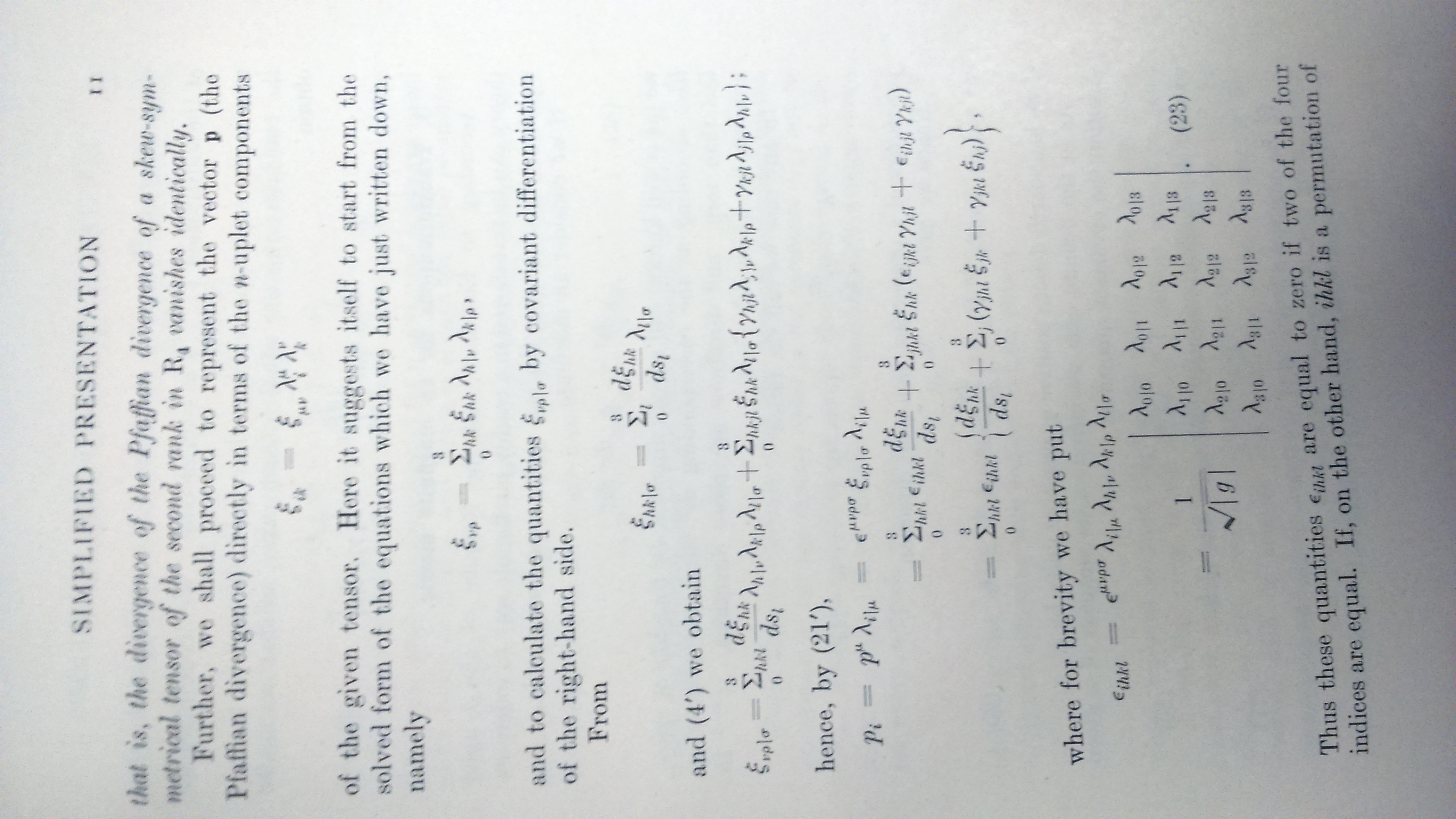
I wonder if you can guess the name of author of the little book in which I found this page, and what it is a `simplified presentation’ of?
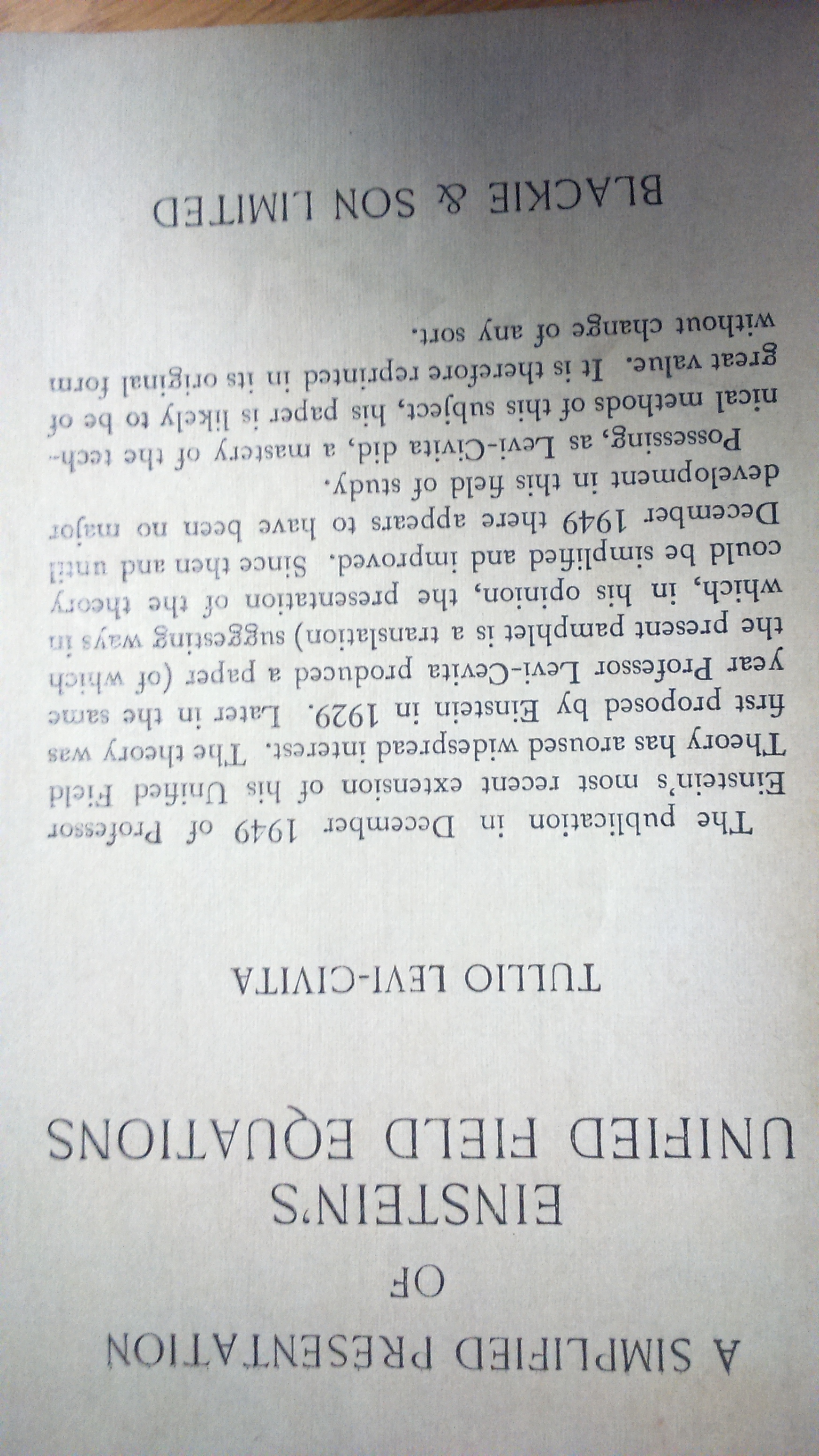
The answer is on the front cover:
Follow @telescoper
 In the Dark
November 24, 2017 at 12:30 pm
Chandra?
November 24, 2017 at 1:19 pm
Not a bad guess, but nope!
November 24, 2017 at 2:20 pm
Well Paul Dirac wrote a lot of simplified GR books. Is it anything to do with Killing vectors?
November 24, 2017 at 2:56 pm
No vectors were killed during the writing of this book.
November 24, 2017 at 2:51 pm
It’s a presentation of the Unified Field Equations, probably an English translation of a book by Levi-Civita, probably from the 1920’s.
November 24, 2017 at 3:12 pm
Yes, a (long) paper by Tullio Levi-Civita on `A Simplified Presentation of Einstein’s Unified Field Equations’ appeared in 1929, shortly after Einstein’s Unified Theory was published. That’s the theory that unified GR and classical EM theory.
I have a translation of the Levi-Civita paper that was produced as a pamphlet in 1949.
November 25, 2017 at 6:35 pm
What do you mean by saying that it “unified” GR and emag, please? Presumably it simply generalised Maxwell’s equations to curved spacetime and incorporated electromagnetic terms in the stress-energy tensor, but those things can be done separately from each other whereas a true unification would be something more.
November 27, 2017 at 12:54 pm
Einstein’s idea with his unified theory was to have EM emerge from geometry in the same sort of way that gravity does. In other words, it should appear on the LHS of the field equations, rather than in the energy-momentum tensor on the RHS.
This is typical of various approaches to unification, in that two (or more) apparently distinct phenomena are described in terms of a single (`more fundamental’) entity.
Einstein’s unified theory is very complicated but a slightly earlier idea which influenced him is the Kaluza-Klein theory. This is a five-dimensional theory (4+1) in which one of the space dimensions is rolled up in the same manner as one dimension of a cylinder. It turns out from that that you can have a theory that describes GR+EM in the other four-dimensions (3+1)…
November 27, 2017 at 2:49 pm
Thanks Peter. In short, Einstein was trying to make emag like gravity, whereas gauge approaches seek to make gravity like emag. With due honour to Einstein, I’ll go with the latter approach. Do you know what his views were at this time on the forces that hold the atomic nucleus together against the mutual emag repulsion of the protons?
November 27, 2017 at 2:53 pm
Yes, I think that’s a good summary.
I’m not sure what he knew about nuclear forces. It’s also worth saying that this was all entirely classical. Unifying QED with GR was outside its scope let alone the other quantum theories.
November 27, 2017 at 3:52 pm
I know! That’s why I asked about the nuclear forces, which are so short-range that only a quantum description will do.