The Problem of the Disintegrating Asteroid
I thought you might enjoy this entry in the Cute Problems folder.
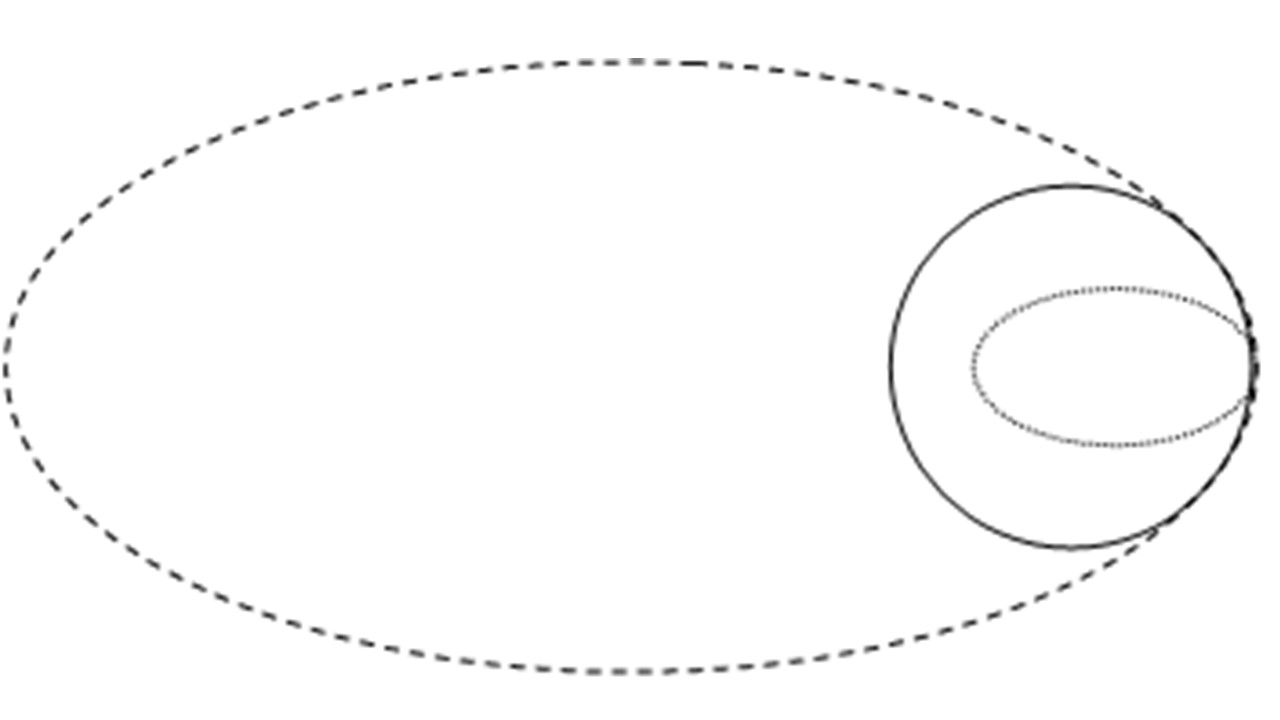
An asteroid is moving on a circular orbit around the Sun with an orbital radius of 3AU when it spontaneously splits into two fragments, which initially move apart along the direction of the original orbit. One fragment has a speed which is a fraction 0.65 of the original speed, the other has a speed of 1.35 times the original speed. The original orbit (solid line) is shown above, along with the two new orbits (dashed and dotted).
- Which orbit does the fast fragment follow, and which the slow fragment?
- Calculate the original orbital speed in AU/year.
- Calculate the angular momentum per unit mass, h, of the original asteroid and of each of the two fragments in units of AU2 per year. [HINT: Show that in these units, for a general orbit of eccentricity e and semi-major axis a, h2=4π2 a (1-e2).]
- Calculate the eccentricities of the orbits of the two fragments.
- Calculate the orbital periods of the two fragments in years.
Answers please through the Comments box. First complete set of answers wins a trip to the Moon on gossamer wings.
Follow @telescoper
 In the Dark
September 30, 2019 at 4:42 pm
I think it might be cheating if I answer this as I inherited this question on the 1st year course in Cardiff!
September 30, 2019 at 4:44 pm
I did it in tutorial with 4th year students here in Maynooth last year. I was surprised how many got the first part wrong when I asked in class!
October 1, 2019 at 12:19 pm
Gossamer wings?? Don’t you mean moon geese?
October 1, 2019 at 9:42 pm
It’s just one of those things.
October 1, 2019 at 9:46 pm
It was just, just one of those nights
Just one of those fabulous flights..