A Problem of Snooker
I came across the following question in a first-year physics examination from Cambridge (Part 1A Natural Sciences) and, since I have posted anything in the Cute Problems folder for a while I thought I would share it here:
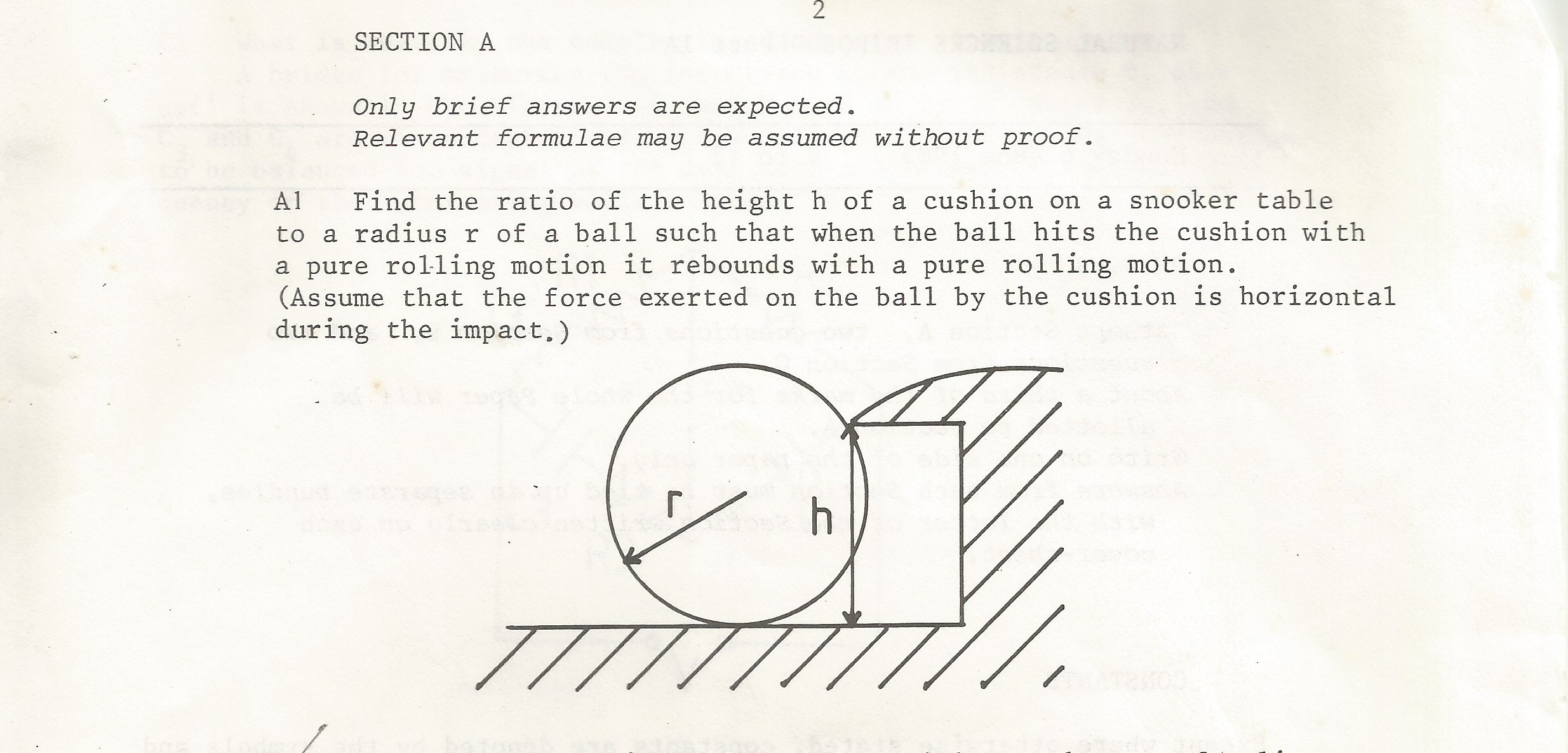
Answers through the comments box please! And please show your working!
P.S. The preamble does not say whether you can also assume irrelevant formulae without proof…
Follow @telescoper
 In the Dark
February 25, 2020 at 4:17 pm
I assume without proof the relevant formula h = (7/5)r, where r is the radius of a snooker ball, and h is the height of the cushion such that a ball hitting the cushion with pure rolling motion rebounds with pure rolling motion. From this formula, I conclude that h = (7/5)r.
February 25, 2020 at 4:19 pm
I think you assume too much.
February 26, 2020 at 4:03 pm
The question clearly says I can assume this. You can’t claim it’s not a “relevant formula”!
February 27, 2020 at 1:36 pm
You have to show the working you used to decide that it was relevant.
February 25, 2020 at 7:26 pm
I don’t think this is such a good question. The 7/5 answer is the one that you obtain by assuming that there is no transverse frictional force at the bottom of the ball. But if there’s no friction, then the force from the cushion can’t act horizontally as the question specifies – it would have to be purely radial. So there is friction, in which case the ball will rebound happily for many values of h – but if h is too small then the ball will climb the cushion and leave the table. A more realistic question would have been to ask how high the cushion needs to be to prevent this. If you assume that the ball sticks instantaneously on the cushion, then you need the total angular momentum about the point of contact to be anticlockwise. This will be so as long as h > 7r/5.
February 25, 2020 at 10:05 pm
I bet whoever set this question is rubbish at snooker
February 27, 2020 at 7:10 am
r=h or h=r (take your pick)
Any other outcome will impart a torque to the collision which will produce a spinning ball (subject to surface friction of course), forward spin if h>r and backspin if h