What’s a good Cosmological Model?
Some years ago – actually about 30! – I wrote a book with George Ellis about the density of matter in the Universe. Many of the details in that book are of course out of date now but the main conclusions still stand. We started the book with a general discussion of cosmological models which I think also remains relevant today so I thought I’d do a quick recap here.
Anyone who takes even a passing interest in cosmology will know that it’s a field that’s not short of controversy, sometimes reinforced by a considerable level of dogmatism in opposing camps. In understanding why this is the case, it is perhaps helpful to note that much of the problem stems from philosophical disagreements about which are the appropriate criteria for choosing a “good” (or at least acceptable) theory of cosmology. Different approaches to cosmology develop theories aimed at satisfying different criteria, and preferences for the different approaches to a large extent reflect these different initial goals. It would help to clarify this situation if one could make explicit the issues relating to choices of this kind, and separate them from the more `physical’ issues that concern the interpretation of data.
The following philosophical diversion was intended to initiate a debate within the cosmological community. Some cosmologists in effect claim that there is no philosophical content in their work and that philosophy is an irrelevant and unnecessary distraction from their work as scientists. I would contend that they are, whether they like it or not, making philosophical (and, in many cases, metaphysical) assumptions, and it is better to have these out in the open than hidden.
To provide a starting point for, consider the following criteria, which might be applied in the wider context for scientific theories in general, encapsulating the essentials of this issue:
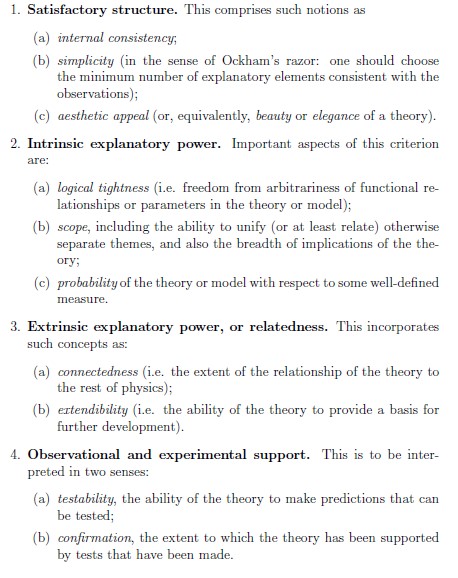
One can imagine a kind of rating system which judges cosmological models against each of these criteria. The point is that cosmologists from different backgrounds implicitly assign a different weighting to each of them, and therefore end up trying to achieve different goals to others. There is a possibility of both positive and negative ratings in each of these areas.
Note that such categories as “importance”, “intrinsic interest” and “plausibility” are not included. Insofar as they have any meaning apart from personal prejudice, they should be reflected in the categories above, and could perhaps be defined as aggregate estimates following on from the proposed categories.
Category 1(c) (“beauty”) is difficult to define objectively but nevertheless is quite widely used, and seems independent of the others; it is the one that is most problematic . Compare, for example, the apparently “beautiful” circular orbit model of the Solar System with the apparently ugly elliptic orbits found by Kepler. Only after Newton introduced his theory of gravitation did it become clear that beauty in this situation resided in the inverse-square law itself, rather than in the outcomes of that law. Some might therefore wish to omit this category.
One might think that category 1(a) (“logical consistency'”) would be mandatory, but this is not so, basically because we do not yet have a consistent Theory of Everything.
Again one might think that negative scores in 4(b) (`confirmation’) would disqualify a theory but, again, that is not necessarily so, because measurement processes, may involve systematic errors and observational results are all to some extent uncertain due to statistical limitations. Confirmation can therefore be queried. A theory might also be testable [4(a)] in principle, but perhaps not in practice at a given time because the technology may not exist to perform the necessary experiment or observation.
The idea is that even when there is disagreement about the relative merits of different models or theories, there is a possibility of
agreement on the degree to which the different approaches could and do meet these various criteria. Thus one can explore the degree to which each of these criteria is met by a particular cosmological model or approach to cosmology. We suggest that one can distinguish five broadly different approaches to cosmology, roughly corresponding to major developments at different historical epochs:
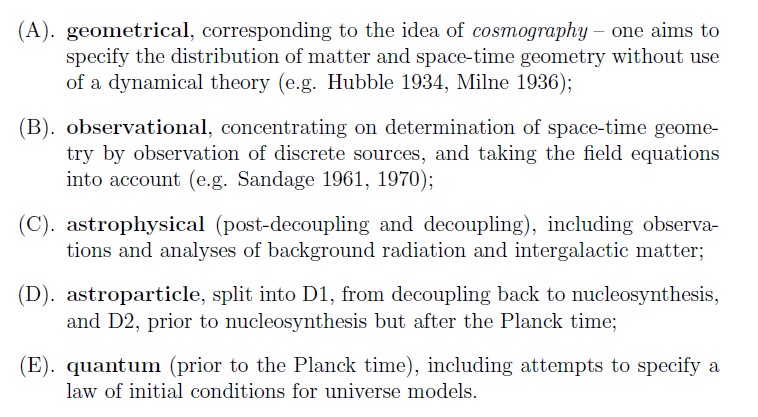
These approaches are not completely independent of each other, but any particular model will tend to focus more on one or other aspect and may even completely leave out others. Comparing them with the criteria above, one ends up with a star rating system something like that shown in the Table, in which George and I applied a fairly arbitrary scale to the assignment of the ratings!
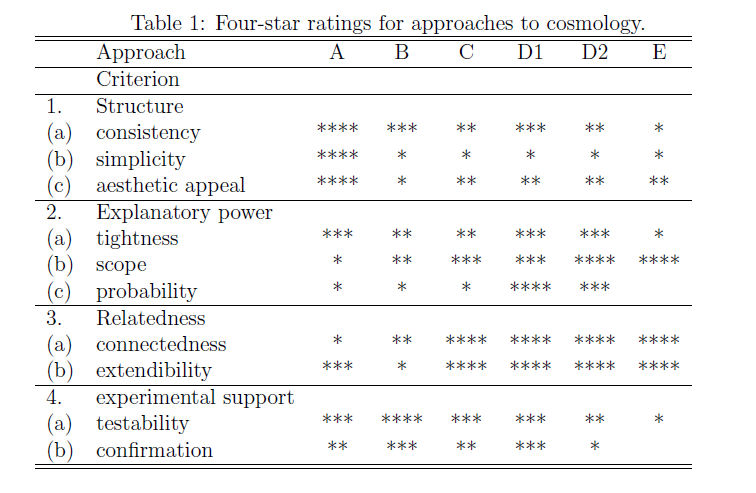
To a large extent you can take your pick as to the weights you assign to each of these criteria, but my underlying views is that without a solid basis of experimental support [4(b)], or at least the possibility of confirmation [4(a)], a proposed theory is not a ‘good’ one from a scientific point of view. If one can say what one likes and cannot be proved wrong, one is free from the normal constraints of scientific discipline. This contrasts with a major thrust in modern cosmological thinking which emphasizes criteria [2] and [3] at the expense of [4].
 In the Dark
April 3, 2023 at 8:34 am
Manfred Eigen said “A theory has only the alternative of being right or wrong. A model has a third possibility: it may be right, but irrelevant.” What would make a cosmological model relevant is being grounded in our understanding of fundamental physics! The present ‘standard model’ of cosmology fails this because there is *no physical understanding* of why its major component – the Cosmological Constant (aka dark energy) – should have the value \Lambda ~ 2H_0^2 that is inferred from observations in the framework of this model. The present expansion rate H_0 is neither fundamental nor a constant (but it is imprinted on every cosmological measurement in this model framework). Alarm bells should be ringing, instead astronomers consider this to be a very successful model of the Universe!
April 3, 2023 at 2:39 pm
Two things. One is that the whole edifice of the standard model isn’t really grounded in fundamental physics because we don’t know how to put QFT + GR together in a fully satisfactory way. The standard model can’t be claimed to be anything but an “effective” description , perhaps arising from a deeper theory we don’t yet have.
The other thing is that while you might argue that being grounded in fundamental physics is necessary, it is not sufficient for the theory to be acceptable. It also has to fit the observational evidence!
April 3, 2023 at 3:07 pm
I agree – indeed the Cosmological Constant problem lives at just that ill-understood QFT-GR interface. Nevertheless given that we have no clue as to why the Universe did not go into eternal inflation (or recollapse) due to the O(TeV)^4 vacuum energy of the Standard SU(3)xSU(2)xU(1) Model, when it was just ~10^-12 s old, it’d seem unwise to (a) completely ignore that issue, and (b) then claim that ~10^10 yr later we have come to be dominated by a O(meV)^4 vacuum energy of entirely unknown origin. Especially when this energy scale is being set by the present day expansion rate – shurely shome mishtake?!
April 3, 2023 at 11:41 am
My impression is that researchers in the field of cosmology agonise more than most about the validity of the general background paradigm they work in. I think it might be because the LCDM model is unusual in that, whilst it provides a really good explanation for a great many phenomena, two significant components of it remain problematic, as you known – DM because of the problem of observation and DE because of the problem of underlying explanation. I think both hypotheses are perfectly reasonable but not many successful scientific theories have giant holes in them like this – imagine the theory of evolution by natural selection was missing 2 key parts, for example!