NANOGrav Newsflash!
In a post earlier this week I wrote that
There is a big announcement scheduled for Thursday by the NANOGrav collaboration. I don’t know what is on the agenda, but I suspect it may be the detection of a stochastic gravitational wave background using pulsar timing measurements. I may of course be quite wrong about that, but will blog about it anyway.
The press conference is not until 1pm EDT (6pm Irish Time) but the papers have already arrived and it appears I was correct in my inference. The papers can be found here, along with a summary. The main results paper is entitled The NANOGrav 15 yr Data Set: Evidence for a Gravitational-wave Background. Here is the abstract (click on the image to make it bigger):
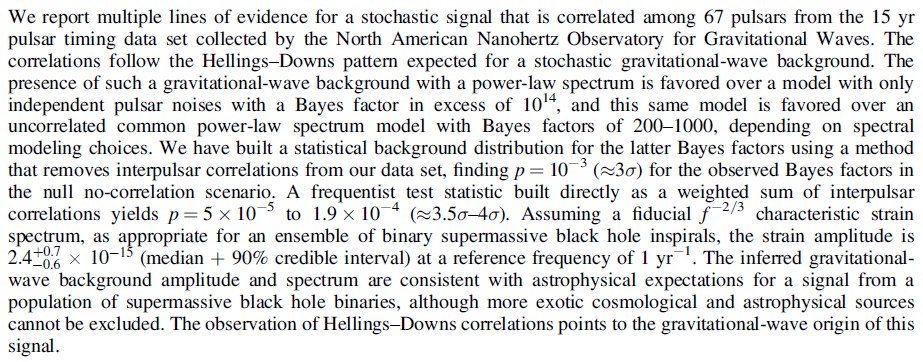
In a nutshell, this evidence differs from the direct detection of gravitational waves by interferometric experiments, such as Advanced LIGO, in that it: (a) does not detect individual sources but an integrated background produced by many sources; (b) it is sensitive to much longer gravitational waves (measured in light-years rather than kilometres).; and (c) the statistical evidence of this detection is far less clear-cut.
While Advanced LIGO can – and does – detect gravitational waves from mergers of stellar mass black holes, the NANOGrav signal would correspond to similar events involving much more massive objects – supermassive black holes (SMBHs) – with masses exceeding a million times the mass of the Sun, such as the one found in the Galactic Centre. If this is the right interpretation, the signal will provide important information about how many such mergers are happening across the Universe and hence about the formation of such objects and their host galaxies.
SMBH mergers are not the only possible source of the NANOGrav signal, however, and you can bet your bottom dollar that there will now be an avalanche of theory papers on the arXiv purporting to explain the results in terms of more exotic models.
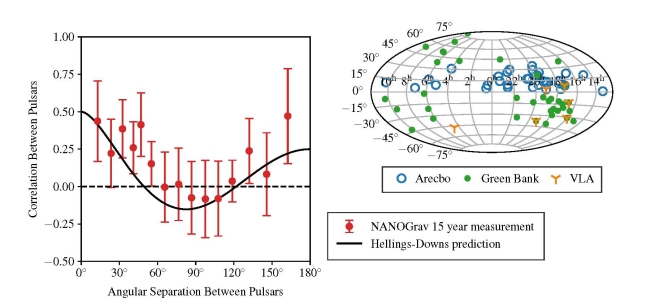
Incidentally, for a nice explanation of the Hellings-Downs correlation, see here. The figure from the paper is
I haven’t had time to go through the papers in detail so won’t comment on the results, at least partly because I find the presentation of the statistical results in the abstract a very confusing jumble of Bayesian and frequentist language which I find hard to penetrate. Hopefully it will make more sense when I have time to read the papers and/or when I watch the announcement later.
 In the Dark
July 3, 2023 at 5:47 am
Peter: you forgot that similar results also came out (on the same day) from CPTA, PPTA and EPTA+InPTA
July 3, 2023 at 7:57 am
I didn’t see any others. I only saw the NANoGrav announcement.
July 3, 2023 at 8:04 am
Papers (accepted or already published) from other PTA collaborations came out on arXiv on the same day. While there was no live press conf. from the other PTAs, there are announcements on their webpages https://www.epta.eu.org/ https://inpta.iitr.ac.in/ https://www.atnf.csiro.au/research/pulsar/ppta/ I couldn’t find a CPTA website but see this article which ctes CPTA
https://www.scmp.com/news/china/science/article/3225765/chinese-team-finds-key-evidence-low-frequency-gravitational-waves-fast-telescope