Proto, by Laura Spinney
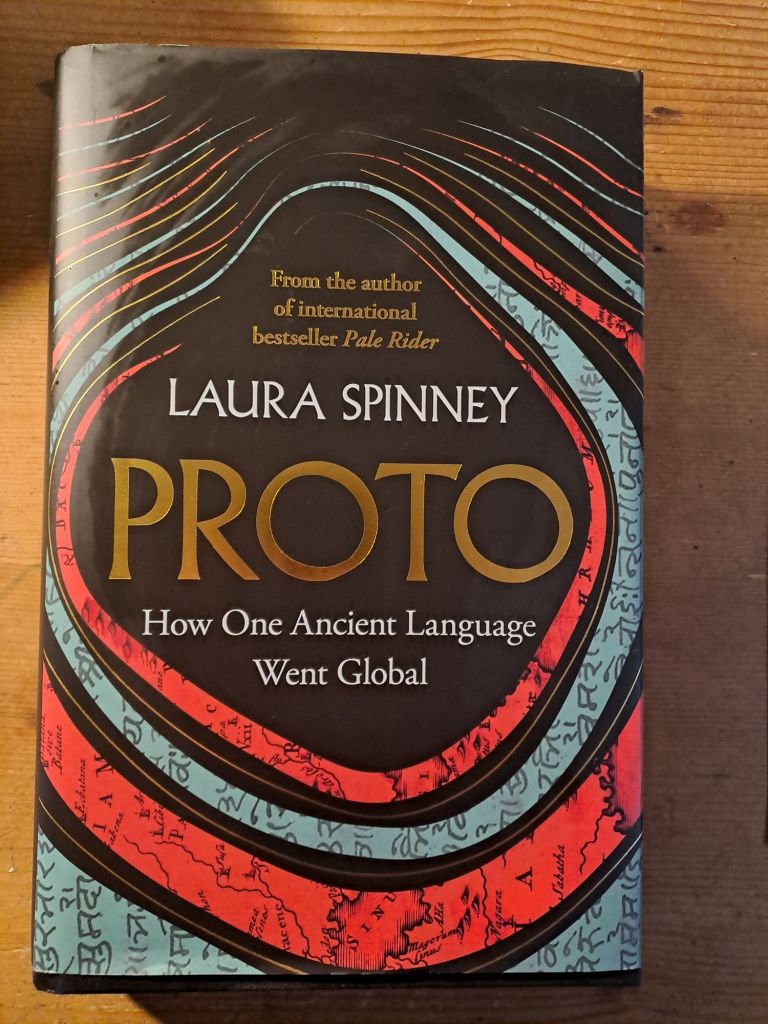
I interrupted the sequence of novels I’ve been reading recently to absorb a non-fiction book, Proto by Laura Spinney (left). I find linguistics a fascinating subject and when I saw a review of this recently and couldn’t resist. I’m glad I bought it because it’s absolutely fascinating. It is the story – or at least a very plausible account of the story of the lost ancestor of the Indo-European languages, the methods that have been used to reconstruct “Proto”, and why it was the spark that generated so many other languages across Europe, Eurasia and India.
The topic is very complex and I won’t attempt to describe it all in depth here; each chapter could be a book in itself because each family of languages within the Indo-European group – including lost ones such as Tocharian – has its own fascinating story. There are chapters focussing on the origins of language itself, the possibilities surround Proto (a language that was never written and probably exists in many dialects), Anatolian, Tocharian, Celtic, Germanic and Italic, the Indo-Iranian group (based on Sanskrit), Baltic and Slavic, and Albanian, Armenian and Greek. The last of these is fascinating because it used a method of writing borrowed from a non-Indo-European source that became the origin of the European alphabet.
The story of which all these are subplots begins around the Black Sea shortly after end of the last Ice Age. In this area there lived mesolithic hunter-gatherers who had survived the ice who interacted with farmers moving up from the direction of modern day Syria. Their languages would have merged in some way to allow them to describe things that their neighbours had that they didn’t. Hunter-gatherers would not have words for, e.g., ploughing or barley while farmers would have fewer words for spears and other hunting equipment. Into this mix, the argument goes, came a third group, a fully nomadic culture called the Yamnaya people. These people and their successors subsequently underwent vast migrations from the steppes across the continent and were responsible for spreading the Proto-Indo-European languages. That’s a hypothesis, not a proven fact, but it is plausible and has a reasonable amount of evidence in its favour.
Recent progress in this field has been driven not only by linguists but also by archaeologists and geneticists, with each aspect of this triangulation vital. It was reading about archaeology in this book that prompted me to write a post about the Nebra Sky Disc. There are some fascinating snippets from palaeogenetics, too. Full DNA sequences are now known for about 10,000 individuals who lived in prehistoric times.
One extraordinary find involves two burials of individuals who both lived about 5,000 years ago. Their DNA profiles match so well that they were probably second cousins or first cousins once removed. The thing is that one of them was buried in the Don Valley, north-east of Rostov in modern-day Russian, while the other was found 3,000 km away in the Altai mountains. Assuming they were both buried where they died, the implications for the distance over which people could move in a lifetime are remarkable.
Another fascinating genetic snippet applies to Irish, a Celtic language. The Celtic languages derive from a proto-Celtic source that probably arose about 1000 BC. Around 2450 BC one of the cultures preceding the Celts arrived in Britain and Ireland, now called the Bell Beaker People because of their taste in pottery. The genetic record shows that the DNA of the Beaker folk replaced about 90% of the previous local gene pool, and all of the Y chromosomes; for some reason men of the earlier culture stopped fathering children. A similar change happened in Ireland, about 200 years later.One possible inference is that there was a violent conquest involving the erasure of the male population, but we don’t know for sure that it was sudden and catastrophic.
Whatever language the Beaker people brought with them was not Celtic (though it may have been Indo-European). The fascinating conundrum is that when Celtic languages arrived in Ireland whoever brought them left not a trace in the genetic record. This is unlike any of the similar changes in language use throughout European pre-history. Either the population responsible has not been identified or the language was spread through communication (e.g. for trade) rather than settlement. Irish may be a Celtic language, but there is little evidence of significant numbers of Celts settling here and bringing it with them.
Some time ago I wrote a post about the Celtic languages, which you might want to look at if you’re interested in this topic. A lot of that post I now realize to be very simplistic, but to add one other snippet I should mention that the name of Turkish football team Galatasaray translates to “Palace of the Celts” after the Celtic-speaking people who settled in Anatolia; these were the Galatians to whom Paul addressed his Epistle.
I thoroughly recommend this fascinating book. It made me want to find out more about so many things. It also gacve me additional motivation to pursue an idea I had a while ago to do a Masters in Linguistics wehn I retire from physics…
 In the Dark
September 24, 2025 at 9:08 pm
I just put in requests for this book at both my public library and my university library.
I had a friend at my university who was a scholar of proto-Indo-European. He taught an undergraduate course (or module as you would say over there) on the subject, and I wanted to take it. Unfortunately, the scheduling never worked out, and he decamped to another university (not, I think, primarily to avoid having me take his module).
September 25, 2025 at 11:01 am
That makes five. I should get a commission from the author.
September 25, 2025 at 2:27 pm
Also fascinated by this stuff although I’ve been following the story since the big breakthrough in ancient DNA about 10 years ago, so much in this book wouldn’t be new to me.
I guess the author is a linguist, but it’s really the aDNA that is revolutionising this field – the linguistic story of PIE was mostly worked out in the 19th and 20th centuries. A lot of the aDNA progress is in improved statistical analysis so if you want a retirement project you already have a foot in the door.
I thought the Beaker folk were the ancestors of the celts, as well as the latins and a lot of the germans, which made subsequent waves of invasion pretty hard to detect genetically: the Beaker transition jumps out from simple PCA, but more sophisticated analysis has recently revealed later invasions of Britain.
September 25, 2025 at 3:03 pm
The book discusses the relationship between the Beaker people and the Celts. The issue is the time between the disappearance of the former and the arrival of the latter. It is perfectly possible – and indeed likely – that the pattern of migration was so complex and the genetic imprint so subtle that it has not been figured out. I haven’t looked at the primary literature in this field, but I’d be surprised if the modelling were sophisticated enough to detect what actually happened.
I’m fascinated by the fact that Linear A still hasn’t been deciphered yet.
September 25, 2025 at 2:32 pm
Some controversial claims:
https://en.wikipedia.org/wiki/Indigenous_Aryanism
The link between Latin and Indian languages was
discovered by Missionaries in Goa who were trying
to translate the Bible into Indian languages.
September 25, 2025 at 9:19 pm
I read somewhere that the aforesaid missionaries were appalled to find a thriving Christian community already there when they arrived, to the extent that they tried, with mixed success, to stamp it out. This Church was said to have been founded by Thomas the Apostle, although there may be some doubts about this. But there is certainly strong evidence of trading links between the Roman empire and what is now India (and, for that matter, Ireland). People did travel quite extensively in the past.
September 25, 2025 at 11:08 pm
Alexander the Great was in India around 327 BC…
September 26, 2025 at 1:04 pm
… along with his army and camp followers. How do you found a city anyway; where do you get all the materials and people from to build it in the first place, and how do you persuade or coerce people to continue to live there after the armies have moved on? All those Alexandrias – Milton Keynes of the ancient world.
No, I was thinking of movement on a much more modest scale, as evidenced by peripli (is that the plural?), portolans, rutters and the like.
November 19, 2025 at 12:48 am
The contrast between cultural continuity and genetic discontinuity in Celtic regions is especially intriguing