Everyone wants something better than ΛCDM
There’s a nice short review article on arXiv today by Mike Turner. I wasn’t going to share it because it hasn’t got any pictures in it, but changed my mind.
Here is the abstract
The current cosmological paradigm, ΛCDM, is characterized (b) its expansive description of the history of the Universe, its deep connections to particle physics and the large amounts of data that support it. Nonetheless, ΛCDM’s critics argue that it has been falsified or must be discarded for various reasons. Critics and boosters alike do agree on one thing: it is the not the final cosmological theory and they are anxious to see it replaced by something better! I review the status of ΛCDM, provide my views of the path forward, and discuss the role that the “Hubble tension” might play.
arXiv:2510.05483
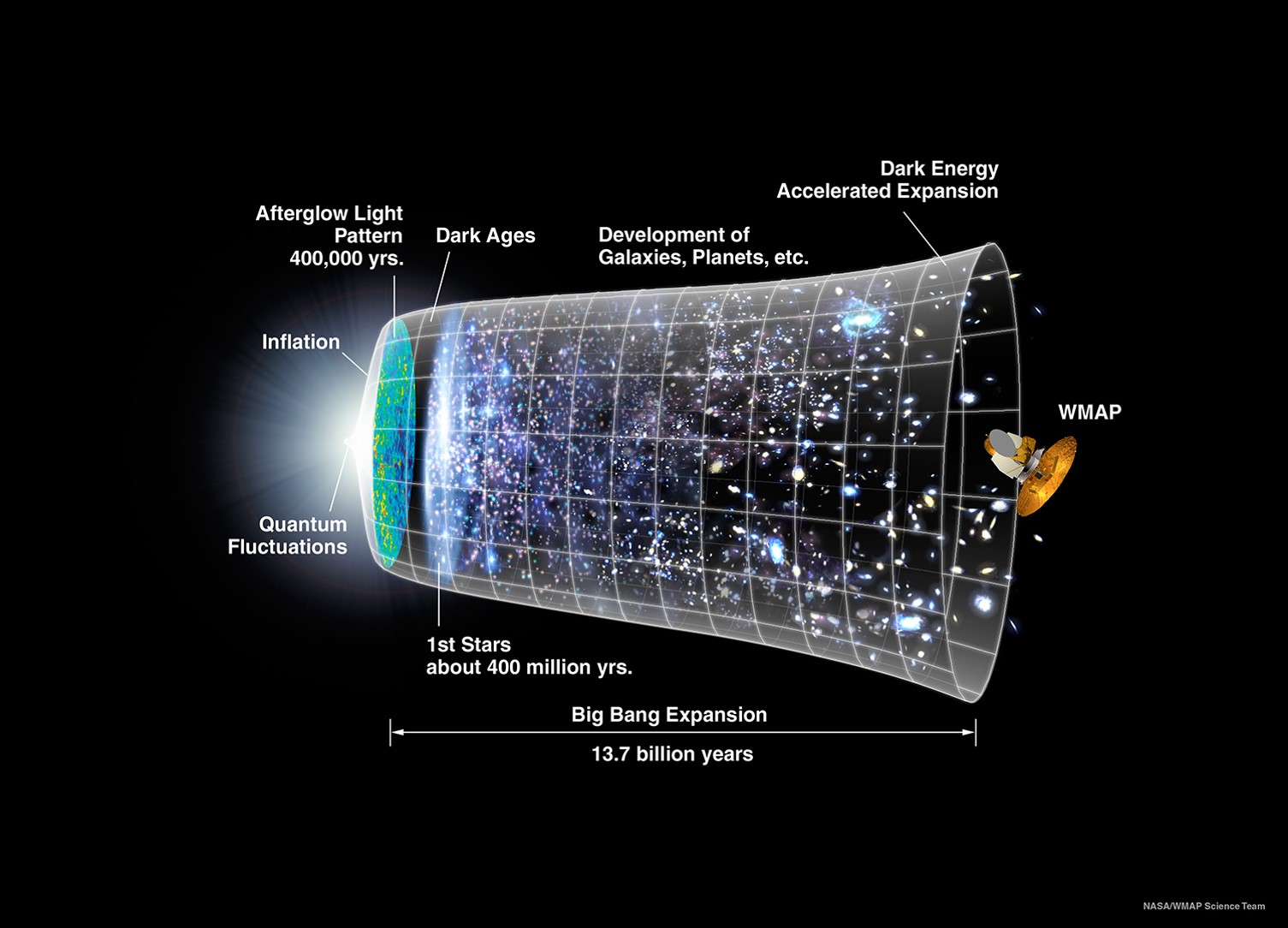
To make up for the lack of pictures in the article, here’s the first image that came up when I did a search for “ΛCDM”:
 In the Dark
October 8, 2025 at 8:42 pm
For circular orbits around and far from an isolated mass M, the centripetal acceleration v2/r is equal, according to Newton’s inverse square law of gravity, to GM/r2, so that v ∝ r-1/2. The orbital velocity of stars revolving around the centre of a galaxy, and of galaxies revolving around the centre of a cluster, has however been observed to be constant (‘flat’) at distances far from the centre. Mass is inferred from luminosity, and the Doppler effect of light is used to estimate the orbital velocity. If the inverse square law of gravity is valid to such radii then dark matter must be influencing the orbit. Weak gravitational lensing allows measurement of the density of this dark matter (above the supposed average estimated from Planck satellite observations) at distances well beyond the visible matter. But the density of dark matter calculated from recent weak lensing observations corresponds to a flat rotation curve at distances greater than predicted by the Navarro-Frenk-White dark matter profile (arXiv:2406.09685). This casts serious doubt on the existence of dark matter, and on the inverse square law at large distances. But I have no taste for Milgrom’s MOND, or Bekenstein’s relativistic theories which reduce to Milgrom’s MOND in the weak-field limit. We’re going to need a better MOND.