An Cháisc versus Y Pasg
Today is Easter Sunday and it says something about my poor grasp of the Irish language that it was only today that I learnt that the word for “Easter” in modern Irish is Cáisc. When following the definite article (as in the title of this blog), this becomes Cháisc. You can also find the possessive form Cásca, e.g. Easter Sunday is Domhnach Cásca.
Although it’s not immediately obvious, the word Cáisc is related linguistically to the Latin “Pascha” and Hebrew “Pesach,” and to the word for Easter in many other European languages Pâques, Pascua, etc.), including the Welsh Pasg (the form Y Pasg with the definite article appears in the title of this post) as well as to the English adjective “paschal”.
I haven’t succeeded in becoming at all fluent in Irish, but I have learnt that isn’t very much like Welsh. Although Irish and Welsh are both Celtic languages they are from two distinct groups: the Goidelic group that comprises Irish, Manx and Scottish Gaelic; and the Brythonic group that comprises Welsh, Cornish and Breton. These are sometimes referred to as q-Celtic and p-Celtic, respectively, although not everyone agrees that is a useful categorization. Nevertheless it has stuck and does help with some aspects. The C at the start of Cáisc is a manifestation of the roots of modern Irish in a q-Celtic, as opposed to p-Celtic, language. Hence the difference between it and the Welsh Pasg. Irish, as a q-Celtic language, will generally tend to have a k/c/q sound at the start of words that start with a p-sound in Welsh (or others derived from Latin); the “q” is, of course, historic, since very few modern Irish words begin with “q”. Another example is the word for the number “four”: in Irish it is ceathair; in Welsh it is pedwar…
Incidentally, Scottish Gaelic is not the language spoken by the Celtic people who lived in Scotland at the time of the Romans, the Picts, which is lost. Scottish Gaelic is actually descended from Middle Irish. Also incidentally, Breton was taken to Brittany by a mass migration of people from South-West Britain fleeing the Anglo-Saxons which peaked somewhere around 500 AD. I guess that was the first Brexodus.
Although I speak neither with any proficiency, Welsh and Irish don’t sound at all similar to me. This is not surprising. It is thought that the Brythonic languages evolved from a language brought to Britain by people from somewhere in Gaul (probably Northern France), whereas the people whose language led to the Goidelic tongues were probably from somewhere in the Iberia (modern-day Spain or Portugal). The modern versions of Irish and Welsh do contain words borrowed from Latin, French and English so there are similarities there, but the original Celtic languages were very different.
Beannachtaí na Cásca!
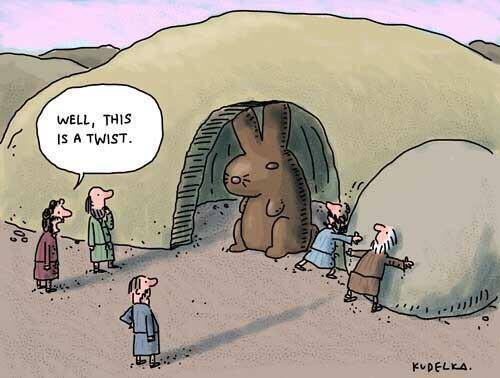
Tá coinín na Cásca tagtha…
 In the Dark
Leave a comment