Farewell to Gaia
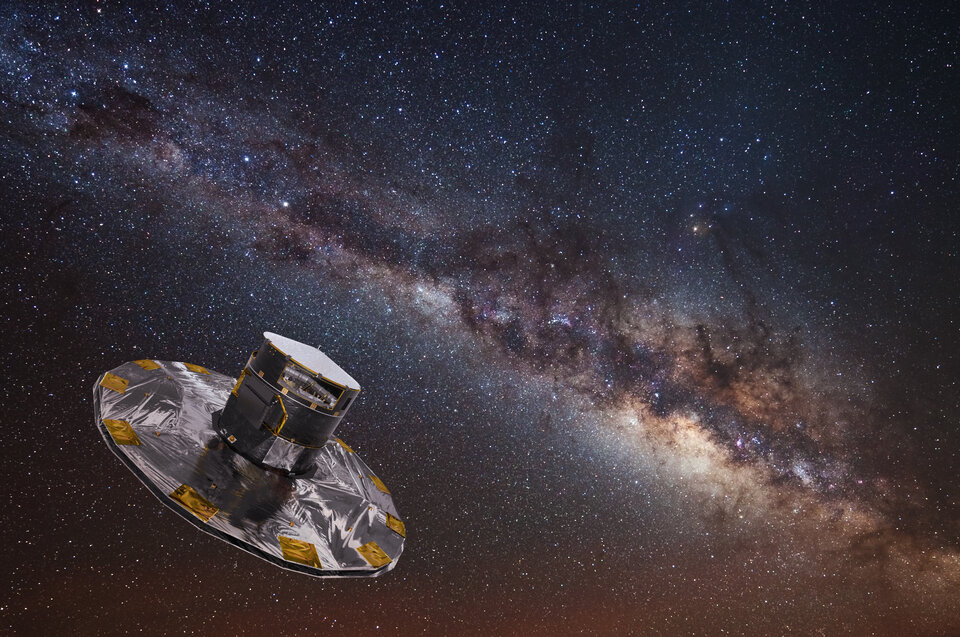
Today (15th January 2025) marks the end of an era. The European Space Agency’s Gaia spacecraft stops taking data today as it is running out of the gas propellant needed to keep it scanning the sky. The spacecraft was launched on 19 December 2013 so has been operating for just over 11 years.
For those of you not in the know, Gaia is a global space astrometry mission, whose mission was to make the largest, most precise three-dimensional map of our Galaxy by surveying more than a billion stars. Gaia was to monitor each of its target stars about 70 times over a five-year period. Alongside this core mission, it has also discovered hundreds of thousands of new celestial objects, such as extra-solar planets and brown dwarfs, and observed hundreds of thousands of asteroids within our own Solar System.
Gaia is creating an extraordinarily precise three-dimensional map of more than a thousand million stars throughout our Galaxy (The Milky Way) and beyond, mapping their motion, luminosity, temperature and chemical composition as well as any changes in such properties. This huge stellar census will provide the data needed to tackle an enormous range of important problems related to the origin, structure and evolutionary history of our Galaxy. Gaia does this by repeatedly measuring the positions of all objects down to an apparent magnitude of 20. A billion stars is about 1% of the entire stellar population of the Milky Way.
For the brighter objects, i.e. those brighter than magnitude 15, Gaia measures their positions to an accuracy of 24 microarcseconds, comparable to measuring the diameter of a human hair at a distance of 1000 km. Distances of relatively nearby stars are measured to an accuracy of 0.001%. Even stars near the Galactic Centre, some 30,000 light-years away, have their distances measured to within an accuracy of 20%.
The huge quantity of high-precision data Gaia has produced constitutes a tremendously influential resource for astronomical research. The fourth data release from Gaia, DR4, is in the pipeline for completion soon but the final data release (DR5) will take some years to appear, so this is by no means the last we will hear from Gaia, but the end of observations does close a significant chapter. Its legacy will be immense.
 In the Dark
January 15, 2025 at 12:00 pm
To even more successful space science missions!
January 16, 2025 at 2:19 am
[…] Releases bis zum kompletten um 2030 vor: Press Releases hier, hier, hier, hier und hier und Artikel hier, hier, hier, hier und […]