The largest and most detailed photo ever made of the Galactic Centre in visible light was taken by the Euclid mission. For just one day (23rd March 2025), Euclid turned its gaze towards the extremely bright inner region of our Milky Way galaxy, known as the galactic bulge. The extraordinary picture that resulted is not part of Euclid’s main cosmological survey, which is designed to look at objects far outside our own Galaxy, but was made in response to a special request from astronomers who were after what Euclid does best: capturing large areas of the sky in crisp detail. Packed with more than 60 million stars, this image opens the door for scientists to confirm the existence of any exoplanet found in this region and measure its mass using tiny changes in starlight over time. The observational data obtained in this project were released today as Euclid’s Q2 data release; for details of Q1 please see here.
Designed to observe billions of faraway galaxies, the space telescope’s visible light camera is sensitive enough to tell apart individual stars in our super-crowded galactic bulge, without being blinded. This ability is crucial for what scientists want to use this image for: studying planets around other stars using a special technique called gravitational microlensing.
For comparison, Euclid’s sharpness and sensitivity in visible light is similar to the NASA/ESA Hubble Space Telescope’s wide field camera. But each pointing that Euclid captures in a few hours spans an area 270 times larger than Hubble’s field of view. To observe the same Euclid mosaic, the Keck Observatory would need around 2000 hours. Euclid is faster, and able to capture details from fainter stars that would be otherwise missed when observing from the ground. This single mosaic also encompasses the entire region that the upcoming Roman space telescope will monitor for planet hunting.
Here we are, on schedule, with another update of activity at the Open Journal of Astrophysics. Since the last update we have published a further seven papers, bringing the number in Volume 9 (2026) to 94 and the total so far published by OJAp up to 542. I checked the corresponding update for last year (on 3rd May 2025), and we’ve had an increase from 54 to 94 in papers published (about 74%) between the first four months of 2025 and the first four months of 2026.
I will continue to include the posts made on our Mastodon account (on Fediscience) to encourage you to visit it. Mastodon is a really excellent service, and a more than adequate replacement for X/Twitter (which nobody should be using); these announcements also show the DOI for each paper.
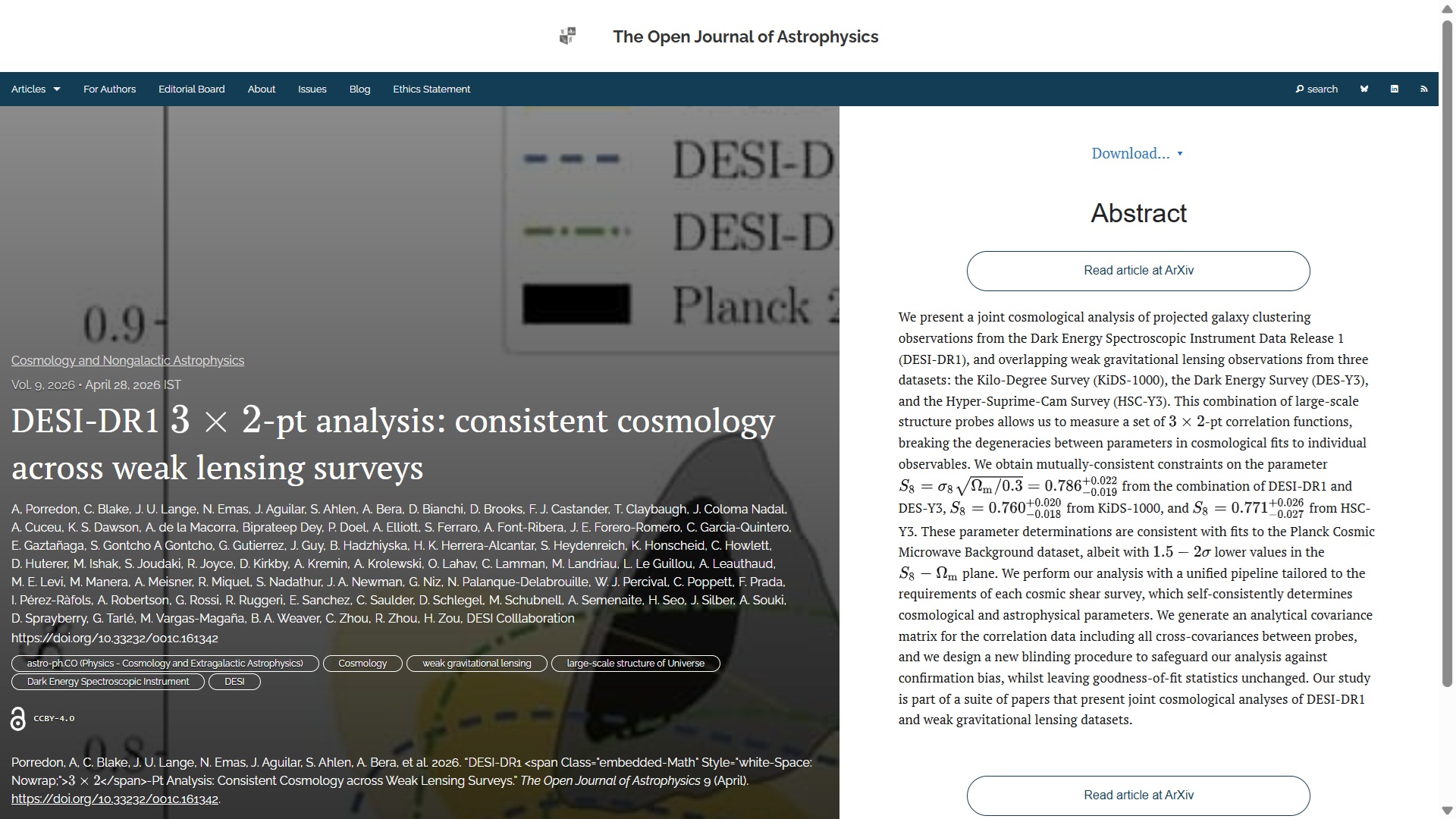
The first paper to report this week is “DESI-DR1 3 × 2-pt analysis: consistent cosmology across weak lensing surveys” by Anna Porredon (CIEMAT, Madrid, Spain) and 72 others (DESI Colllaboration). This paper was published on Tuesday 28th April in the folder Cosmology and Nongalactic Astrophysics. This paper presents a joint cosmological analysis of galaxy clustering and gravitational lensing observations, providing consistent constraints on cosmological parameters. The analysis also introduces a new blinding procedure to prevent confirmation bias. See this post for news of an important DESI milestone.
The overlay for this paper is here
You can find the officially accepted version on arXiv here and the announcement on Fediverse here:
New Publication at the Open Journal of Astrophysics: "DESI-DR1 3 × 2-pt analysis: consistent cosmology across weak lensing surveys" by Anna Porredon (CIEMAT, Madrid, Spain) and 72 others (DESI Colllaboration)
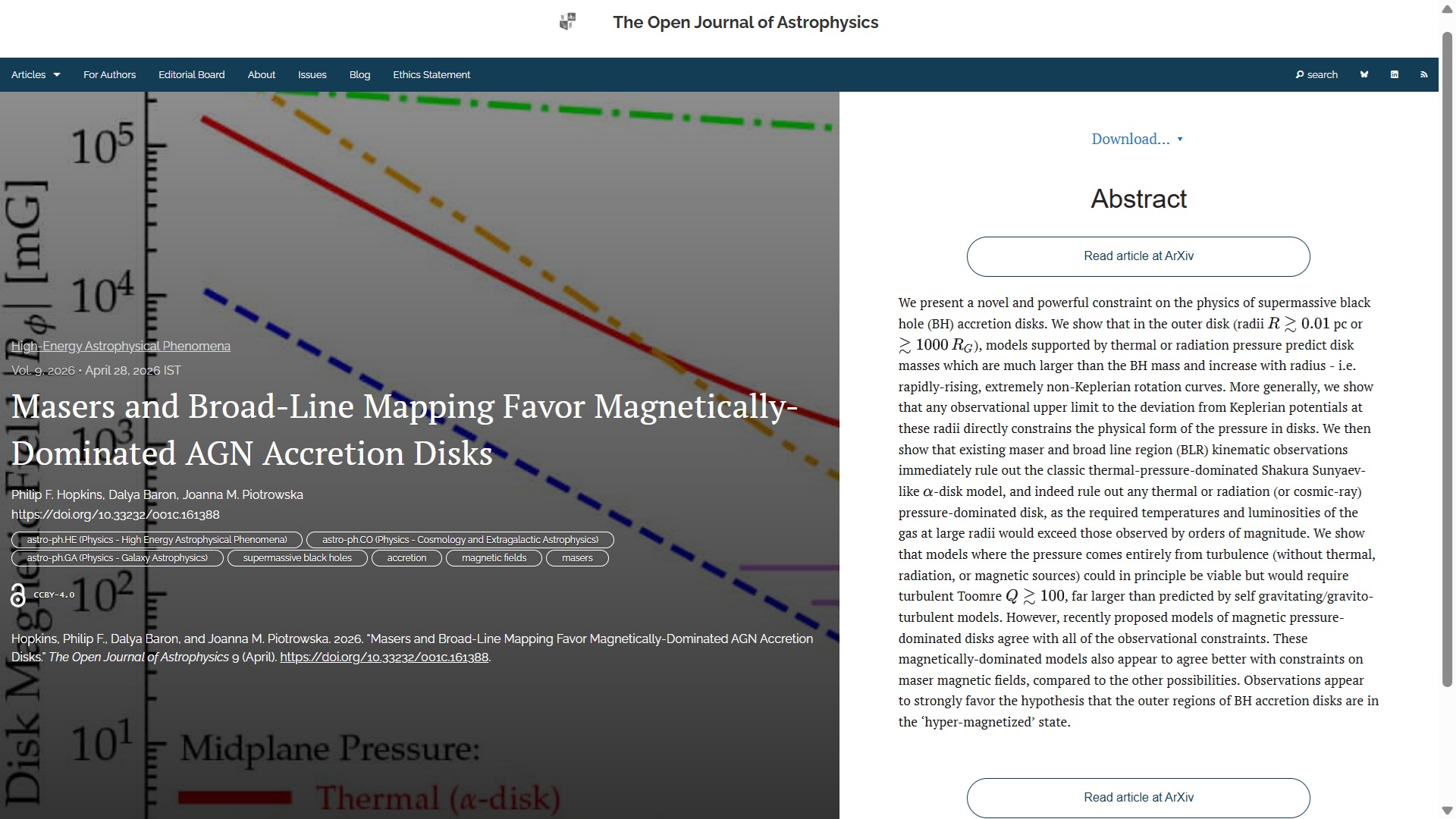
The second paper for this week, also published on Tuesday 28th April but in the folder High-Energy Astrophysical Phenomena is “Masers and Broad-Line Mapping Favor Magnetically-Dominated AGN Accretion Disks” by Philip F. Hopkins (Caltech, USA), Dalya Baron (Stanford U., USA) and Joanna M. Piotrowska (Caltech). This one presents a new constraint on supermassive black hole accretion disks physics, suggesting that outer regions are likely in a ‘hyper-magnetized’ state, as thermal or radiation pressure models appear inconsistent.
The overlay for this one is here:
The official version of the paper can be found on arXiv here and the Fediverse announcement here:
New Publication at the Open Journal of Astrophysics: "Masers and Broad-Line Mapping Favor Magnetically-Dominated AGN Accretion Disks" by Philip F. Hopkins (Caltech, USA), Dalya Baron (Stanford U., USA) and Joanna M. Piotrowska (Caltech)
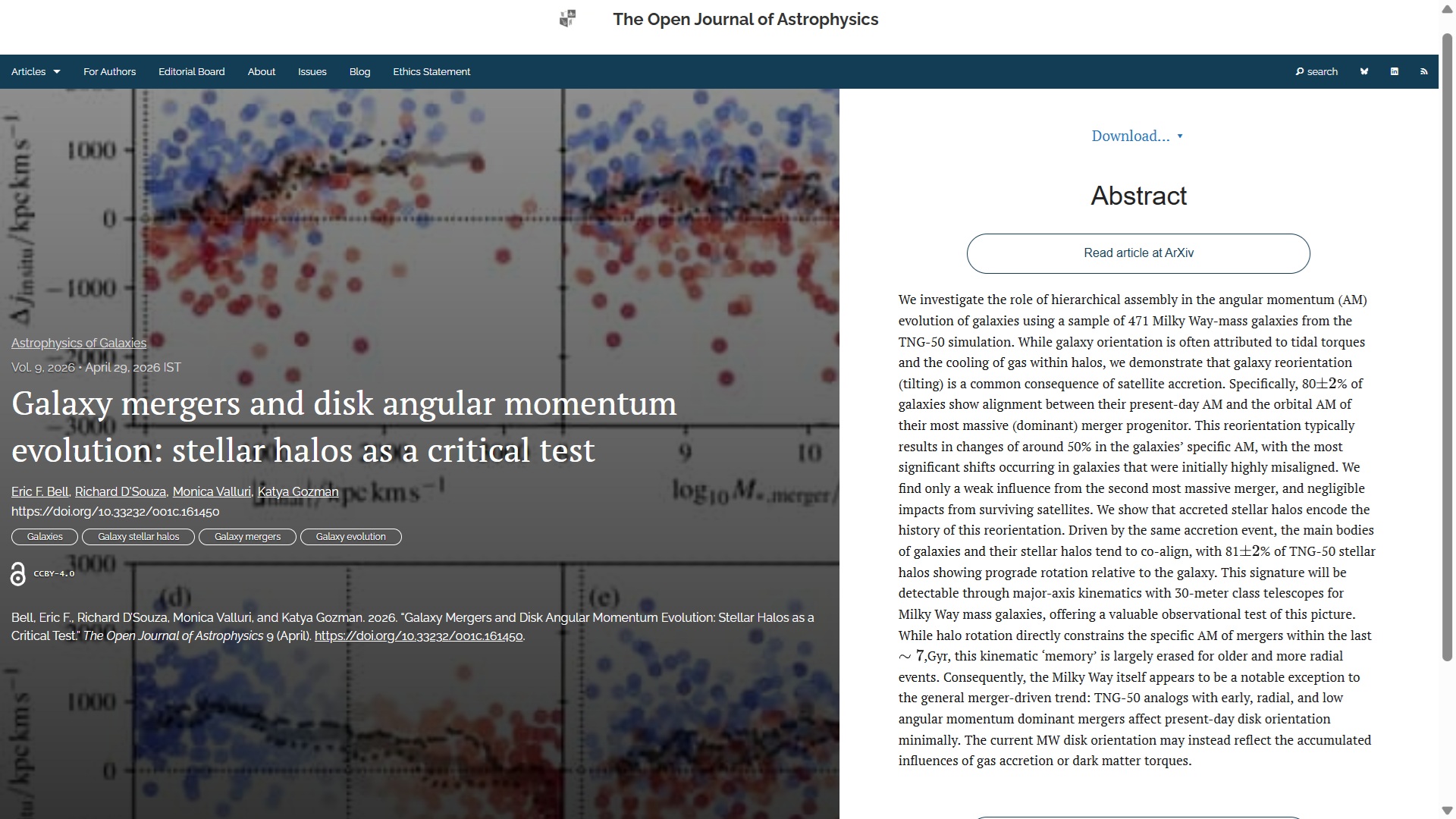
Next one up, the third paper of the week, is “Galaxy mergers and disk angular momentum evolution: stellar halos as a critical test” by Eric F. Bell (U. Michigan, Ann Arbor, USA), Richard D’Souza (Vatican Observatory), Monica Valluri & Katya Gozman (U. Michigan). This was published on Wednesday 29th April in the folder Astrophysics of Galaxies. The paper argues that satellite accretion impacts the angular momentum evolution of galaxies, often causing significant reorientation. This process is detectable in Milky Way-mass galaxies so the idea is testable observationally.
The overlay for this one is here:
The final, accepted version can be found on arXiv here and the Mastodon announcement is here:
New Publication at the Open Journal of Astrophysics: "Galaxy mergers and disk angular momentum evolution: stellar halos as a critical test" by Eric F. Bell (U. Michigan, Ann Arbor, USA), Richard D'Souza (Vatican Observatory), Monica Valluri & Katya Gozman (U. Michigan)
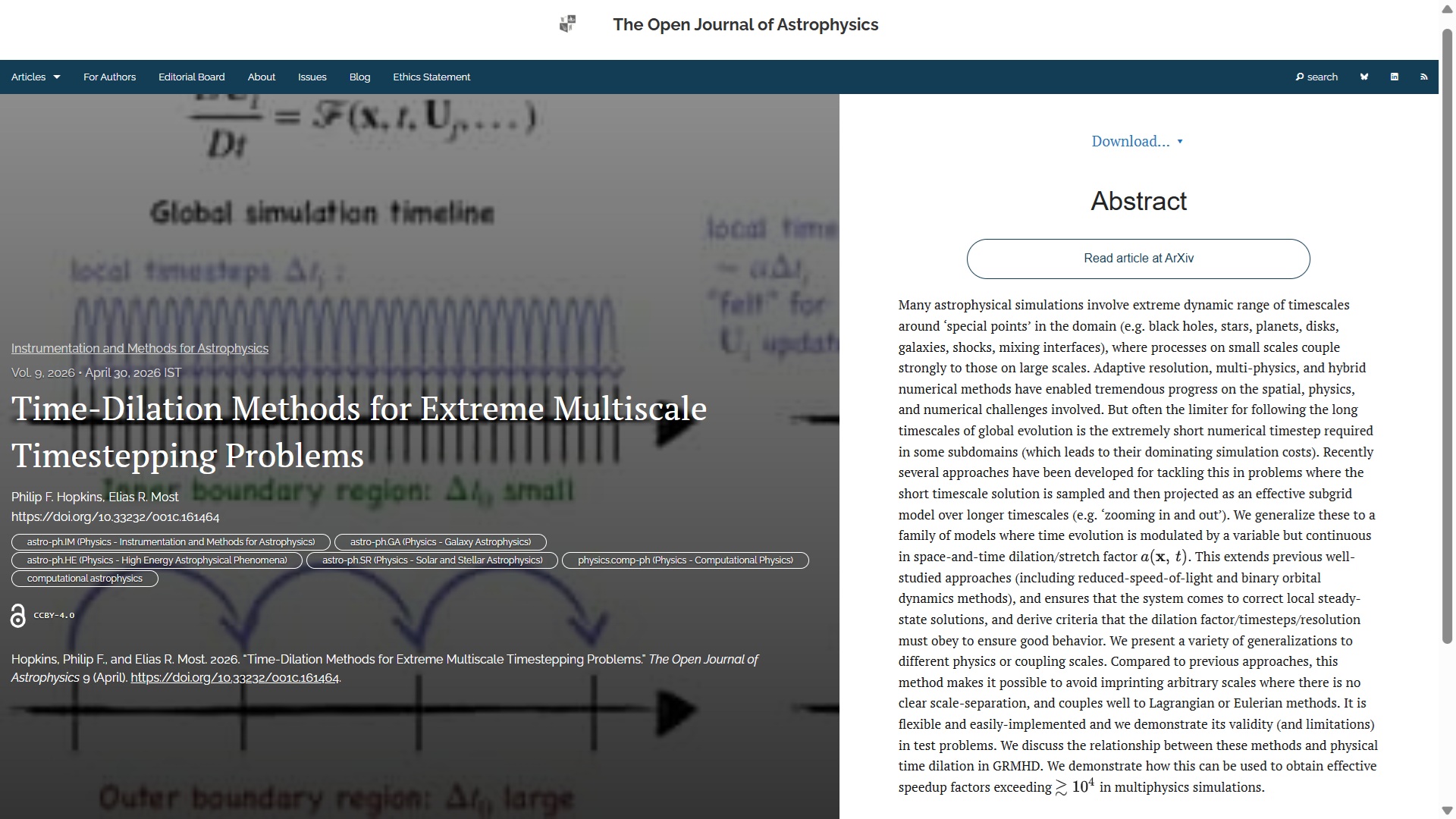
The fourth paper this week, published on Thursday April 30th, is “Time-Dilation Methods for Extreme Multiscale Timestepping Problems” by Philip F. Hopkins and Elias R. Most (Caltech, USA). This paper is in the folder Instrumentation and Methods for Astrophysics: it presents a new method for astrophysical simulations that modulates time evolution with a variable dilation/stretch factor, improving efficiency and accuracy in modeling processes across different scales.
The overlay is here:
The finally accepted version of this paper can be found here and the Mastodon announcement follows:
New Publication at the Open Journal of Astrophysics: "Time-Dilation Methods for Extreme Multiscale Timestepping Problems" by Philip F. Hopkins and Elias R. Most (Caltech, USA)
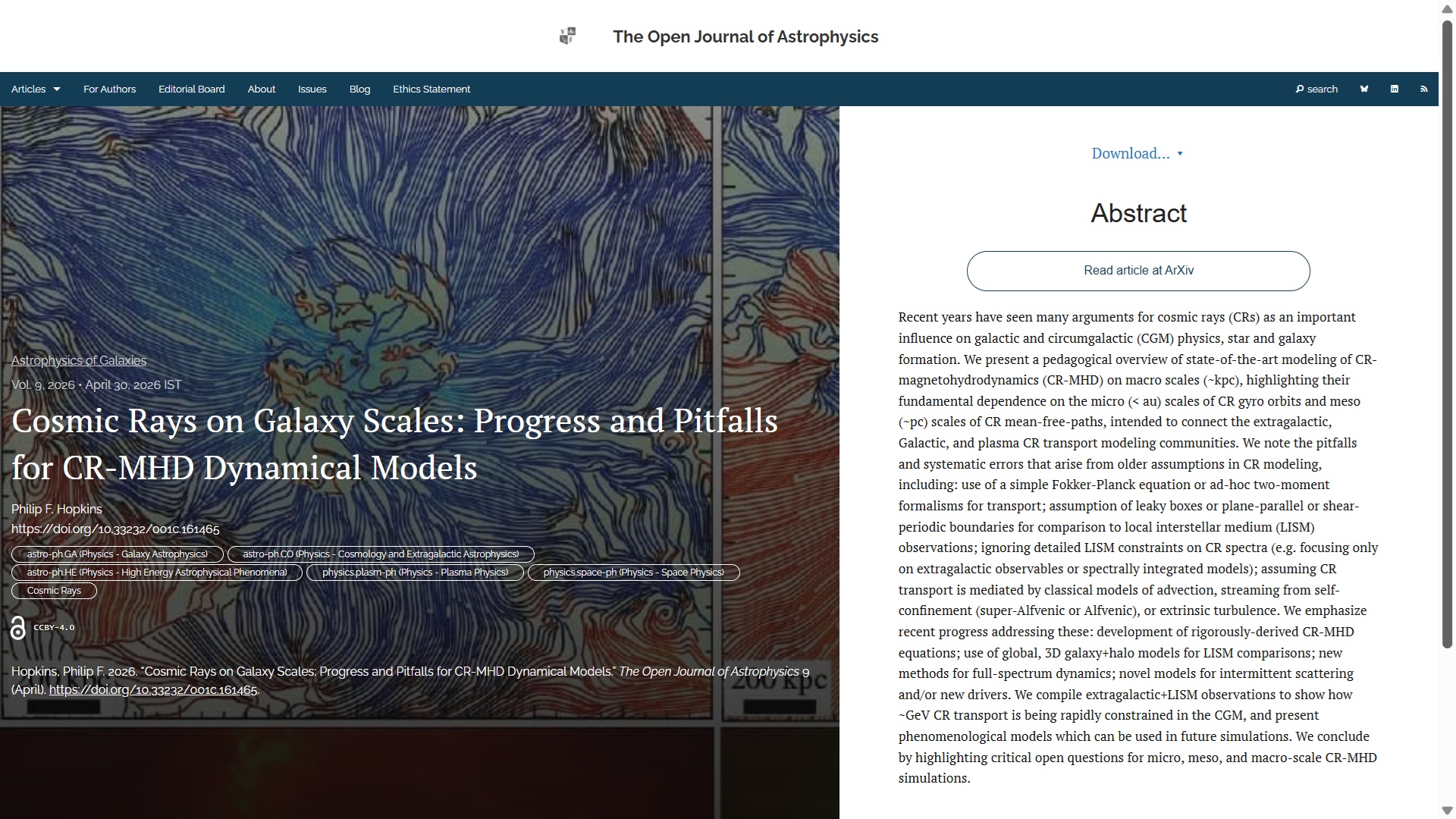
The fifth article of this week was also published on Thursday 30th April, but in the folder Astrophysics of Galaxies. The title is “Cosmic Rays on Galaxy Scales: Progress and Pitfalls for CR-MHD Dynamical Models” and the author is Philip F. Hopkins (Caltech, USA) who has three papers featured this week. The paper presents an overview of cosmic ray (CR) modeling, highlighting its influence on galactic physics and star formation. It addresses previous modeling errors and presents new methods for full-spectrum dynamics.
The overlay is here:
You can find the authorized version of this paper on arXiv here and the Fediverse announcement is here:
New Publication at the Open Journal of Astrophysics: "Cosmic Rays on Galaxy Scales: Progress and Pitfalls for CR-MHD Dynamical Models" by Philip F. Hopkins (Caltech, USA)
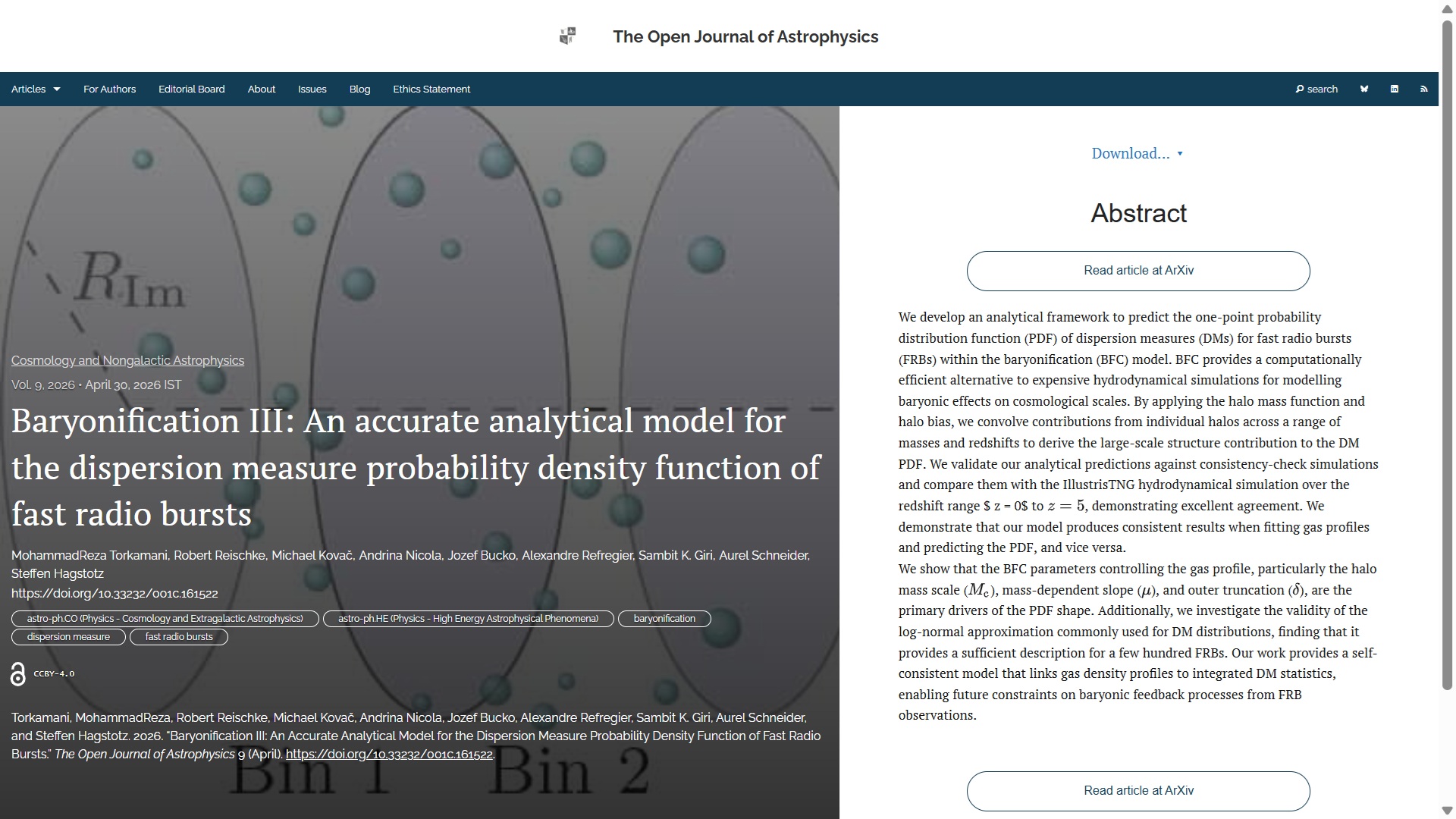
New Publication at the Open Journal of Astrophysics: "Baryonification III: An accurate analytical model for the dispersion measure probability density function of fast radio bursts" by MohammadReza Torkamani (Universität Bonn, Germany) and 8 others based in Germany, Switzerland, UK and Sweden
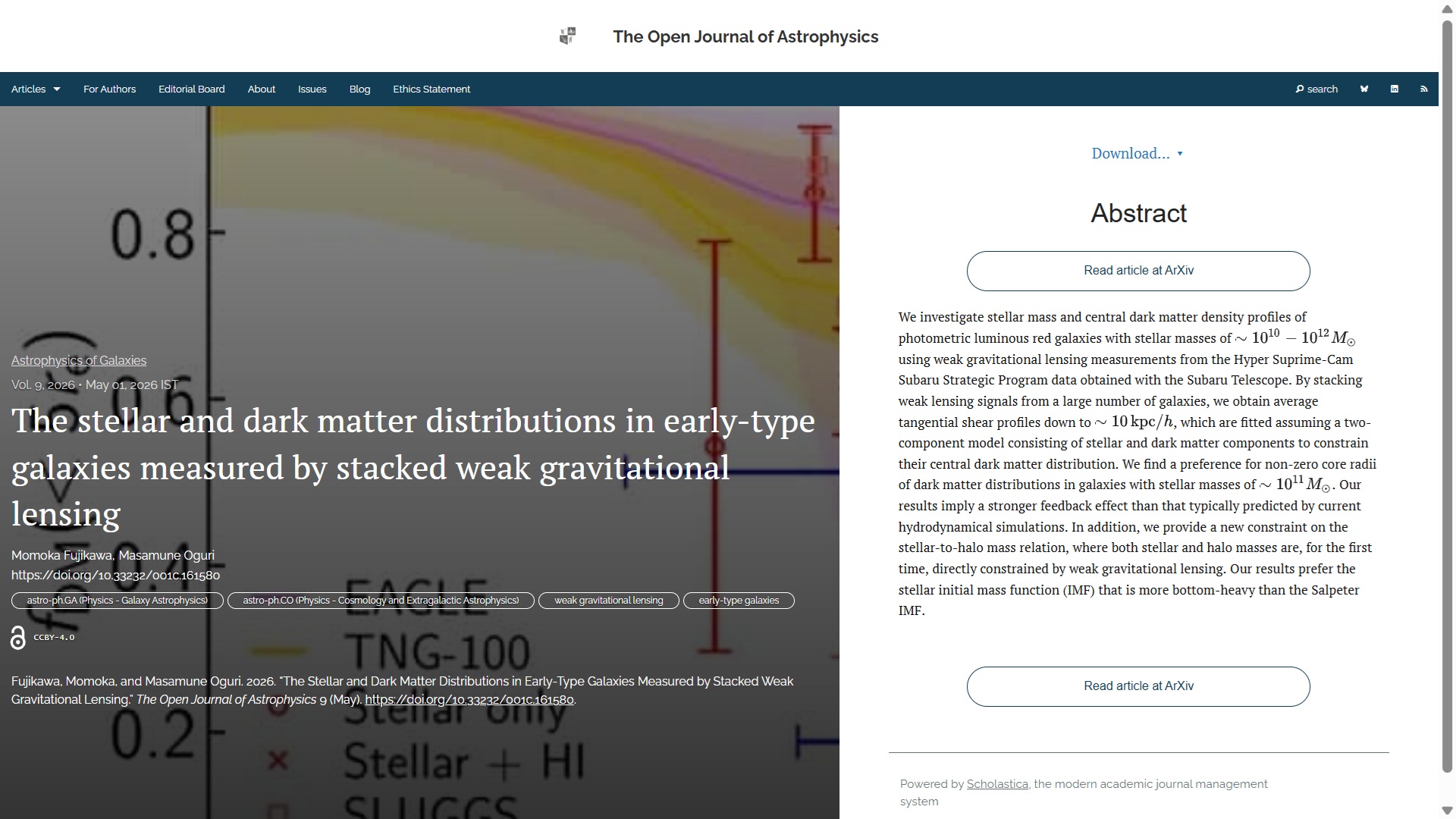
New Publication at the Open Journal of Astrophysics: "The stellar and dark matter distributions in early-type galaxies measured by stacked weak gravitational lensing" by Momoka Fujikawa & Masamune Oguri (Chiba University, Japan)
So here we are again, on a Saturday morning, with another update of activity at the Open Journal of Astrophysics. Since the last update we have published a further five papers, bringing the number in Volume 9 (2026) to 87 and the total so far published by OJAp up to 535.
I will continue to include the posts made on our Mastodon account (on Fediscience) to encourage you to visit it. Mastodon is a really excellent service, and a more than adequate replacement for X/Twitter (which nobody should be using); these announcements also show the DOI for each paper.
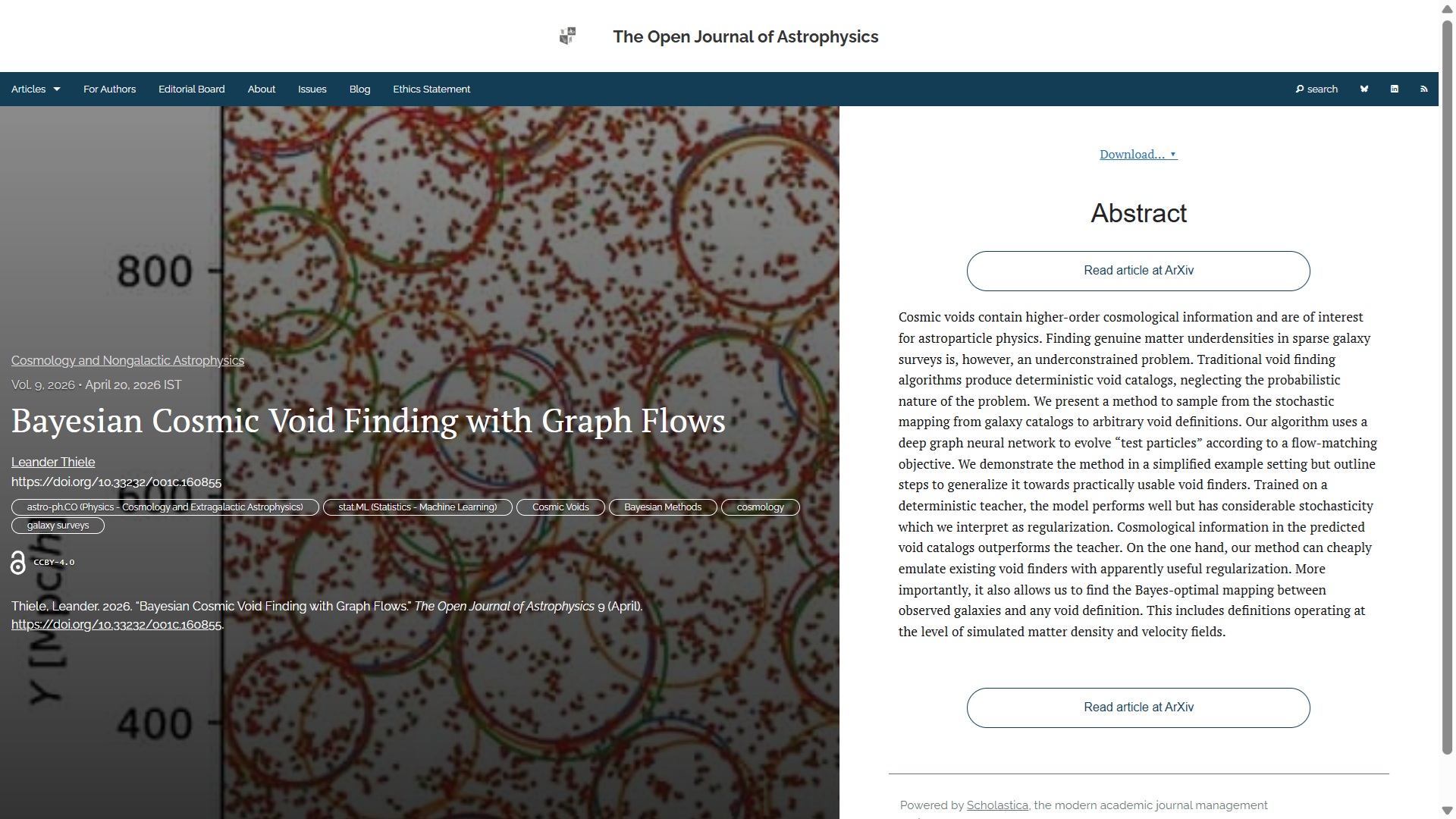
The first paper to report this week is “Bayesian Cosmic Void Finding with Graph Flows” by Leander Thiele (U. Tokyo, Japan). This was published on Monday 20th April in the folder Cosmology and Nongalactic Astrophysics. The paper presents a method using a deep graph neural network to identify cosmic voids in sparse galaxy surveys, improving upon traditional deterministic algorithms by considering the problem’s probabilistic nature. The overlay is here:
You can find the officially accepted version on arXiv here and the announcement on Fediverse here:
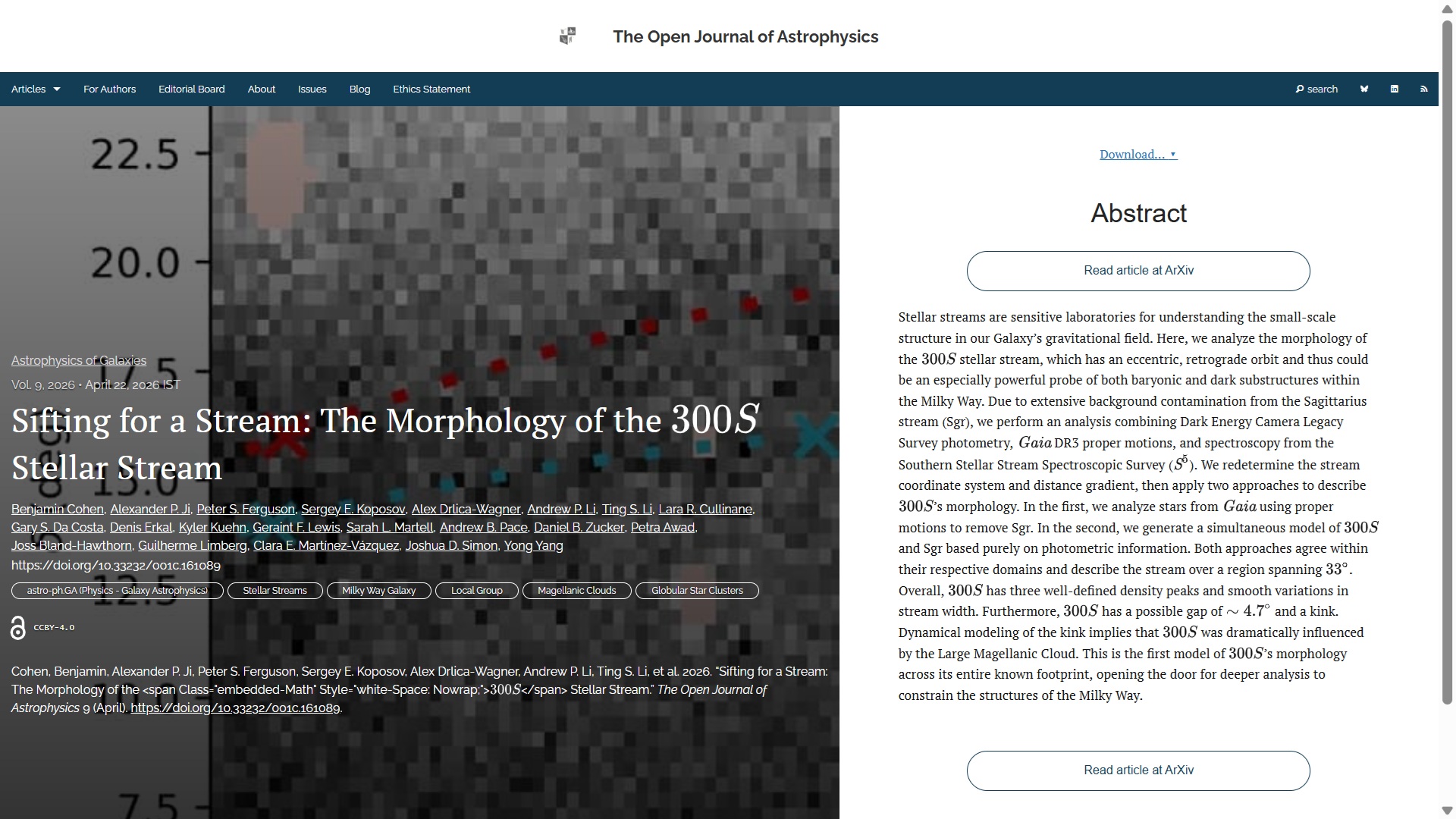
The second paper for this week, published on Wednesday 22nd April in the folder Astrophysics of Galaxies, is “Sifting for a Stream: The Morphology of the 300S Stellar Stream” by Benjamin Cohen (U. Chicago, USA) and 20 others distributed around the world. This study analyzes the morphology of the $300S$ stellar stream, revealing three density peaks, a possible gap, and a kink, suggesting significant influence from the Large Magellanic Cloud on its structure.
The overlay for this one is here:
The official version of the paper can be found on arXiv here and the Fediverse announcement here:
New Publication at the Open Journal of Astrophysics: "Sifting for a Stream: The Morphology of the 300S Stellar Stream" by Benjamin Cohen (U. Chicago, USA) and 20 others distributed around the world.
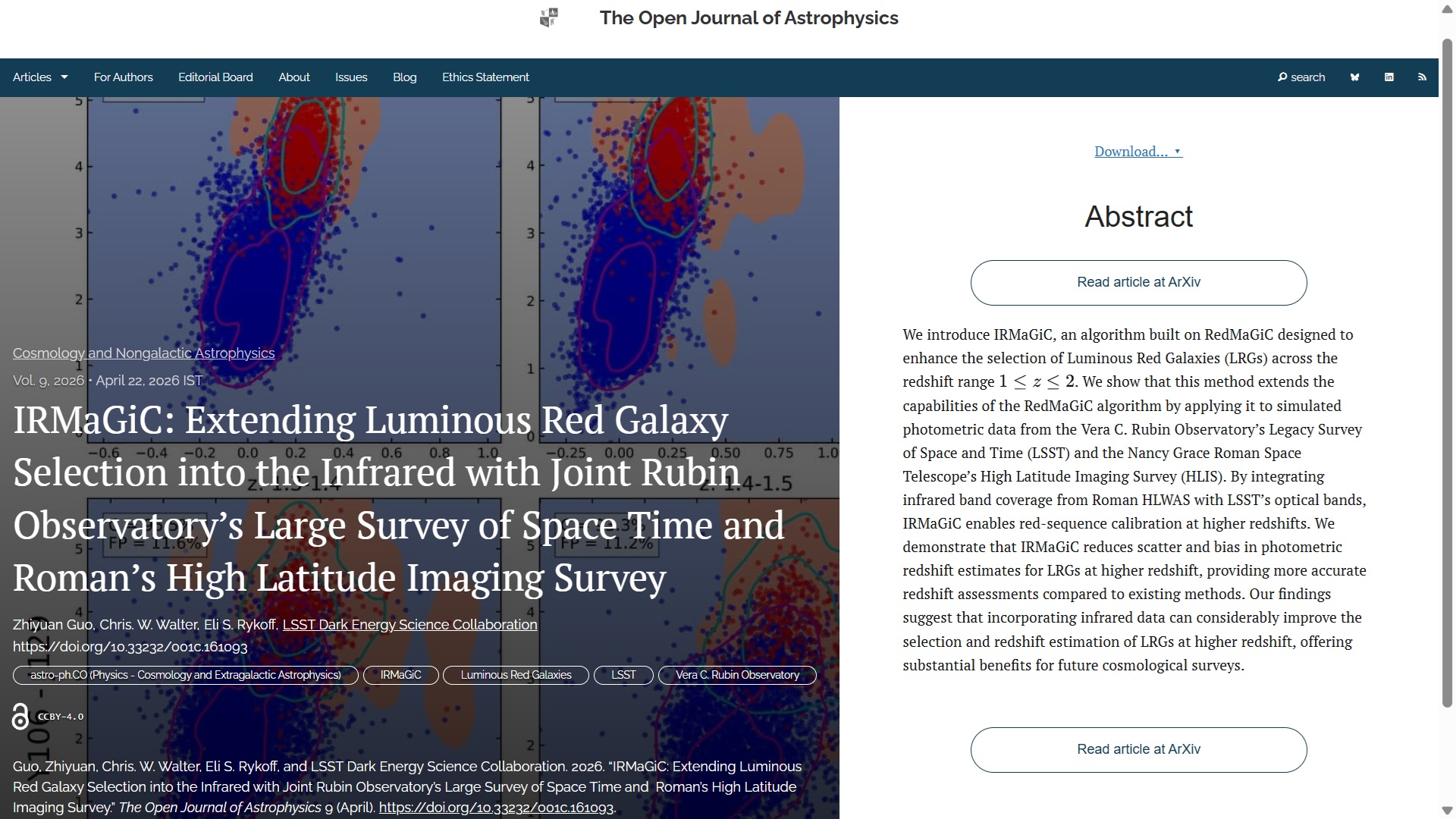
New Publication at the Open Journal of Astrophysics: "IRMaGiC: Extending Luminous Red Galaxy Selection into the Infrared with Joint Rubin Observatory’s Large Survey of Space Time and Roman’s High Latitude Imaging Survey" by Zhiyuan Guo & Chris. W. Walter (Duke U., USA) and Eli S. Rykoff (Stanford U., USA) on behalf of the LSST Dark Energy Science Collaboration
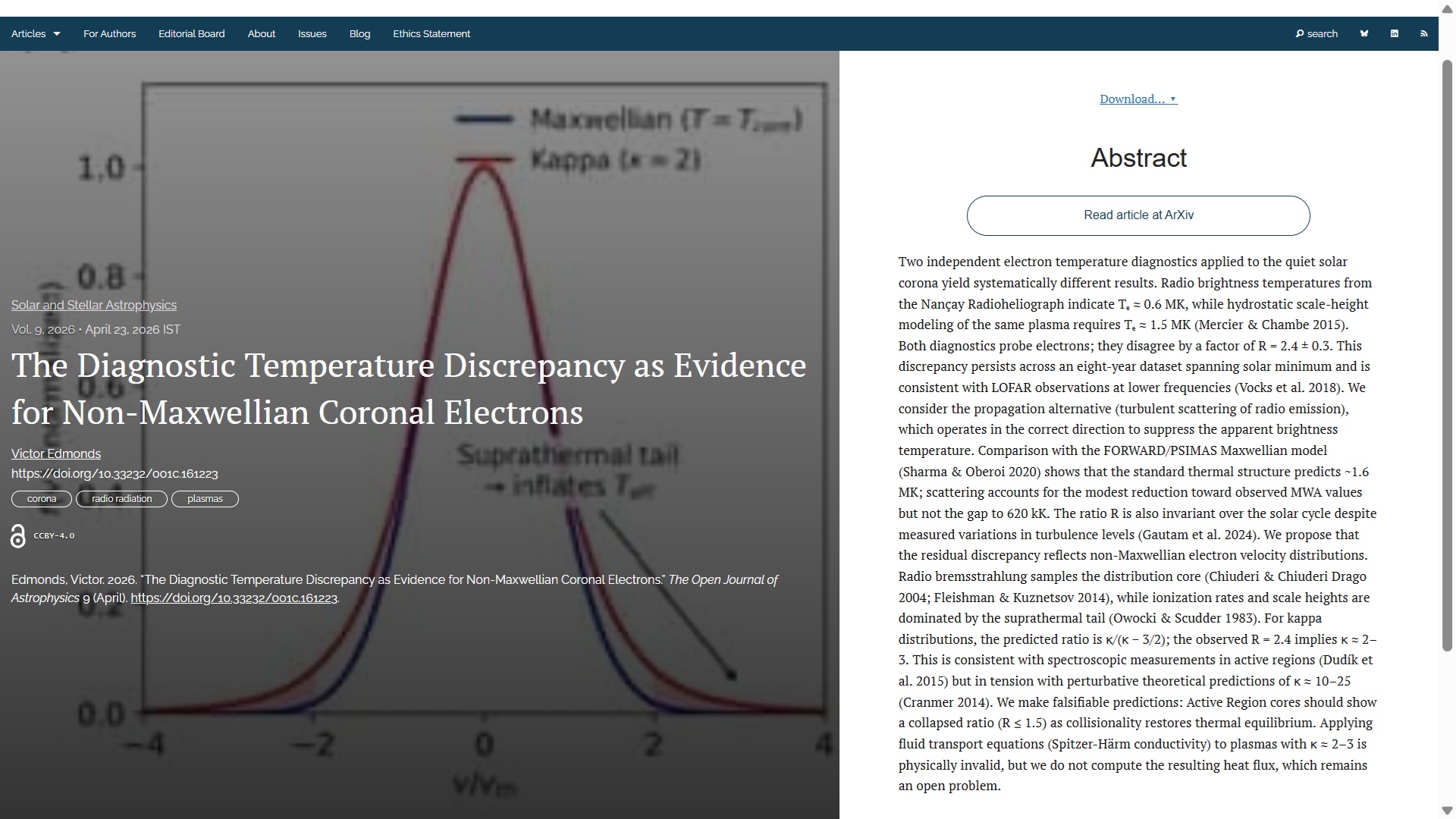
New Publication at the Open Journal of Astrophysics: "The Diagnostic Temperature Discrepancy as Evidence for Non-Maxwellian Coronal Electrons" by Victor Edmonds (Final Stop Consulting, USA)
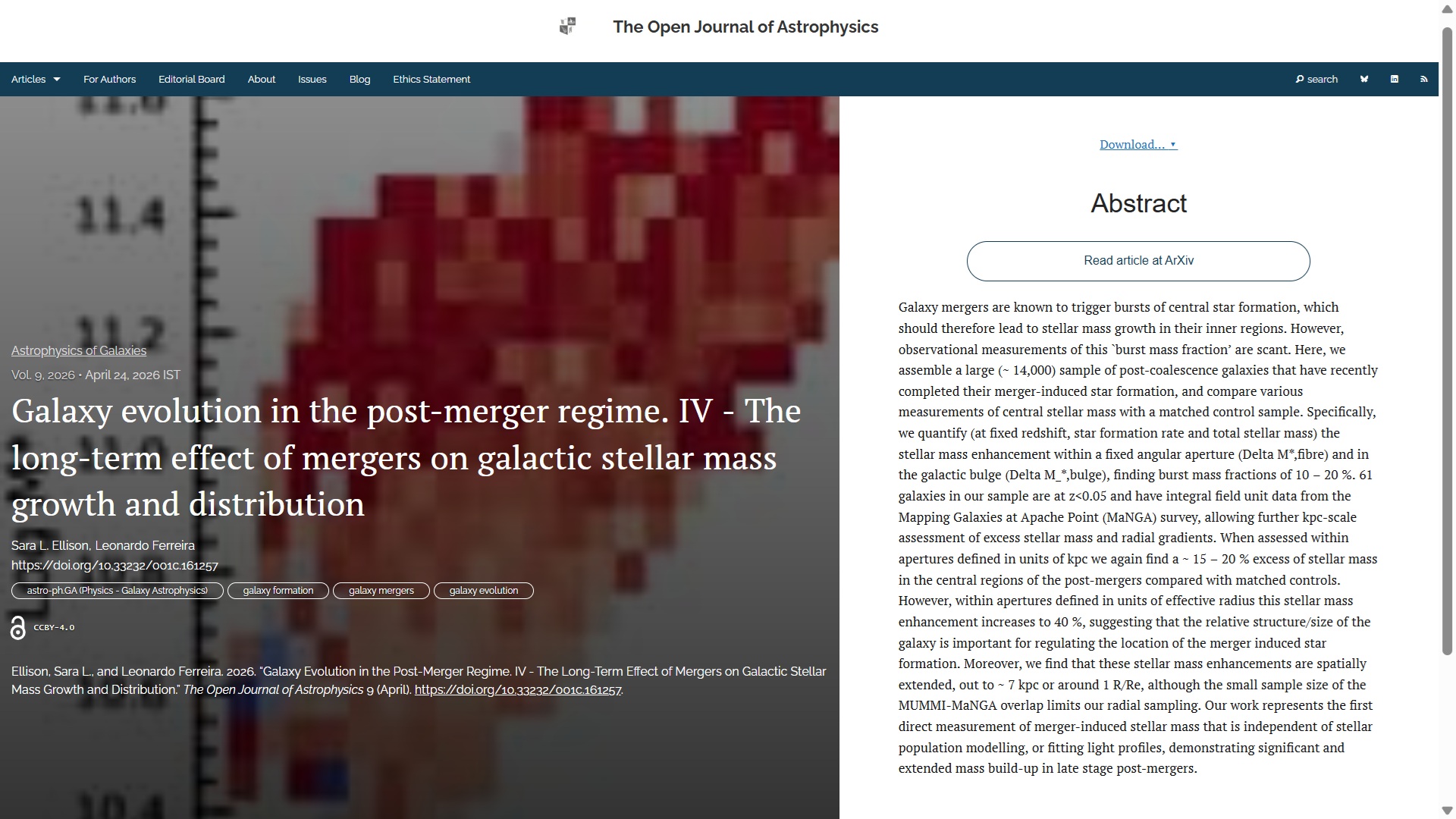
The fifth and final paper for this week was published on Friday 24th April in the folder Astrophysics of Galaxies. The title is “Galaxy evolution in the post-merger regime. IV – The long-term effect of mergers on galactic stellar mass growth and distribution” by Sara L. Ellison (U. Victoria, Canada) and Leonardo Ferreira (Universidade Federal do Rio Grande, Brazil). This study uses a large sample of post-merger galaxies to demonstrate that galaxy mergers trigger significant and extended stellar mass growth in their central regions, independent of stellar population modelling.
The overlay is here:
You can find the authorized version of this paper on arXiv here and the Fediverse announcement is here:
New Publication at the Open Journal of Astrophysics: "Galaxy evolution in the post-merger regime. IV – The long-term effect of mergers on galactic stellar mass growth and distribution" by Sara L. Ellison (U. Victoria, Canada) and Leonardo Ferreira (Universidade Federal do Rio Grande, Brazil)
New Publication at the Open Journal of Astrophysics: "Galaxy evolution in the post-merger regime. IV – The long-term effect of mergers on galactic stellar mass growth and distribution" by Sara L. Ellison (U. Victoria, Canada) and Leonardo Ferreira (Universidade Federal do Rio Grande, Brazil)
It may be the Easter weekend, but it’s still time for a Saturday morning update of activity at the Open Journal of Astrophysics. Since the last update we have published a further four papers, bringing the number in Volume 9 (2026) to 71 and the total so far published by OJAp up to 519. This update coimpletes the first quarter of 2026, which suggests that if we continue to publish at the same rate we’ll reach about 280 for the year.
I will continue to include the posts made on our Mastodon account (on Fediscience) to encourage you to visit it. Mastodon is a really excellent service, and a more than adequate replacement for X/Twitter (which nobody should be using); these announcements also show the DOI for each paper.
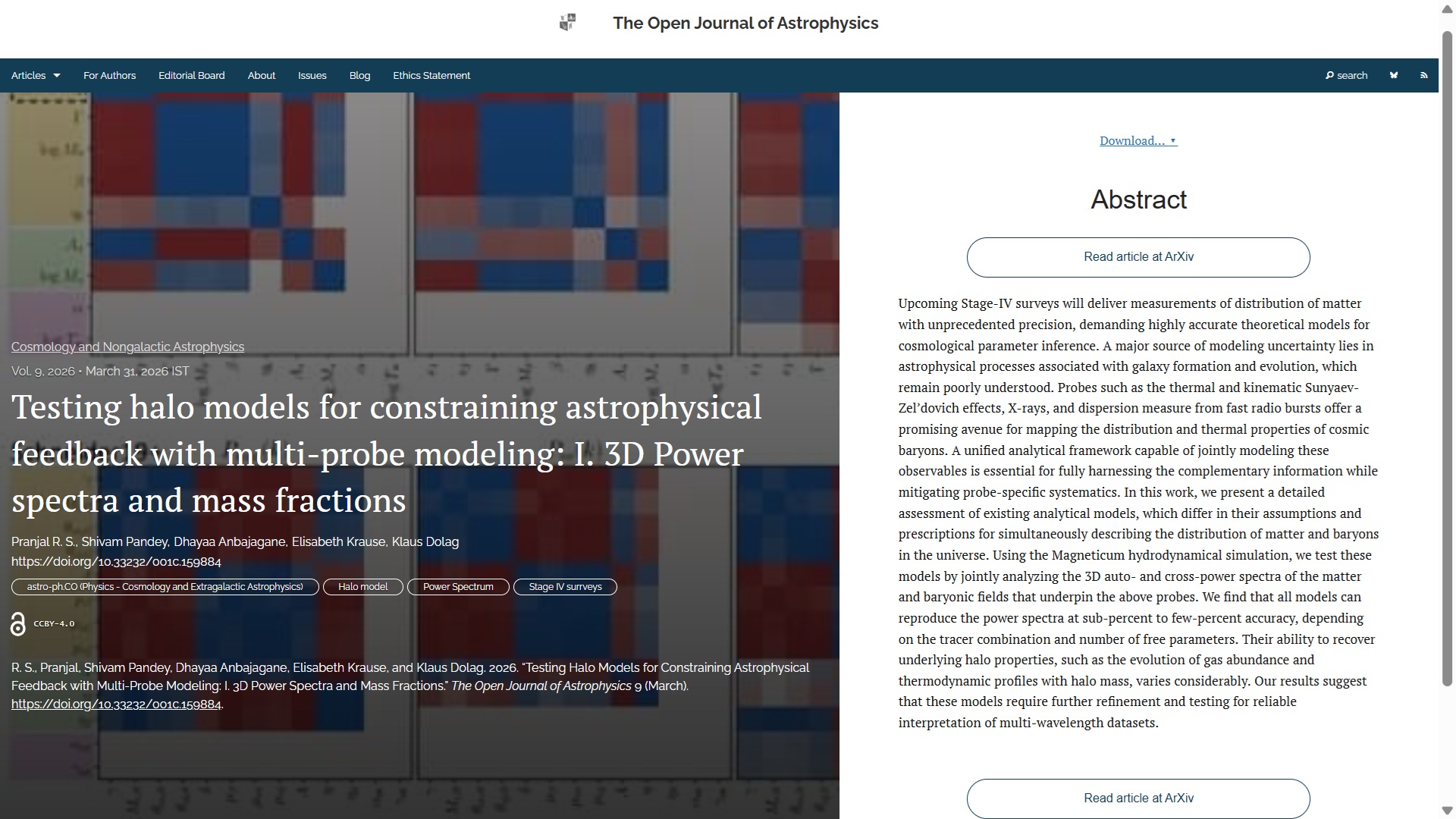
New Publication at the Open Journal of Astrophysics: "Testing halo models for constraining astrophysical feedback with multi-probe modeling: I. 3D Power spectra and mass fractions" by Pranjal R. S. (U. Arizona, USA), Shivam Pandey Johns Hopkins U., USA), Dhayaa Anbajagane (U. Chicago, USA), Elisabeth Krause (U. Arizona) and Klaus Dolag (Max Planck Institute for Astrophysics, Germany)
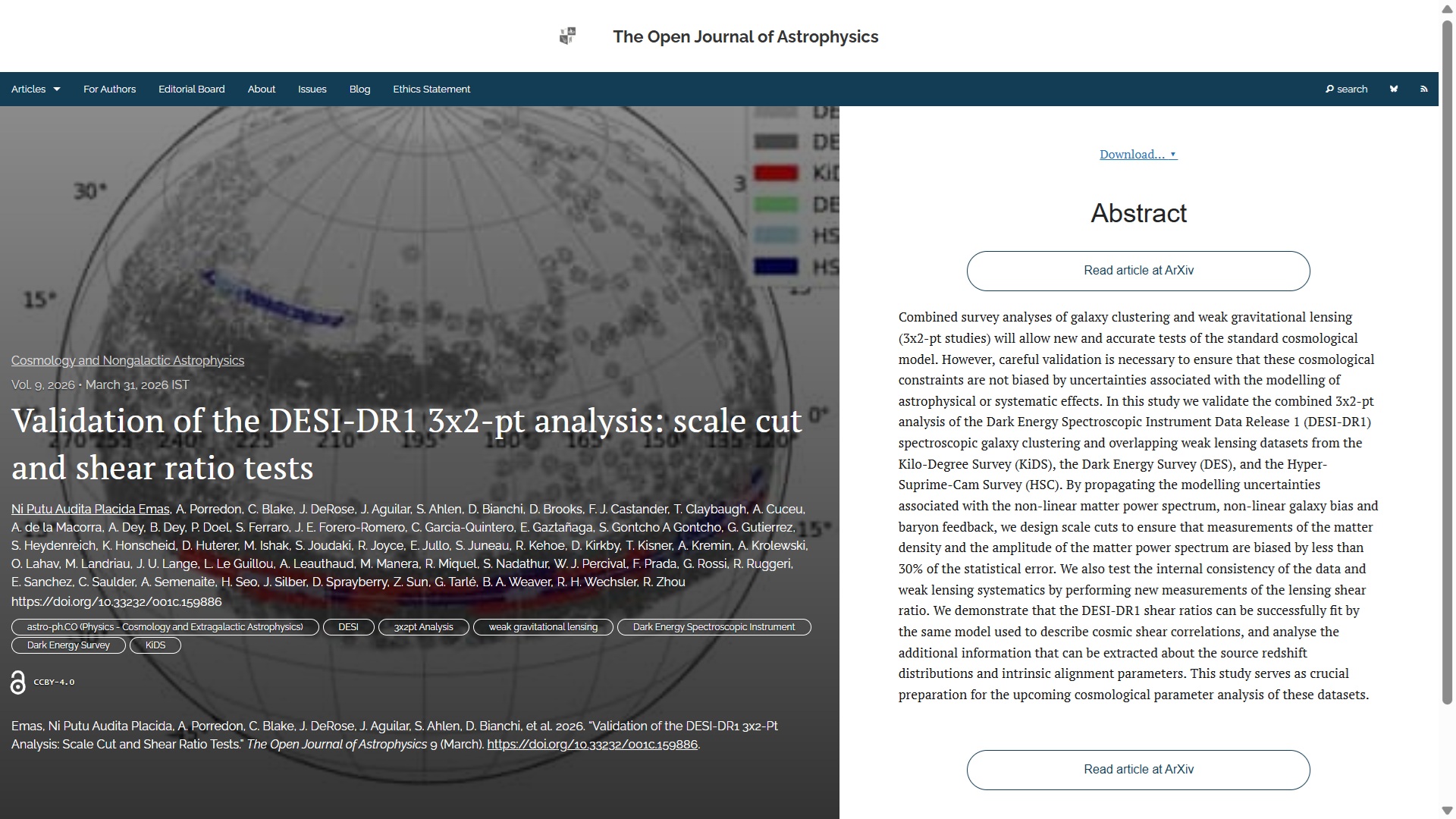
The second paper for this week, also published on Tuesday March 31st in the folder Cosmology and Nongalactic Astrophysics, is “Validation of the DESI-DR1 3×2-pt analysis: scale cut and shear ratio tests” by Ni Putu Audita Placida Emas (Swinburne University of Technology, Australia) and an international cast of 56 others. This study validates the combined analysis of galaxy clustering and weak gravitational lensing data from various surveys, ensuring accurate tests of the standard cosmological model using future Stage-IV surveys
The overlay for this one is here:
The official version of the paper can be found on arXiv here and the Fediverse announcement here:
New Publication at the Open Journal of Astrophysics: "Validation of the DESI-DR1 3×2-pt analysis: scale cut and shear ratio tests" by Ni Putu Audita Placida Emas (Swinburne University of Technology, Australia) and an international cast of 56 others.
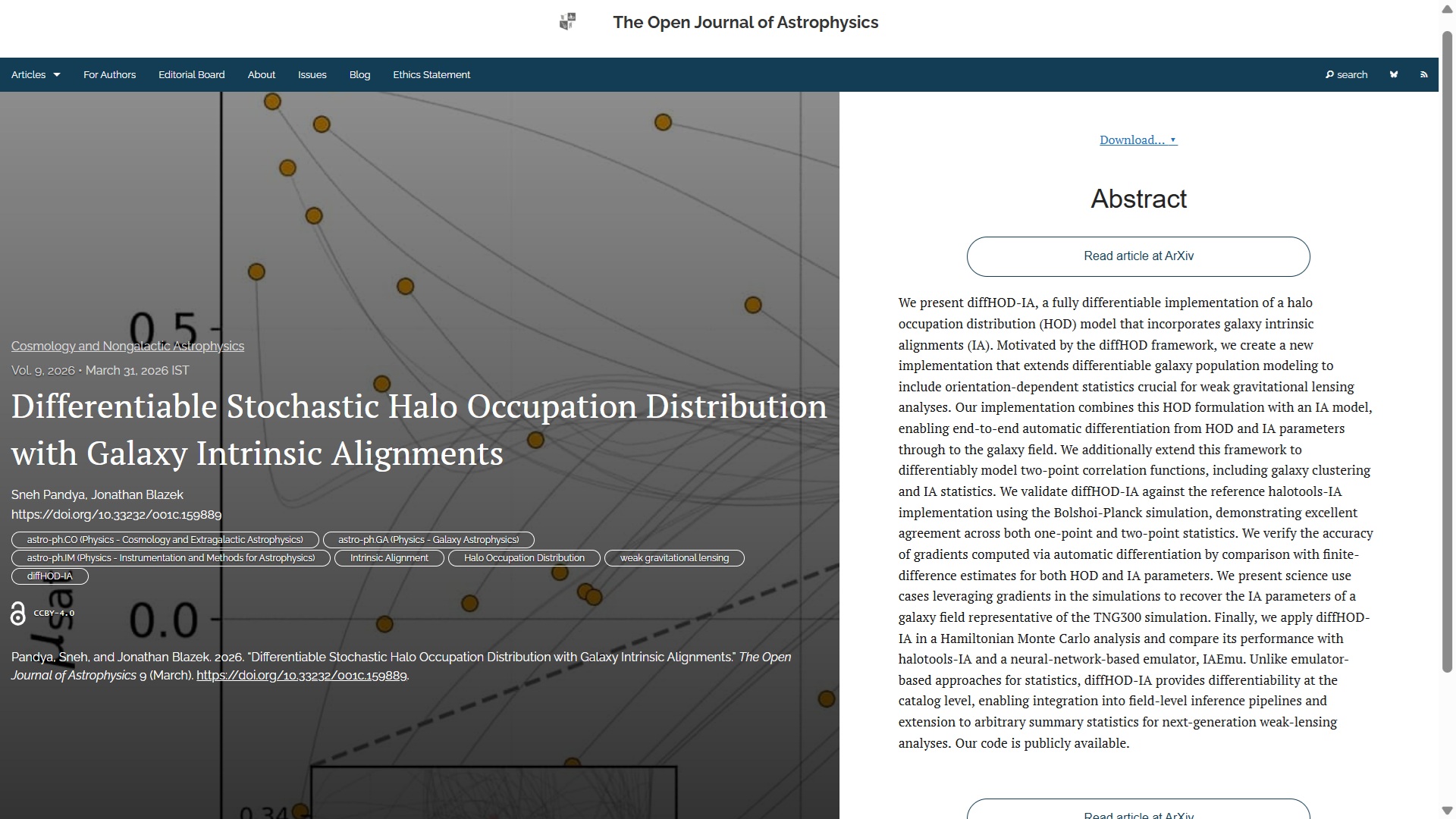
Next one up, the third paper of the week, also published on Tuesday March 31st in the folder Cosmology and Nongalactic Astrophysics, is “Differentiable Stochastic Halo Occupation Distribution with Galaxy Intrinsic Alignments” by Sneh Pandya and Jonathan Blazek (both of Northeastern University, USA). This is a paper introducing diffHOD-IA, a differentiable model for galaxy population analysis that incorporates intrinsic alignments and halo occupation distribution. It’s validated against existing models and can be used in next-generation weak-lensing analyses.
The overlay for this one is here:
The final, accepted version can be found on arXiv here and the Mastodon announcement is here:
New Publication at the Open Journal of Astrophysics: "Differentiable Stochastic Halo Occupation Distribution with Galaxy Intrinsic Alignments" by Sneh Pandya and Jonathan Blazek (Northeastern U., USA)
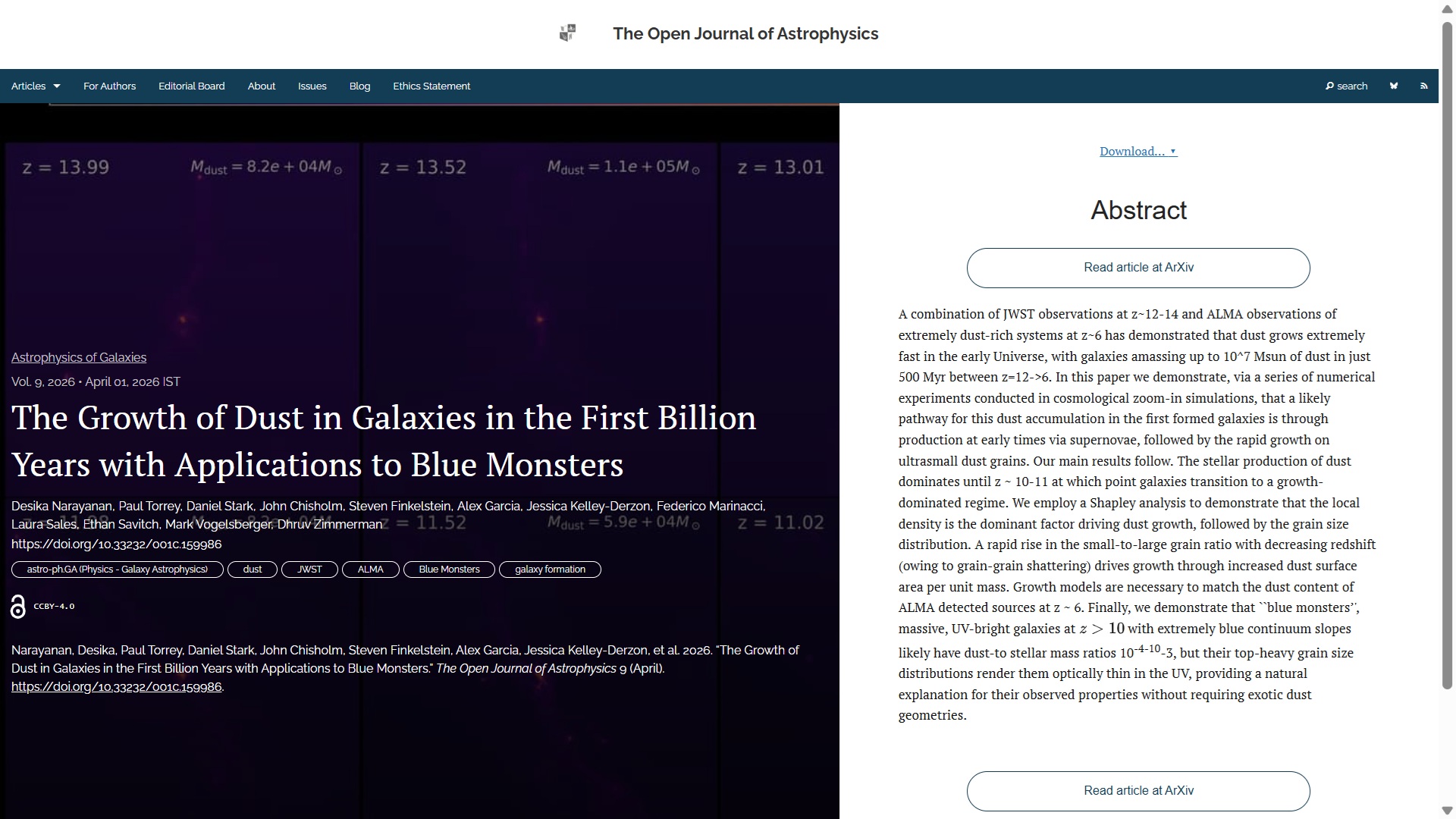
The fourth and final paper this week, published on Wednesday April 1st (but not a joke), is “The Growth of Dust in Galaxies in the First Billion Years with Applications to Blue Monsters” by Desika Narayanan (U. Florida, USA) and 11 others based in the USA and Europe. This one is in the folder Astrophysics of Galaxies; it presents a simulation-based study of dust accumulation in early galaxies via supernovae production and rapid growth on tiny dust grains, with local density and grain size being important factors.
The overlay is here:
The finally accepted version of this paper can be found here and the Mastodon announcement is here:
New Publication at the Open Journal of Astrophysics: "The Growth of Dust in Galaxies in the First Billion Years with Applications to Blue Monsters" by Desika Narayanan (U. Florida, USA) and 11 others based in the USA and Europe.
Once again it’s time for the usual Saturday morning update of activity at the Open Journal of Astrophysics. Since the last update we have published a further eight papers, bringing the number in Volume 9 (2026) to 67 and the total so far published by OJAp up to 515.
I will continue to include the posts made on our Mastodon account (on Fediscience) to encourage you to visit it. Mastodon is a really excellent service, and a more than adequate replacement for X/Twitter (which nobody should be using); these announcements also show the DOI for each paper.
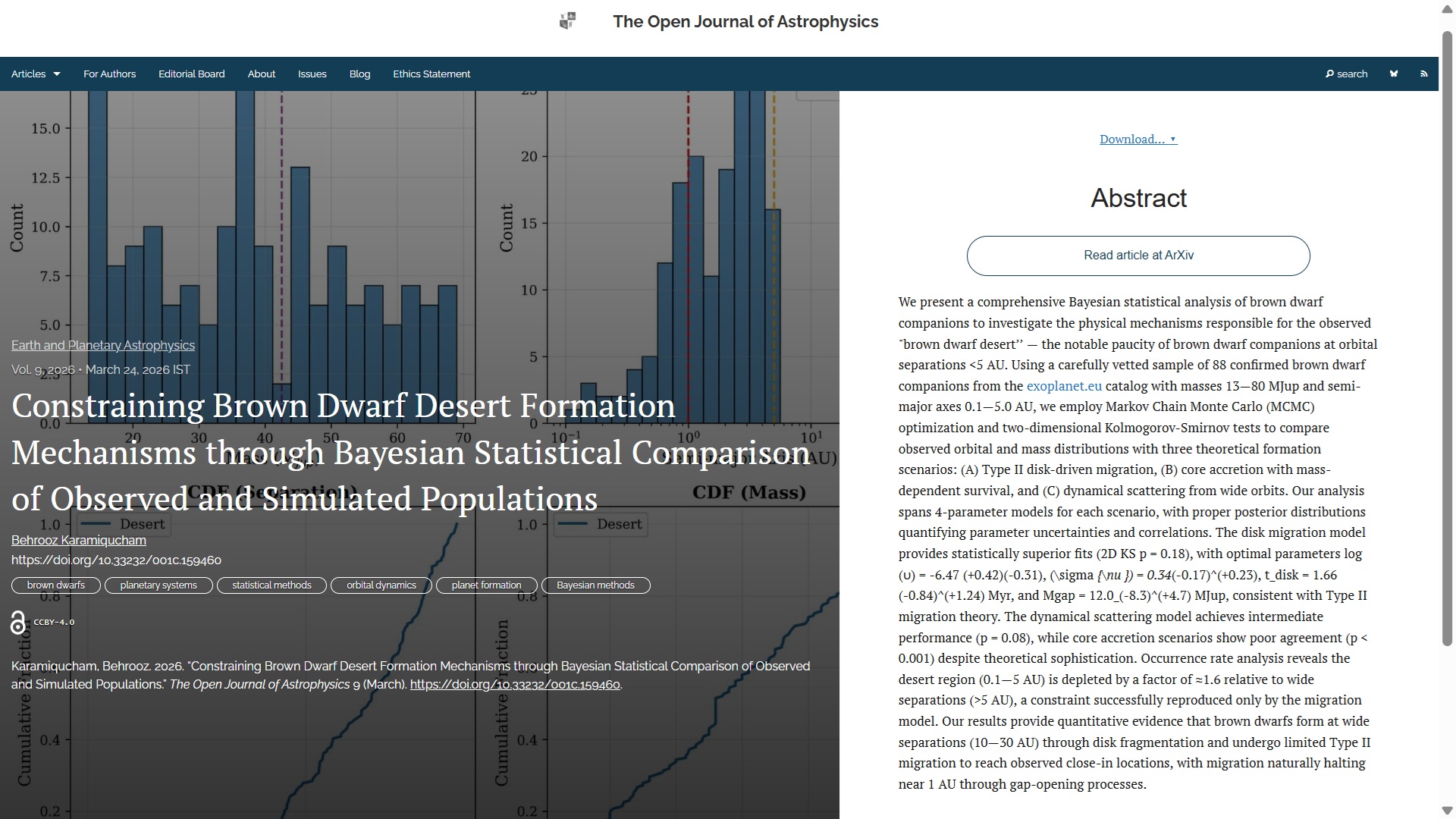
New Publication at the Open Journal of Astrophysics: "Constraining Brown Dwarf Desert Formation Mechanisms through Bayesian Statistical Comparison of Observed and Simulated Populations" by Behrooz Karamiqucham (College of Charleston, USA)
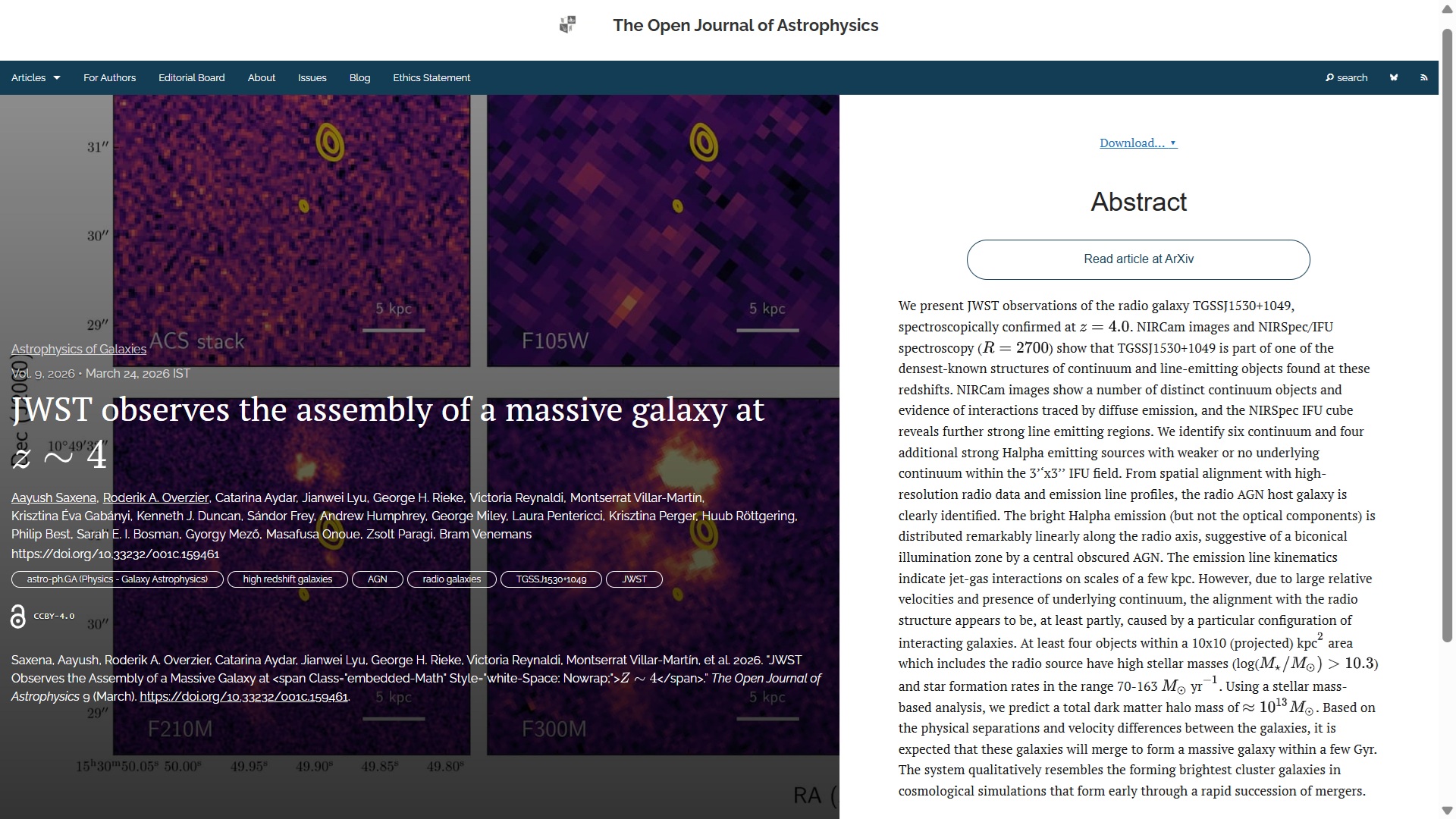
The second paper for this week, also published on Tuesday March 24th, but in the folder Astrophysics of Galaxies, is “JWST observes the assembly of a massive galaxy at z ~ 4” by Aayush Saxena (University of Oxford, UK) and 20 others (based in the UK, Europe, USA, Brazil, Japan and China). The paper presents observations of radio galaxy TGSSJ1530+1049, revealing it as part of a dense structure of emitting objects likely to merge to form a massive galaxy within a few Gyr.
The overlay for this one is here:
The official version of the paper can be found on arXiv here and the Fediverse announcement here:
New Publication at the Open Journal of Astrophysics: "JWST observes the assembly of a massive galaxy at z ~ 4" by Aayush Saxena (University of Oxford, UK) and 20 others (based in the UK, Europe, USA, Brazil, Japan and China)
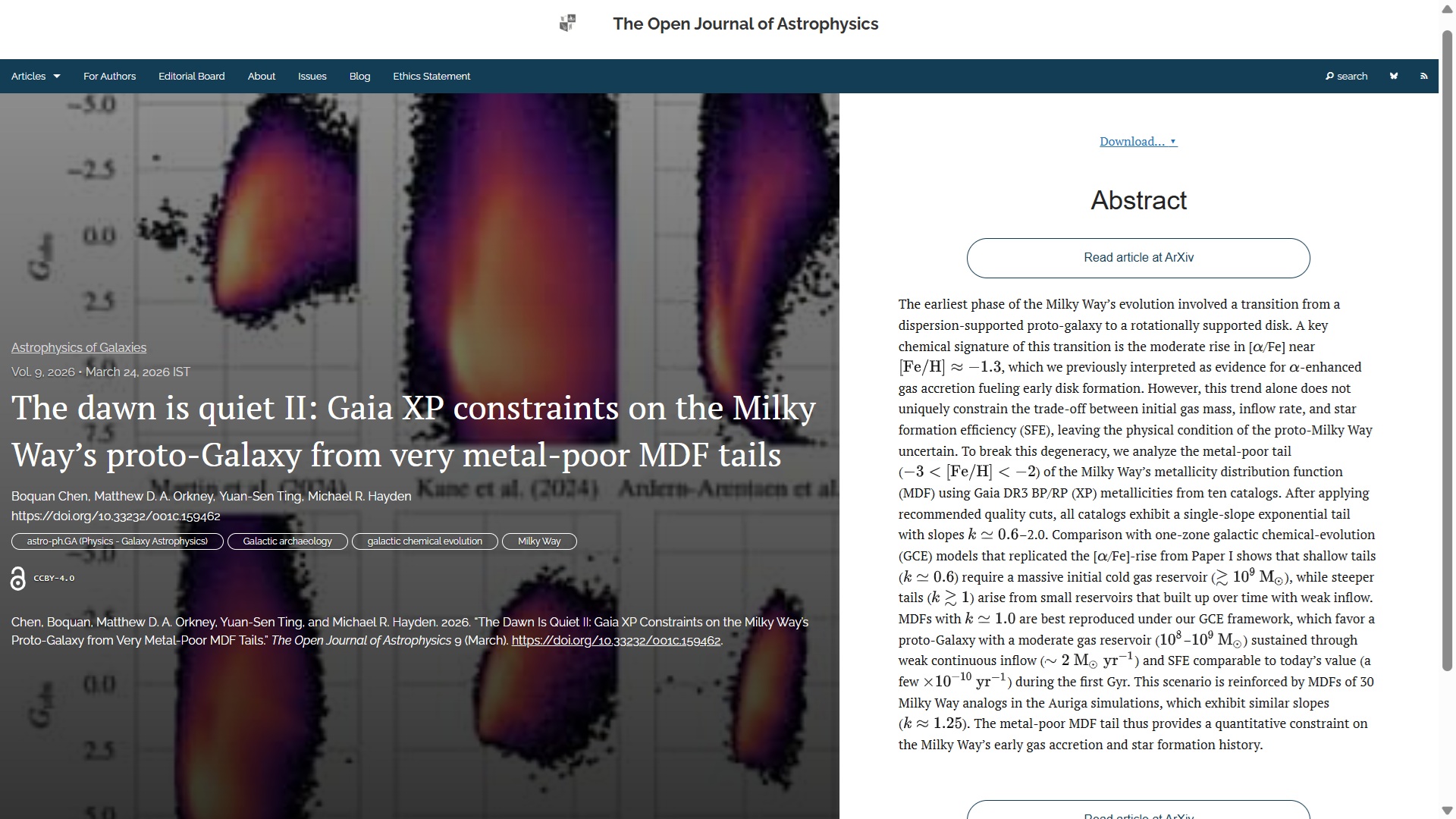
Next one up, the third paper of the week, also published on Tuesday March 24th in the folder Astrophysics of Galaxies, is “The dawn is quiet II: Gaia XP constraints on the Milky Way’s proto-Galaxy from very metal-poor MDF tails” by Boquan Chen (Ohio State U., USA), Matthew D. A. Orkney (Universitat de Barcelona, Spain), Yuan-Sen Ting (Ohio State U.) & Michael R. Hayden (U. Oklahoma, USA). The paper aegues that the Milky Way’s metallicity distribution suggests that its early evolution involved a moderate gas reservoir, sustained by weak continuous inflow, and star formation efficiency similar to the present value.
The overlay for this one is here:
The final, accepted version can be found on arXiv here and the Mastodon announcement is here:
New Publication at the Open Journal of Astrophysics: "The dawn is quiet II: Gaia XP constraints on the Milky Way’s proto-Galaxy from very metal-poor MDF tails" by Boquan Chen (Ohio State U., USA), Matthew D. A. Orkney (Universitat de Barcelona, Spain), Yuan-Sen Ting (Ohio State U.) & Michael R. Hayden (U. Oklahoma, USA)
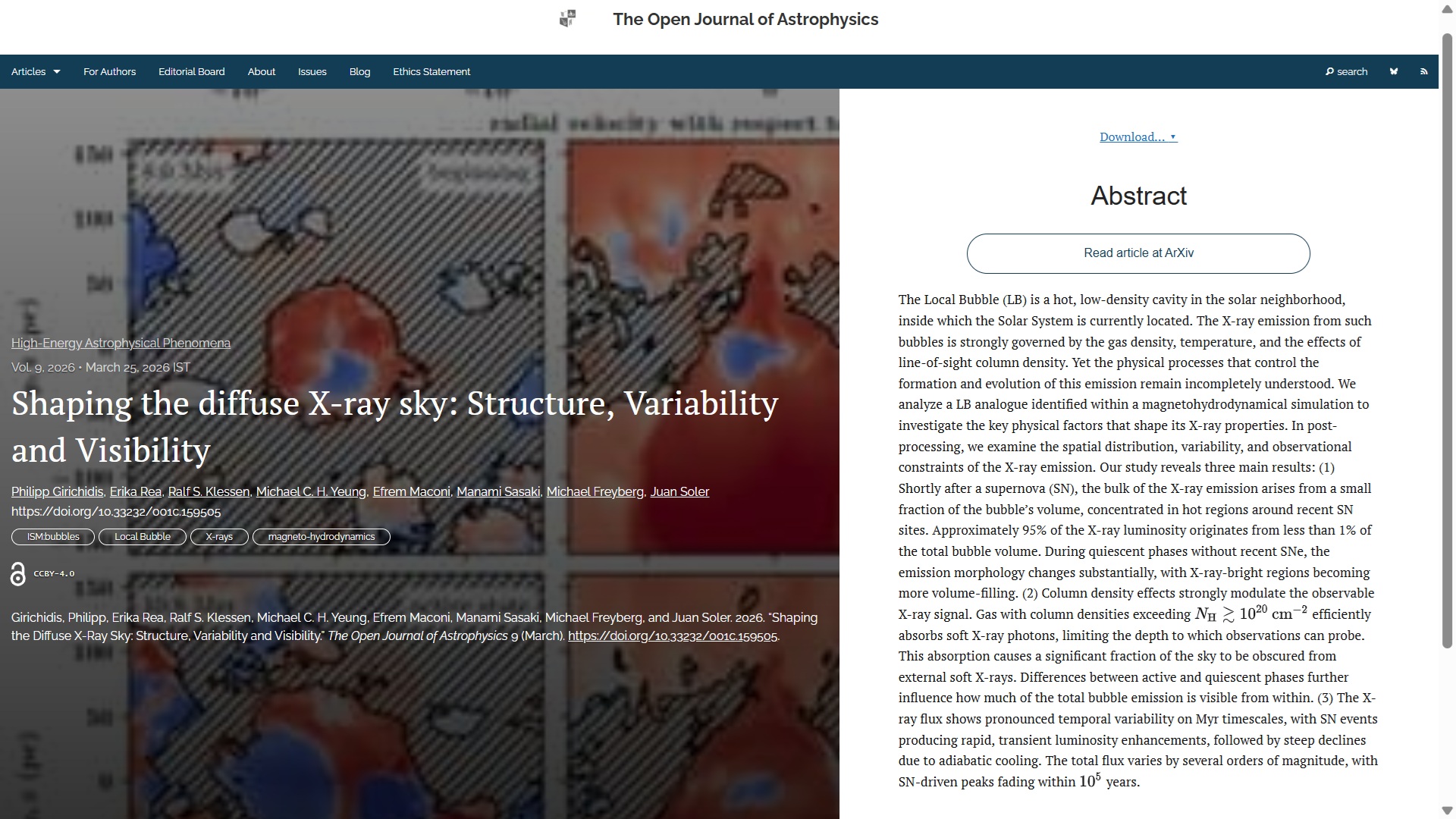
The fourth paper this week, published on Wednesday 25th March 2026 in the folder High-Energy Astrophysical Phenomena is “Shaping the diffuse X-ray sky: Structure, Variability and Visibility” by Philipp Girichidis (Heidelberg U., Germany) and 7 others based in Germany, USA, Austria and Italy. The paper argues that the X-ray properties of the Local Bubble (LB), a low-density cavity in the solar neighborhood reveal that supernova events significantly influence X-ray emissions, which show pronounced temporal variability
The overlay is here:
The finally accepted version of this paper can be found here and the Mastodon announcement is here:
New Publication at the Open Journal of Astrophysics: "Shaping the diffuse X-ray sky: Structure, Variability and Visibility" by Philipp Girichidis (Heidelberg U., Germany) and 7 others based in Germany, USA, Austria and Italy
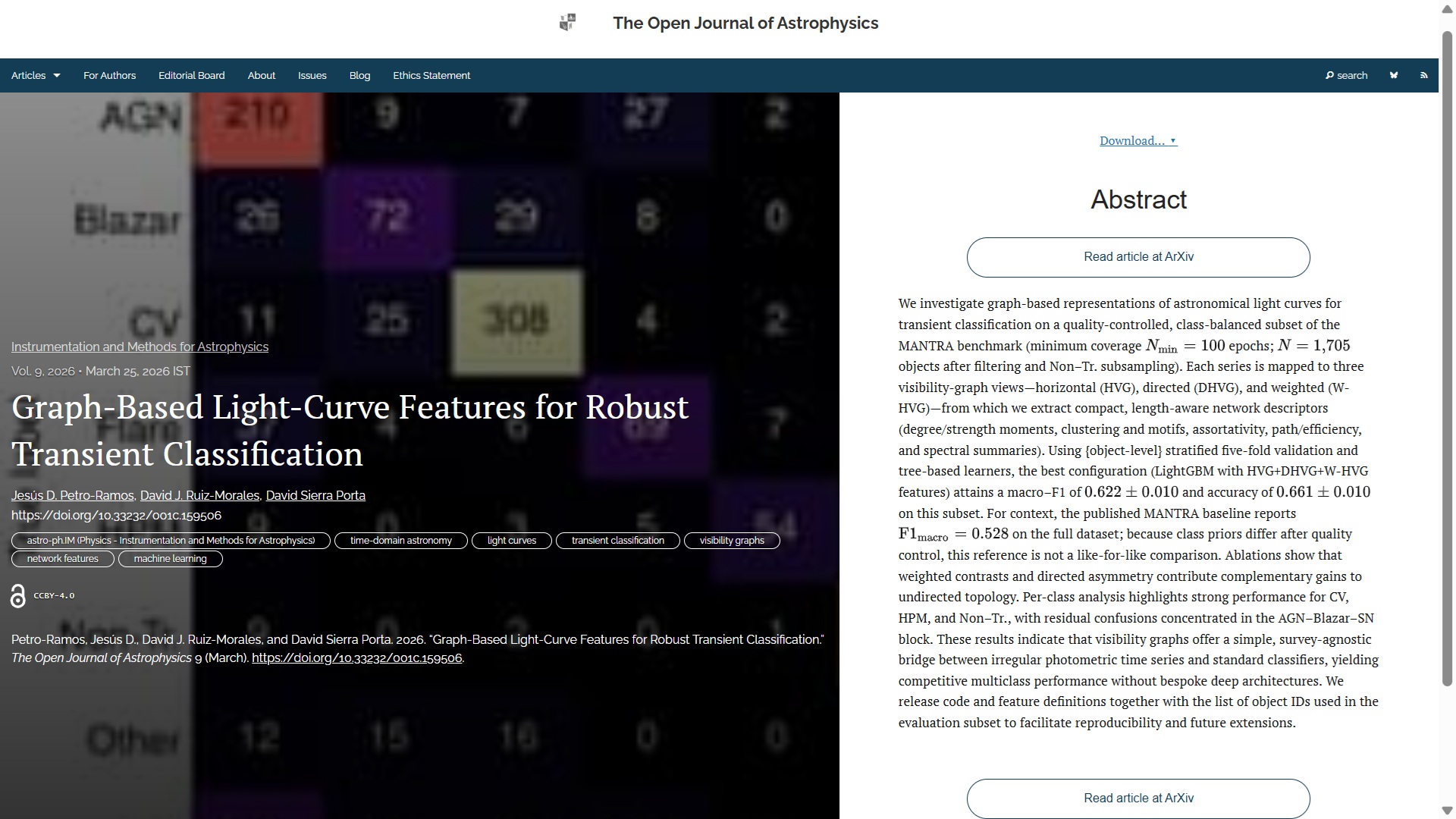
The fifth paper this week, also published on Wednesday 25th March 2026, is “Graph-Based Light-Curve Features for Robust Transient Classification” by Jesús D. Petro-Ramos David J. Ruiz-Morales, David Sierra Porta (Universidad Tecnológica de Bolívar, Colombia). This paper, which is in the folder Instrumentation and Methods for Astrophysics, uses graph-based representations of astronomical light curves for transient classification, achieving competitive multiclass performance, highlighting the potential of visibility graphs as a survey-agnostic tool for classifying time series.
This is the overlay:
The officially accepted version can be found on arXiv here and the Mastodon announcement follows:
New Publication at the Open Journal of Astrophysics: "Graph-Based Light-Curve Features for Robust Transient Classification" by Jesús D. Petro-Ramos David J. Ruiz-Morales, David Sierra Porta (Universidad Tecnológica de Bolívar, Colombia)
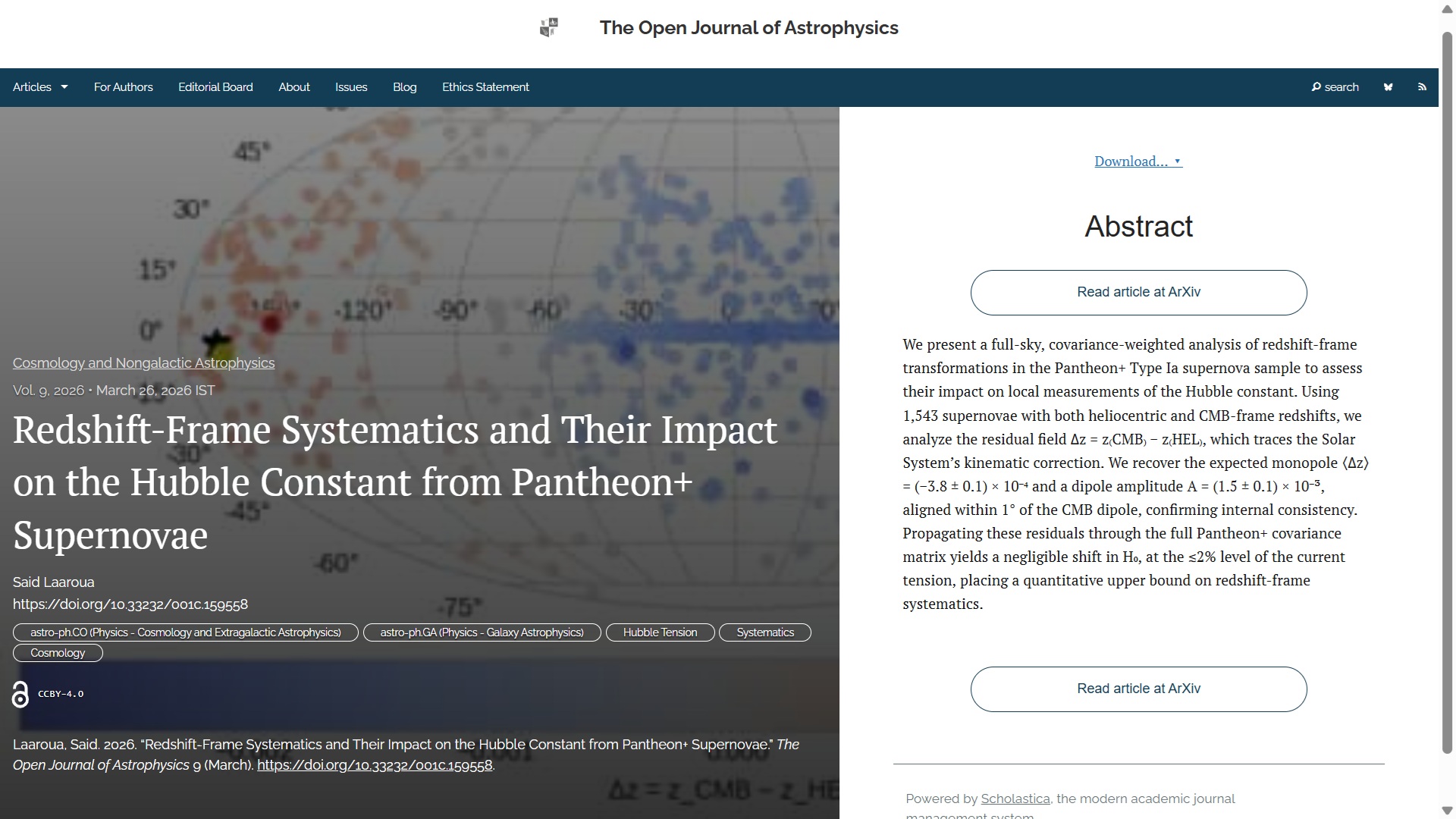
New Publication at the Open Journal of Astrophysics: "Redshift-Frame Systematics and Their Impact on the Hubble Constant from Pantheon+ Supernovae" by Said Laaroua (Santa Rosa Junior College, USA)
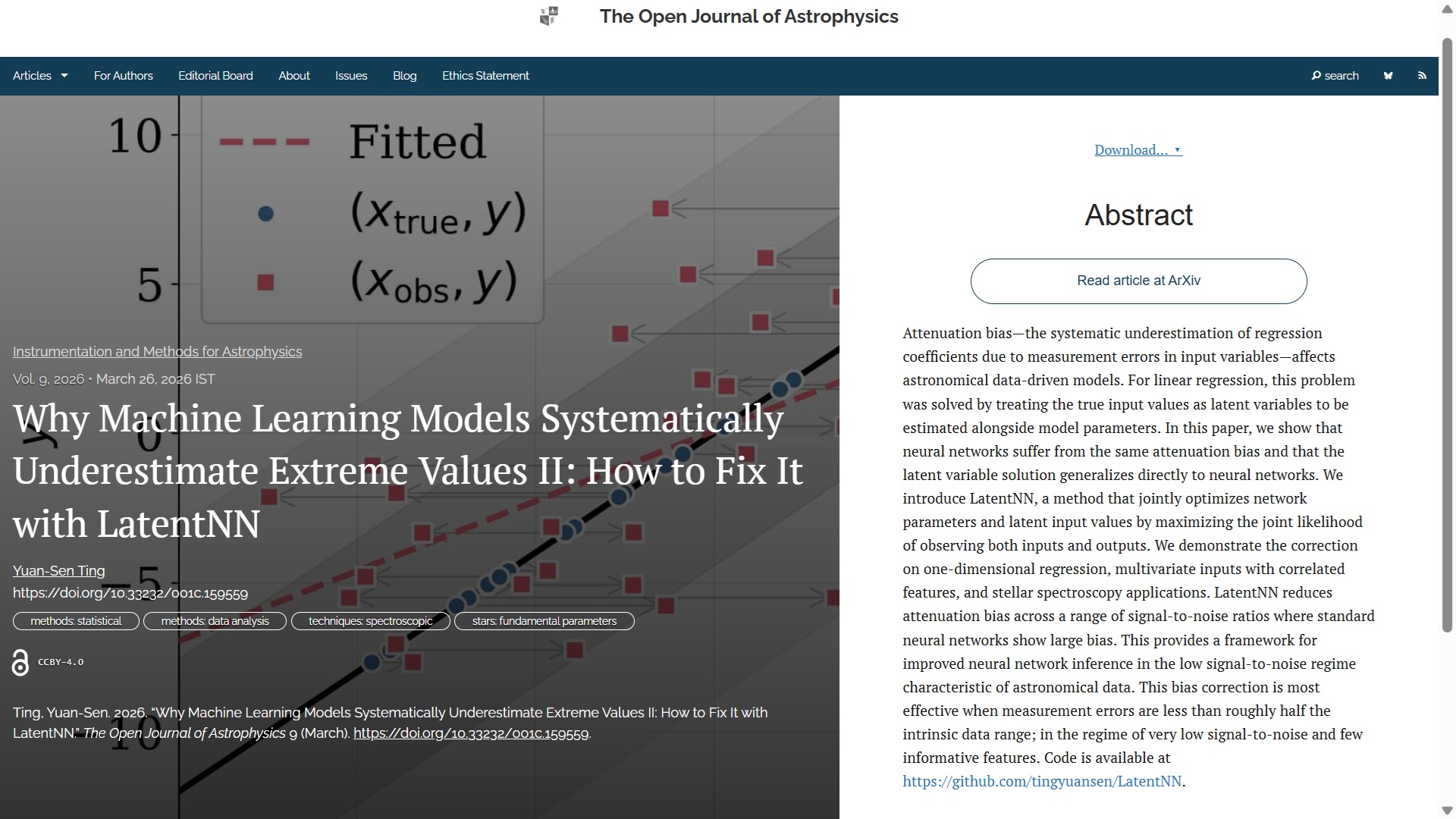
New Publication at the Open Journal of Astrophysics: "Why Machine Learning Models Systematically Underestimate Extreme Values II: How to Fix It with LatentNN" by Yuan-Sen Ting (Ohio State University, USA)
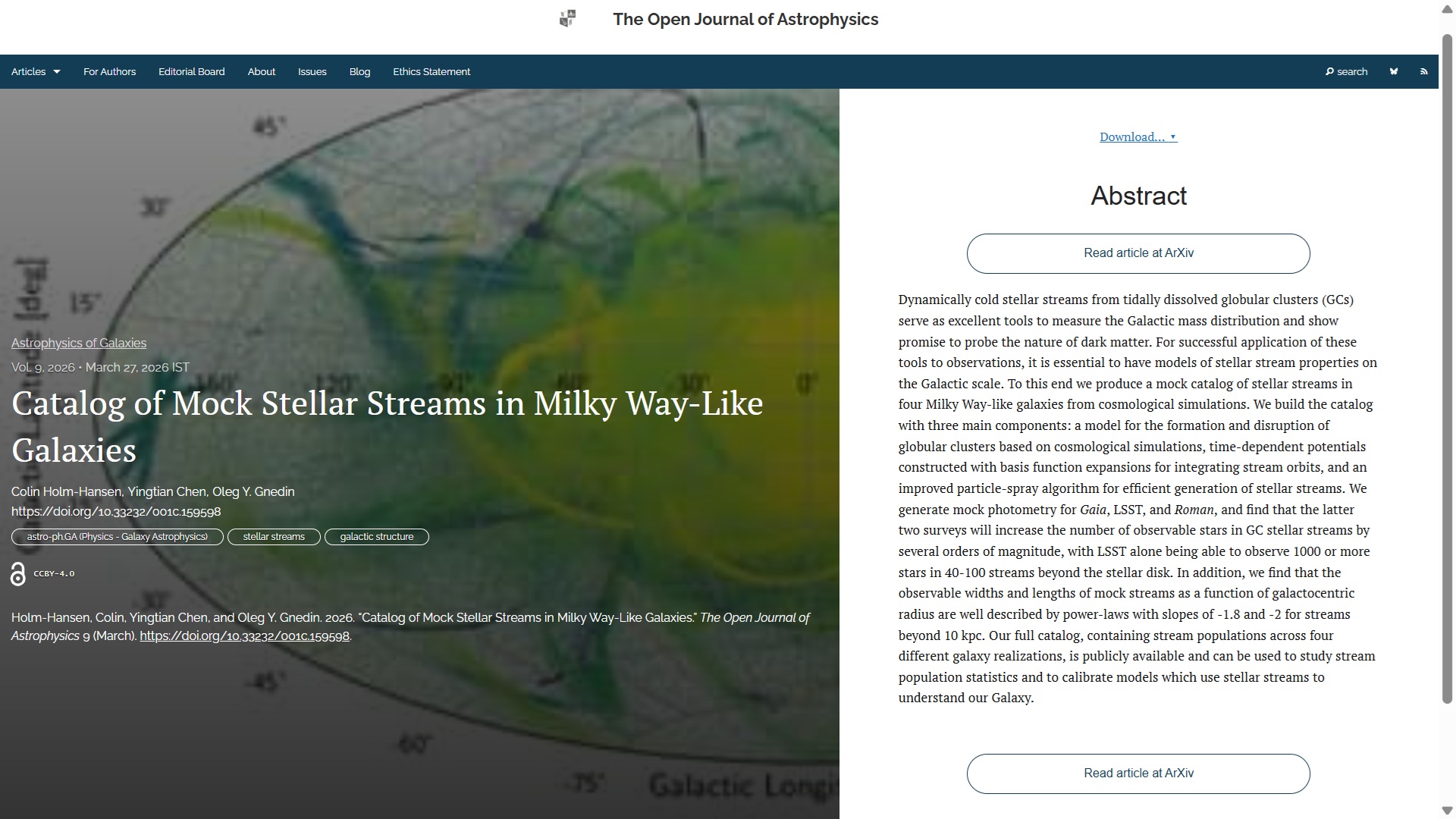
New Publication at the Open Journal of Astrophysics: "Catalog of Mock Stellar Streams in Milky Way-Like Galaxies" by Colin Holm-Hansen, Yingtian Chen and Oleg Y. Gnedin (University of Michigan, USA)
You will have observed that this week’s papers cover five of the six main categories on astro-ph. We haven’t yet managed to cover all six in a week – we only missed Solar and Stellar Astrophysics this time!
It’s Saturday once more so time for another update of activity at the Open Journal of Astrophysics. Since the last update we have published seven papers, bringing the number in Volume 9 (2026) to 11 and the total so far published by OJAp up to 459. This week has been quite busy; for only the second time in recorded history we published at least one paper each working day.
I will continue to include the announcements made on our Mastodon account (on Fediscience) to encourage you to visit it. Mastodon is a really excellent service, and a more than adequate replacement for X/Twitter which nobody should be using.
The first three papers this week were all published on Monday January 12th in the folder Astrophysics of Galaxies.
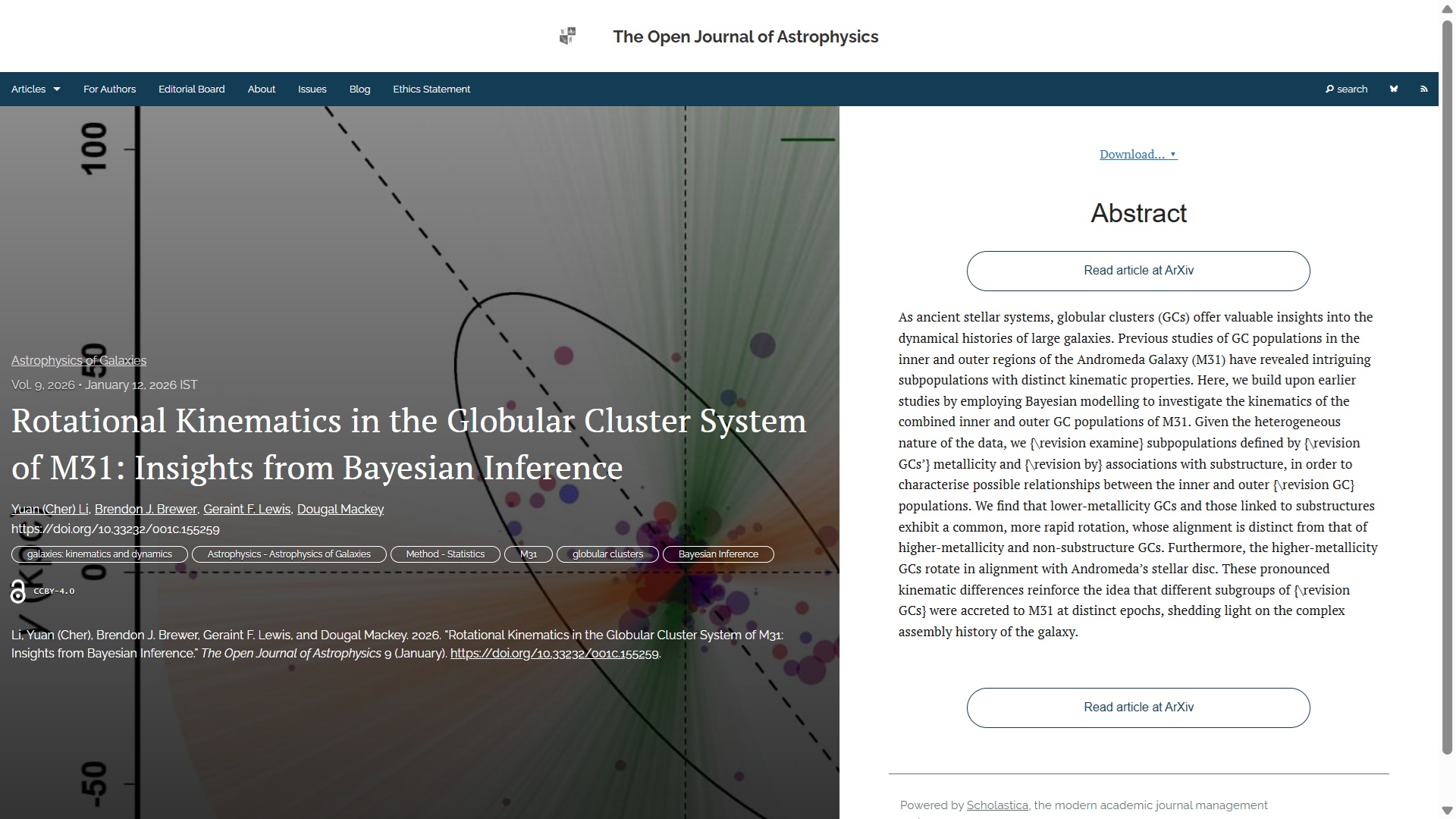
The first paper to report this week is “Rotational Kinematics in the Globular Cluster System of M31: Insights from Bayesian Inference” by Yuan (Cher) Li & Brendon J. Brewer (U. Auckland, New Zealand), Geraint F. Lewis (U. Sydney, Australia) and Dougal Mackey (independent researcher, Australia). This study uses Bayesian modelling to explore the kinematics of globular clusters in the Andromeda Galaxy, revealing distinct rotation patterns that suggest different subgroups were added at separate times.
The overlay is here:
You can find the officially accepted version on arXiv here and the announcement on Fediverse here:
New Publication at the Open Journal of Astrophysics: "Rotational Kinematics in the Globular Cluster System of M31: Insights from Bayesian Inference" by Yuan (Cher) Li & Brendon J. Brewer (U. Auckland, New Zealand), Geraint F. Lewis (U. Sydney, Australia) and Dougal Mackey
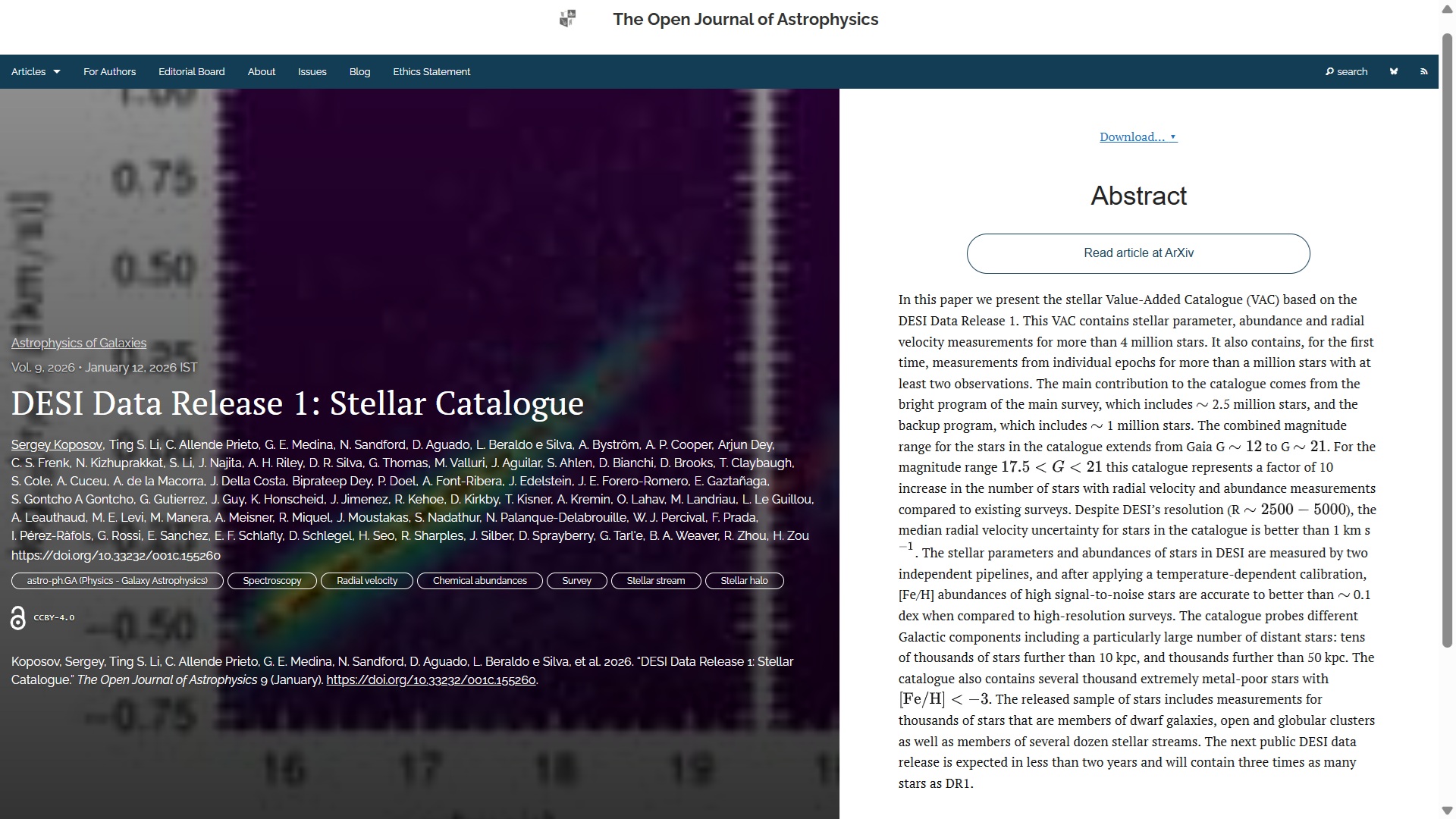
The second paper is “DESI Data Release 1: Stellar Catalogue” by Sergey Koposov (U. Edinburgh, UK) and an international cast of 67 other authors. This paper introduces and describes the stellar Value-Added Catalogue (VAC) based on DESI Data Release 1, providing measurements for over 4 million stars, including radial velocity, abundance, and stellar parameters.
The overlay for this one is here:
The official version of the paper can be found on arXiv here and the Fediverse announcement here:
New Publication at the Open Journal of Astrophysics: "DESI Data Release 1: Stellar Catalogue" by Sergey Koposov (U. Edinburgh, UK) and an international cast of 67 other authors.
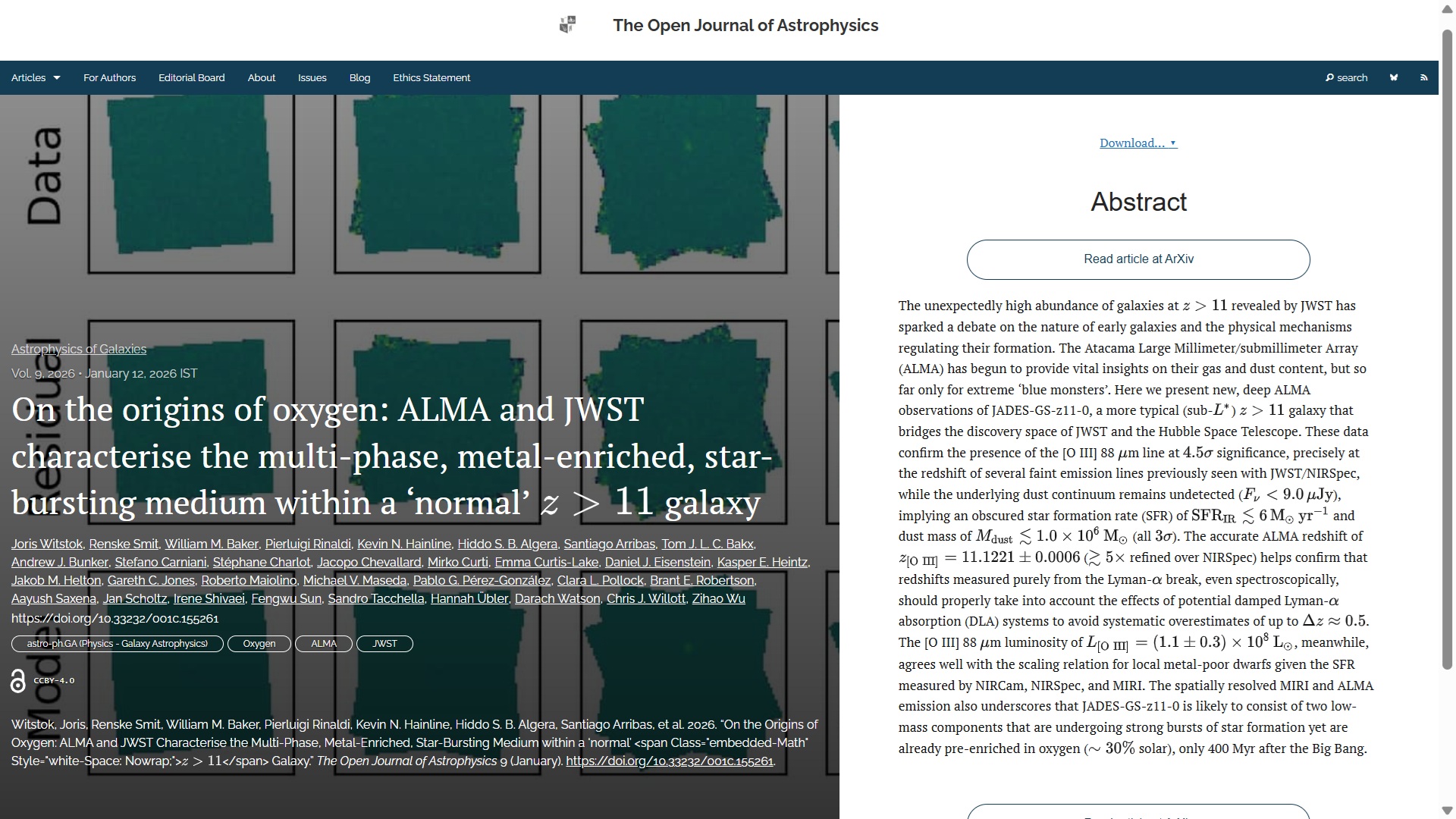
New Publication at the Open Journal of Astrophysics: "On the origins of oxygen: ALMA and JWST characterise the multi-phase, metal-enriched, star-bursting medium within a ‘normal’ z>11 galaxy" by Joris Witstok (Cosmic Dawn Centre, Copenhagen, Denmark) and 37 others dotted around the world
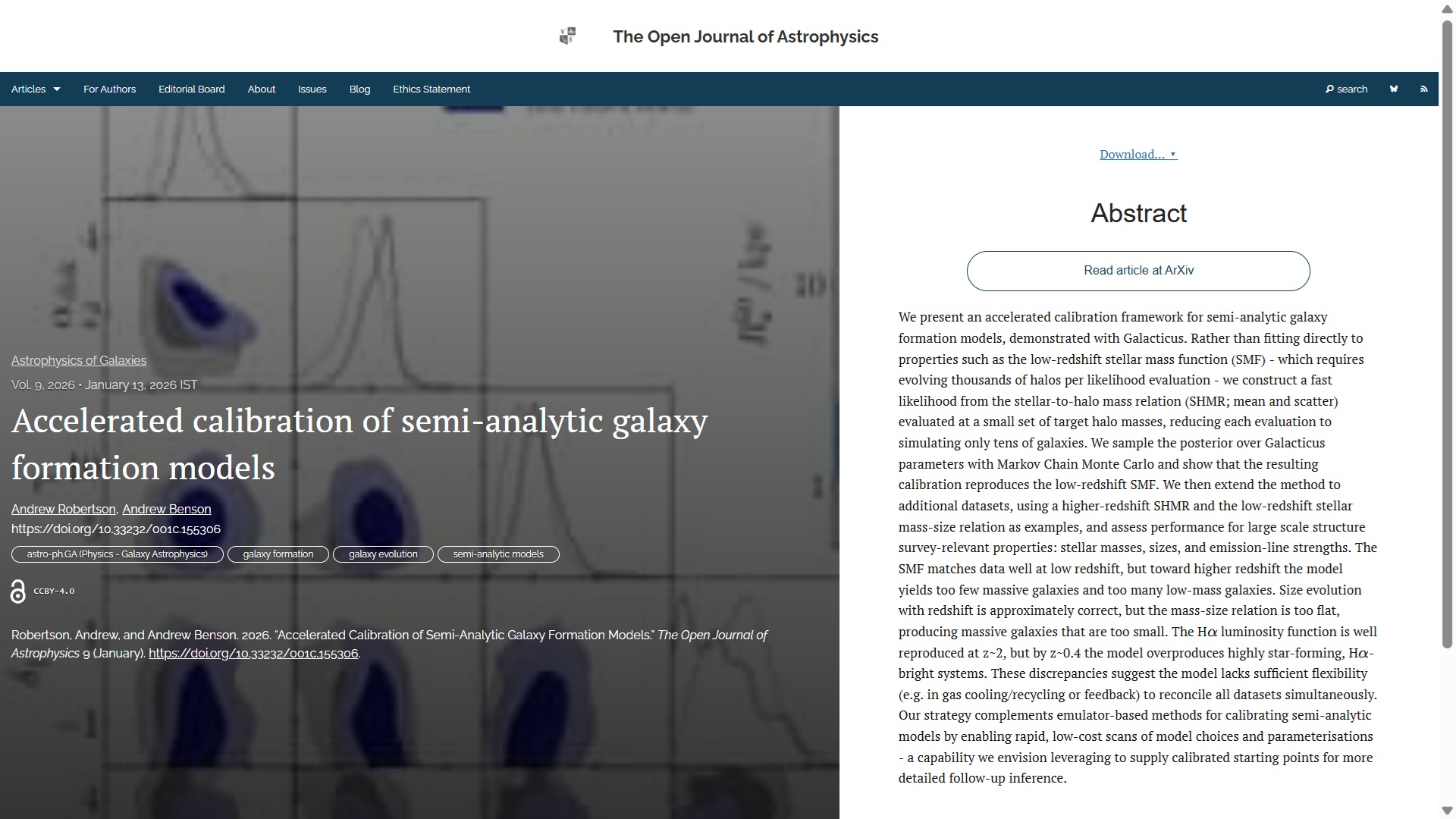
The fourth paper this week is also in the folder Astrophysics of Galaxies. but was published on Tuesday 13th January. It is entitled “Accelerated calibration of semi-analytic galaxy formation models” by Andrew Robertson and Andrew Benson (Carnegie Observatories, USA). This paper presents a faster calibration framework for galaxy formation models, using fewer simulations for each evaluation. However, the model shows discrepancies suggesting the model needs to be made more flexible.
The overlay is here:
You can find the officially accepted version on arXiv here and the Mastodon announcement here:
New Publication at the Open Journal of Astrophysics: "Accelerated calibration of semi-analytic galaxy formation models" by Andrew Robertson and Andrew Benson (Carnegie Observatories, USA)
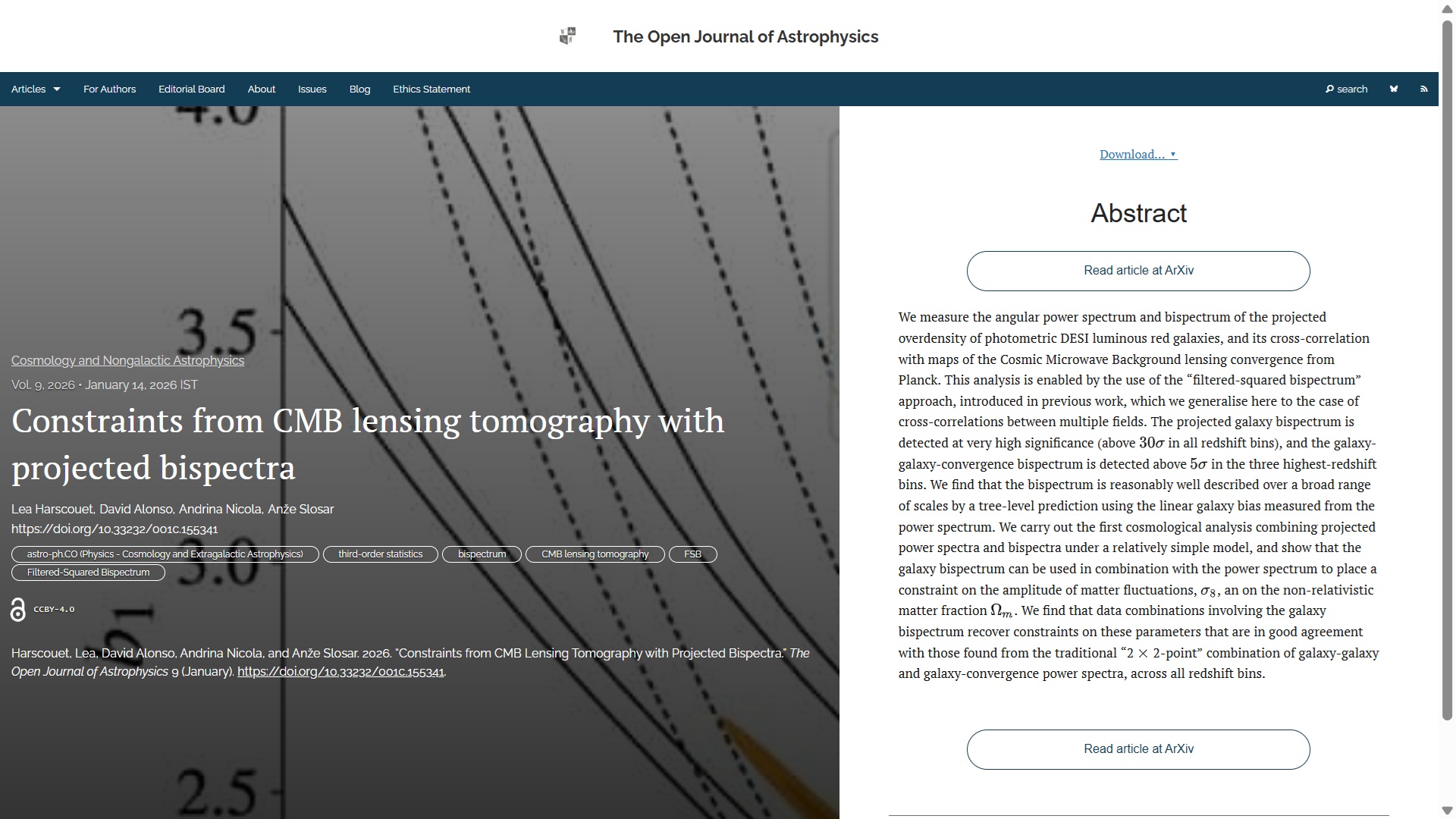
Next one up, published on Wednesday 14th January in the folder Cosmology and Nongalactic Astrophysics, is “Constraints from CMB lensing tomography with projected bispectra” by Lea Harscouet & David Alonso (U. Oxford), UK), Andrina Nicola (U. Manchester, UK) and Anže Slosar (Brookhaven National Laboratory, USA). This study presents angular power spectra and bispectra of DESI luminous red galaxies, finding that the galaxy bispectrum can constrain the amplitude of matter fluctuations and the non-relativistic matter fraction. The overlay is here:
You can find the officially accepted paper on arXiv here and the Mastodon announcement here:
New Publication at the Open Journal of Astrophysics: "Constraints from CMB lensing tomography with projected bispectra" by Lea Harscouet & David Alonso (U. Oxford, UK), Andrina Nicola (U. Manchester, UK) and Anže Slosar (Brookhaven National Laboratory, USA)
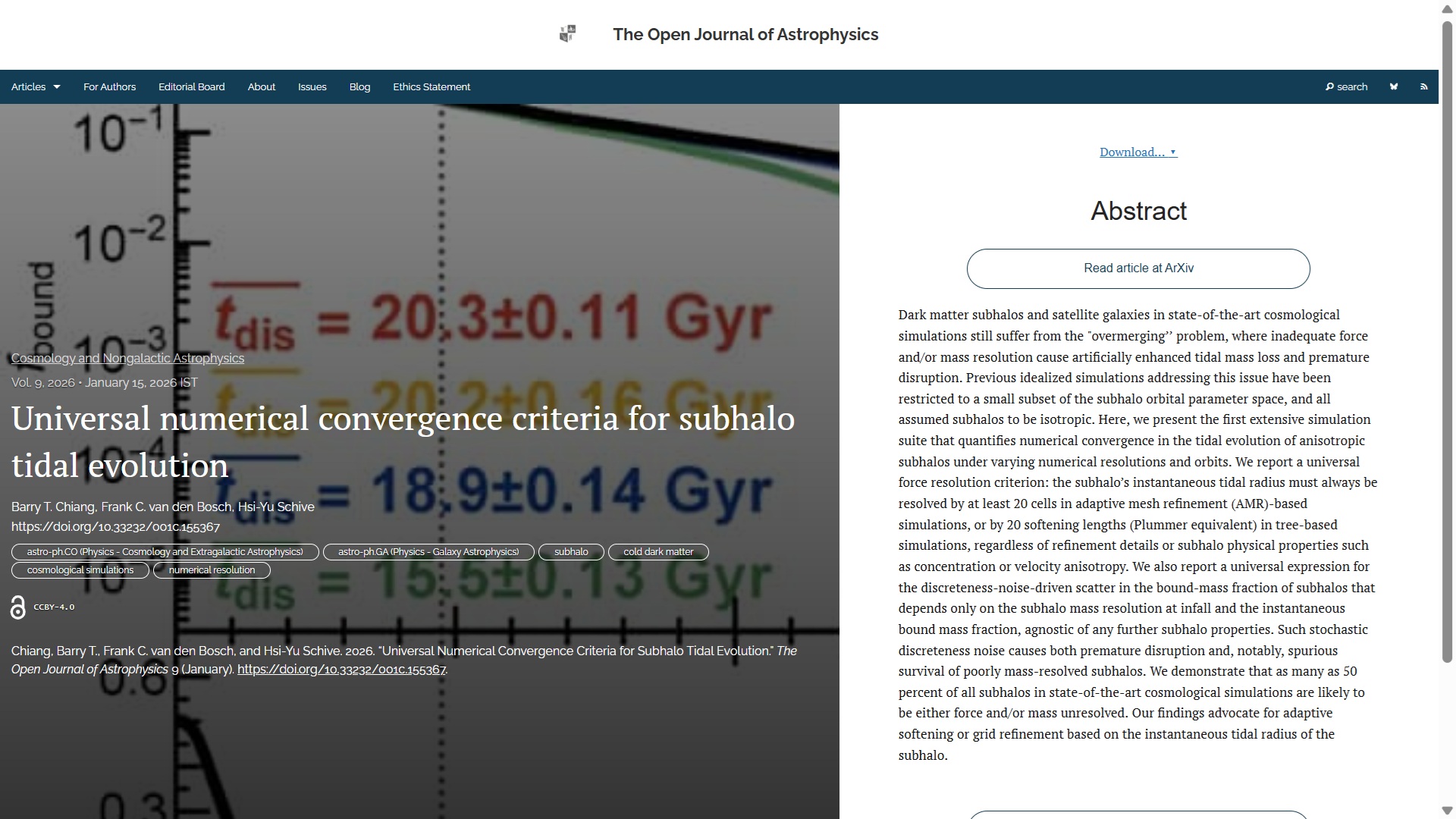
The sixth paper this week is “Universal numerical convergence criteria for subhalo tidal evolution” by Barry T. Chiang & Frank C. van den Bosch (Yale U., USA) and Hsi-Yu Schive (National Taiwan University, Taiwan). This was published on Thursday 15th January in the folder Cosmology and Nongalactic Astrophysics; it presents an analysis of a simulation suite that addresses the ‘overmerging’ problem in cosmological simulations of dark matter subhalos, showing that up to 50% of halos in state-of-the art simulations are unresolved. The overlay is here:
The final accepted version of this paper can be found on arXiv here. The Mastodon announcement follows:
New Publication at the Open Journal of Astrophysics: "Universal numerical convergence criteria for subhalo tidal evolution" by Barry T. Chiang & Frank C. van den Bosch (Yale U., USA) and Hsi-Yu Schive (National Taiwan University, Taiwan)
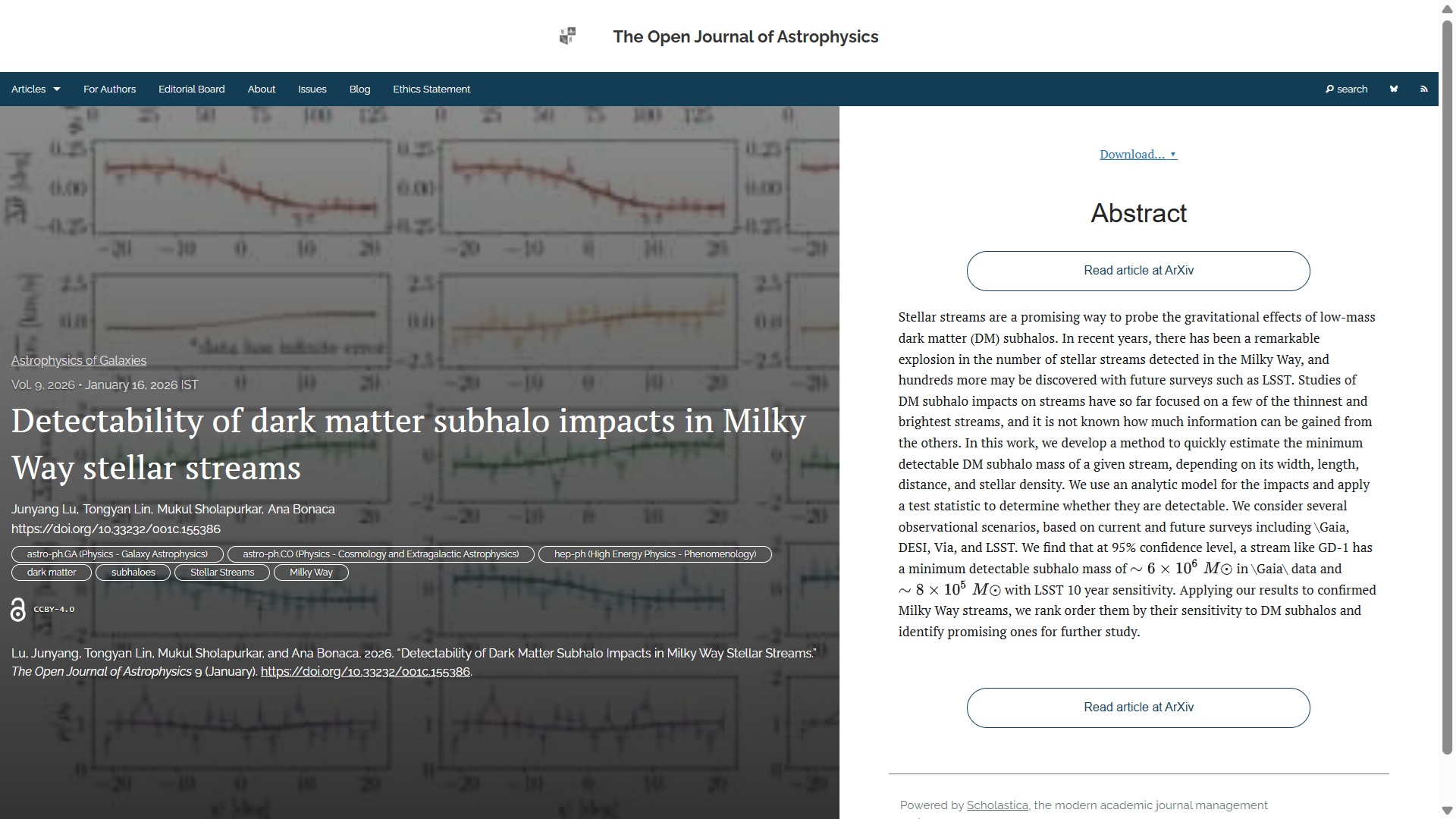
Finally for this week we have “Detectability of dark matter subhalo impacts in Milky Way stellar streams” by Junyang Lu , Tongyan Lin & Mukul Sholapurkar (UCSD, USA) and Ana Bonaca (Carnegie Observatories, USA). This was published on Friday 16th January (i.e. yesterday) in the folder Astrophysics of Galaxies. The study develops a method to estimate the minimum detectable dark matter subhalo mass in stellar streams, ranking them by sensitivity and identifying promising lines for further research.
The overlay is here:
The officially accepted version can be found on arXiv here and the Fediverse announcement here:
New Publication at the Open Journal of Astrophysics: "Detectability of dark matter subhalo impacts in Milky Way stellar streams" by Junyang Lu , Tongyan Lin & Mukul Sholapurkar (UCSD, USA) and Ana Bonaca (Carnegie Observatories, USA)
It’s Saturday morning again, so it’s time again for an update of papers published at the Open Journal of Astrophysics. Since the last update we have published seven new papers, which brings the number in Volume 8 (2025) up to 92, and the total so far published by OJAp up to 327.
This was a slightly strange week, starting with the fact that there were no new arXiv announcements on Monday 7th July because of the 4th July holiday in the USA on Friday so no papers were published that day. We were not able to publish any papers on Wednesday 9th July either because Crossref was offline for 24 hours that day while its data was migrated into the cloud. Our publishing process requires a live connection with Crossref to deposit metadata upon publication so we can’t publish while that service is down. Fortunately the update seems to have gone well and normal services resumed the following day. That partially accounts for the fact that four of this week’s papers were published on 10th July.
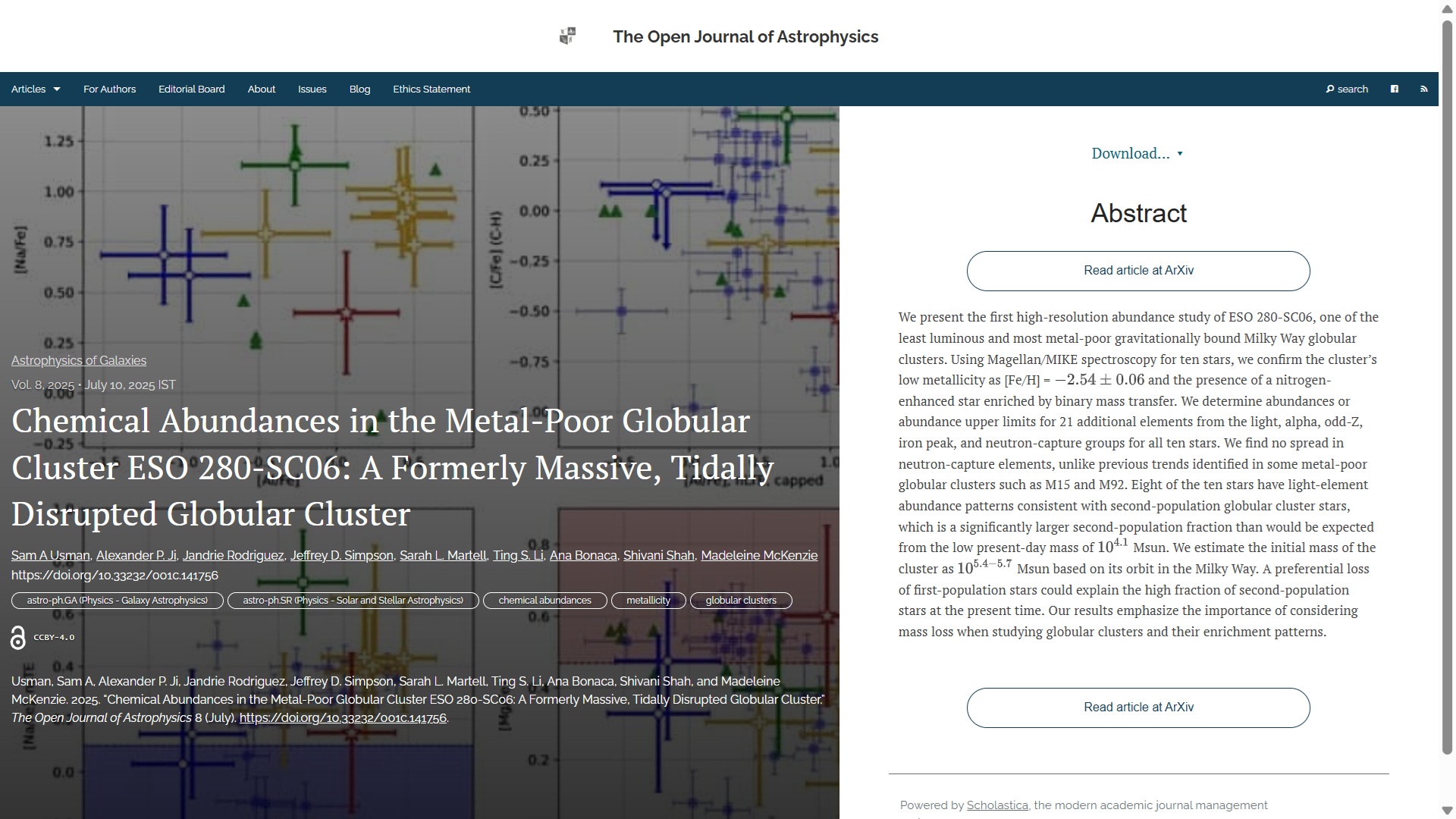
Anyway, The papers published this week, with their overlays, are as follows. You can click on the images of the overlays to make them larger should you wish to do so.
The officially-accepted version can be found on arXiv here.
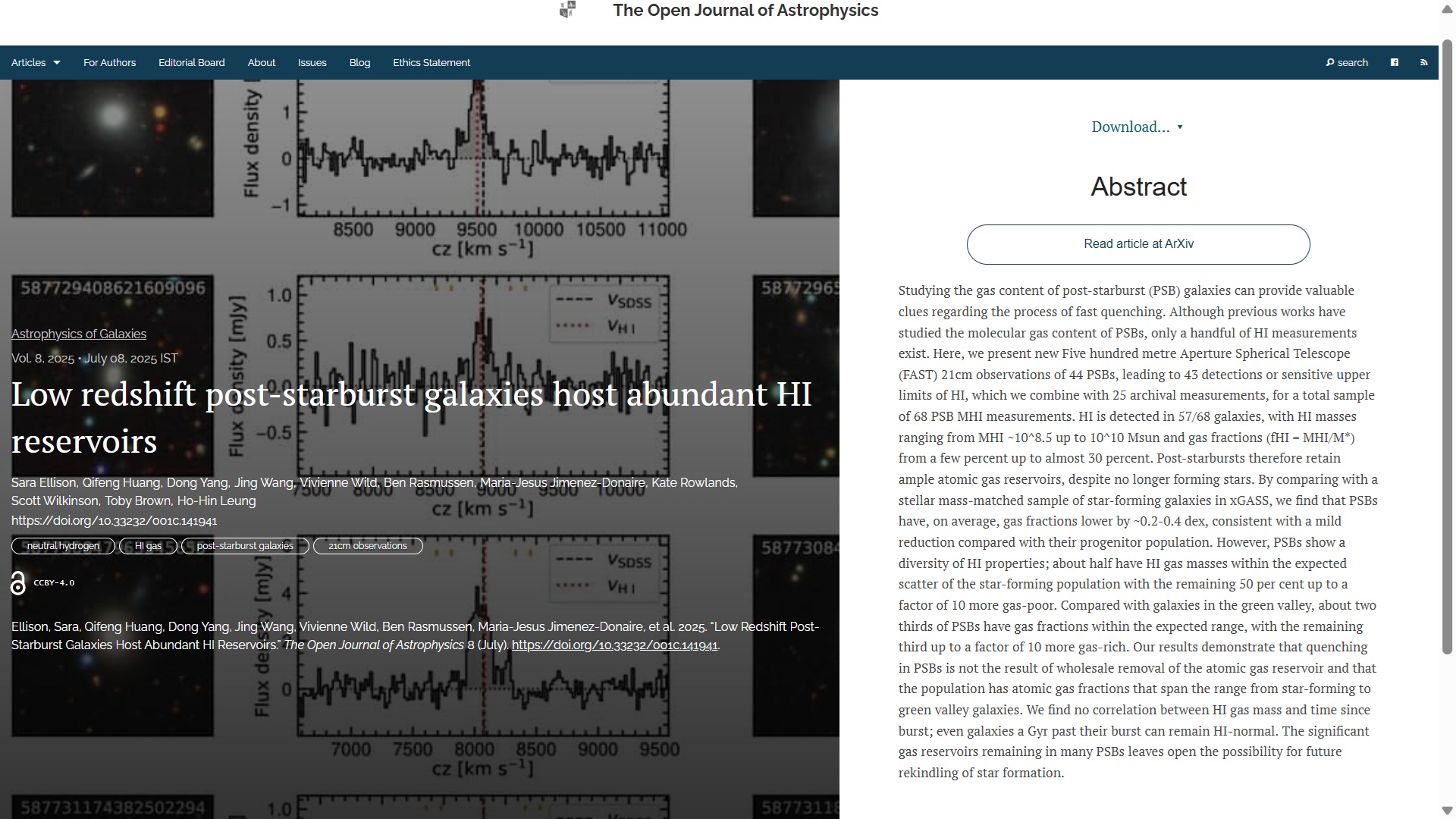
The second paper is “Low redshift post-starburst galaxies host abundant HI reservoirs” by Sara Ellison (U. Victoria, Canada) and 10 others based in China, UK, Spain, USA and Canada. This one was also published oon Tuesday 8th July but in the folder Astrophysics of Galaxies. This paper uses 21cm observations of a sample of post-starburst galaxies, to show that they contain large reservoirs of neutral hydrogen. Here is the overlay:
You can find the final version of the manuscript on arXiv here.
You can find the officially-accepted version of the paper on arXiv here.
The penultimate paper for this week, and the last of the batch published on 10th July, is “Systematically Measuring Ultra-Diffuse Galaxies. VIII. Misfits, Miscasts, and Miscreants” by Dennis Zaritsky, Richard Donnerstein, and Donghyeon J. Khim (Steward Observatory, U. Arizona, USA). This paper presents a morphological study of weird and wonderful galaxies as part of an effort to Systematically Measure Ultra-Diffuse Galaxies (the SMUDGes survey). It is in the folder marked Astrophysics of Galaxies. The overlay is here:
You can find the officially-accepted version of the paper on arXiv here.
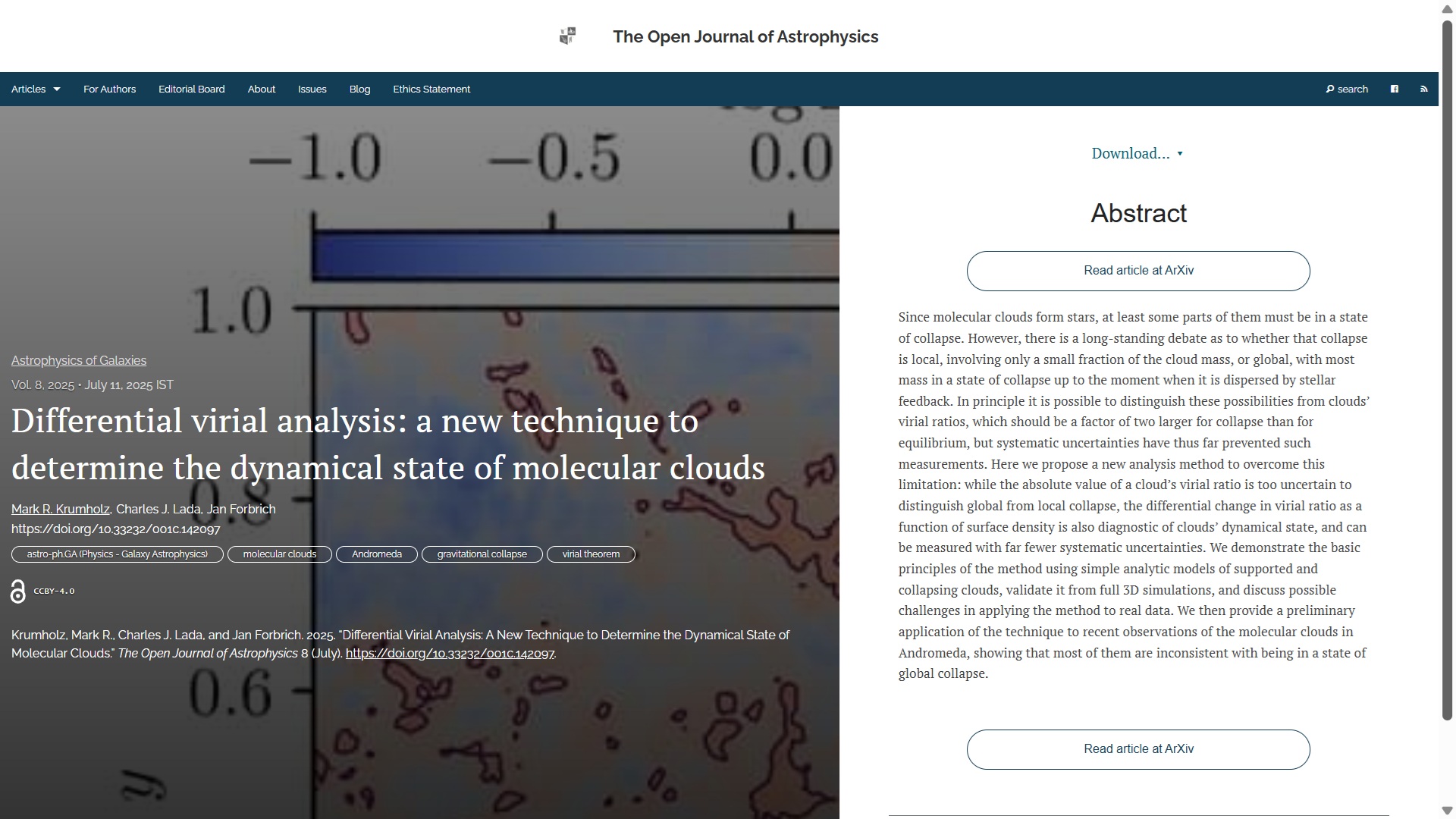
The last article published this week is “Differential virial analysis: a new technique to determine the dynamical state of molecular clouds” by Mark R. Krumholz (ANU, Australia), Charles J. Lada (Harvard, USA) & Jan Forbrich (U. Herts, UK). This paper presents simple analytic models of supported and collapsing molecular clouds, tested using full 3D simulations and applied to observed clouds in Andromeda. It is in the folder marked Astrophysics of Galaxies and was published yesterday, i.e on Friday 11th July 2025. Here is the overlay
You can find the officially-accepted version on arXiv here.
And that’s all the papers for this week. I will, however, take this opportunity to mention that a while ago I was interviewed about the Open Journal of Astrophysics by Colin Stuart on behalf of the Foundational Questions Institute; the write-up of the interview can be found here.
It’s Saturday so once again it’s time for the weekly update of papers published at the Open Journal of Astrophysics. Since the last update we have published two new papers, which brings the number in Volume 8 (2025) up to 69 and the total so far published by OJAp is now up to 304.
The two papers published this week, with their overlays, are as follows. You can click on the images of the overlays to make them larger should you wish to do so.
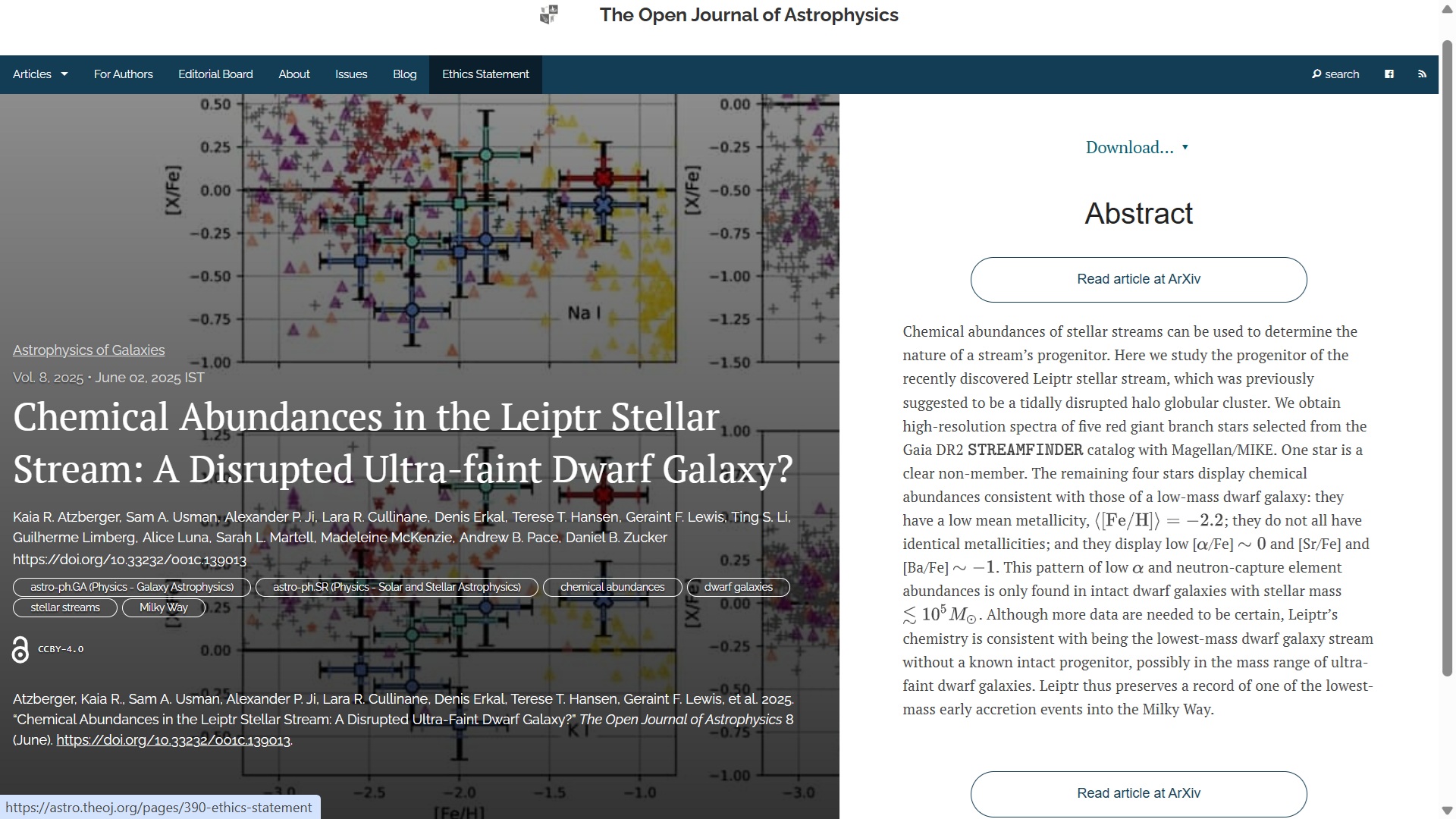
The first paper to report is “Chemical Abundances in the Leiptr Stellar Stream: A Disrupted Ultra-faint Dwarf Galaxy?” by Kaia R. Atzberger (Ohio State University) and 13 others based in the USA, Germany, the UK, Sweden, Australia, Canada and Brazil. This one was published on 2nd June 2025 and is in the folder marked Astrophysics of Galaxies. It presents a spectroscopic study of stars in a stellar stream suggesting that the stream originated by the accretion of a dwarf galaxy by the Milky Way.
The overlay is here:
You can read the final accepted version on arXiv here.
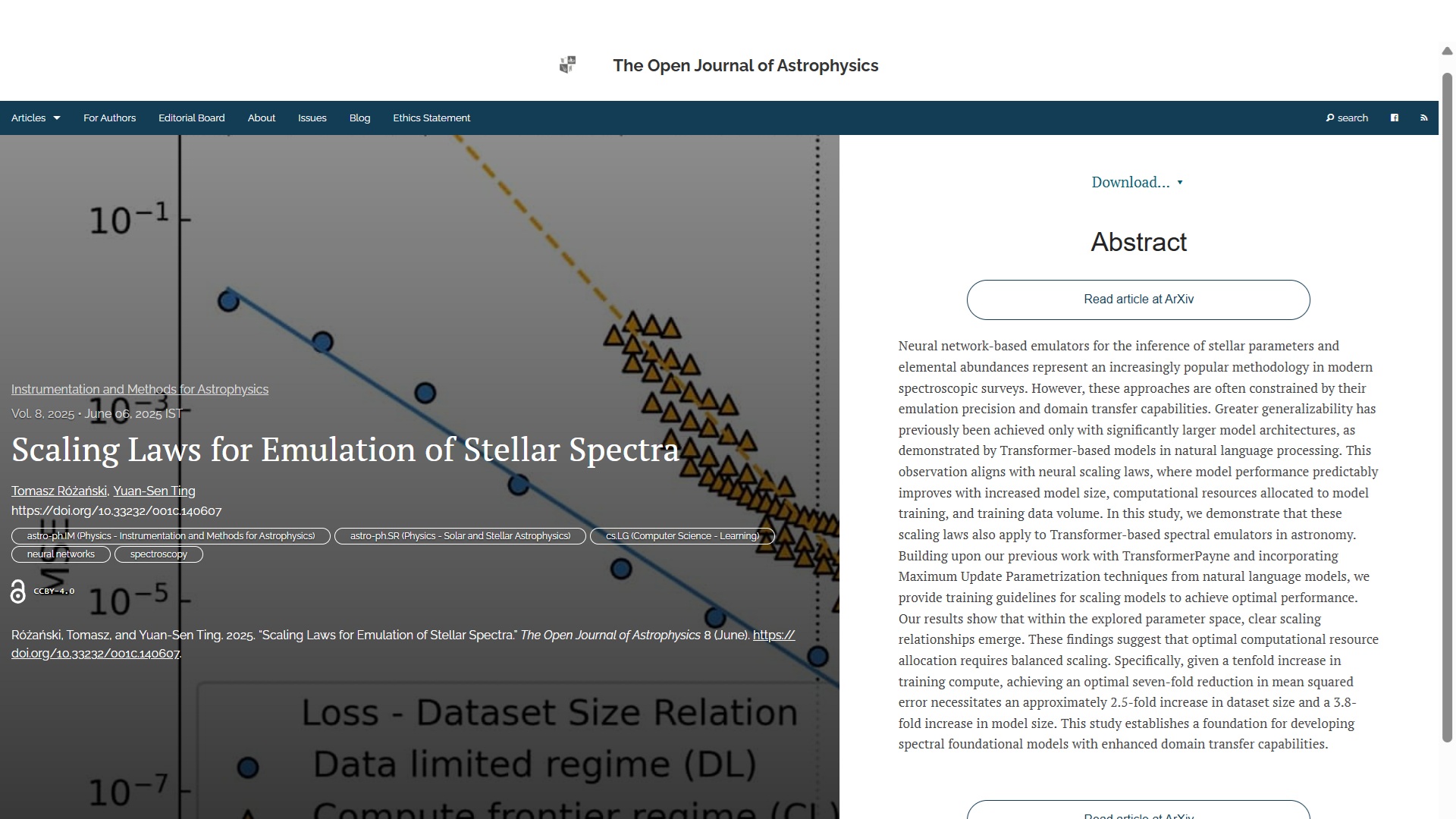
The second paper is “Scaling Laws for Emulation of Stellar Spectra” by Tomasz Różański (Australian Nastional University) and Yuan-Sen Ting (Ohio State University, USA). This was published yesterday, i.e. on 6th June 2025, and is in the folder Instrumentation and Methods for Astrophysics. The paper discusses certain scaling models and their use to achieve optimal performance for neural network emulators in the inference of stellar parameters and element abundances from spectroscopic data.
The overlay is here:
You can find the officially-accepted version of the paper on arXiv here.
That’s the papers for this week. I’ll post another update next weekend.
As a postscript I have a small announcement about our social media. Owing to the imminent demise of Astrodon, we have moved the Mastodon profile of the Open Journal of Astrophysics to a new instance, Fediscience. You can find us here. The old profile currently redirects to the new one, but you might want to update your links as the old server will eventually go offline.
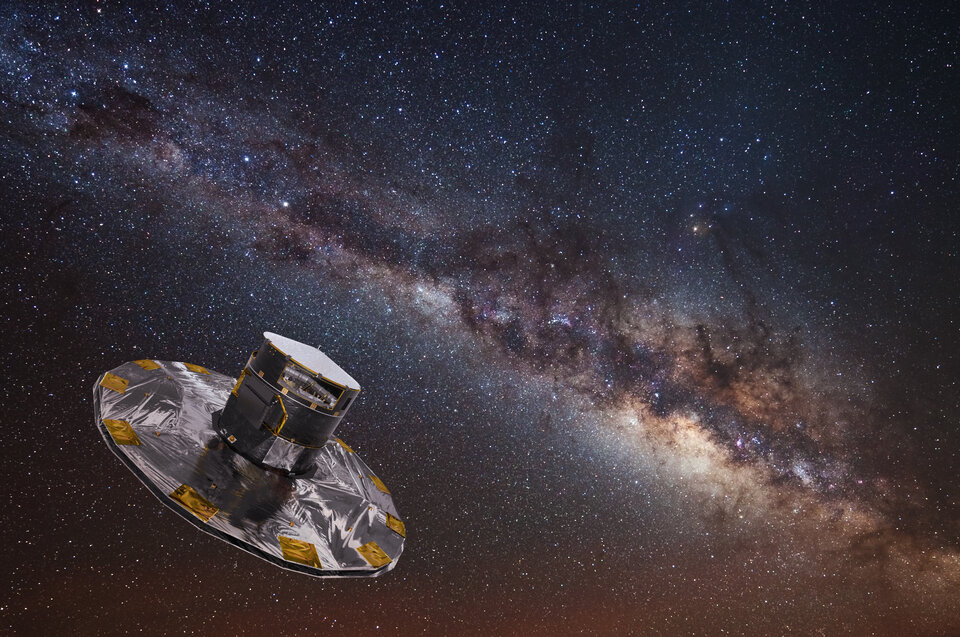
Artist impression of ESA’s Gaia satellite observing the Milky Way. The background image of the sky is compiled from data from more than 1.8 billion stars. Spacecraft: ESA/ATG medialab; Milky Way: ESA/Gaia/DPAC. Acknowledgement: A. Moitinho
Today (15th January 2025) marks the end of an era. The European Space Agency’s Gaia spacecraft stops taking data today as it is running out of the gas propellant needed to keep it scanning the sky. The spacecraft was launched on 19 December 2013 so has been operating for just over 11 years.
For those of you not in the know, Gaia is a global space astrometry mission, whose mission was to make the largest, most precise three-dimensional map of our Galaxy by surveying more than a billion stars. Gaia was to monitor each of its target stars about 70 times over a five-year period. Alongside this core mission, it has also discovered hundreds of thousands of new celestial objects, such as extra-solar planets and brown dwarfs, and observed hundreds of thousands of asteroids within our own Solar System.
Gaia is creating an extraordinarily precise three-dimensional map of more than a thousand million stars throughout our Galaxy (The Milky Way) and beyond, mapping their motion, luminosity, temperature and chemical composition as well as any changes in such properties. This huge stellar census will provide the data needed to tackle an enormous range of important problems related to the origin, structure and evolutionary history of our Galaxy. Gaia does this by repeatedly measuring the positions of all objects down to an apparent magnitude of 20. A billion stars is about 1% of the entire stellar population of the Milky Way.
For the brighter objects, i.e. those brighter than magnitude 15, Gaia measures their positions to an accuracy of 24 microarcseconds, comparable to measuring the diameter of a human hair at a distance of 1000 km. Distances of relatively nearby stars are measured to an accuracy of 0.001%. Even stars near the Galactic Centre, some 30,000 light-years away, have their distances measured to within an accuracy of 20%.
The huge quantity of high-precision data Gaia has produced constitutes a tremendously influential resource for astronomical research. The fourth data release from Gaia, DR4, is in the pipeline for completion soon but the final data release (DR5) will take some years to appear, so this is by no means the last we will hear from Gaia, but the end of observations does close a significant chapter. Its legacy will be immense.
It’s time once more for the usual Saturday roundup of business at the Open Journal of Astrophysics. The latest batch of publications consists of three papers, taking the count in Volume 7 (2024) up to 39 and the total published by OJAp up to 154. We’re still on track to publish around 100 papers this year, compared to last year’s 50.
All three of this week’s papers involve use of data from the European Space Agency’s Gaia mission, which is proving an immensely rich resource for astrophysics.
First one up is “Asymmetric Drift Map of the Milky Way Disk Populations between 8 -16 kpc with LAMOST and Gaia datasets” which is by Xin Li (Nanchong, China), Peng Yang (Chengdu, China) , Hai-Feng Wang (Nanchong, China), Qing Li (Jiangmen, China), Yang-Ping Luo (Nanchong, China), Zhi-Quan Luo (Nanchong, China), Guan-Yu Wang (Nanchong, China). This is a study of the asymmetric drift, the difference of the local circular speed and the mean rotational speed of the stellar population, for various stellar populations in the Milky Way. It is in the folder marked Astrophysics of Galaxies and was published on Tuesday 14th May 2024.
Here is a screen grab of the overlay, which includes the abstract:
This one is in the folder Solar and Stellar Astrophysics and was published on 16th May 2024. The overlay looks like this:
You can read this paper directly on the arXiv here.
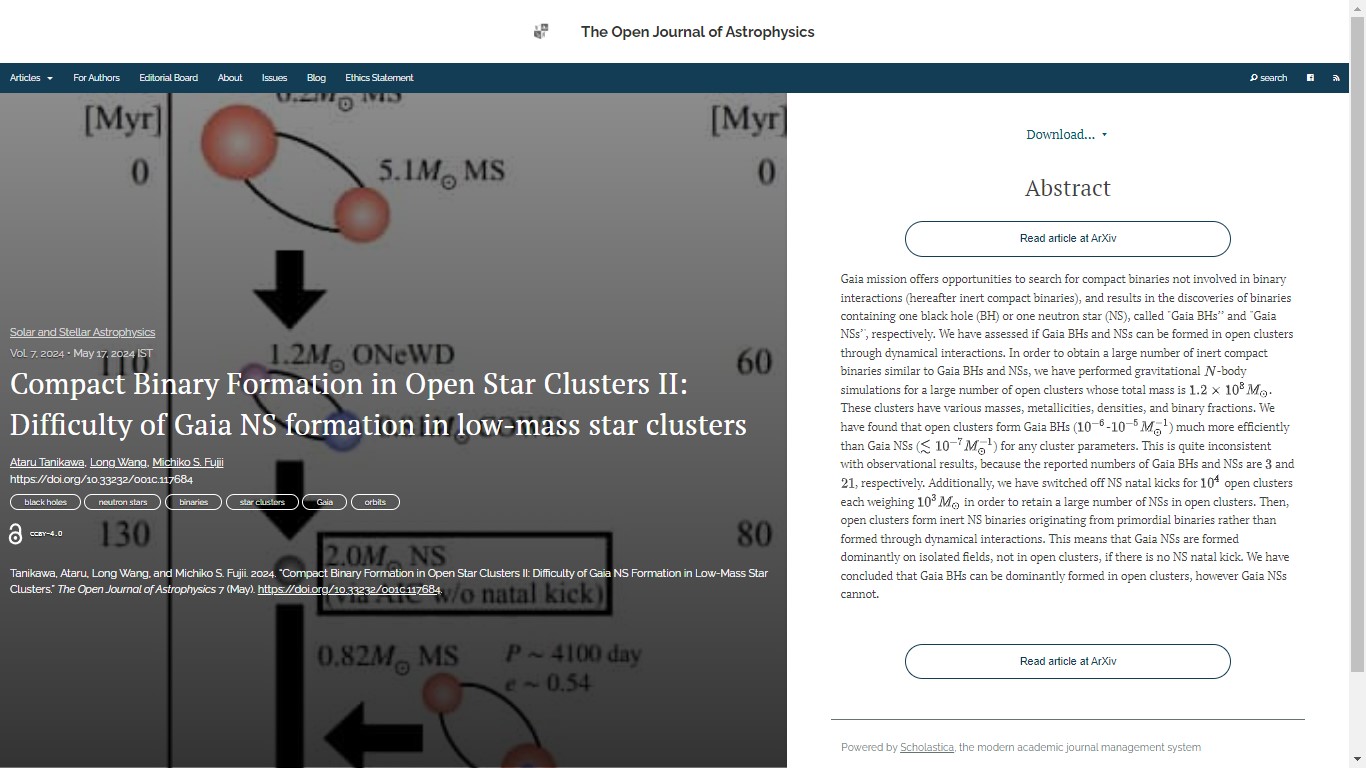
The last paper of this batch, also in the in the folder Solar and Stellar Astrophysics, is entitled “Compact Binary Formation in Open Star Clusters II: Difficulty of Gaia NS formation in low-mass star clusters” and it presents a discussion of the formation of binary neutron stars and black holes found in Gaia data based on their orbital properties. It was published on Friday May 17th 2024 (i.e. yesterday). The authors are Ataru Tanikawa (Fukui University, Japan), Long Wang (Sun-yat Sen University, China) and Michiko S. Fujii (Tokyo University, Japan).
Here is a screengrab of the overlay:
To read the accepted version of this on the arXiv please go here.
The views presented here are personal and not necessarily those of my employer (or anyone else for that matter).
Feel free to comment on any of the posts on this blog but comments may be moderated; anonymous comments and any considered by me to be vexatious and/or abusive and/or defamatory will not be accepted. I do not necessarily endorse, support, sanction, encourage, verify or agree with the opinions or statements of any information or other content in the comments on this site and do not in any way guarantee their accuracy or reliability.