Google Citations
Just time for a quick post this morning to pass on the news that Google Citations is now openly available. I just had a quick look at my own bibliometric data and, as far as I can tell, it’s pretty accurate. As well as total citations, Google Scholar also produces an h-index and something called the i10-index (which is just the number of papers with more than 10 citations). It also gives the corresponding figures for the past 5 years as well as for the entire career of a given researcher.
I’ve bragged blogged already about my most popular paper citation-wise, which has 287 citations on Google Scholar, which doesn’t exactly make it a world-beater but I’m still quite please with its impact. What I find particularly interesting about that paper is its longevity. This paper was published in 1991, i.e. 20 years ago, but I recently looked on the ADS system at its citation history and found the following:
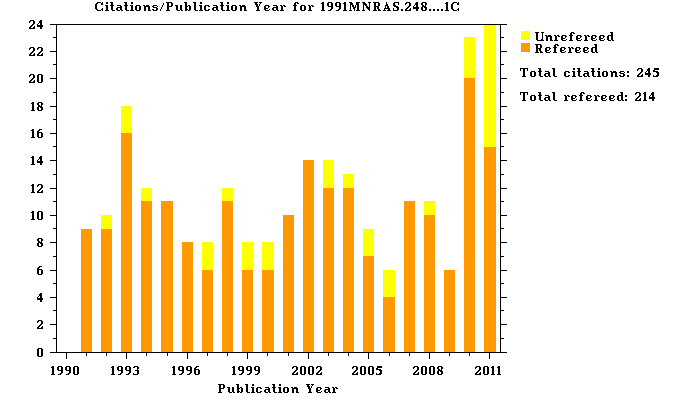
Curiously, it’s getting more citations now than it did when it was first published. I’ve got quite a few “slow burners” like this, in fact, and many of the citations listed for me in the last 5 years actually stem from papers written much earlier. Unfortunately, although I think this steady rate of citation is some sort of indicator of something or other, this is exactly the wrong sort of paper for the Research Excellence Framework, as it is only papers that are published within the roughly 5-year REF window that are taken into account. It would be more useful for the REF panels if the “5-year” window listed citations only to those papers actually published within the last five years. I wonder how the panel will try to use this limited information in assessing the true quality of a paper?
I should also say that although this paper is, by a large margin, the nearest I’ve got to the citation hit parade, I don’t think it’s by any means the best paper I’ve ever written.
Another weakness is that Google Scholar doesn’t give a normalized h-index (i.e. one based on citations shared out amongst the authors of multi-author papers).
Still, you can’t have everything. Now that this extremely useful tool is available (for free) to all scientists and other denizens of the interwebs, I re-iterate my point that the panels involved in the assessing research for the Research Excellence Framework should use it rather than the inferior commercial versions, which are much less accurate.
Follow @telescoper
 In the Dark
November 18, 2011 at 7:58 pm
I went over to Google Citations to have a look at how accurately it handled my papers. Sadly it doesn’t work as well in my case as in yours: it only picked up about 30% of the citations recorded on InSpire or the NASA ADS system (which agree reasonably well with each other).
As I’m at the stage of my scientific life where (rightly or wrongly) number of citations appears to matter quite a lot when it comes to job prospects, Google Citations is some way from being my favourite reference tool!
November 18, 2011 at 9:29 pm
First, I’m happy and relieved that Google is continuing to invest in Scholar. It had felt like a stagnant project without priority in Google’s overall plan. So … Thank!
Sadly, the new ‘Citations’ accuracy is poor for my own work. One paper is scattered across ten (10) …um… formulations and ‘Citations’ states that 79 papers cite it. I just verified that this “79” includes (also) key word hits in the body-text without a citation in the papers’ reference sections. Also, I’ve verified that 115 papers (and likely more) do actually list my/this paper in their reference sections.
November 19, 2011 at 10:40 am
Had a look at this – it seems wierd. For most of my papers google gives a higher citation rate than NASA ADS (e.g. 537 for Dunlop & Peacock 1990 versus 441 citations on NASA ADS), but then my third most cited first-author paper which has 309 citations on ADS basically disappears on Google – I found it down at 45 citations! There seems no way to fix this sort of thing so it is a bit worrying – clearly some sort of serious bug as there is nothing specially wierd about where this paper was published (MNRAS) or where most of the citations come from.
November 19, 2011 at 11:21 am
Generally, google citations gives higher numbers than ADS for mine; I assume that’s because it includes sources not included in the ADS database. The fact that some papers have many fewer on google citations is therefore perplexing and worrying. There may be a simple bug that can be fixed. If so, that will require looking at individual papers and trying to see what’s gone wrong. I suggest reporting such anomalies. I didn’t find any with mine.
November 19, 2011 at 1:33 pm
like jim i have a bunch of fragmented paper citations. the overall total is ~20% higher than ADS (which makes me worry) and even after editing the ~40% of dross out… things didn’t settle down. i had a long list of papers with ~10-50 citations where gCite (or whatever we should call it) returned 0.
for astronomy – ADS is still the gold standard – but of course REF isn’t just about astronomy… and this may be better than SCOPUS (although WoK has got better in my view).
November 19, 2011 at 1:38 pm
I’m not worried about the fact that Google returns higher numbers than ADS because the database it’s drawing from is much much larger; I know that some of my papers are cited in fields outside physics and astronomy so this doesn’t surprise me.
However, the missing and/or fragmented papers are a worry, and it’s useful to report them to find out what’s going wrong.
November 19, 2011 at 4:53 pm
…the problem is that it appears to overcite highly cited papers [perhaps due to unidentified duplicate citations from arxiv and the corresponding journal papers?] and undercite the newer/less cited stuff. at least compared to ADS – where i can easily check the quality/type of the citing articles (few/none of which are outside “astronomy” for me).
so i think its got a long way to go before i’ll be using it instead of ADS (although i do admit i use general google searches instead of ADS for trying to find general material, rather than specific papers).
November 22, 2011 at 3:45 pm
I found it rather less reliable than ADS, as have others. In particular, looking at the lower end of the Google citations shows lots of missing papers that the ADS catches in my case. There’s no obvious pattern to why Google missed them: papers in standard journals that it recognizes over a range of years don’t show up.
Still, it’s a start. A couple of useful features that could give it an advantage over the ADS is to allow the user to group papers and have the statistics run on separate groups (eg, by user-selected
topics or years). A feature ADS has that Google lacks is the facility to tally citations only by refereed papers, something the REF should do (if it doesn’t plan to already).