In a Physicist’s Mailbag…
Among the delights (?) of being a scientist are those priceless pieces of unsolicited mail from members of the public. When I went to collect my mail this morning I found a prime example waiting in my pigeonhole. I knew what it was going to be like before I even opened it because the envelope was addressed (rather inaccurately) using an old-fashioned typewriter. Only a certain kind of person uses a typewriter these days.

I particularly enjoyed the “Emeritus Prof. ” bit. And Cardiff isn’t in “Engand”, by the way. Or even “England”.
Inside were six pieces of paper – all of different sizes – on which fascinating things had been typed and later highlighted with red and black pens in order to enhance both their scientific and artistic impact.
I’m in the middle of a load of project vivas today so haven’t had time to scan this masterpiece neatly, but it’s such a wonderful piece of correspondence that I couldn’t resist taking a few pictures of various elements for the edification of my vast readership. I think if you click on the images you might be able to read them more clearly but, if you do, I will not accept liability for the consequences.
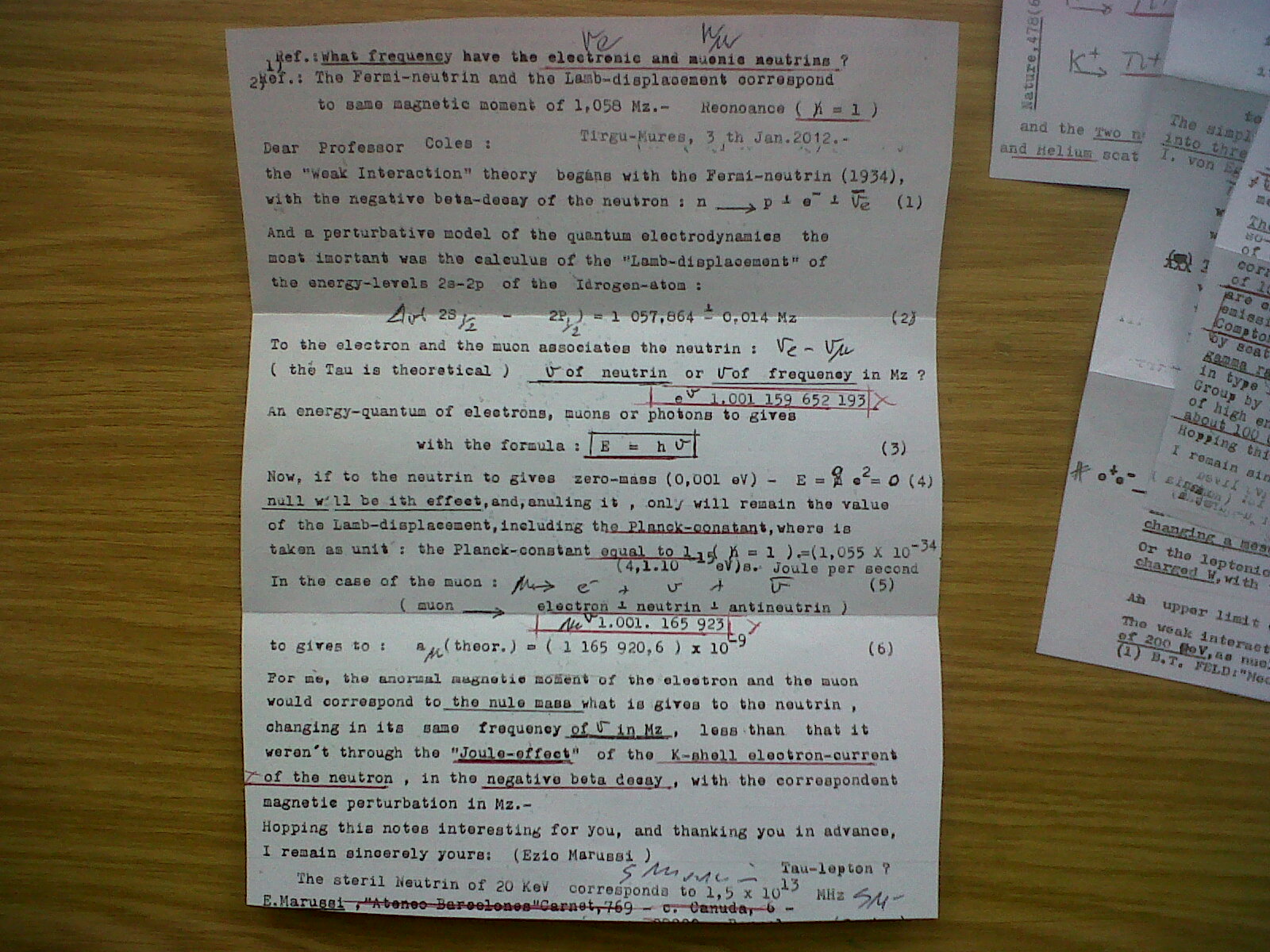
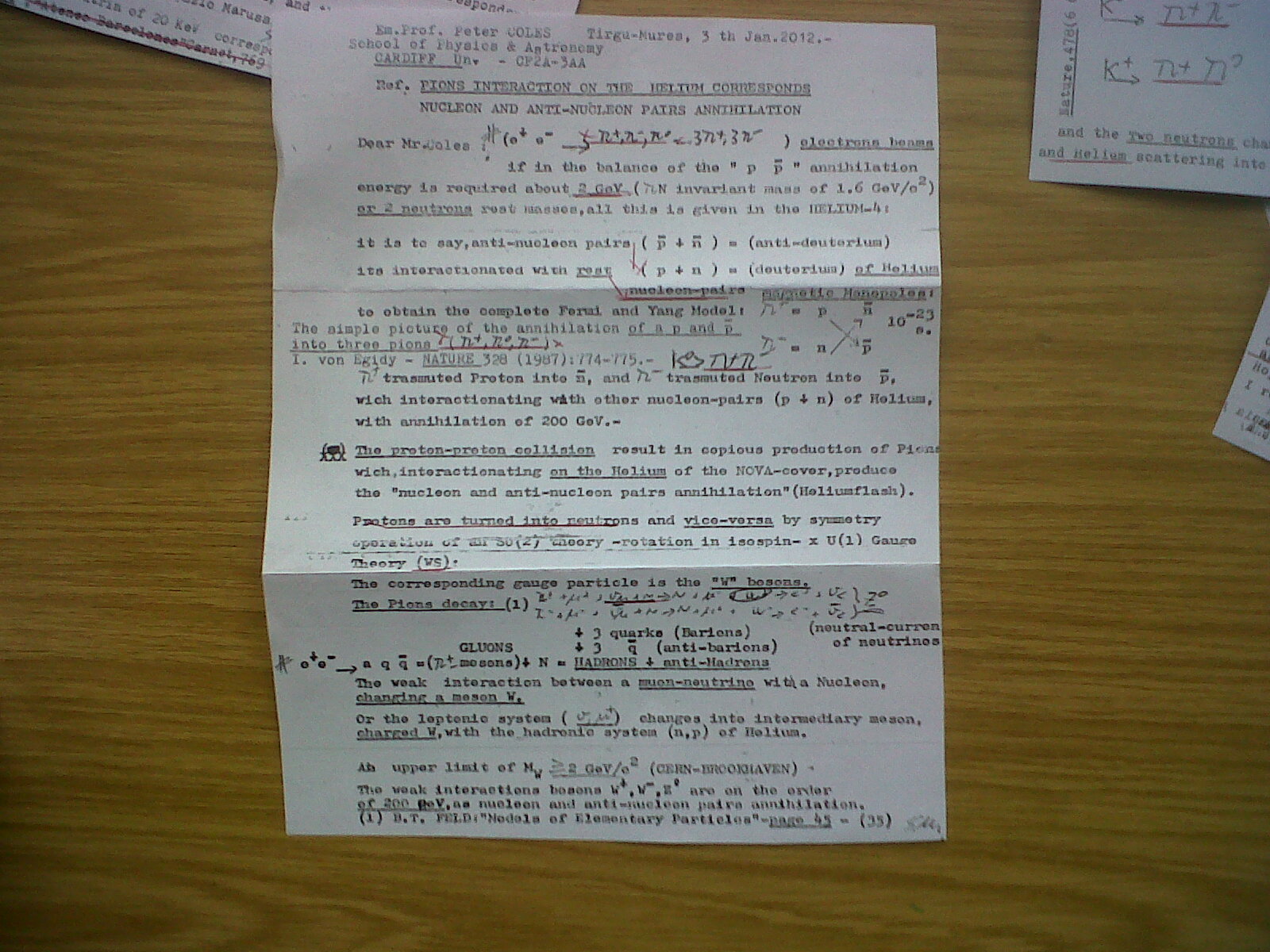

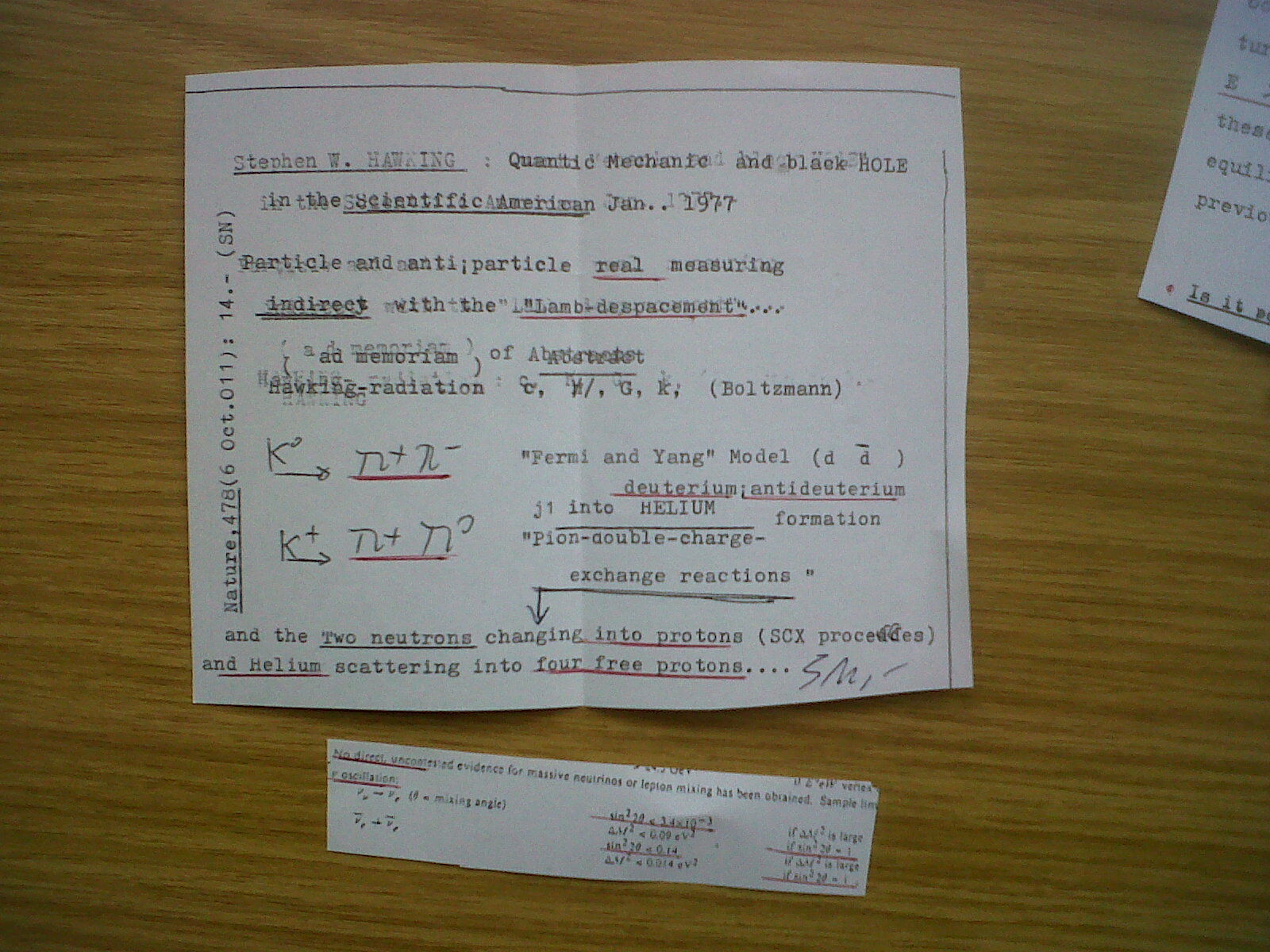
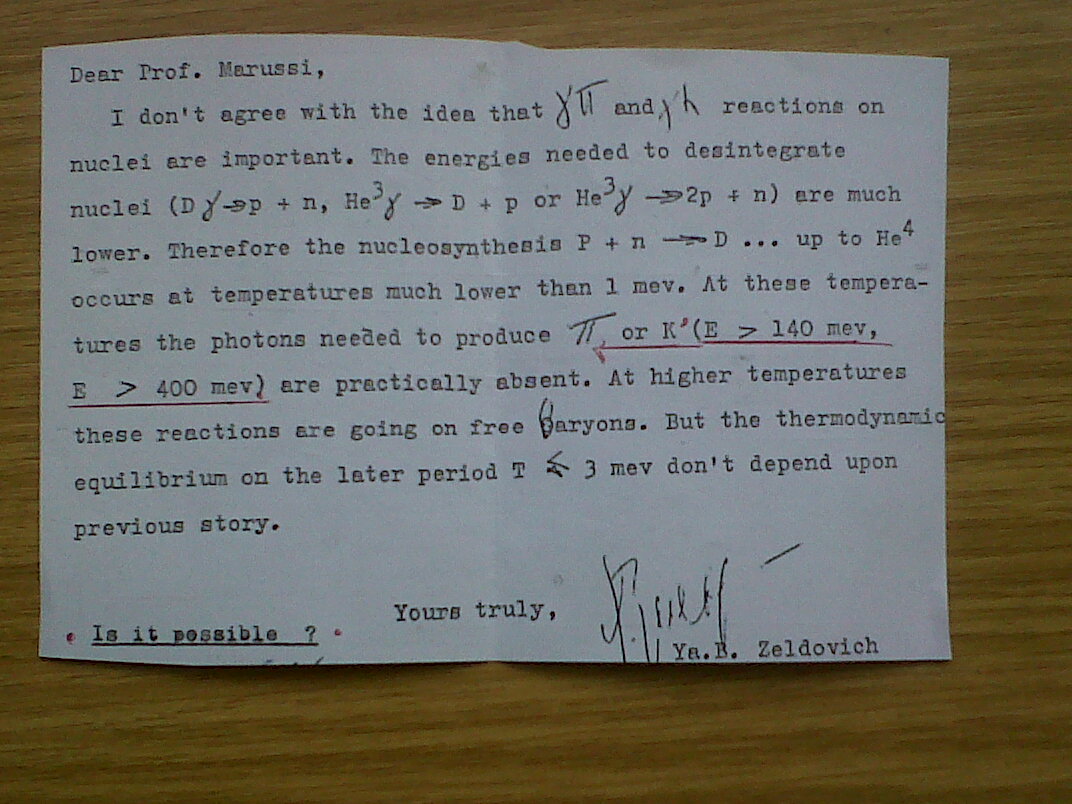
Unfortunately I’m not sure whether I have them in the right order, as the logic that connects them together escapes me.
I have a large collection of similar missives but, despite some obvious deficiencie, such as a lack of drawings, this letter is one of the best and will now take pride of place in the bottom drawer of my filing cabinet. Perhaps one day I’ll write a book about them…
Follow @telescoper In the Dark
January 10, 2012 at 2:34 pm
“And Cardiff isn’t in “Eng[l]and”, by the way.”
If ever I wanted to irritate the janitor and the secretaries during my time at the physics dept in Glasgow, I asked my Australian friends to write to me c/o Department of Physics and Astronomy, University of Glasgow, Scotland, England. It worked every time.
“I’m not sure whether I have them in the right order, as the logic that connects them together escapes me.”
A long time ago – probably during your time in fact, Peter – I was one of several who ran the film club of Magdalene College, Cambridge. After a debacle in which we had to return money to a full house because we had ordered and advertised Zeffirelli’s Romeo and Juliet, but opened the box of reels to find Cecil B. de Mille’s Samson and Delilah (in which the female lead, Hedy Lamarr, was also a serious physicist), we always checked the reels when they arrived in advance. But we didn’t always think to look any closer… then one week we showed Lenny, starring Dustin Hofmann as Lenny Bruce. Three reels arrived, and we projected Reel 1 and enjoyed the start of the movie. The film tells its tale in a deliberately disjointed fashion. At the end of Reel 1 we cranked up the spool labelled Reel 2. At its end the film finished and the audience dispersed, one or two surprised that the film was so short. Reels 2 and 3 had of course been mislabelled as each other. We refunded the sole audience member who had seen the film before and said so…
January 10, 2012 at 2:44 pm
Richard Kenway has a box file in his office labelled “Idiots”. It was left there by Max Born. Alas it refers not the genuine nutters we know and love, but simply communications from physicists not quite as smart as Max Born.
January 10, 2012 at 3:07 pm
It was said that von Neumann never solved a problem he found difficult – only problems that others found difficult.
January 10, 2012 at 2:59 pm
Maybe this a missive from the other side as it seems to be signed by none other than Yakov Borisovich Zel’dovich himself!!!
January 10, 2012 at 3:03 pm
I should explain that Prof. Marussi is the person who sent the letter to me. I’m not sure why he included a letter sent from Zel’dovich to him, but it might be connected with the fact that my correspondent lives in Tirgu-Mures which, I am reliably informed, is in Transylvania….
January 10, 2012 at 7:31 pm
When I worked at the Natural History Museum, I used to get letters of this ilk every week. For some reason, because I worked on meteorites (=things from outer space), I was the official museum contact for UFO and space aliens, etc. My favourite letter concerned a hovering spacecraft that the letter writer had been keeping under observation for several months. It hovered at the bottom of his garden behind a hedge. Neither the police nor the MoD were interested in his thesis, that the alien spaceship was responsible for outbreaks of road rage and cot death. Sadly, although he had taken many photos of the spacecraft, none had ever come out when the films were developed.
M
January 10, 2012 at 7:37 pm
The University of London Observatory used to have a box labelled “Eccentric Communications”. A pamphlet entitled Careers in Astronomy was filed there.
January 11, 2012 at 7:58 am
Sometime science writer for The Guardian, Margaret Wertheim, recently wrote a book on this phenomenon. She calls it ‘Physics on the Fringe.’ —
January 11, 2012 at 11:12 am
It happens in mathematics too. A mathematician called Underwood Dudley wrote a fine essay called “What to do when the trisector comes”. (The ancient Greeks tried and failed to find a straight-edge-and-compass construction for trisecting an arbitrary angle; it has now been proven to be impossible, but that doesn’t stop people trying.) Dudley collects trisection attempts. He first sends trisectors a letter of congratulation on how good an approximation they have found, with details and a statement that exact trisection has been proved impossible; if they persist, he sends a sharp letter; if they still persist, he puts them in contact with another trisector…
January 11, 2012 at 4:05 pm
I used to get a lot of mail like this. My response was that I was not qualified to pass judgement, but that I had a friend who would be willing to take a look. The address is…..
Sometimes I suggested they write to the president of the Royal Society.
January 12, 2012 at 7:17 pm
The last one seems to be addressed from YB Zel’dovich http://en.wikipedia.org/wiki/Yakov_Borisovich_Zel%27dovich
January 16, 2012 at 3:59 am
The serious question is– what should we do with these missives?
They show that people care about the universe, but feel entitled to skip freshman physics so they can get right to the meat of matter that is original without being interesting.
I have a box. Actually, I have two big boxes, and they are both brimming over with nut mail of this ilk. The University archive doesn’t want this stuff. I have lugged it from office to office, but, though I’ve thrown out plenty of my own junk, I can’t quite bring myself to toss this dross.
The enthusiasm is appealing while the substance is appalling.
Maybe I need a third box.
Please call when you are ready to write that book. I’ll pay the shipping charges.
January 17, 2012 at 12:19 pm
Telescoper, you have admirers. This is normal for someone who writes about physics. Normally, when one has fans, is happy about this and shows at least some respect, if not love, to his supporters. A singer would never accuse a fan of having gross ear. For some reasons, many scientists mock their own fans, trying to prove how stupid they are. It is like showing off whose girlfriend is uglier.
I don’t say that you should read everything you receive in your (e)mailbox. Nobody has that much time, and one should make a selection. The selection cannot be made by knowing the content in detail, because the point of the selection is to not have to read everything. So, no reasonable person would expect you to read everything, especially if there is something difficult to read. But then, how can you find time to write a blog post just to mock a person who did nothing but admired you? Come on, he or she is a real human, with feelings etc. there. Maybe is not as smart as you are (although you failed to prove this), but so what? Is this relevant? If an amateur writes you, and tries to present you some of his ideas, does this mean you should laugh about him? Isn’t him one of those buying your books and creating traffic to your blog?
Frankly, I don’t understand why being so cruel with an admirer. I can only think that you are insecure about your skills, and find comfort in trying to prove that there are others who are less worthy than you are.
Sincerely,
Another former admirer
P.S. I am writing after a week since your post, because I did not want to spoil your moment of glory, and I wanted to see others comments.
January 17, 2012 at 12:28 pm
What makes you think this person is “an admirer”? Sending a letter containing random bits of photocopied material with no covering explanation is a very strange way of expressing admiration!
Anyway, I’ve done him/her a favour by disseminating the ideas across the whole internet, even if I can’t make any sense of them myself…
January 18, 2012 at 12:10 am
JSRebell: The big difference is that a fan of a pop star is probably a fan of THAT pop star, whereas the people who send letters like this probably send them to every physicist who has a media profile. Robert Kirshner made an important point in his 2nd paragraph above.
January 18, 2012 at 12:48 pm
When someone writes you an email, you may very well be on a spam list which is longer. When it writes your name on a paper, and sends it by mail, it takes more effort, it is less automate. Also there are costs, which for someone who doesn’t own a computer and uses an old typewriter are not negligible. So, I think that his or her mail list is shorter than that of the usual email spammer. Given that this blog is popular also among other physicists, many of them having blogs, and so far no other one reported to receive the same letter, it seems that Telescoper is special for the person who sent the letter. But even if he would not be special, that’s not the point.
I don’t know if the author implied directly or not that he is smarter than Telescoper. I think it is a compliment: he or she sees Telescoper as smart enough to understand his/her ideas.
Frankly, if someone believes is the next Einstein, what would prefer: the glory of Einstein, in the conditions that nobody understands him, or a few specialists who can understand his ideas and who appreciate them?
When a kid decides to become an astronaut, a cowboy, an archeologist or a physicist, is because of the dreams of the age, fueled by the movies, games or readings. A kid who wants to become a physicist when he will grow up, wants this because of the ideals followed by Newton, Einstein, Bohr, Weinberg, Hawking, Higgs etc, as they appear from the popular science readings. If when they grow up continue to want these things, they shouldn’t be blamed, or ashamed by this, or treated as crackpots. Nobody is born a mature physicist, and if for someone the process takes longer, this is no problem. Some scientists think are mature enough, while in fact they simply learned from others to hide their ideals, because people would laugh, and in science credibility is more important than in politics. Then they spend their lives trying to comply to others, because this is the only way to get published and not perish, or to get grants and tenure. When they are doing peer reviewing, they try to kill any ideal of this kind, by mean comments originating from their bitterness. When they are approached by an amateur or less lucky scientist who tries to find a person who understands him, they act as “this kind of people” should not even exist, or as if they are some kind of freaks, who don’t deserve the minimum respect we usually accord to an average person.
In a previous post about the impostor syndrome, Telescoper commented about the importance of being lucky. Well, some are not that lucky. Maybe if they would have the opportunity to find a good environment … you never know.
January 18, 2012 at 8:59 pm
As a physicist who has responded to a few of these letters in my time – politely, but with some sharp comments in the departmental tea room – let me add that they are never from young people learning the trade. They are from would-be short-cutters.
I once decided to open my office door to a perpetual motion guy. I don’t regret it as I learned something from the experience (albeit no physics). His device was a variant on the ‘overbalancing wheel’ which is a common PM proposal. He had good physical insight into forces and I explained to him why it didn’t work. He accepted my explanation, and proposed a more complicated version designed to overcome my objection. I found another objection. Each time this happened his proposed device got more complicated, until I could no longer see what was wrong by eye and would have needed a serious analysis. I then did two things: (1) congratulated him on his general insight and willingness to listen and told him that the laws of force which he had accepted upon accepting my explanations implied the convervation of energy (as a ‘first integral’), so these things could never work; (2) suggested that he produce a prototype. His response to (2) was that it wouldn’t produce enough free energy to overcome friction unless he got expensive kit that allowed very low friction. His response to (1) was that he didn’t understand the relation between Newton’s laws of force and energy conservation. I told him that I couldn’t help with (2), and that he should take a course to deal with (1) and recommended a book. Whether he still believes it, I don’t know. He had crossed half of the country to see me, and I had an obligation to be courteous, but I also needed to ration my time. In one sense he did win, in that I could not provide an instant refutation of the last device he proposed to me.
January 18, 2012 at 10:41 pm
@Anton Garrett January 18, 2012 at 8:59 pm
I loved your story. As I already mentioned, there’s not enough time to invest analyzing too many ideas, so we should not be blamed for making a selection (unfortunately, too often based on recommendations and arguments from authority, because we can’t know from the beginning the best choices). This is why I admire your effort to discuss with the perpetual motion guy, and the altruistic and non-condescendent manner in which you conducted the dialog.
It is known that for long time, the patent offices and the academiae refuse from start ideas of perpetual motion machines. Probably this is related to the first issue, that of the limited time. The simplest way is to just refute them without discussing, on the grounds that it would violate the conservation of energy.
The hardest way (and I would add, the correct one, in an ideal world in which we have an unlimited amount of time) is to understand, and explain to the inventor, the precise way in which the energy is actually conserved. We know from the example of Stevin and of other physicists, that sometimes this understanding pays back. Of course, now it is very unlikely to discover new physical laws by studying the ideas of perpetual machines, but there is at least a pedagogical gain. Anyway, I’d like to congratulate you for choosing the less comfortable path in this case, and went the extra mile and explained, or challenged to think, the perpetuum mobile guy.
I know from experience too that it is difficult to convince people to give up of their weirdest beliefs. If someone is really convinced that he is a genius, taking this from him can be very painful. What would be a better approach: (1) to just tell him he is stupid and then laugh at him, or (2) to walk along with him and take him out of the darkness? The second approach seems to be fairer, but it may be the most painful. Mocking him is very simple to accommodate for him: he only has to think that you are just as stupid as the others who don’t understand his genius, and his ego is saved. Trying to understand him, and to make him understand, may save him for wasting the rest of his life, may save his family and friends for having to suffer the caprices of his genius, with the risk of being fatal for his self-esteem. Of course, in this latter case, if this would destroy his self-esteem, we can remind him that he is in good company. It is widely believed now that Einstein could not accept quantum mechanics, probably because he could not let go some classical ideas. It is less known that Bohr was conducted, by his viewpoint on quantum mechanics, to the idea that energy is not conserved. Maybe this makes him good company for the perpetual motion guys.
Anyway, after a person caught in his mind trap of believing he is a misunderstood genius can sometimes be freed and returned to the society, where he can produce something useful. Even great science.
As maybe it is visible by now, I am interested in this phenomenon. You used the expression “short-cutters”. It seems to me that, in this context at least, it has a bad connotation. I am interested in “why being a short-cutter would be wrong, and what is the alternative?” (I assume that it is not being a “long-cutter”, whatever this means). These short-cutters often remain unchanged after many years, even though they don’t progress at all, while those committed to the traditional approach in science seem to advance, slow but with greater certainty.
January 19, 2012 at 10:55 am
By short-cutter I meant what Robert Kirshner wrote above: people who are deeply interested in the material universe but feel entitled to skip freshman physics before advancing their unorthodox opinions about it.
As you say, it is often not possible, even if much time is invested, to lift people out of their darkness, because they have an attachment to their position, whether as lone-hero-against-the-Establishment or something else. I think the best thing to do is remain courteous but ask questions that show the point of professional training, such as “Do you think that you could design a skyscraper without any training in architecture? Or a warship without any training in marine architecture? Do you do your own car maintenance? Your own computer maintenance? If not, why not? Physics is not less complicated. To understand the things you are talking about you need several years of training. If your life is such that you are not able to do that, please consider some humility – not in the face of physicists but in the face of the complexity of nature.”
January 19, 2012 at 12:39 pm
@Anton Garrett January 19, 2012 at 10:55 am
Thanks for your answer. What you say is reasonable. But you probably know from your experience the most frequent counterarguments one will get to the argument of qualification:
– references to the example of a young technical expert (third class) at the Bern Patent Office
– natural intuition, sometimes backed up by “philosophy”, vs. failing to see the forest for the trees (the trees are usually identified with “meaningless mathematical technicalities” or “mathematical mumbo jumbo”)
The argument of qualifications can be dangerous. It is very often used by people to preserve power, for example political, religious, and even to maintain a certain paradigm in science. There is no sensible demarcation between the cases when we should apply it, and when we shouldn’t. For example, at any stage in one’s career, there may be someone more qualified. Should one obey to the more qualified, as in the military or church?
I can understand why someone who is in a high position in hierarchy considers this an objective measure of qualification and of the value as a scientist.
I can also understand why a short-cutter can’t forget the so many stories of a poor, untrained David defeating a well established Goliath: because it happened so many times in the history, including the history of science.
January 19, 2012 at 12:39 pm
Let’s imagine a world in which there are not many good reviewers for journals, in which the decision to read carefully a manuscript or to reject it from the beginning is made quickly based on credentials, affiliations, degrees, quotations of previous papers of the same author, or whether they support or not the editor’s own research program. Let’s imagine a world in which the reviewers don’t read with much care what it is written, because they are only humans. A world in which they would skip quickly the papers from less known researchers, hoping to have more opportunities to review papers of reputed scientists, and their review be published with the reviewed paper.
Of course, our world is not like this. In our world, the reviewer takes point by point the good and the bad, gives always generous advices of how to improve the manuscript, whether if you are just an unknown student form the third world, or a famous scientist from a great university. He sis always patient, and tries to understand the viewpoint of a researcher, even if his own views are totally different, and even if the researcher donesn’t cite his papers.
The qualifications and credentials of the author are never in the way of understanding and evaluating a paper, because everybody knows how important is to make the proper decisions.
Or not?
January 19, 2012 at 12:56 pm
We can also imagine a world in which there are many individuals who refuse to accept that their attempts to do science are erroneous, and instead blame their lack of success on a conspiracy conducted by an evil scientific autocracy.
January 19, 2012 at 1:07 pm
@Phillip Helbig, January 19, 2012 at 12:26 pm
I agreed from the beginning with ignoring them. My point was that, if one doesn’t ignore them, to maintain a polite tone and bring correct arguments.
I liked very much your observation that there are “well respected refereed journals which really do consider submissions solely on content without any prejudice based on lack of previous publications, lack of institutional affiliation etc”. Could you please give some examples of physics journals? (and if possible some which are not like this…)
Could you detail how do you know that those journals are correct as you described them? Is it from a scientific study, or from the way they treated you personally? Can you point some cases in which they revealed this lack of prejudice you mentioned?
Today, even posting a preprint on the arxiv is difficult. And it is just a preprint, nobody claims it passed the peer review test. What would take to make arxiv free, by adding search filters like “eprint for unaffiliated researchers”, “eprint for people with affiliation and endorsement”, “accepted for publication” and “published”? In fact, even on those forums you are moderating this can be done. If someone wants to see all posts, can check “see all posts”, otherwise, “see only the moderated posts”. The practical reasons can be satisfied without introducing censorship based on what a few moderators consider important.
Sorry for asking so many questions, but I am very interested in this.
January 19, 2012 at 1:24 pm
@telescoper, January 19, 2012 at 12:56 pm
We live in this world you described.
There are conspiracy theories about governments, as they are about the scientific establishment.
Maybe the government can be more transparent, as in Popper’s open society.
Maybe what you called scientific autocracy can be more transparent too. Maybe we can conduct more research studies on the reviewing process in science (I am a supporter of the peer review process, as I am a supporter of democracy; I just think that they are abused, and to prevent this, they should be more transparent).
We are allowed to question the political and religious authorities. Could we question the way the current peer review process itself is conducted? Or only the crackpots would dare to criticize and question it?
January 19, 2012 at 6:01 pm
Dear JSRebell: It’s not a case of qualifications, it’s a case of the years of study that has gone into getting them. I have NEVER ‘pulled rank’ on a layman in a physwical discussion by saying that I have a PhD, you don’t, we disagree and ‘therefore’ you must be wrong. I take the view that if I can’t beat a layman in a disagreement about physics then I don’t deserve my qualification. But what do you do when you have answered his questions, he is unable to answer yours, but he won’t change his mind?
January 19, 2012 at 6:47 pm
@Anton Garrett, January 19, 2012 at 6:01 pm
You never gave me the reason to suspect that you would use your degrees to win a debate. The discussion is purely theoretical. In fact, I even like what you told and I appreciate very much how you acted. My observations about the dangers of the argument from qualification are general.
“But what do you do when you have answered his questions, he is unable to answer yours, but he won’t change his mind?”
That’s one of the questions I want to find an answer. Most people, even the most educated, won’t agree immediately when someone proves them wrong. Maybe that’s a good thing, because I observed from my experience that when I tried to admit as quick as possible that I was wrong, sometimes I discover that I was not. So it’s a good position to ask for more time to think. After all, the Bohr-Einstein debate did not happened in one night only.
When I realize the discussion is taking too long, I exhausted my arguments and they are simply ignored, and I don’t have much to learn from it, I try to close it smoothly. One way is to tell the other person that you have a particular definition of science, and try to see what definition he has. In most cases, he avoids making falsifiable predictions, or reserves the right to change the experimental regimes. Then, I can tell that no matter how much I like your theory, if I can’t test it, it doesn’t fit in my definition of science. I explain him that this definition is used by most scientists, and he would have difficulties to convince any of them without evidence. That they usually don’t take as evidence that it is written in Bible, or that it is sound or that nobody proved the idea wrong. Hence, he will have a lot of difficulties in his crusade. I encourage him to learn the language and methods of the scientists, in order to be able to communicate with them, and especially the critical thinking. Of course, all these if he survives until the end of the discussion. Usually he accuses me for being short sighted and tries to make sure he leaves first.
People don’t like to be told they are wrong. If they understand, they don’t like to admit it, especially in front of those who contradicted them. Admitting you were wrong is difficult, and not only for less educated, but also for the most educated of us. In fact, the resistance does not depend on education, but on the reputation invested in the problem. This is why you will find great scientists unable to admit their mistakes.
Some people realize that they are wrong, but instead of admitting, claim that they gave up their ideas because of external reasons, such as the world being too stupid for them.
And when somebody admits he was wrong, it is usually because he considers a good quality to admit when you are wrong. In all cases, it is about the preservation of self-esteem. Cultivating the idea that it is a positive quality to admit when you are wrong, makes you able to change.
I wish to thank you all for your inputs.
January 20, 2012 at 1:58 pm
I didn’t take you to be accusing me of that, don’t worry. Are you a scientist BTW?
January 20, 2012 at 10:57 pm
mathematician
January 20, 2012 at 10:17 pm
“A man does not attain the status of Galileo merely because he is persecuted; he must also be right.
—Stephen Jay Gould”
Sure, probably only a few of the persecuted are right.
But the persecution is always wrong. And that’s why being right is not enough.
“I think the fact that arXiv has some minimal moderation (not refereeing) is why it is useful; otherwise, there might be too much chaff and not enough wheat.”
My point was another: have the capacity to filter the moderated vs. non-moderated. Any scientist should be capable of selecting from a drop down to filter the moderated eprints, exactly how they filter the category. Also they can subscribe to feeds containing only moderated papers.
It’s good to be skeptical with people who try to sell us their theories. It is also good to be skeptical about how peer review is done. Scientists should question everything, including the way scientific research is evaluated, without being afraid to be considered cranks and lose their status.
How it is possible for youths without very much school to learn by themselves programming languages and make software or websites which revolutionizes our lives? It seems that many can do great things without being doctors in computer science, and they can become incredible rich without MBA’s.
If the compiler would ask them for their affiliations and their degrees, or send the code to referees, how long would take them to obtain the output: “Errors: 0, Warnings: 0”?
April 24, 2013 at 10:03 am
We have just received a similar letter from Ezio Marussi in our lab. This man claims to have been living in Barcelona for various years, yet, his former direction is blacked out in our letter. We are curious about him, so, we’d like to know whether you can tell that from your copy.
Thanks!
July 26, 2013 at 12:43 pm
Hey guys,
I live in Germany where I am currently heading a junior research group working on supramolecular chemistry.
Today I have received a letter from Ezio Marussi…I was really confused and then I checked on the internet and found your letter too….Who is this guy? All that he sent me has no connection, it just like a collection of random ideas that actually have nothing to do with my research…Just in case I washed my hands after I touched the pieces of paper inside the letter…I am still alive and hope to stay so for a long time!! ;-)