The Number 1 Scientist from the North
This morning I was glancing through an old book called Science since 1500, which was written by H.T. Pledge and published in 1939 by Her Majesty’s Stationery Office on behalf of the Ministry of Education.
The map shows the distribution of birthplaces of famous British scientists (from about 1800 to about 1900). This map is restricted to the “exact” sciences, and I’m not exactly sure what that means, but judging by the names, it includes physics, astronomy and chemistry. Clustering is apparent, especially in Edinburgh and Glasgow but also in Ireland.
Note, however, the relative dearth of such scientists from the North of England. In fact there is only one (appropriately enough labelled ‘1’), though there are several born in the Midlands, especially near Manchester..
I have scanned the legend which reveals the names, and will post it in due course, but I thought it would be fun to have a small competition to see who knows the identity of the Number 1 Scientist from the North.
If you’d like to guess any of the others please feel free too. Just to give an example, No. 7 is Arthur Stanley Eddington (who was born in 1882 in Kendal, in what is now Cumbria).
Answers through the comments box please!
Follow @telescoper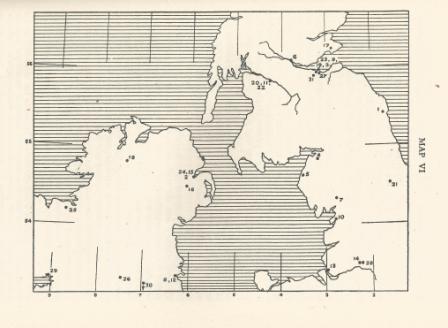
 In the Dark
November 10, 2013 at 4:13 pm
That map only shows a narrow strip of the North; most of the map shows parts of England, Scotland and Ireland instead.
Number 1 looks close to Alnwick in Northumbria, the birthplace of Sir George Biddell Airy (1801-1892), Astronomer Royal from 1835 to 1881.
Incidentally, the map shows only three islands, which is odd. The place where I grew up is under the sea.
November 10, 2013 at 5:13 pm
Anglesey was formed in a volcanic eruption in 1946, which is why it doesn’t appear on the map.
PS Airy is the right answer.
November 10, 2013 at 5:24 pm
Thanks for improving my understanding of geology. I grew up on Ynys Gybi (Holy Island) on the western side of Anglesey. The island is not shown on the map.
November 10, 2013 at 5:59 pm
You’re making this up. The island immediately to the west of Ynys Mon is called Ynys Sun…
November 10, 2013 at 6:52 pm
I emerged fully formed from the sea, like Venus.
November 11, 2013 at 11:09 am
Hi Bryn, in 1961 aged 4 on holiday I nearly drowned off the north coast of Anglesey in a boating accident in which two others did die and which elicited a helicopter from RAF Valley. Earlier this year my rescuer (another holidaymaker, before the helicopter arrived) tracked me down and we met at the spot where it happened.
November 11, 2013 at 11:52 am
Oh, I am very sorry to learn that. I do express my sincere condolences. It must have been a greatly distressing event.
November 11, 2013 at 12:52 pm
Thank you Bryn. I have only two memories of it: going under the water and being unable to breathe (my mother supported me as I had not learned to swim by then) and someone else from our boat managing to leap to nearby rocks. The people who died were in another boat which came out to help but sadly got into the same difficulties. The deceased, my rescuer and our party were all from the same part of Greater Manchester but did not know each other; evidently there was a local tradition of going on holiday round there, east of Amlwch.
While I was there this year I had a look at Parys Mountain above Amlwch, which from the mid-18th to mid-19th century was the world’s largest copper mine. The thought of that enormous hole in the ground being dug out not by machine but by hand set me reeling. What a piece of work is man… I also learned that in the 1990s when it was discovered that a dam associated with the old workings was likely to burst and send a tidal wave through the town, most people just crossed their fingers until the remedial work had been done.
November 11, 2013 at 4:36 pm
Those are tragic events. My thoughts are with the survivors and for those who died.
Parys Mountain is indeed a remarkable place with its huge cavity and the strange colours of the rocks.
November 11, 2013 at 8:07 pm
And the total absence of vegetation on spoil containing metals in such concentrations.
November 11, 2013 at 10:47 pm
That’s right. It is a strange landscape.
Much of the ore was taken to Swansea for smelting, where further toxic chemicals were released, including in smoke, leaving land within Swansea vegetation-free as well.
November 11, 2013 at 11:27 pm
Arsenic is a common byproduct of copper smelting, as it is found in the ore in significant quantities. Not good.
November 10, 2013 at 5:33 pm
Incidentally, it might be added that Airy was born in Alnwick but his family soon moved to Herefordshire and then to Essex. So he spent little time there.
November 11, 2013 at 11:23 am
There are Higgs and Hoyle, although regarding the latter you probably regard the Bradford area as in the Midlands.
November 12, 2013 at 2:51 pm
Yes, Bradford is definitely in the Midlands. Higgs was born in Elswick, a part of Newcastle upon Tyne not far from Benwell where I grew up.