Brighton Seafront in Wartime
Yesterday I stumbled across a collection of old photographs of Brighton seafront. Most of the pictures are charming images of everyday life Brighton, made all the more fascinating by the fact that the city has changed relatively little and all the locations are immediately recognizable. However, in the middle of a sequence of such photographs I saw this:

The view is from the Hove side of the city, with Hove lawns to the left and the West Pier in the distance. Notice that there’s a gap in the Pier. All piers along the south coast of England were cut during the Second World War to prevent them being used as landing jetties by the enemy. I didn’t know that until I saw the gap in this picture and found out more.
There’s no date on the original, so I initially guessed that it must have been taken in 1940 when the threat of invasion during World War 2 was at its height. However, as Bryn Jones pointed out to me on Twitter, the presence of the white star on the vehicle in the foreground marks it out belonging to the US military. I did a little bit of research (via Google) and discovered that the plain white cross was only used by US troops exercising in Britain in 1942. The symbol was subsequently replaced by a white cross surrounded by a white circle, which is the marking used on all US vehicles in Normandy from 1944 onwards. The photograph must therefore have been taken some time in 1942, although the static defences were presumably put in place much earlier in the war. At a guess I’d say that it seems quite likely that US troops stationed in this area may well have used Brighton beach to train for the eventual Normandy landings
As it turns out, Brighton would have been in the front line had the Germans tried to invade England, as the following plan of Operation Sealion makes clear:
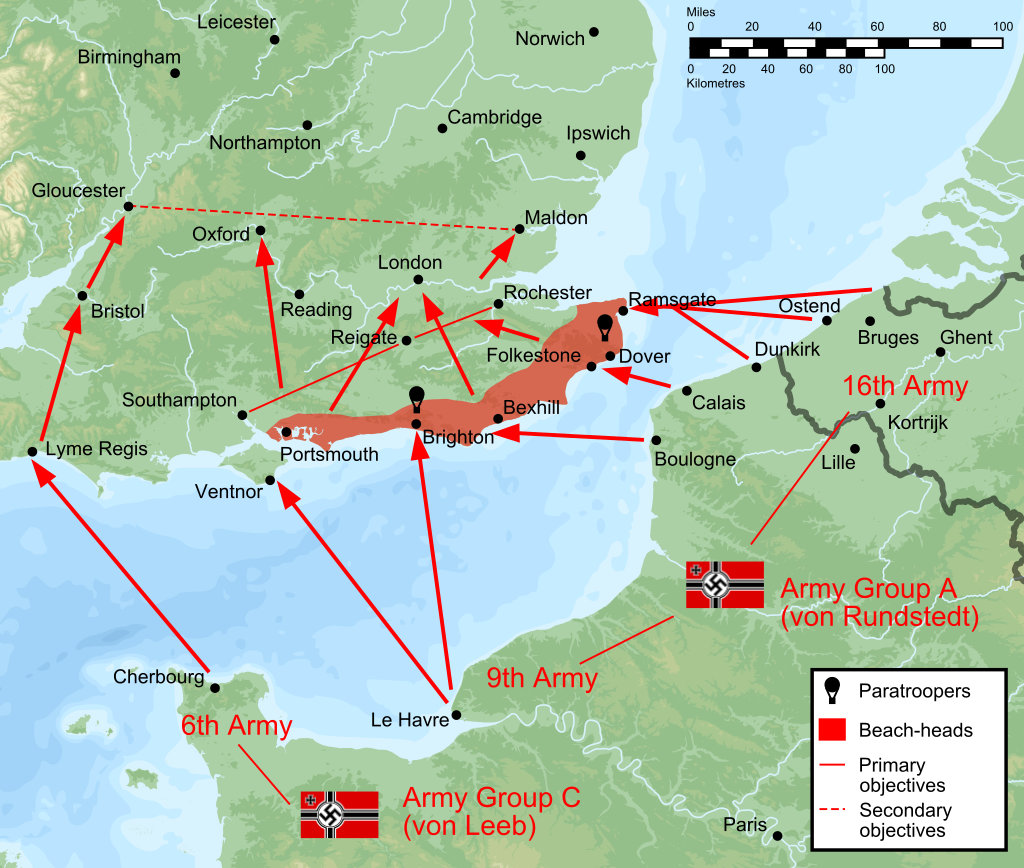
The shore defences in the photograph look pretty fierce, but the planned amphibious assault would have been preceded by parachute landings, so they may have been seized and rendered ineffective by the time the landings began.
Here is a picture of the same general area looking to the West with Hove Lawns on the right:

The beaches were out of bounds to the general public for most of the war, primarily because they were covered in mines, but in any case they would have been pretty inaccessible through all the barbed wire and other obstacles.
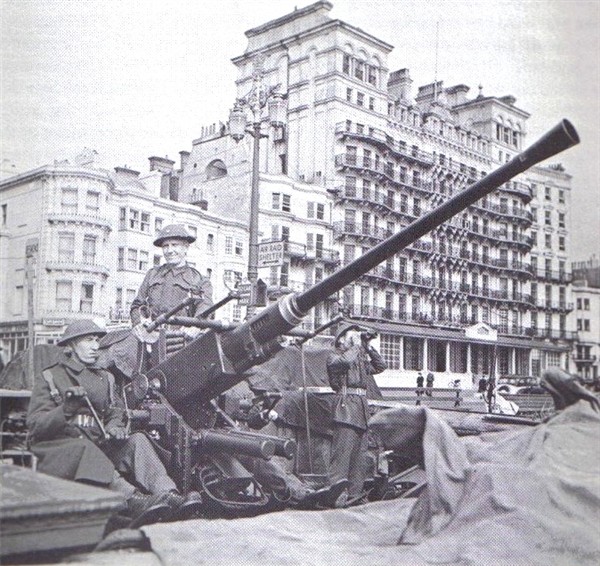
Although the immediate threat of invasion had receded by 1942, Brighton remained on high alert. Here is a picture I found elsewhere on the net, taken in 1943, showing a 40mm Bofors anti-aircraft gun stationed on the seafront not far from the Grand Hotel seen clearly in the background:
The juxtaposition of the comfortingly familiar with the shockingly unfamiliar gives these images tremendous power. It’s hard to imagine what life must have been like under the constant threat of invasion and air raids, but these pictures at least give an idea of how grim it must have been to those of us who are fortunate enough to have never been forced to experience anything like it.
Follow @telescoper
 In the Dark
February 15, 2015 at 2:40 pm
At that time I think US forces would be practising for landing on the beaches of North Africa rather than northern France.
February 15, 2015 at 2:58 pm
There were also preparations for the ill-fated Dieppe raid. Although mainly British and Canadian soldiers were involved, there were also some Americans. And the shingle beach at Brighton is not dissimilar to that at Dieppe. I wonder if the Americans may have played the enemy in exercises relating to this?
January 12, 2016 at 8:44 pm
I would like to use the first photo in my book about the 345 Squadron based at Shoreham. Can somebody advise me who I have to contact. The book is produced on behalf of the Shoreham Airport Museum.
January 13, 2016 at 9:56 am
You will need to contact the owner of the original. I took it from the page linked to in my post:
January 14, 2016 at 3:41 pm
Do you know who the owner is?
January 15, 2016 at 6:46 pm
No.
February 6, 2018 at 3:15 am
My grandmother was a warbride from Brighton…my grandfather was part of the Canadian Army – The First Hussars – a regiment billeted in Hove. This was one of the main areas where the Canadian army was stationed in WWII. There was no training taking place in this area.
May 24, 2020 at 10:38 pm
I have a 2nd great uncle who served in the U.S. infantry during Normandy in the second wave. His division,the 35th, was broken up as replacements. He was most likely in the 140th infantry and landed in Brighton sometime in May 1944 approximately. He stayed in Brighton for about a month and then moved out to Liverpool.He ended up landing on either Utah or Omaha beach on June 8th. The rest of his service is completely unknown except for his being awarded the Bronze Star Medal. Any more info on Brighton U.S. troops would be greatly appreciated.
June 18, 2021 at 8:39 am
The vehicle is not American. It’s a British Bedford 15cwt bowser, and the Allied star was used on all Allied vehicles from c1944 onwards.
February 28, 2025 at 10:46 am
I’d like to use the photograph of Hove looking west in a display for VE Day at Seaford Museum. Do you know who owns the copyright? I’m trying to find images of beach defences in Sussex, if anyone can help.