Einstein’s Legacy
Yesterday I braved the inclement weather and the perils of weekend travel on Southern Trains to visit Queen Mary College, in the East End of London, for the following event:
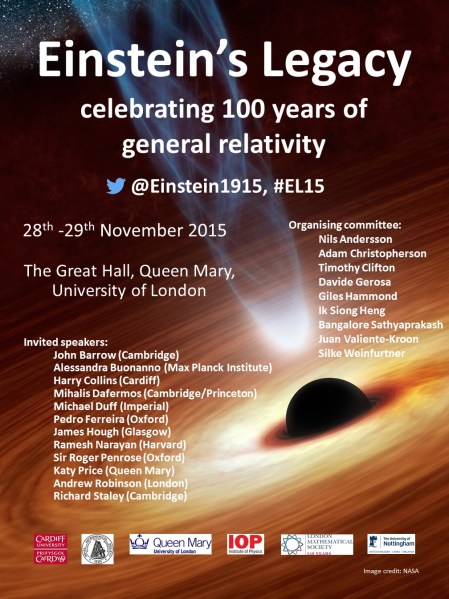
I used to work at Queen Mary, but haven’t been back for a while. The college and environs have been smartened up quite a lot since I used to be there, as seems to be the case for the East End generally. I doubt if I could afford to live there now!
Owing to a little local difficulty which I won’t go into, I was running a bit late so I missed the morning session. I did, however, arrive in time to see my former colleague Bangalore Sathyaprakash from Cardiff talking about gravitational waves, Jim Hough from Glasgow talking about experimental gravity – including gravitational waves but also talking about the puzzling state of affairs over “Big G” – and Pedro Ferreira from Oxford whose talk on “Cosmology for the 21st Century” gave an enjoyable historical perspective on recent developments.
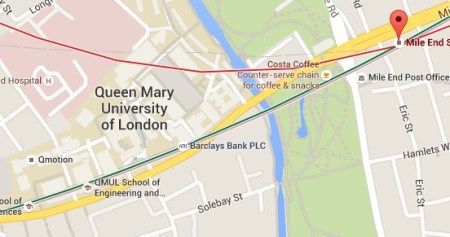
The talks were held in the Great Hall in the People’s Palace on Mile End Road, a large venue that was pretty full all afternoon. I’m not sure whether it was the District/Hammersmith & City Line or the Central Line (or both) that provided the atmospheric sound effects, especially when Jim Hough described the problems of dealing with seismic noise in gravitational experiments and a train rumbled underneath right on cue.
UPDATE: Thanks to Bryn’s comment (below) I looked at a map: the Central Line goes well to the North whereas the District and Hammersmith & City Line go directly under the main buildings adjacent to Mile End Road.
Anyway, the venue was even fuller for the evening session, kicked off by my former PhD supervisor, John Barrow:
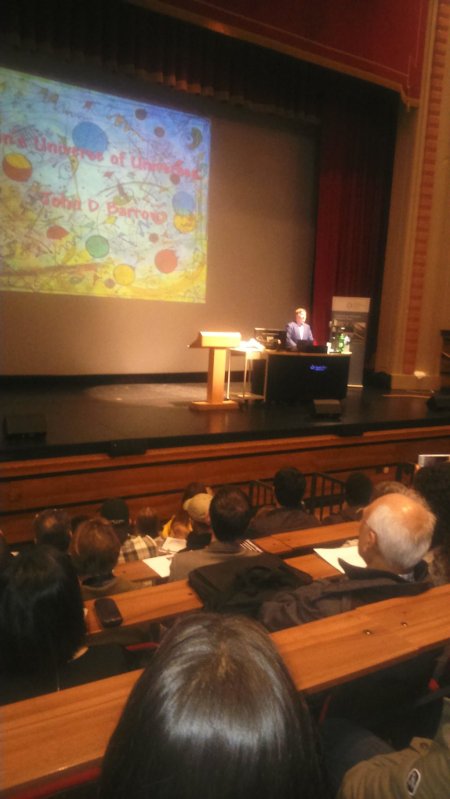
This session was aimed at a more popular audience and was attended by more than a few A-level students. John’s talk was very nice, taking us through all the various cosmological models that have been developed based on Einstein’s theory of General Relativity.
Finally, topping the bill, was Sir Roger Penrose whose talk was engagingly lo-tech in terms of visual aids but aimed at quite a high level. His use of hand-drawn transparencies was very old-school, but a useful side-effect was that he conveyed very effectively how entropy always increases with time.
Penrose covered some really interesting material related to black holes and cosmology, especially to do with gravitational entropy, but my heart sank when he tried at the end to resurrect his discredited “Circles in the Sky” idea. I’m not sure how much the A-level students took from his talk, but I found it very entertaining.
The conference carries on today, but I couldn’t attend the Sunday session owing to pressure of work. Which I should be doing now!
P.S. I’ll say it before anyone else does: yes, all the speakers I heard were male, as indeed were the two I missed in the morning. I gather there was one cancellation of a female speaker (Alessandra Buonanno), for whom Sathya stood in. But still.
Follow @telescoper
 In the Dark
November 29, 2015 at 3:15 pm
It’s the District and the Hammersmith and City lines that run under the People’s Palace. I experienced the rumbling in the Great Hall many times when conducting examinations, although on one occasion I had extra background noise from two people playing the piano on stage during the early part of an examination. I didn’t say anything and they left.
November 29, 2015 at 3:19 pm
Thanks! I’ve often wondered. Presumably the Central Line passed nearby, though, as it has to get from Bethnal Green to Mile End…
I added a map to show the two…
November 29, 2015 at 3:35 pm
Yes, and there are now Crossrail tunnels in the area as well (connecting Whitechapel and Stratford).
November 29, 2015 at 5:20 pm
That’s three blog posts about GR’s 100th birthday. And quite right too!
November 30, 2015 at 8:25 am
You mentioned it – having no female speakers is neither surprising not acceptable. Does QMW have a problem of discrimination? How can this be improved?
November 30, 2015 at 9:46 am
You are, I think, misses an opportunity to make a statement. I don’t believe that in this field women ‘aren’t good enough’. Is there an environment which has discouraged their participation or hindered career progression? Other fields of astronomy have come a long way in addressing the problem of gender discrimination. This field apparently hasn’t . Is there a Marcy problem? Is it something else? In either case, it won’t solve itself and excusing it is not the right approachI.
If you can’t find women working in the field (hard to believe), you redefine the scope of the meeting. You give opportunities to younger people (a meeting such as this is ideal, and most supervisors would happily push their proteges to speak). If the younger people still lack women, it isn’t a problem, it is a crisis.
QMW used to have the lowest fraction of female academics of any UK astronomy department. The current staff list doesn’t show much improvement. They should be aware of this situation and avoid any suggestion of bias.
http://astro.qmul.ac.uk/directory/academic
November 30, 2015 at 12:02 pm
No, you didn’t say that women weren’t good enough and I didn’t intend to imply that. I disagree on you regarding ‘reverse discrimination’. Careers are advanced by invitations to meetings, panels, etc. Denying this to women, either deliberate or unconciously, is discrimination. Countering this is not reverse discrimination. If the speakers list resembles the field (which I doubt), it needs action, not passively waiting until the weather improves. There are things that can be done, starting with the composition of the SOC.
Regarding Marcy, in a field where very few women work and the jobs are handed out by men, people can be very vulnerable. It provides opportunities for predatory behaviour. The Marcy case has been an eye opener. But that is a different discussion.
November 30, 2015 at 12:04 pm
And like you, I am bewildered by the (dis) order in which the comments appear.
November 30, 2015 at 10:12 am
If you can’t find women working in the field (hard to believe), you redefine the scope of the meeting.
You would also need to retitle it if truth is to be maintained.
November 30, 2015 at 10:13 am
PS That’s to Albert, of course.
November 30, 2015 at 11:35 am
Yes, titles of meetings can be adjusted. With A-level student present, it is particularly important to challenge the stereotype of the (older) male physicist. They should have aimed towards a 50/50 ratio of speakers, and SOC members. Is Einstein’s legacy only for half the human race?
November 30, 2015 at 2:16 pm
Anybody of either sex can learn GR and understand Einstein’s legacy. To insist on a 50:50 split of speakers is ludicrous. You choose the best people regardless of sex, orientation, race, height, weight, religion or anything else. Otherwise – and to answer Phillip as well – you should call it the “gender/race/religion-adjusted conference to celebrate the 100th anniversary of GR”. Then people will know what they are really getting.
When my dentist is messing around in my mouth with a sharp drill I want to know that he or she passed dentistry finals on merit, not because of clandestine (or even open) selection by other criteria.
November 30, 2015 at 11:42 am
Thanks for filling me in with some of the details of a meeting I would have loved to attend, but, unfortunately, couldn’t, Peter. Cheers!
December 1, 2015 at 5:43 pm
Peter, are the videos online (or planned to be online)?
Was there any discussion/mention about the LIGO rumor of detection of gwaves which is all over social media?
December 9, 2015 at 9:52 pm
! Re female presenters, Katy Price gave a very nice talk on the reception of GR by different audiences. This included a good discussion of relativity in the British media, although I felt it could have been usefully contrasted with the markedly less enthusiastic reception in Einstein’s homeland..