Archive for general relativity

Weekly Update from the Open Journal of Astrophysics – 16/05/2026

Posted in OJAp Papers, Open Access, The Universe and Stuff with tags , , , , , , , , , , , , , , , , , , , , , , , , , , on May 16, 2026 by telescoper

It’s Saturday once again, so time for another update of activity at the Open Journal of Astrophysics. Since the last update we have published a further five papers, bringing the number in Volume 9 (2026) to 104 and the total so far published by OJAp up to 552. It took us until late July to pass 100 last year.

I will continue to include the posts made on our Mastodon account (on Fediscience) to encourage you to visit it. Mastodon is a really excellent service, and a more than adequate replacement for X/Twitter (which nobody should be using); these announcements also show the DOI for each paper.

The first paper to report this week, published on Monday 11th May in the folder High-Energy Astrophysical Phenomena is “Triaxial magnetars as sources of fast radio bursts” by Jonathan I Katz (Washington University, USA). This paper suggests that the mysterious properties of Fast Radio Bursts (FRB) could be explained by triaxial magnetars, with their activity levels influenced by precessional time scales.

The overlay for this paper is here
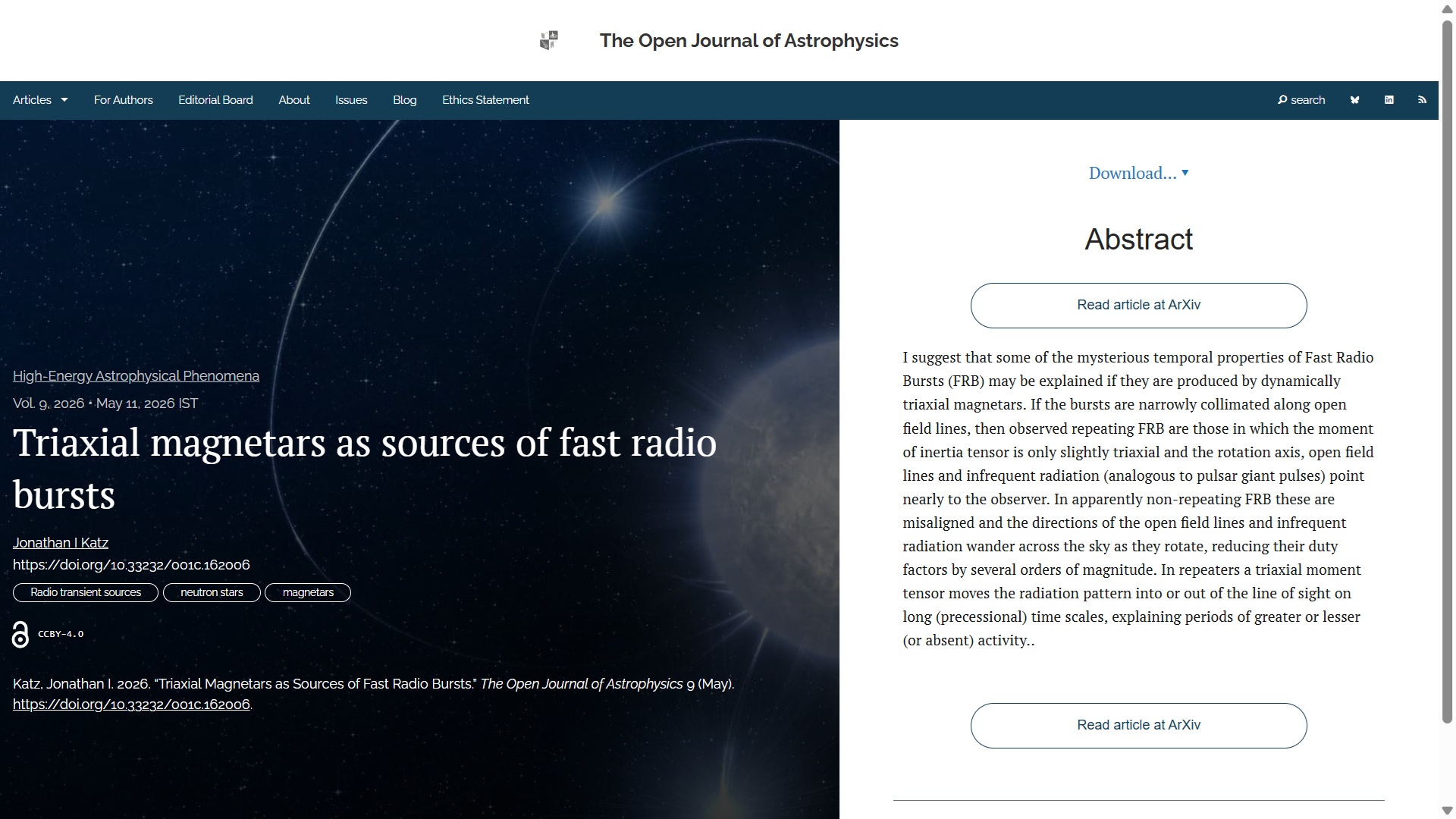
You can find the officially accepted version on arXiv here and the announcement on Fediverse here:

Open Journal of Astrophysics

New Publication at the Open Journal of Astrophysics: "Triaxial magnetars as sources of fast radio bursts" by Jonathan I Katz (Washington University, USA)

doi.org/10.33232/001c.162006

May 11, 2026, 7:32 am 0 boosts 0 favorites

The second paper for this week, published on Tuesday 12th May in the folder Astrophysics of Galaxies, is “The Abundance of Thin Dwarf Galaxies: a Challenge for Cosmological Simulations” by Jose Benavides & Laura V. Sales (UC Riverside, USA), Julio F. Navarro (U. Victoria, Canada), Simon D. M. White (MPA Garching, Germany), and Carlos S. Frenk, Kyle A. Oman & Shaun Cole (U. Durham, UK). Depending on mass up to 40% of galaxies are intrinsically flat, a fraction that numerical models of galaxy formation struggle to reproduce suggesting the models are incomplete.

The overlay for this one is here:
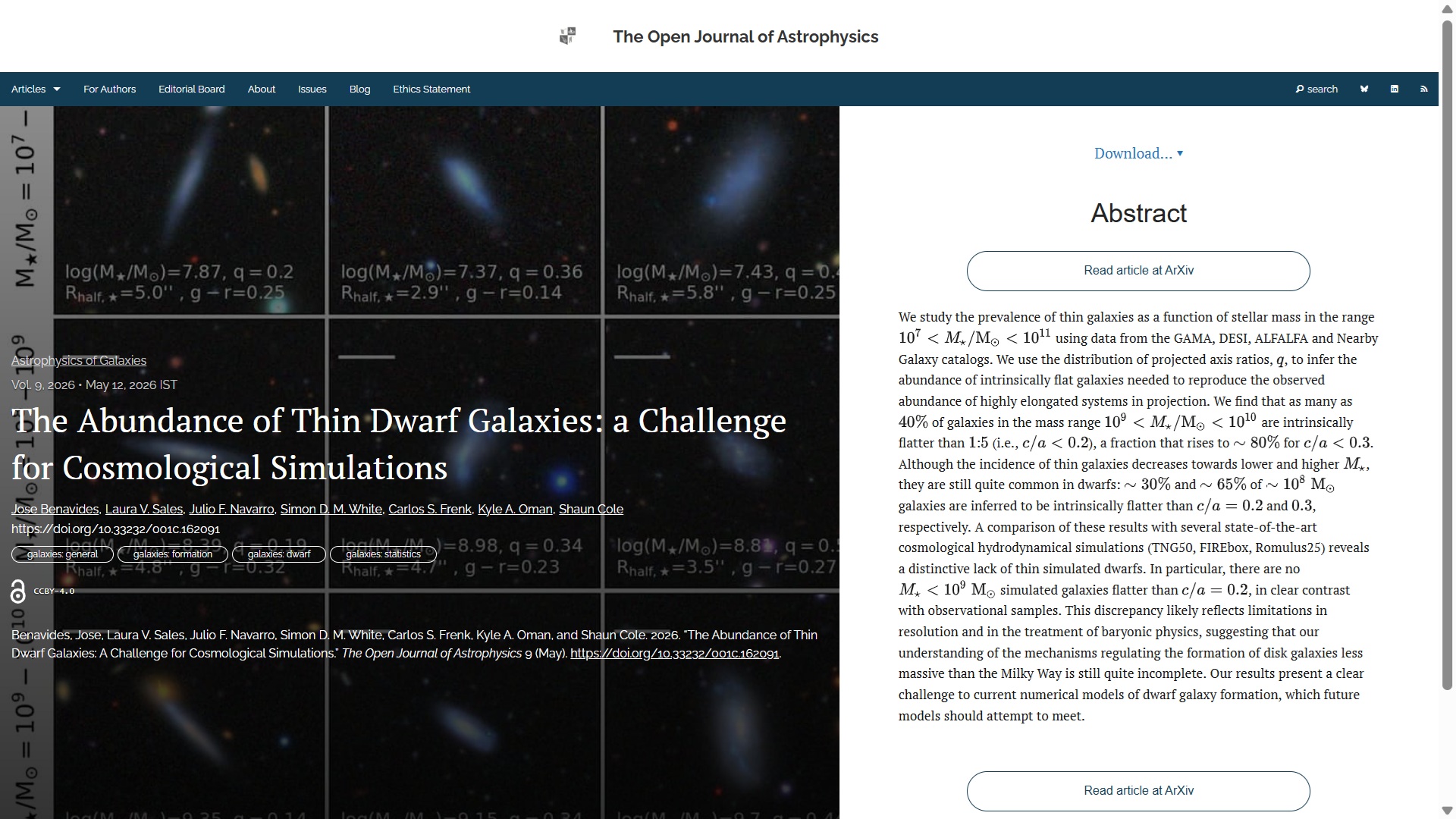
The official version of the paper can be found on arXiv here and the Fediverse announcement here:

Open Journal of Astrophysics

New Publication at the Open Journal of Astrophysics: "The Abundance of Thin Dwarf Galaxies: a Challenge for Cosmological Simulations" by Jose Benavides & Laura V. Sales (UC Riverside, USA), Julio F. Navarro (U. Victoria, Canada), Simon D. M. White (MPA Garching, Germany), and Carlos S. Frenk, Kyle A. Oman & Shaun Cole (U. Durham, UK)

doi.org/10.33232/001c.162091

May 12, 2026, 6:07 am 1 boosts 3 favorites

Next one up, the third paper of the week, also published on Tuesday 12th May but in the folder Cosmology and Nongalactic Astrophysics is “Cosmological peculiar velocities in general relativity” by Chris Clarkson (Queen Mary, University of London, UK) and Roy Maartens (U. Western Cape, South Africa). This paper refutes claims that the 1+3 covariant approach to cosmological perturbation theory predicts stronger growth of galaxy peculiar velocities, arguing that standard treatments are correct and fully relativistic.

The overlay for this one is here:
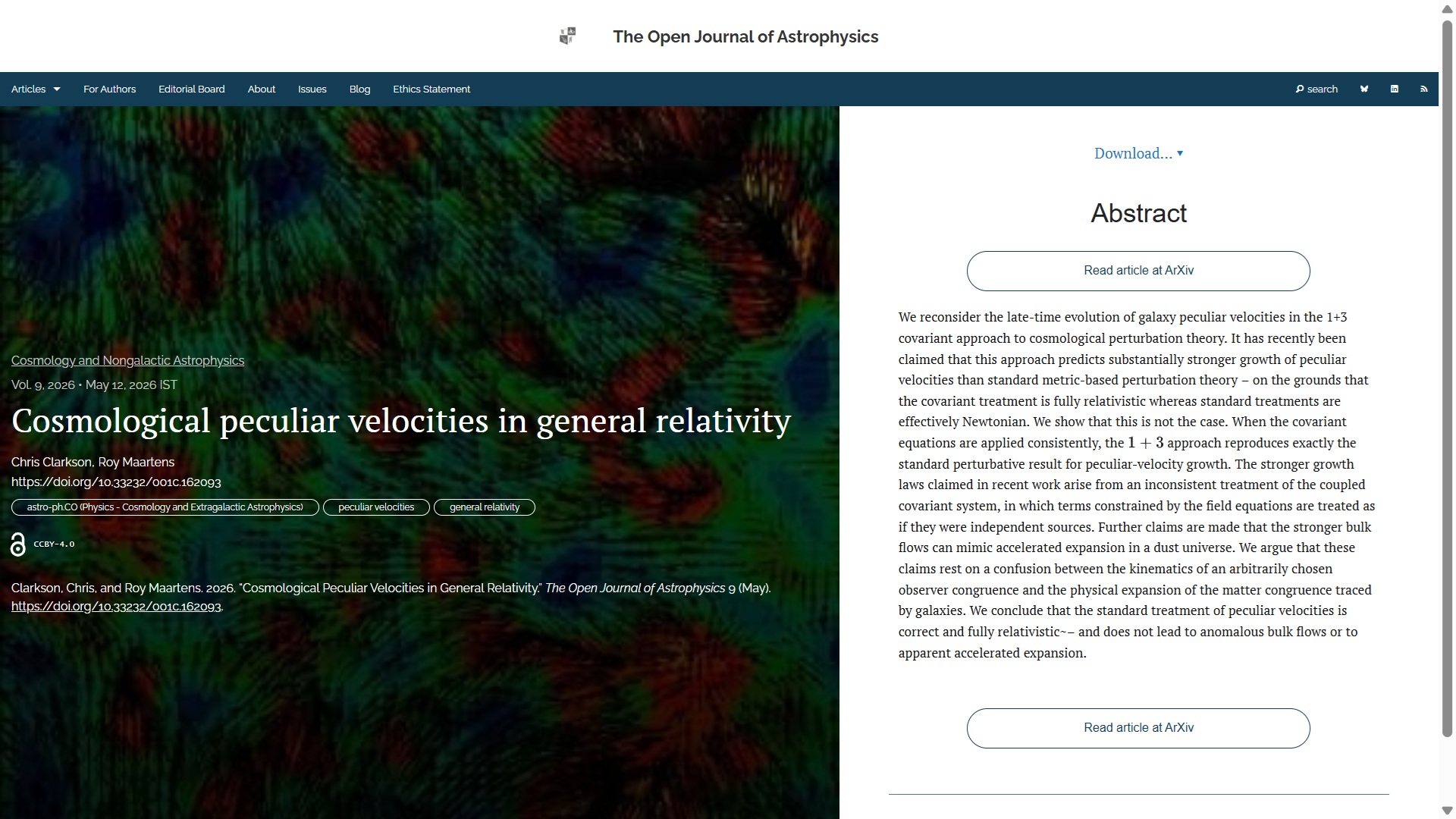
The final, accepted version can be found on arXiv here and the Mastodon announcement is here:

Open Journal of Astrophysics

New Publication at the Open Journal of Astrophysics: "Cosmological peculiar velocities in general relativity" by Chris Clarkson (QMUL, UK) and Roy Maartens (U. Western Cape, South Africa)

doi.org/10.33232/001c.162093

May 12, 2026, 6:37 am 1 boosts 1 favorites

The fourth paper this week, published on Wednesday May 13th “Possible evidence for a pair-instability supernova nature of ultra-early JWST sources” by Andrea Ferrara & Stefano Carniani (Scuola Normale Superiore, Pisa, Italy), Takahiro Morishita (California Institute of Technology, USA), and Massimo Stiavelli (Space Telescope Science Institute, USA). Published in the section Astrophysics of Galaxies. This paper argues that recent observations challenge early galaxy formation models, suggesting that the bright source, Capotauro, could be a supernova from a massive, metal-free star, not a luminous galaxy as initially thought.

The overlay is here:
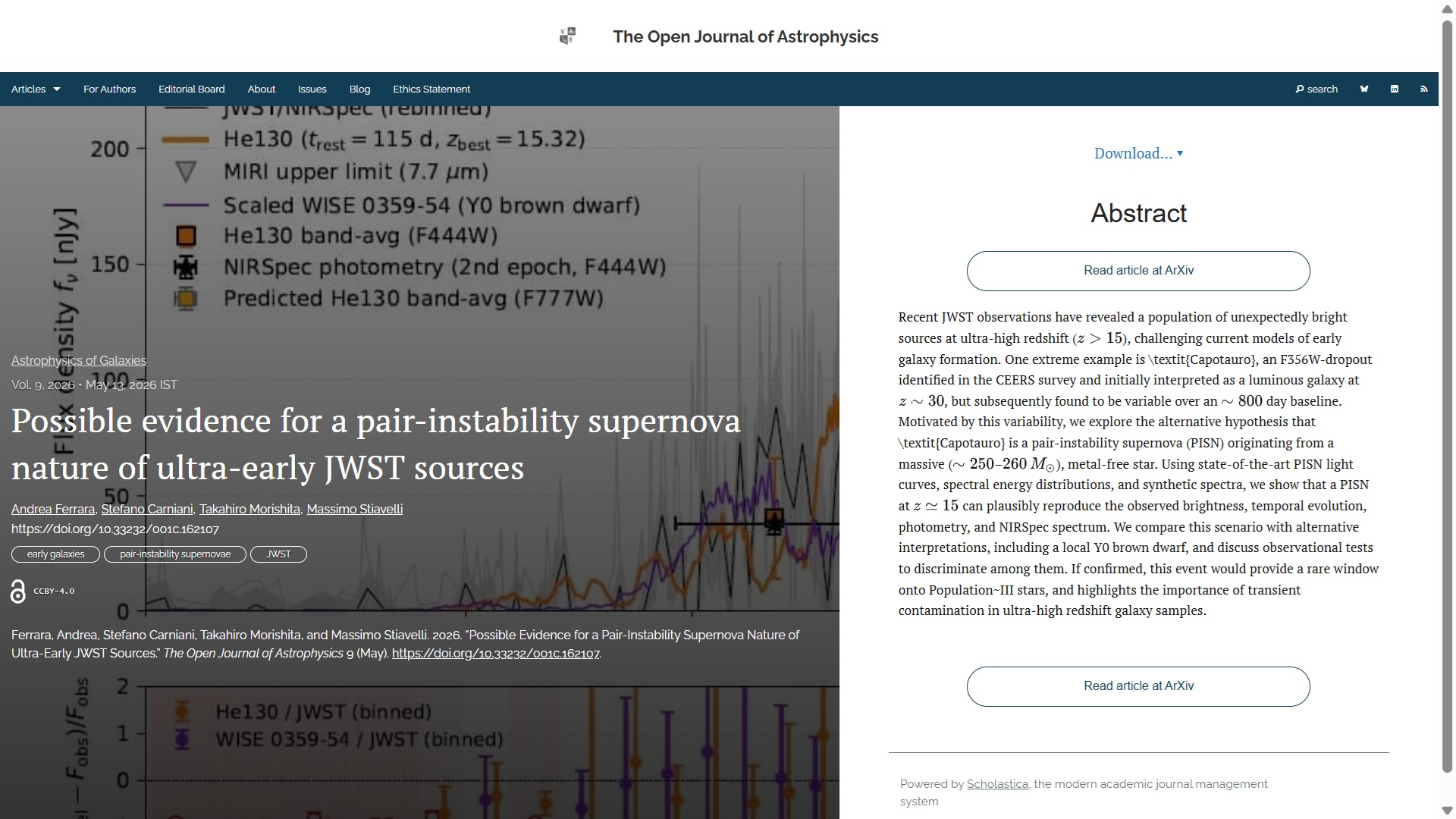
The officially accepted version can be found on arXiv here and here is the Mastodon announcement:

Open Journal of Astrophysics

New Publication at the Open Journal of Astrophysics: "Possible evidence for a pair-instability supernova nature of ultra-early JWST sources" by Andrea Ferrara & Stefano Carniani (Scuola Normale Superiore, Pisa, Italy), Takahiro Morishita (Caltech, USA) and Massimo Stiavelli (STScI, USA)

doi.org/10.33232/001c.162107

May 13, 2026, 7:44 am 1 boosts 1 favorites

The fifth and final article of this week was also published on Wednesday 13th May but in the folder Cosmology and Nongalactic Astrophysics. The title is “Evolving and interacting dark energy: photometric and spectroscopic synergy with DES Y3 and DESI DR2” and it is by Maria Tsedrik and Benjamin Bose (University of Edinburgh, UK). The study investigates the Dark Scattering interacting dark energy scenario, using data from various sources. Results show no evidence of dark-sector interaction and a preference for the Chevallier-Polarski-Linder parametrisation.

The overlay is here:
You can find the authorized version of this paper on arXiv here and the Fediverse announcement is here:

Open Journal of Astrophysics

New Publication at the Open Journal of Astrophysics: "Evolving and interacting dark energy: photometric and spectroscopic synergy with DES Y3 and DESI DR2" by Maria Tsedrik and Benjamin Bose (University of Edinburgh, UK)

doi.org/10.33232/001c.162135

May 13, 2026, 7:48 am 1 boosts 0 favorites

And that concludes this week’s update. I’ll do another next Saturday.

Geometric and General Relativistic Techniques for Non-relativistic Quantum Systems

Posted in Maynooth, The Universe and Stuff with tags , , on February 19, 2025 by telescoper

The other day I mentioned the forthcoming graduation of a Maynooth PhD student. His name is Aonghus Hunter-McCabe and his main supervisor was Maynooth colleague Brian Dolan, and I just took over when Brian retired to see Aognhus through the latter stages. Anyway, asof yesterday, his thesis is available on arXiv (on hep-th) as well as on the Maynooth University Research Archive Library (MURA) here, so as it is all in the public domain I thought I would advertise it here, as I think it is very good indeed (though I would say that!) and also in case anyone out there is looking to employ a PDRA in a related area…

The abstract is:

This thesis explores the application of differential geometric and general relativistic techniques to deepen our understanding of quantum mechanical systems. We focus on three systems, employing these mathematical frameworks to uncover subtle features within each. First, we examine Unruh radiation in the context of an accelerated two-state atom, determining transition frequencies for a variety of accelerated trajectories via first-order perturbation theory. For harmonic motion of the atom in a vacuum, we derive transition rates with potential experimental realizations. Next, we investigate the quantum Hall effect in a spherical geometry using the Dirac operator for non-interacting fermions in a background magnetic field generated by a Wu-Yang monopole. The Atiyah-Singer index theorem constrains the degeneracy of the ground state, and the fractional quantum Hall effect is studied using the composite fermion model, where Dirac strings associated with the monopole field supply the statistical gauge field vortices. A unique, gapped ground state emerges, yielding fractions of the form ν=1/(2⁢k+1) for large particle numbers. Finally, we examine the AdS/CMT correspondence through a bulk fermionic field in an RN-AdS4 background (with a U(1) gauge field), dual to a boundary fermionic operator. Spherical and planar event horizon geometries are discussed, with the temperature of the RN black hole identified with that of the dual system on the boundary. By numerically solving for the spectral functions of the dual theory, for a spherical event horizon at zero temperature, we identify a shift in the Fermi surface from that which arises in the planar case. Preliminary evidence of a phase transition emerges upon examining these spectral functions, again for the spherical horizon, at non-zero temperature.

arXiv:2502.13009

Newton’s Opticks and a Query about the Bending of Light

Posted in History, The Universe and Stuff with tags , , , , on December 5, 2024 by telescoper

The story of the famous 1919 expeditions to measure the bending of light by the Sun as a test of general relativity has featured many times on this blog (e.g. here). I ahve also written elsewhere about it, e.g. here. One way this is often presented is whether the measurements preferred the “Einstein” prediction or one consistent with “Newton”, there being a famous factor of two between the two.

In fact the earliest published calculation of the deflection of light by the Sun was not by Isaac Newton but by Johann Georg von Soldner (Uber die Ablenkung eines Lichstrals von seiner geradlinigen Bewegung, durch die Attraktion eines Weltk¨orpers, and welchem er nahe vorbei geht. Berliner Astronomisches Jahrbuch, 1801: 161-172). This calculation does use Newtonian theory, but as far as I know there is no record tof any calculation of this sort by Newton himself.

There is, however, something very tantalizing in Newton’s 1704 book Opticks, published almost 20 years after his Principia outlined the laws of mechanics and of universal gravitation. Opticks which (unlike the Principia) was written in English, ends with a series of rhetorical questions called “Queries” which present speculative ideas about light and its interactions with matter. The first of these reads:

Query 1. Do not Bodies act upon Light at a distance, and by their action bend its Rays; and is not this action (caeteris paribus) strongest at the least distance?

This looks very much like a speculation about the bending of light by gravitation. But if that’s what it is, he could have done exactly what Soldner did about a century later. Why then did he never publish the result and why was it never found among his unpublished papers?

I’ve spoken to several people about this and there are three main ideas. One is that Newton actual did the Soldner calculation, and that the manuscript was accidentally destroyed in a fire caused by his dog, Diamond. The other is that he just never got round to it, which seems unlikely because it’s not a difficult calculation and Newton lived over 20 years after the publication of the Opticks. The third possibility is that Query 1 wasn’t about gravity at all. If it had been, wouldn’t he have used the word and wouldn’t he have mentioned the inverse-square law specifically? Perhaps what he had in mind was some kind of refraction. This interpretation is consistent with other Queries where he talks about the “aetherial Medium” through which he supposed light to propagate being distorted by the presence of massive bodies and thus causing refraction. For example, from Query 21,

Is not this Medium much rarer within the dense Bodies of the Sun, Stars, Planets and Comets, than in the empty celestial Spaces between them?

I suppose we’ll never know what Newton had in mind. I am split between the first and third explanations above.

It’s worth mentioning that some of the other Queries are very prescient. Take Query 5, for example:

Do not Bodies and Light act mutually upon one another; that is to say, Bodies upon Light in emitting, reflecting, refracting and inflecting it, and Light upon Bodies for heating them, and putting their parts into a vibrating motion wherein heat consists?

Clever chap, Newton!

Gravitational Waves from Failing Warp Drives

Posted in OJAp Papers, The Universe and Stuff with tags , , , , , on July 29, 2024 by telescoper

In Saturday’s roundup of the week’s publications at the Open Journal of Astrophysics I mentioned a paper entitled “What no one has seen before: gravitational waveforms from warp drive collapse” by Katy Clough (QMUL, UK), Tim Dietrich (Potsdam, Germany) and Sebastian Khan (Cardiff, UK). 

Looking at the title of this paper you might be tempted to dismiss it on the grounds that warp drives are the stuff of science fiction (which they are), but this paper is really a rigorous technical study of the dynamical evolution and stability of spacetimes that violate the null energy condition, inspired by the idea of a warp drive. As soon as I announced this paper on social media it started to get attention. That will probably increase because there is now a press release to accompany the paper. I’ve taken the liberty of reproducing the text of the press release here:

–o–

Imagine a spaceship driven not by engines, but by compressing the spacetime in front of it. That’s the realm of science fiction, right? Well, not entirely. Physicists have been exploring the theoretical possibility of “warp drives” for decades, and a new study published in the Open Journal of Astrophysics takes things a step further – simulating the gravitational waves such a drive might emit if it broke down. 

Warp drives are staples of science fiction, and in principle could propel spaceships faster than the speed of light. Unfortunately, there are many problems with constructing them in practice, such as the requirement for an exotic type of matter with negative energy. Other issues with the warp drive metric include the potential to use it to create closed time-like curves that violate causality and, from a more practical perspective, the difficulties for those in the ship in actually controlling and deactivating the bubble. 

This new research is the result of a collaboration between specialists in gravitational physics at Queen Mary University of London, the University of Potsdam, the Max Planck Institute (MPI) for Gravitational Physics in Potsdam and Cardiff University. Whilst it doesn’t claim to have cracked the warp drive code, it explores the theoretical consequences of a warp drive “containment failure” using numerical simulations.

Dr Katy Clough of Queen Mary University of London, the first author of the study explains: “Even though warp drives are purely theoretical, they have a well-defined description in Einstein’s theory of General Relativity, and so numerical simulations allow us to explore the impact they might have on spacetime in the form of gravitational waves.” 

Co-author Dr Sebastian Khan, from Cardiff University’s School of Physics and Astronomy, adds: “Miguel Alcubierre created the first  warp drive solution during his PhD at Cardiff University in 1994, and subsequently worked at the MPI in Potsdam. So it’s only natural that we  carry on the tradition of warp drive research in the era of gravitational wave astronomy .”

The results are fascinating. The collapsing warp drive generates a distinct burst of gravitational waves, a ripple in spacetime that could be detectable by gravitational wave detectors that normally target black hole and neutron star mergers. Unlike the chirps from merging astrophysical objects, this signal would be a short, high-frequency burst, and so current detectors wouldn’t pick it up. However, future higher-frequency instruments might, and although no such instruments have yet been funded, the technology to build them exists. This raises the possibility of using these signals to search for evidence of warp drive technology, even if we can’t build it ourselves. 

Dr Khan cautions “In our study, the initial shape of the spacetime is the warp bubble described by Alcubierre. While we were able to demonstrate that an observable signal could in principle be found by future detectors, given the speculative nature of the work this isn’t sufficient to drive instrument development.”

The study also delves into the energy dynamics of the collapsing warp drive. The process emits a wave of negative energy matter, followed by alternating positive and negative waves. This complex dance results in a net increase in the overall energy of the system, and in principle could provide another signature of the collapse if the outgoing waves interacted with normal matter. 

This research pushes the boundaries of our understanding of exotic spacetimes and gravitational waves. Prof Dietrich comments: “For me, the most important aspect of the study is the novelty of accurately modelling the dynamics of negative energy spacetimes, and the possibility of extending the techniques to physical situations that can help us better understand the evolution and origin of our universe, or the avoidance of singularities at the centre of black holes.”

Dr Clough adds: “It’s a reminder that theoretical ideas can push us to explore the universe in new ways. Even though we are sceptical about the likelihood of seeing anything, I do think it is sufficiently interesting to be worth looking!” 

The researchers plan to investigate how the signal changes with different warp drive models and explore the collapse of bubbles travelling at speeds exceeding the speed of light itself. Warp speed may be a long way off, but the quest to understand the universe’s secrets continues, one simulated crash at a time.

Relativistic Hurling?

Posted in GAA with tags , , , on May 22, 2024 by telescoper

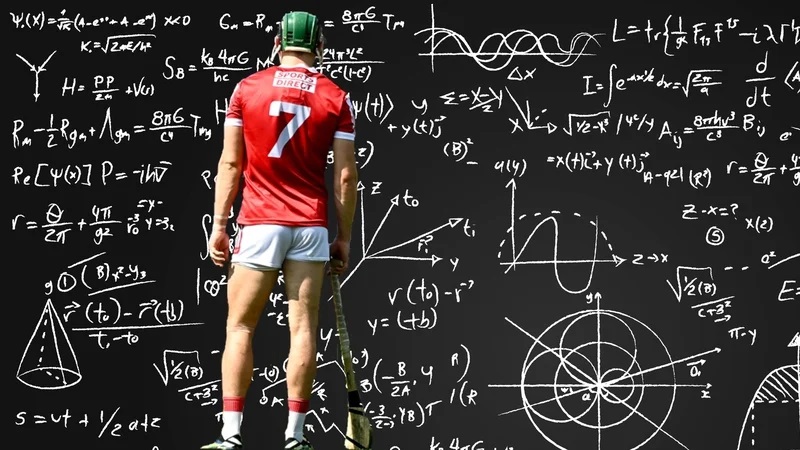
I was intrigued to see this graphic accompanying an article about hurling. Notice that the left hand side shows the field equations of Einstein’s General Theory of Relativity and some expressions to do with quantum mechanics. Hurling is indeed an extraordinary – and extraordinarily fast – sport but is the article implying that classical physics is inadequate to describe it? Perhaps it is implying that through hurling we will at last arrive at a Theory of Everything?

New Publication at the Open Journal of Astrophysics

Posted in OJAp Papers, The Universe and Stuff with tags , , , , , on December 31, 2023 by telescoper

It’s New Year’s Eve and I just remembered that there was a paper at the Open Journal of Astrophysics site that we published before Christmas but that I haven’t yet announced on here, so for the sake of completeness here it is. It takes us to 50 papers published in 2023.

The paper in question is the 50th and final paper  in Volume 6 (2023)  and it’s the 115th altogether. This one was actually published on Friday 22nd December 2023 but owing to the vacations we had to wait a bit to get the metadata registered.

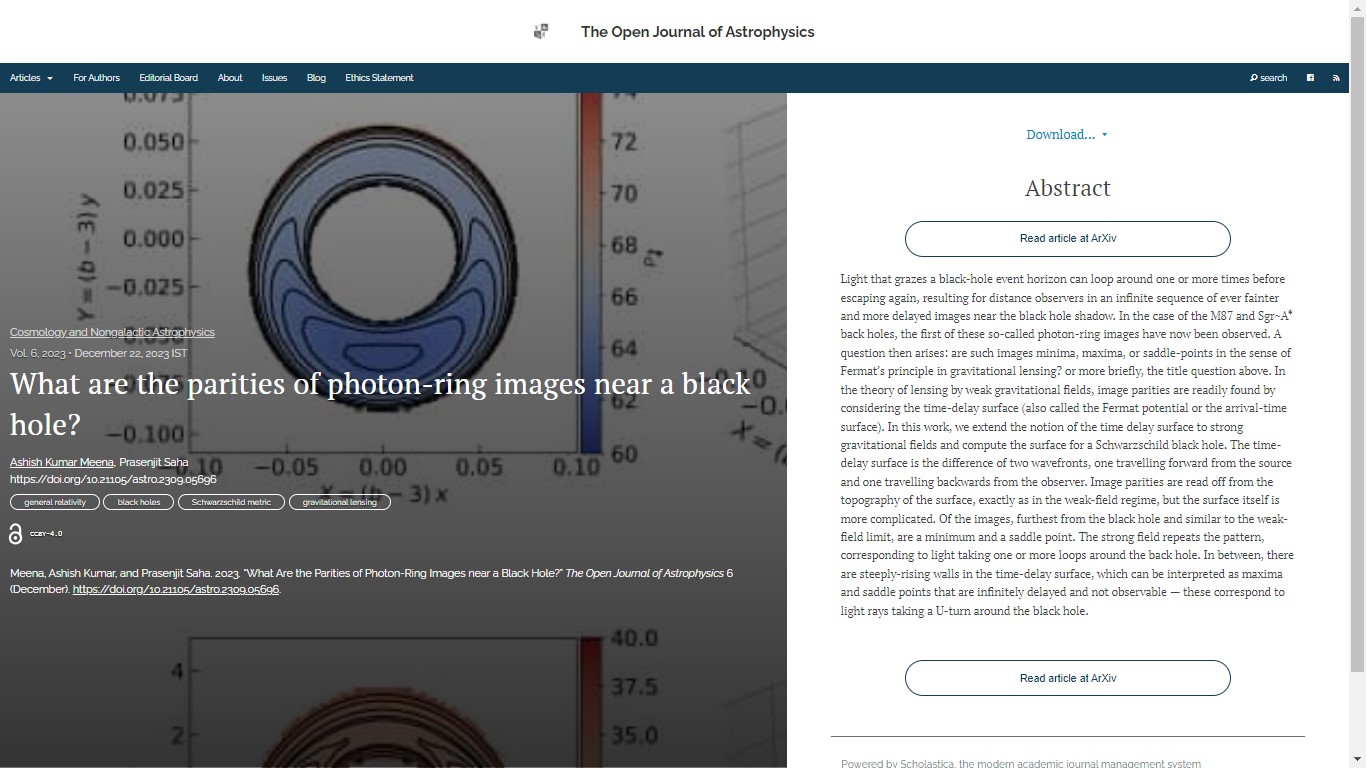
The title of this one is “What are the parities of photon-ring images near a black hole?” and is a discussion of the Fermat potential (also known as the arrival-time surface) in the context of gravitational lensing by strong gravitational fields and the implication for image parities thereby produced. This one is actually listed in General Relativity and Quantum Cosmology (gr-qc, on arXiv) but is cross-listed as Cosmology and Non-galactic Astrophysics so is eligible for publication here in the appropriate folder.

The authors are Ashish Kumar Meena (Ben Gurion University of the Negev, Israel) and Prasenjit Saha (University of Zurich, Switzerland).

Here is the overlay of the paper containing the abstract:


You can click on the image of the overlay to make it larger should you wish to do so. You can find the officially accepted version of the paper on the arXiv here.

And that concludes Volume 6 of the Open Journal of Astrophysics. Roll on Volume 7.


DolanFest

Posted in Maynooth, The Universe and Stuff with tags , , , on September 9, 2023 by telescoper

This morning found me in Renehan Hall in St Patrick’s House in Maynooth for ‘DonalFest’, a meeting to mark the retirement of former colleague (now Emeritus) Professor Brian P. Dolan, who retired a couple of years ago in the midst of the pandemic, which delayed his leaving do.

Today’s meeting involved a number of talks given by Brian’s past and present collaborators in the splendid surroundings of the old college (and, I might add, in glorious weather). Unfortunately I had to leave before the end in order to attend to some logistical matters to do with my impending departure on sabbatical, but I’m sure the rest of it was as enjoyable as the bit I was able to be at.

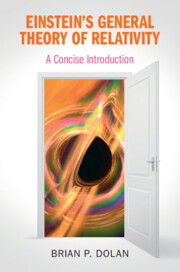
All of which gives me an excuse to plug again this textbook (left), based on the lecture notes Brian used to teach a final-year undergraduate course in General Relativity to Mathematical Physics students here in Maynooth.

The book’s description reads:

Einstein’s general theory of relativity can be a notoriously difficult subject for students approaching it for the first time, with arcane mathematical concepts such as connection coefficients and tensors adorned with a forest of indices. This book is an elementary introduction to Einstein’s theory and the physics of curved space-times that avoids these complications as much as possible. Its first half describes the physics of black holes, gravitational waves and the expanding Universe, without using tensors. Only in the second half are Einstein’s field equations derived and used to explain the dynamical evolution of the early Universe and the creation of the first elements. Each chapter concludes with problem sets and technical mathematical details are given in the appendices. This short text is intended for undergraduate physics students who have taken courses in special relativity and advanced mechanics.

You can order the book and/or recommend a copy to your library here.

Anyway, let me end with some personal wishes to Brian for a long and happy retirement!

General Relativity Book Plug!

Posted in Maynooth, The Universe and Stuff with tags , , on June 8, 2023 by telescoper

Just a very quick note to advertise a new book by former colleague (now Emeritus) Professor Brian P. Dolan, who retired a couple of years ago, but is still active in research.This textbook (left) is based on the lecture notes he used to teach a final-year undergraduate course in General Relativity to Mathematical Physics students here in Maynooth.

The book’s description reads:

Einstein’s general theory of relativity can be a notoriously difficult subject for students approaching it for the first time, with arcane mathematical concepts such as connection coefficients and tensors adorned with a forest of indices. This book is an elementary introduction to Einstein’s theory and the physics of curved space-times that avoids these complications as much as possible. Its first half describes the physics of black holes, gravitational waves and the expanding Universe, without using tensors. Only in the second half are Einstein’s field equations derived and used to explain the dynamical evolution of the early Universe and the creation of the first elements. Each chapter concludes with problem sets and technical mathematical details are given in the appendices. This short text is intended for undergraduate physics students who have taken courses in special relativity and advanced mechanics.

You can order the book and/or recommend a copy to your library here.

R.I.P. Jim Hartle (1939-2023)

Posted in R.I.P., The Universe and Stuff with tags , , , , on May 27, 2023 by telescoper

It’s another one of the occasions on which I have to use this blog to pass on some sad news. Renowned physicist James B. Hartle has passed away.

Jim Hartle’s scientific work was concerned with the application of Einstein’s theory of general relativity to astrophysics, especially gravitational waves, relativistic stars, black holes, and cosmology, specifically the theory of the wave function of the universe. For much of his career he was interested in the earliest moments of the big bang where the subjects of quantum mechanics, gravity theory and cosmology overlap, leading among other things to the Hartle-Hawking conjecture.

Jim Hartle was one of the speakers at the very first scientific conference I attended in Cargèse, Corsica way back in 1986. I remember his lectures very well after all these years, not least because he was so witty. I remember his response when someone asked him about the existence of large dimensionless numbers in cosmology: “…it’s a property that numbers have that some of them are larger than others.”

Condolences to his family, friends and colleagues. Rest in peace, Jim Hartle (1939-2023).

50 Years of Hawking & Ellis

Posted in mathematics, The Universe and Stuff with tags , , , on February 15, 2023 by telescoper

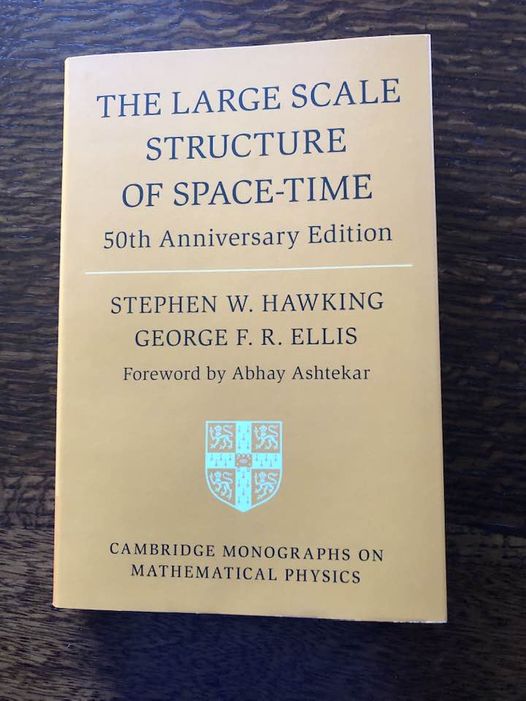
Today, 16th February 2023, sees the official publication of a special 50th anniversary edition classic monograph on the large scale structure of space-time by Stephen Hawking and George Ellis. My copy of a standard issue of the book is on the left; the special new edition is on the right. The book has been reprinted many times, which testifies to its status as an authoritative treatise. I don’t have the new edition, actually. I just stole the picture from the Facebook page of George Ellis, with whom I have collaborated on a book (though not one as significant as the one shown above).

This book is by no means an introductory text but is full of interesting insights for people who have studied general relativity before. Stephen Hawking left us some years ago, of course, but George is still going strong so let me take this opportunity to congratulate him on the publication of this special anniversary edition!

P.S It struck me while writing this post that I’ve been working as a cosmologist in various universities for getting on for about 35 years and I’ve never taught a course on general relativity. As I’ll be retiring pretty soon it’s looking very likely that I never will…