A Cube of Resistance
It has been brought to my attention that I haven’t posted any cute physics problems recently, so here’s one (which involves applying Kirchoff’s laws) that’s a bit harder than A-level standard which might be of interest to students about to begin a degree in physics this month!
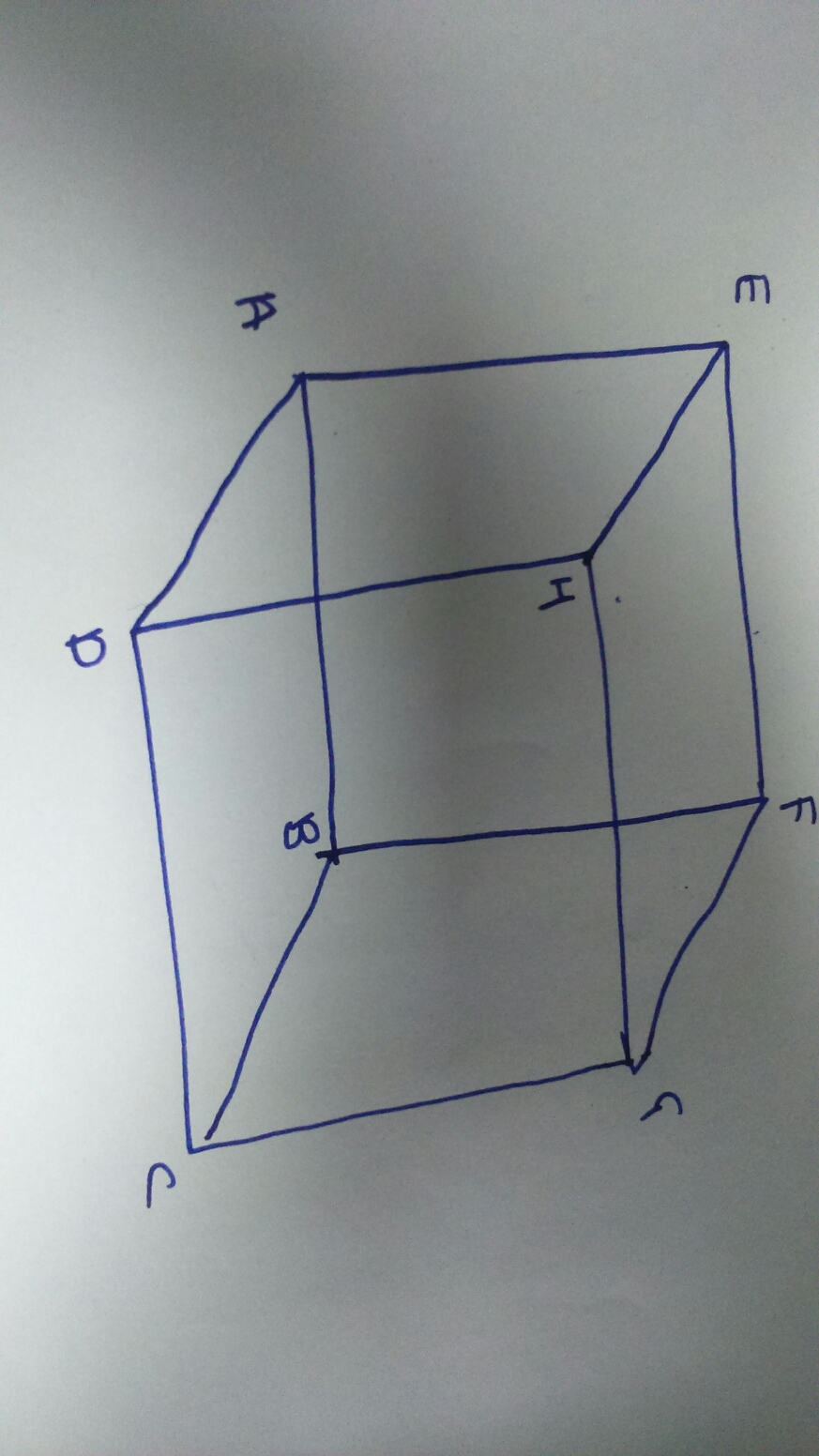
The above image, produced using the advanced computer graphics facilities available at Cardiff University’s Data Innovation Research Institute, represents a cube formed of 12 wires each of which has resistance 1Ω.
What is the electrical resistance between: (i) A and G; (ii) A and H; and (iii) A and D?
As usual, answers through the comments box please!
Follow @telescoper In the Dark
September 14, 2017 at 7:06 pm
5/6, 3/4, 7/12 Ohms? Or are we supposed to notice that there a break in part of the circuit at C, in which case it’s probably harder…
September 14, 2017 at 8:12 pm
That’s an error in the software…
September 15, 2017 at 1:01 am
5/8 for A-G
September 15, 2017 at 4:43 pm
That’s not the answer on the card….
September 15, 2017 at 6:24 pm
I got the same answers as Alan.
This is a nice problem. To keep the algebra from getting ugly, you need to pay attention to the symmetries, of course. I found it a bit tricky to do that on my drawing at first. If I had had an actual cube in front of me that I could draw on, I think it would have been a lot easier.
September 15, 2017 at 6:32 pm
Yes, the symmetry is key!
Alan’s answers are correct, by the way. Or at least they’re the same as mine!
September 15, 2017 at 6:36 pm
Well, which?
September 15, 2017 at 10:00 pm
Ted obviously meant to say “..on which I could draw”..
September 15, 2017 at 8:53 pm
AG = 2 ohms, AD = 1 ohm
September 16, 2017 at 6:15 pm
5/6, 3/4, 7/12. I don’t teach maths (but is did electronic engineering 😉
September 19, 2017 at 10:35 am
Here’s the reasoning for AG.
Connect A and G to a variable-voltage battery, and adjust this battery so that we inject 1A at A and take out 1A at G. If we can work out what voltage V we are running the battery at, we know the resistance R between A and G since R = V/I and I = 1 A.
Let the potential at A be zero. Then, by symmetry, 1/3 A flows from A through each of the 1 ohm resistors AB, AD and AE. So the potential at B, D and E is 1/3.
Similarly, 1/3 A flows through CG, FG and HG towards G. So, since the potential at G is V, the potential at C, F, H is (V – 1/3).
Consider now the situation at one of the intermediate vertices, say E. By symmetry the current in EF and EH is identical. For EF the current is the potential difference between E and F divided by the resistance of 1 ohm, ie I_EF = (V – 1/3) – 1/3 = (V – 2/3). Now apply Kirchhoff’s law of conservation of current at E. 1/3 A flows into it from A, and 2(V – 2/3) flows out of it. So
1/3 = 2(V – 2/3)
and consequently V = 5/6. This is (as stated above) the voltage which gives rise to an overall current of 1A; hence the resistance between A and G is 5/6 ohm.
The other situations have lower symmetry and we therefore have to work Kirchhoff’s laws a bit harder, but the idea is the same.
September 19, 2017 at 2:42 pm
Surely that’s the reasoning of AJMG?