Drought in Greater Dublin
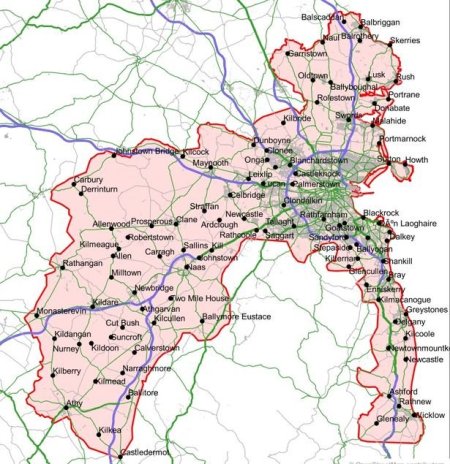
The prolonged period of dry weather we’ve been having in Ireland has led to a water shortage in Greater Dublin and some surrounding districts, including Maynooth in County Kildare (where I live). A hosepipe ban has been in place for some time and now there are restrictions on overnight water usage in Dublin, although not yet in Maynooth.
The map above shows the area affected by the hosepipe ban, which doesn’t affect me because I haven’t got a garden, but I’ve included it because it shows Maynooth and some of the neighbouring towns, in one of which I might well find myself living permanently.
The bus route from Maynooth to Dublin Airport passes through Leixlip and Lucan Village. My current residence is on Straffan Road, which leads south from Maynooth to Straffan. Other notable places are Kilcock, Celbridge, and… er…. Newcastle.
Follow @telescoper In the Dark
July 17, 2018 at 9:51 am
The drought is having interesting effects in Britain and Ireland:
https://www.bbc.co.uk/news/uk-44767497
July 17, 2018 at 10:03 am
County Meath (which is next door to Kildare) has some amazing neolithic sites, especially around Newgrange. Ongoing excavations there have revealed a passage tomb which is 5500 years old:
https://www.irishtimes.com/news/science/5-500-year-old-passage-tomb-at-dowth-is-find-of-a-lifetime-1.3567118
July 17, 2018 at 11:20 am
Yes indeed, I read this same story here:
https://www.bbc.co.uk/news/world-europe-44850668
July 17, 2018 at 11:37 am
Irish archaeology is absolutely fascinating – there are many amazingly rich sites. A big contrast with England & Wales of course is that there is no period of Roman occupation.
July 17, 2018 at 12:30 pm
But there was a Roman camp on the coast wasn’t there, even if they didn’t take it further?
July 17, 2018 at 12:57 pm
That’s controversial, I believe. There is evidence of a fortified settlement at Drumanagh (near Dublin) where Roman coins and goods were found but it could well have been a Celtic settlement and the finds might have been loot from elsewhere.
I do find it a bit hard to believe that no Romans ever set foot in Ireland, though, and Drumanagh may well have been some sort of trading post or temporary fort for a reconnaissance mission. If that site is Roman, and that was all there was, then it didn’t amount to a full invasion and there’s certainly nothing like the roads or other infrastructure that’s so common in England & Wales.
July 17, 2018 at 1:23 pm
Sure. I think it wonderful that nobody knows the site of the Battle of Watling Street at which Boudicca’s federation of British tribes went down to the Romans nearly 20 years after they had invaded, ending significant resistance to Roman rule in the south of England. Various sites have been proposed but these are dozens of miles apart. The clues are Tacitus’ description of the immediate geography (a valley opening out into a plain) plus what is stated of the Roman commander’s movements. Upon hearing of Boudicca’s uprising he sped back from Anglesey, where he was campaigning, to London, ordering his troops to follow as quickly as possible; decided London was indefensible and ordered its evacuation; hurried back along Watling St, made the same decision about St Albans, then met up with his troops on the road; after that came the battle. A clue is that he ordered other legionnaires in the west country to join him, and he might have sought to expedite the rendezvous. But nobody knows for sure. Also the site of the Battle of the Teutoburg Forest, at which three Roman legions were taken down in AD9, essentially ending Roman attempts to extend the borders of their empire from the Rhine to the Elbe, was found only in 1987. (There was a campaign of reprisal against the Germanic tribes involved, but no further attempt at colonisation.)
July 17, 2018 at 1:39 pm
Tacitus did write that Agricola planned an invasion of Ireland, perhaps in conjunction with an exiled Irish chief, but also suggested that Agricola thought just one legion would be enough. If he did send one legion to conquer Ireland then it clearly didn’t succeed…
July 17, 2018 at 2:00 pm
I think it was at No. 37 Watling Street.
July 17, 2018 at 2:13 pm
Agricola thought just one legion would be enough. If he did send one legion to conquer Ireland then it clearly didn’t succeed
Ah, a new theory for what happened to the lost 9th?
Any sources for the Drumanagh site, please?
July 17, 2018 at 2:36 pm
Here’s a nice overview of the context for the whole site (It’s on the coast, North of Dublin, not far from the airport). There is a Martello tower on the promontory visible from the air as you fly in. That dates from the 19th Century. Given its location it’s no surprise that there is evidence of Viking activity in the neighbourhood too.
There are various newspaper articles arguing for or against the possibility of there being a Roman camp there. Some would argue that it looks more like an Iron Age fort.
Click to access C%20Drumanagh%20Understanding%20the%20monument%20-%20history.pdf
July 17, 2018 at 2:38 pm
ps. Here’s a wordpress blog about the site:
July 17, 2018 at 3:01 pm
Fascinating – thank you!
July 18, 2018 at 7:48 am
[…] post here because it’s very interesting and it follows on from a comment thread relating to my post a few days ago about the current drought in Ireland which has revealed many previously unknown features of […]
July 19, 2018 at 12:14 am
I don’t know much about the outer parts of Dublin, but I did spend an enjoyable couple of days walking in the Wicklow mountains about 10 years ago, staying at a B&B. It was n the white area of the map to the south, east of Calverstown and Castledermot, and a bit east of that green road running through the white area. There were 4 very interesting stone circles, Athgreany, Bohonagh, Castleruddery and I forget the name of the 4th. The landlady showed true Irish hospitality by driving me to a suitable place to start walking, as the sites were well separated, and recommending pubs to stop for lunch/dinner. Beware, Irish country pubs seem less common than English ones, and some only open in the evening.