Archive for the Maynooth Category

My Bucket’s Got a Hole in It

Posted in Biographical, Jazz, Maynooth with tags , , , , on June 14, 2026 by telescoper

“Only connect” is EM Forster’s best known adage about writing, though he didn’t mean it in the context of a “shitty WordPress blog”. Nevertheless I do find it fun sometimes to connect disparate things, so here goes.

I was doing a turn in the garden this afternoon when I noticed that an old bucket left here by the previous occupant had corroded enough to develop a hole:

This reminded me of the old song My Bucket’s Got a Hole in It and especially this very enjoyable version of it by Humphrey Lyttelton’s 1954 seven-piece live at the Conway Hall in London.

It’s hard to believe that it’s 18 years since Humph passed away, but it’s great to hear his voice again in the introduction to the track which ends the A side of the album Humph at the Conway. The cartoon on the cover is by him too. The record features Humph on trumpet, the clarinet by Wally Fawkes (who plays the first clarinet solo) and Bruce Turner on alto sax who switches to clarinet for the second solo but plays sax in the ensembles which sound absolutely terrific as a result. Many “trad” jazz fans took against Humph for including a saxophonist in his band, but Bruce Turner was a great musician and added a new dimension. The other members of the band were Johnny Parker (piano), Micky Ashman (bass), Freddy Legon (banjo) and George Hopkinson (drums).

So that’s one connection. Another is that yesterday saw the announcement of the King’s Birthday Honours in the UK, which was not covered widely here in in Ireland, but which independently reminded me that Humphrey Lyttelton turned down a knighthood on principle back in 1995. Good for him!

Boards of Examinations

Posted in Education, Maynooth with tags , , , , , on June 10, 2026 by telescoper

Over the last few days we have been having our annual meetings of the Board of Examiners in the Department of Physics at Maynooth. This process began last Friday with a preliminary meeting of those involved in the theoretical side of the Department, continued on Monday with another preliminary meeting for the experimentalists, continued yesterday with a final meeting with both sides of the house and a visit by two External Examiners, and ended this morning with a meeting I couldn’t attend with feedback. This is the first time since the Departments of Theoretical Physics and Experimental Physics merged that we have run the process like this. I think one of the primary purposes of the merger was to streamline the bureaucracy, but it seems to have had the opposite effect, with everything taking much longer. It was ever thus.

Still, at least I got a nice dinner with the Externals.

Since we have reached the end of the academic year, we looked yesterday at the final grades of those students who are completing their studies this year in order to consider the classification of their degrees. Another (pleasant) duty of our Examination Board was to award prizes for the best performance, not just for finalists but for students at every stage, including the first year. These will be announced in due course.

But that’s not quite the end of it – there is an overall University Examination Board that covers all courses in the University to formally bring an end to the examination process. It is not until after all the Boards have done their business that the students get their marks. If all goes to plan, students will receive their final marks onThursday 25th June, a couple of weeks from now.

In previous years this would have been followed by a Consultation Day on which:

Staff will be available in all Departments to discuss results with students. Students are entitled to see their examination scripts if they wish, these will be generally available on this day or at another mutually convenient time.

In its drive to scrap everything that could possibly be useful to students, however, Maynooth University has now ditched the formal Consultation Day. Well, you can’t expect a University running an €11M surplus to put any resources into processes for advising students can you?

If I had my way we would actually give all students their marked examination scripts back as a matter of routine. Obviously examination scripts have to go through a pretty strict quality assurance process involving the whole paraphernalia of examination boards (including External Examiners), so the scripts can’t be given back immediately but once that process is complete there doesn’t seem to me any reason why we shouldn’t give their work, together with any feedback written on it,  back to the students in its entirety. I have heard it argued that under the provisions of the Data Protection Act students have a legal right to see what’s written on the scripts – as that constitutes part of their student record – but I’m not making a legalistic point here. My point is purely educational, based on the benefit to the student’s learning experience, so this is unlikely to be adopted.

So that’s my internal examination duties here at Maynooth done and dusted. In a month or so I have to travel abroad to be an external examiner at another institution.

Leaving Again

Posted in Biographical, Education, Maynooth with tags , , , on June 3, 2026 by telescoper

It is an important day for many young people in Ireland because the Junior Certificate and Leaving Certificate examinations both start today, so the first thing I need to do is wish everyone starting their examinations the very best of luck!

Among other things, the results of the leaving certificate examinations are important for September’s university admissions. In the system operating in England and Wales the standard qualification for entry is the GCE A-level. Most students take A-levels in three subjects, which gives them a relatively narrow focus although the range of subjects to choose from is rather large. In Ireland the standard qualification is the Leaving Certificate, which comprises a minimum of six subjects, with many students taking more than this. This gives students a broader range of knowledge at the sacrifice (perhaps) of a certain amount of depth; it has been decreed for entry into this system that an Irish Leaving Certificate subject counts as about 2/3 of an A-level subject for admissions purposes, so Irish students do the equivalent of at least four A-levels, and many do more than this. It’s also worth noting that all students have to take Mathematics at Leaving Certificate level. One can choose to do Leaving Certificate subjects at Ordinary or Higher level and there’s quite a big difference between the two, especially in Mathematics.

Overall I prefer the Leaving Certificate over the UK system of A-levels, partly the former gives the students a broader range of subjects than the latter. I would have liked to have been allowed to take at least one arts subject past O-level, for example. Another reason is that all students across the country take the same examination, so the difficulty or otherwise of the papers is a topic of national conversation. There will no doubt be many reactions in the media over the forthcoming days!

Anyway, tomorrow is a significant date for me (in more ways than one) so I’m up early this morning before heading off on a short journey to mark the occasion in style.

Eclipse Event – a Date for your Diaries!

Posted in The Universe and Stuff, Maynooth with tags , , , , , on June 2, 2026 by telescoper

Here’s an invitation to people interested in astronomy to join staff from the Department of Physics at Maynooth University on Wednesday, August 12th 2026 from 5:30 pm to 8:30 pm for a special public celebration of one of the deepest solar eclipses visible from Ireland in decades. The next eclipse with > 90% obscuration of the Sun by the Moon won’t be seen again in Ireland until 2090, by which time I will have retired.

Experience the eclipse safely through:

  • eclipse viewing glasses
  • solar telescopes
  • live astronomy demonstrations

List of Solar Talks during the evening:

  • Dr. Emma Whelan – The Story of the Sun
  • Dr. Joshuah Heath – The Quantum Sun
  • Dr. Marcin Gradziel – (Electric) Power from the Sun. The good, the bad, and the glinty!
  • Dr. Michelle McCrystall – The star of the show: How the Sun drives our climate
  • Prof. Peter Coles – Einstein and the Eclipse (Who He? Ed.)
  • Dr. Patrick Kavanagh – Will our Sun go Supernova?

The evening will also include:

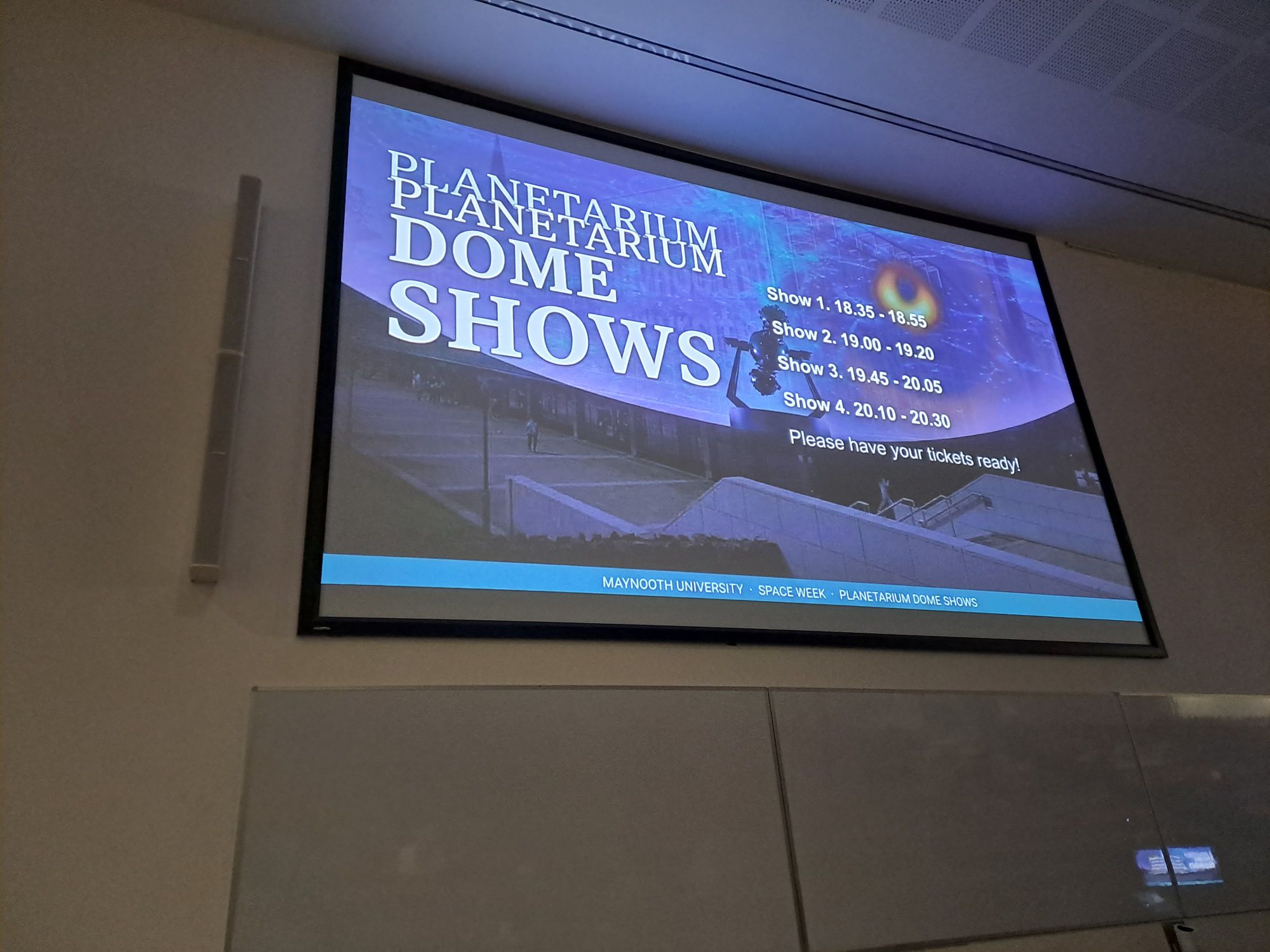
  • an immersive* astronomy show in our inflatable planetarium
  • hands-on arts and crafts activities for children

*especially if it rains

Maynooth University Staff can reserve a place here until June 14th, after which booking will be opened to the general public – I’ll repost this invitation with a link at that time.

Concern about Research Ireland’s Strategy and Programme Plan

Posted in Maynooth, Science Politics with tags , , on May 28, 2026 by telescoper

This post is to draw attention of Irish colleagues to an open letter going around about the “Strategy” recently publuished by Research Ireland (Taighde Éireann). I have signed it, as have over a thousand others, including many colleagues at Maynooth University. The opening paragraph of this letter reads:

We, the undersigned, are writing to express deep concern about the priorities within Taighde Éireann – Research Ireland’s recently published 2026-2030 strategy and programme plan that will guide the distribution of over €4.55 billion in public funds over the next five years. The new strategy is structurally, rhetorically and materially focused on commercially translatable research and economic impact rather than supporting bedrock, fundamental, discovery research and research for the public good. The disproportionate focus on industry interests instead of discovery research and the public interest marginalises the Arts, Humanities and Social Sciences (AHSS) and the fundamental sciences, and minimises research for social good and research that is truly innovative and ground-breaking.

You can read the rest of the letter, and also sign it if you are so inclined, here. The letter highlights the downgrading of Arts, Humanities and Social Sciences but is relevant to anyone in any discipline who believes in funding research as a public good, not just a means of channeling funding to the private sector.

When I arrived in Ireland in 2017 the thing that struck me immediately was that funding for basic or fundamental research – especially in the sciences – is extremely poor, and in some areas non-existent. That is still the case now. I was cautiously optimistic when Research Ireland was created from the merger of Science Foundation Ireland and the Irish Research Council, but the general thrust seems to be more of the same. Worse, some of the few valuable programmes (such as those for funding PhD students and postdoctoral researchers) are being completely dismantled.

For what it’s worth, I’ll repeat a view that I have shared previously on many occasions:

… “commercially useful” research should not be funded by the taxpayer through research grants. If it’s going to pay off in the short term it should be funded by private investors, venture capitalists of some sort or perhaps through some form of National Investment Bank. When the public purse is so heavily constrained, it should only be asked to fund those things that can’t in practice be funded any other way. That means long-term, speculative, curiosity driven research.

This is pretty much the opposite of the Research Ireland strategy. It wants to continue concentrating public funds in projects that can demonstrate immediate commercial potential. Taxpayer’s money used in this way ends up in the pockets of entrepreneurs if the research succeeds and, if it doesn’t, the grant has not fulfilled its stated objectives and the funding has therefore, by its own standards, been wasted.

My proposal, therefore, is phase out research grants for groups that want to concentrate on commercially motivated research and replace them with research loans. If the claims they make to secure the advance are justified, they should have no problem repaying the funds from the profits they make from patent income or other forms of exploitation. If not, then they will have to pay back the loan from their own funds (as well as being exposed as bullshit merchants). The loans could be made at very low interest rates and still save a huge amount of the current research budget. I suggest these loans should be repayable in 3-5 years, so in the long term this scheme would be self-financing. I think a large fraction of research in, e.g., the applied sciences and engineering should be funded in this way. I think it is wrong to nationalise the risk only to privatise the profits.

The money saved by replacing grants to commercially driven research groups with loans could be re-invested in those areas where public investment is really needed, such as purely curiosity-driven science. Here grants are needed because the motivation for the research is different. Much of it does, in fact, lead to commercial spin-offs, and when that happens it is a very good thing, but these are likely to appear only in the very long term. But just because this research does not have an immediate commercial benefit does not mean that it has no benefit. For one thing, it is subjects such as Astronomy and Particle Physics that inspire young people to get interested in science in the first place.

You don’t have to agree with this, however, to sign the letter.

UPDATE: The letter has been noticed. It is featured in the Irish Times of 2nd June 2026.

UPDATE: Research Ireland has now issued a statement in response.

A Room with a View

Posted in Biographical, Maynooth with tags , on May 27, 2026 by telescoper

The spell of warm sunny weather has made a huge difference to the view from my office window:

Well, what did you expect to see from a Maynooth University office window? Sydney Opera House perhaps? The Hanging Gardens of Babylon? Herds of Wildebeest sweeping majestically across …

On Blow-Ins

Posted in Biographical, Maynooth with tags , , on May 25, 2026 by telescoper
ox-eye daisies

At the start of the spring gardening season I decided to leave a bed that I had cleared unplanted to see what would grow there of its own accord. I expected standard weeds like dandelions, and did get a few of those, but more recently I have a considerable number of Ox-eye Daisies (Leucanthemum vulgare). The flowers look very like those of regular daisies (of which I also have a few on the front lawn) but the plants are much bigger: I estimate they’re about 80cm tall. Anyway, I find the white and yellow very striking against the green foliage behind so I’m very happy to see these wild flowers thriving.

These must have blown in as seeds, along with the numerous other wild flowers I have in the garden. That reminds me that the term “blow-in” is used colloquially in Ireland to denote someone who has just moved into a town or village where they have no deep familial roots. I’ve been called a “blow-in” many times, not always in a friendly way.

This reminds me of  an article I saw in the Irish Times soon after arriving here about British immigrants in Ireland. Being one such myself I find a lot of it rings true. You can read the article here (I don’t think it’s behind a paywall). I think it’s well worth a look.

I found quite a few things in it resonate quite strongly with my experiences since I arrived here eight and a half years ago. Top of these was the realization of just how ignorant I was about Irish history, thanks to the almost total neglect of this topic in British schools. Lack of education inevitably leads to lack of understanding and more often than not leads to prejudice and one finds a lot of that in the attitude of British people, even senior figures (many of them “educated” at Oxford) who are supposed to know better.

I was also struck by the “Not Really Irish” tag, which I think about rather a lot. It’s not really just a question of whether or not you have Irish citizenship or an Irish passport, it’s about the extent to which you belong. I spent over fifty years living in England and Wales so I’m missing a huge amount of cultural background pertaining to Ireland. I won’t ever be able to catch up all that so I don’t suppose I’ll ever feel `really Irish’. Of course people speak English here, but I’m very conscious that I have a funny accent. I suppose that means I’ll always feel like a stranger in Ireland. If there is predominant attitude towards the British over here, however, in my experience it is one of sympathy rather than hostility.

Anyway, since I am a metaphorical blow-in I suppose it’s only fair that I have so many literal ones in my garden!

Not in Barcelona…

Posted in Barcelona, Biographical, Maynooth with tags , , , on May 25, 2026 by telescoper

So much has happened since that it’s hard to believe that just two years ago I was enjoying a sabbatical in Barcelona. I was delighted when it was announced that this year’s Euclid Consortium Meeting would be held there, but when I saw the dates (25th to 29th May) I was worried that the meeting might clash with examining duties. When the examination timetable was published a couple of months ago, that possibility became a reality and I realized that I couldn’t attend. In fact I have an examination to deal with tomorrow, and will be grading the scripts for the rest of the week ahead of the Bank Holiday weekend.

It’s a shame I can’t make the EC meeting because this will be the last one before the first main release of data, DR1, which is scheduled to take place on October 21st this year. I’ve been following progress in the science working group on galaxy clustering via weekly Zoom conferences, but it would have been nice to see what has been going on in the other groups as well as catching up with colleagues in person as opposed to online.

The second data release, DR2 will not happen until March 2029, by which time I will have retired. In fact there will be at most two Euclid Consortium meetings that I can attend – in 2027 and 2028 – and the second of those may be after my retirement. The final data release, DR3, will happen in October 2031.

It’s worth also mentioning that there will be another Quick Release of data, this one from the Euclid Galactic Bulge Survey, on June 24 this year. There will be quite a lot of press activity around that, but I’m not involved in it.

Here is the complete timeline for reference:

I’d like to take this opportunity to wish everyone involved in the Euclid Consortium Meeting an enjoyable and productive time in Barcelona as well as a fun stay in what is truly an amazing city. I’ll be enjoying the beautiful weather in Maynooth (25°C and sunny) while all the participants are slaving over hot cosmology.

On My Knees

Posted in Biographical, Education, Maynooth with tags , , , , on May 22, 2026 by telescoper

It has taken a bit longer that I expected to get this far but I have now completed the grading of one of my modules. It wasn’t the written examination that took all the time, but the marking of the computational physics projects. This is always a slow job but for some reason it took even longer this year. Anyway, all components of the assessment for that module are now done and dusted and everything uploaded.

To add to the fun and games, last week I did the biannual trip to Naas for my anti-arthritis injections. I’ve been doing this regularly for some years now and it has become routine. When I first started I was told that there was a risk of one or both knees swelling up, but that has never happened. Until last week, that is. My right knee decided to swell up alarmingly. Although this was not really painful, I was forced to stay at home to rest and periodically apply a bag of ice. That worked well enough that I could go to last Friday’s concert (with the aid of a walking-stick) but it wasn’t until Sunday that I was properly recovered.

The alarm having passed I am now starting to feel the benefit of the jabs. I am planning sometime soon to walk from Maynooth to Dublin along the Royal Canal, that being the last leg of the National Famine Way. I want to be sure I can manage the 27km walk before attempting to do the full walk later in the summer. The weather is set fair for a few days so I might give it a go next week, assuming I manage to finish all my examining duties promptly. It’s the season finale at the National Concert Hall next Friday – followed by a long weekend break when I will be travelling a little, so I might try to do it on Thursday.

My next examination is not until Tuesday morning so, after several days of being shut away doing corrections, I can now spend a few days until the scripts are ready to collect doing numerous things that I’ve let slip while I’ve been busy. For one thing I have an inbox full of unanswered emails to attend to.

But for now I’m quite tired and in the mood only to vegetate.

Cat Crainn

Posted in Irish Language, Maynooth with tags , , , , , on May 21, 2026 by telescoper

In Irish, a pine marten – such as the one shown on the left – is cat crainn which means literally “cat of the tree” or, less clumsily, “tree cat”. The word for “tree” in the nominative case is crann and the genitive meaning “of the tree” is crainn. They are about the size of a domestic cat.

I mention the pine marten partly because a while ago it came up on Bitesize Irish, which is a way I’m trying to add to my meagre vocabulary of Irish words and phrases, and partly because the story of these animals is quite fascinating. Pine martens have existed in Ireland for thousands of years alongside native red squirrels whose habitat is similar. More recently the invasive grey squirrels arrived and bullied their smaller red cousins into decline. Pine martens were also in serious decline because of hunting and deforestation and were critically endangered until recently, when legal protections were introduced. Now the population is growing and they are spreading into new areas.

Pine martens are fierce predators who eat all kinds of small mammals including rats and voles as well as squirrels. Having coexisted with them for ages, red squirrels have learnt to avoid pine martens quite effectively. Pine martens will try to catch them but don’t find them easy prey. Grey squirrels are a different matter, though, so there has been a big difference in the rate of predation with the grey squirrels being forced out of many areas. This differential effect has been excellent news for the red squirrels, whose population is recovering strongly.

I’m told that there are pine martens on the campus at Maynooth, though I have never actually seen one in the flesh and am not sure where they live. This is not surprising – they are secretive and good at hiding. There are grey squirrels on Maynooth campus too. I have seen many. I’ve never seen any red squirrels though. If the pine martens thrive, perhaps that will change?

Although undeniably cute, with their chocolate-coloured coat and creamy yellow bib, pine martens are wild animals and will bite if you give them cause. The word for “bite” in Irish is greim.