The Simons Observatory: Science Goals and Forecasts
I haven’t been involved in this project, but several of my former colleagues at Cardiff have beenm and still are, so I know how much work has gone into this (especially by the amazing Erminia Calabrese), so I am happy to share this impressive work here. This long (54 pages) paper, which appeared on the arXiv last week, describes the latest step forward in ground-based cosmology using the cosmic microwave background. It shows just how rapid the onward march of instrumental technology continues to be.
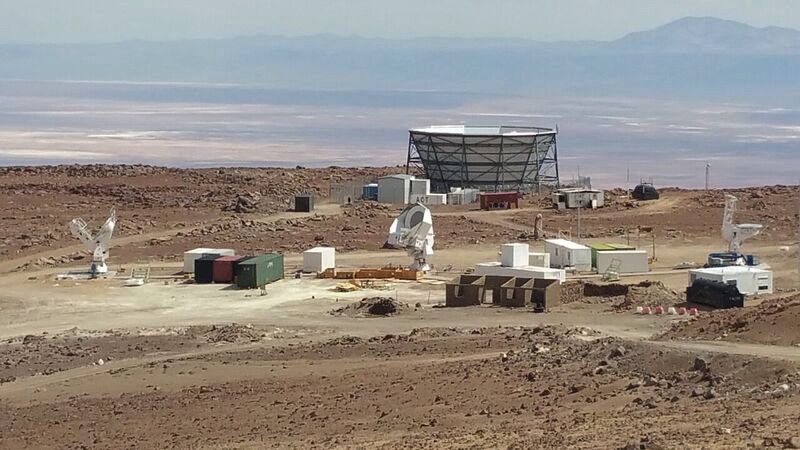
The Simons Observatory Site, in Chile
It is likely that the Simons Observatory (based on a single 6m dish) will form part of the next generation CMB experiment known currently as CMB-S4.
You can download the paper in full from the arXiv here.
Follow @telescoperThe Simons Observatory (SO) is a new cosmic microwave background experiment being built on Cerro Toco in Chile, due to begin observations in the early 2020s. We describe the scientific goals of the experiment, motivate the design, and forecast its performance. SO will measure the temperature and polarization anisotropy of the cosmic microwave background in six frequency bands: 27, 39, 93, 145, 225 and 280 GHz. The initial configuration of SO will have three small-aperture 0.5-m telescopes (SATs) and one large-aperture 6-m telescope (LAT), with a total of 60,000 cryogenic bolometers. Our key science goals are to characterize the primordial perturbations, measure the number of relativistic species and the mass of neutrinos, test for deviations from a cosmological constant, improve our understanding of galaxy evolution, and constrain the duration of reionization. The SATs will target the largest angular scales observable from Chile, mapping ~10% of the sky to a white noise level of 2 μK-arcmin in combined 93 and 145 GHz bands, to measure the primordial tensor-to-scalar ratio, r, at a target level of σ(r)=0.003. The LAT will map ~40% of the sky at arcminute angular resolution to an expected white noise level of 6 μK-arcmin in combined 93 and 145 GHz bands, overlapping with the majority of the LSST sky region and partially with DESI. With up to an order of magnitude lower polarization noise than maps from the Planck satellite, the high-resolution sky maps will constrain cosmological parameters derived from the damping tail, gravitational lensing of the microwave background, the primordial bispectrum, and the thermal and kinematic Sunyaev-Zel’dovich effects, and will aid in delensing the large-angle polarization signal to measure the tensor-to-scalar ratio. The survey will also provide a legacy catalog of 16,000 galaxy clusters and more than 20,000 extragalactic sources.
 In the Dark
August 27, 2018 at 3:23 pm
Peter any comments on https://arxiv.org/abs/1808.04597?
August 27, 2018 at 3:45 pm
Yes. It’s irrelevant to this blog post.
August 27, 2018 at 5:06 pm
I know. I should have mentioned OT. But was hoping for some expert insight from you on this.
August 28, 2018 at 12:28 pm
Philip, In any field there is a confirmation bias (cf https://arxiv.org/abs/1112.3108 for an example in Cosmology). Independent of CMB and other probes of DE, there is still an important question of whether the SN data alone provided smoking gun evidence for DE.
August 28, 2018 at 12:33 pm
The SN data on their own do not provide compelling evidence for dark energy. They never have and probably never will.
August 28, 2018 at 2:51 pm
That’s not the point I was making, The SN measurements don’t on their own provide evidence for FRW at all, so one can appeal to, e.g., inhomogeneous cosmologies to fit them. And even if you believe there is direct evidence of acceleration (which there isn’t), it could be modified gravity rather than dark energy.
August 28, 2018 at 3:21 pm
I don’t think there’s really ever `direct evidence’ in cosmology (as it is understood in the context of forensic science) . But `circumstantial evidence’ is not the same as `no evidence’.
October 4, 2018 at 11:00 pm
With this level of sensitivity one is in Clover – if not well beyond.
October 18, 2022 at 1:52 pm
[…] seems a lot longer than four years ago that I drew the attention of readers of this blog to the science case for the Simons Observatory, the next big thing in ground-based studies of the cosmic microwave […]