Thoughts on `Plan S’, `cOAlition S’ and Open Access Publishing
Those of you who have been following my recent updates on progress with The Open Journal of Astrophysics may be interested to hear about `Plan S’, which is a proposal by 11 European Nations to give the public free access to publicly funded science. The 11 countries involved in this initiative are: France, Italy, Austria, Ireland, Luxembourg, the Netherlands, Norway, Poland, Slovenia, Sweden, and the UK. Since the plan will not come into effect until 1st January 2020, which is after the UK leaves the EU it is by no means clear whether the UK will actually be involved in ERC initiatives after that. Norway is not in the EU but is associated to the ERC. It is unlikely that the UK will have a similar status after Brexit.
Anyway, these 11 countries have formed `cOAlition S’ – the `OA’ is for `Open Access’ – to carry out the plan, which can be found here.
Here is a summary:
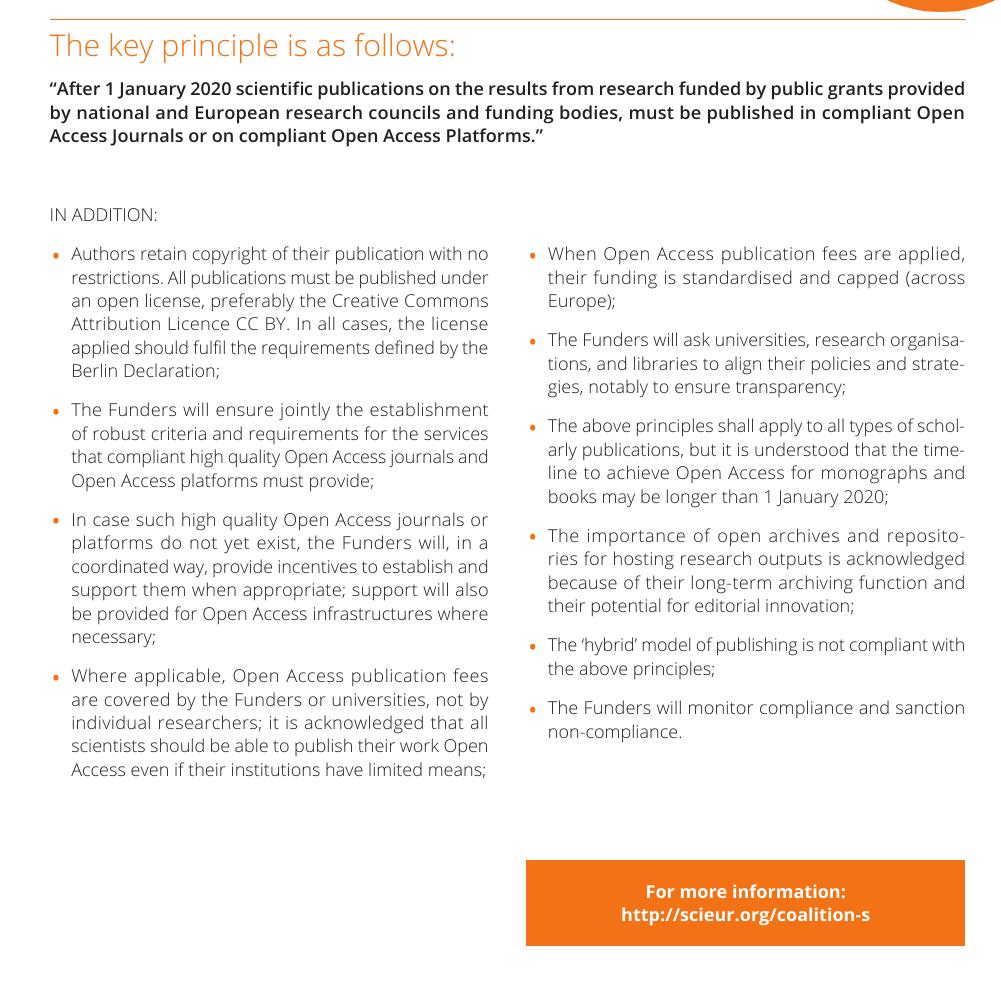
You can read more about it here. I have not yet looked at the details of what will be regarded as `compliant’ in terms of Open Access but if the the Open Journal of Astrophysics is not fully compliant as it stands, I expect it can be made so (although we are a genuinely international journal not limited to the 11 countries involved in Plan S).
Anyway, although I support Plan S in general terms what I sincerely hope will not happen with this initiative is that researchers and their institutions get mugged into paying an extortionate `Gold’ Open Access Article Processing Charge (APC) which is simply a means for the academic publishing industry to maintain its inflated profit margins at the expense of actual research. The Open Journal of Astrophysics is Green rather than Gold. In fact the cost of maintaining and running the platform is about $1000 per annum, and the marginal cost for processing each paper is $10 or actually $11 if you count registering published articles with CrossRef (though we do not incur that cost if the article is rejected). In effect running the entire journal costs less than a typical APC for Gold Open Access for one physics paper. Those costs will be born by my institution, Maynooth University. The UK was conned into going down this route some years ago by the publishing lobby, and I hope the other cOAlition S partners do not fall for the same scam.
Follow @telescoper In the Dark
September 22, 2018 at 7:04 pm
Open Access Gold creates a market, where scientists rather than libraries have the say over where the paper goes and what price they pay. The main impediment to the market operating efficiently to lower prices is not the publishers, who will generally always try to raise prices. it is the effective monopoly that we, the scholars and especially the universities, give to certain journals by ranking them as ‘prestigious’ (= high impact). Universities look on such simplistic ratings as important in promotions. So if we are to exploit this market that the EU is creating and that can in principle lower prices, then the universities have to get smarter about how they judge the quality of their staff and their hiring/promotion procedures.
September 24, 2018 at 9:04 am
Indeed but it is associated to the ERC.
September 24, 2018 at 5:16 pm
Sigh. The journal you mention *is* a Gold OA journal–one that, like 70% of DOAJ-listed Gold OA journals active in 2017, does not charge APCs. Don’t confuse APCs with Gold OA.
September 24, 2018 at 6:53 pm
Thank you for your sigh.
As fast as I can tell the OJA is Green by some definitions and Gold by others. It may even be Diamond or Platinum.
September 25, 2018 at 4:02 pm
Phillip: I was referring to the Open Journal of Astrophysics. I think it’s sad that long-agreed definitions of green and gold are getting confused. Maybe I’ve been writing about this stuff for too long…
September 26, 2018 at 9:49 am
The problem as I see it is that in a field that is changing very rapidly `long-agreed’ may cease to be useful.
September 25, 2018 at 4:04 pm
Phillip: I was referring to the Open Journal of Astrophysics. I think it’s sad that long-agreed definitions of green and gold are getting confused. Maybe I’ve been writing about this stuff for too long…
September 26, 2018 at 4:04 pm
A journal run entirely on volunteer labor is gold OA. Always has been. It’s a no-fee gold journal. Transparency in funding levels and sources is desirable, but is a separate issue.
September 26, 2018 at 4:06 pm
It’s not exactly volunteer.It’s part of my job as an academic, and I do get a salary.
September 25, 2018 at 4:10 pm
To my knowledge, the long-standing definitions have gold for what you (Phillip) are now calling gold and diamond/platinum. Most gold OA journals–70% of those in the Directory of Open Access Journals–do not charge APCs. The equation of Gold with APC has been convenient for opponents of OA, but is a recent and to my mind unwelcome complication, as are using “diamond” or “platinum” for no-fee gold. I can’t dictate terms to be used, but my series of SPARC-funded comprehensive surveys of serious gold OA ceases to make sense if others assume “gold=APC.” It doesn’t and shouldn’t.
September 25, 2018 at 4:12 pm
On the other hand, if it’s based on self-archiving via the arXiv then isn’t it also Green?
Reminds me of this:
November 6, 2018 at 5:08 pm
[…] own thoughts on Plan S can be found here. I’m basically supportive of it. I suggest you read the letter for yourself and decide what […]
November 27, 2018 at 10:14 am
[…] have blogged about this and some of the reactions to it before (e.g. here and […]
January 22, 2019 at 6:01 pm
[…] have blogged about Plan S and some of the reactions to it before (e.g. here and […]