Chemists against Plan S..
There’s an `Open Letter’ doing the rounds which rails against the European Plan S for open access to research papers . You can find it here on Google Docs. It is apparently initiated by some chemists, and there are very few signatories who are not chemists, though the language used in the letter suggests that the authors are talking for a much broader group.
My own thoughts on Plan S can be found here. I’m basically supportive of it. I suggest you read the letter for yourself and decide what you think. I think there are many rather inaccurate statements in it, including the idea that the journals run by Learned Societies are not profit-making. In my experience some of the most exploitative publishing practice comes from these organizations, though it takes something to beat the likes of Elsevier and Springer in that regard.
I share the concern about some researchers being driven to expensive `Gold’ Open Access modes of publication, which is why I started the Open Journal of Astrophysics which I think offers a viable route to peer-reviewed publication that’s not only low-cost, but entirely free for authors and readers. Open Access publication is really not expensive to do. It’s just that some organizations see it as an opportunity to make enormous profits.
Incidentally, I just came across this summary of different routes to open access and their implications here:
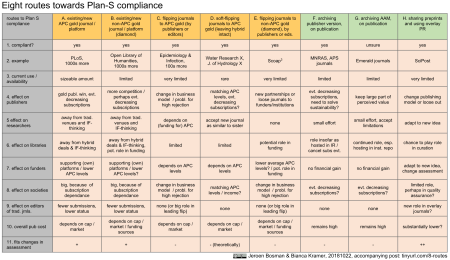
In my opinion, Column H is the place to be!
I’ve given quite a few talks about Open Access recently and one of the things that struck me in the Q & A sessions after them is the extent to which attitudes differ in different disciplines. My own research area, astrophysics and cosmology, embraced open access over twenty-five years ago. Virtually every paper published in this discipline can be found for free on the arXiv, as is the case for particle physics. More recently, condensed matter physics and some branches of mathematics have joined in.
Chemistry, by contrast, is conspicuous by its absence from the arXiv. I don’t know why. Moreover, those who have expressed the most negative attitudes to Open Access whenever I’ve given talks about it have always been chemists. And now there’s this letter. It’s definitely part of a pattern. If any chemists out there are reading this, perhaps they could tell me why there’s such an enormous cultural difference between physics and chemistry when it comes to research publication?
The Letter states (paragraph 4):
Plan S has (probably) a much larger negative effect on chemistry than on some other fields.
Maybe so, but isn’t that just another way of saying that chemistry is more in need of cultural change than other disciplines?
P.S. I’d be happy to advise anyone interested in setting up an Open Journal of Chemistry, but if you want it to run like the Open Journal of Astrophysics you will have to set up a chemistry arXiv first – and that’s a much bigger job!
P.P.S. Thanks to a comment below I now know that there is a Chemistry archive, but it only has a small number (hundreds) of papers on it. Moreover, it does not host final refereed versions of papers. It is run by the American Chemical Society, German Chemical Society, and the Royal Society of Chemistry all learned societies who are opposed to Open Access no doubt because it threatens their funding models.
Follow @telescoper In the Dark
November 6, 2018 at 11:13 pm
There already is ChemRxiv: https://chemrxiv.org/
November 6, 2018 at 11:24 pm
I stand corrected!
It seems that it is not used much, though. There are only ~ 800 entries.
November 6, 2018 at 11:21 pm
Learned Societies have gained vested interests and no longer champion the people they should in this regard.
November 7, 2018 at 7:38 am
Learned societies are run by their membership. If you don’t like their policies, change them.
November 7, 2018 at 10:12 am
They are not in practice “run” by their membership, but you are correct that the members can influence them. In the present case it is not necessary: bold and good initiatives like Open Journal of Astrophysics will eventually render learned-society journals obsolete simply by being far cheaper. We shall hear bleatings about supposedly essential services to members being cut, but you can bet that subscriptions won’t be.
November 7, 2018 at 9:27 am
You seem not to have grasped the key concept behind an arXiv overlay journal.
November 7, 2018 at 9:30 am
As far as I understand it, Plan S does not mandate Gold Open Access at all. The only thing it rules out explicitly are the so-called `hybrid’ journals which are a double rip-off.
November 7, 2018 at 9:51 am
My understanding is that plan S corresponds to “gold” open access. My partner ran into problems with such journals because the people funding her job do not provide money to pay the high fees for that. So she has had to put a publication on hold until she can find some funding to apply for to pay the fee. This does not seem a good system if it means people cannot publish their research because it depends on having funds to do so?
Its all very well saying everyone should just go down the route of your new journal – but as an early career researcher its not something she can do herself (even if she argues for it nothing would happen for several years at least), and meanwhile open access fees are impacting on her career.
November 7, 2018 at 1:12 pm
As a matter of fact, our Scholastica platform *does* allow authors to submit initial versions directly to the platform.
The final version, if accepted, must be on arXiv, however, so it is a lot simply for us if we know from the start that the paper conforms to the arXiv criteria. Otherwise we might get into an absurd situation in which we accept a paper but cannot publish it as the author cannot place it on the arXiv.
That practical reason aside, the main reason for asking authors to submit first to the arXiv is that it encourages open science. Often comments from people who have seen the arXiv version are more useful than those from referee(s).
P.S. All the direct uploads we have received so far have been rejected.
November 7, 2018 at 3:04 pm
The interface is public. The option exists on the upload page, and always has done.
November 7, 2018 at 4:12 pm
Further down it says:
“We strongly encourage submit in the manner described above (i.e. on the arXiv first). We can receive and review papers submitted directly to this platform but since the final version must be on the arXiv in order to be published we feel it is far better to submit it there first in order to establish that it is on an appropriate topic for this journal.”
November 7, 2018 at 11:30 pm
The solution to this problem is obvious. OJA should have a standing fictitious co-author available who has arXiv clearance, and if OJA accepts a paper from an author who is not arXiv-cleared then it instructs the author to add the fictitious co-author and submits to the arXiv that way. The tale (tail?) of Hetherington and Willard (1975) comes to mind, Willard being a cat.
https://en.wikipedia.org/wiki/F._D._C._Willard
November 8, 2018 at 9:40 am
I don’t do smileys.
November 8, 2018 at 11:28 am
Having a cat as a co-author gets better; the American Physical Society made this announcement four years ago:
APS is proud to announce a new open access initiative designed to further extend the benefits of open access to a broader set of authors. The new policy, effective today, makes all papers authored by cats freely available.
https://journals.aps.org/2014/04/01/aps-announces-a-new-open-access-initiative
Notice the date of the announcement, however.
November 8, 2018 at 11:23 pm
And I notice that Peter even has a Maynooth Library cat to hand…
November 7, 2018 at 5:03 pm
One of the promoters of the letter, Lynn Kamerlin, who is Professor of Structural Biology at Uppsala University, is an open access activist (see: https://kamerlinlab.com/ and https://twitter.com/kamerlinlab?lang=en). Their letter is against Plan S and not against OA.
To the best of my knowledge, Plan S is the brainchild of Robert-Jan Smits who will soon leave the European commission to become president of TU Eindhoven.
https://ec.europa.eu/epsc/team/robert-jan-smits_en
https://sciencebusiness.net/news/former-eu-research-chief-appointed-run-tu-eindhoven
November 7, 2018 at 6:12 pm
Thanks for that. Do you know what version of Open Access Professor Kamerlin advocates?
November 8, 2018 at 5:13 am
From the letter and her tweets, I infer that she is in favour of a system like the following:
1. You submit and publish your paper where you wish;
2. you are “funder compliant” if you save your paper in a public repository;
3. you should not be obliged to pay APCs.
See https://twitter.com/kamerlinlab/status/1060216072006234112
I will contact her to point her to your blog post as I may misrepresent her position.
Incidentally, looking deeper into the EU H2020 documents, one can find this page:
http://ec.europa.eu/transparency/regexpert/index.cfm?do=groupDetail.groupDetail&groupID=3463
If you look at the member organisations you see, among others:
Springer Nature, Frontiers, the Bill & Melinda Gates Foundation and the Wellcome Trust. This could explain the spin operation around Plan S, with the recent supporting press releases of the Bill & Melinda Gates Foundation and the Wellcome Trust. You can also notice the absence of any learned society in this expert group. They are not there as organisations. After reading this, I decided to sign the letter.
November 8, 2018 at 6:54 pm
Enrico contacted me about this so I would like to raise a few points:
1. As already pointed out by others, Chemistry has been late to come to preprints. However, all major and reputable chemistry journals now allow preprint deposition, and some, such as JACS (which is *the* chemistry journal) even allow preprint updates up until the decision letter is issued. There will be some chemistry stuff on arXiv (this is an acceptable repository for e.g. JACS), but it will very much depend on where in the chemistry spectrum the research falls, and therefore others will end up on bioRxiv, chemRxiv, et al.
2. Learned societies are the backbone of chemistry, and we value them deeply. Their journals are driven by scientists for scientists, and they engage in massive work both for the community and also outreach to the general public through educational activities etc. As an example, the American Chemical Society has almost 157,000 members, according to this: https://www.acs.org/content/acs/en/about/aboutacs.html. As I just pointed out on Twitter to Stephen Curry, all major society publishers in chemistry offer a variety of routes towards openness, but these would not be Plan S compliant (hybrid/licensing/embargo). While there are a number of pure OA quality chemistry journals, such as ACS Central Science, ACS Omega, Chemical Science etc, these are limited and clearly cannot carry the bulk of chemistry research. However, already the landscape has become dominated by pay-to-publish for-profit Gold publishers, and to many of us the principles as described are pushing us to that. In addition, as pointed out by other posters on this thread, if you look at the transparency register listing of advisory organizations, the heavy involvement of organizations with massive conflict of interests, and the striking absence of scholarly societies, does not inspire confidence.
3. The letter is NOT an anti-Open Access letter, but rather a criticism of what we see as the likely outcome of Plan S, unless the plan is massively reformed in the implementation stage. Many of us are strong supporters of Open Access, and I have been for a long time involved in promoting Open Science, including at high-level policy level. I have seen many blog posts like yours that attack the letter on the basis of either misunderstanding of it’s contents or jumping immediately to the defense of Plan S (and making this conflation that Plan S = Open Access in general), but what I would love to see are blog posts that tell us how precisely those who are going to implement Plan S will take action to make sure that the very serious concerns we raise, in particular in terms of breaking international collaborations and problems recruiting students (both of which have started to happen), will not actually happen in reality.
4. The letter, while started by chemists, has spread well beyond the chemistry community. We are at just over 800 signatures now. If/once we reach 1000, I will update Zenodo with a new list of signatures. However, the website is updated regularly: https://sites.google.com/view/plansopenletter/home. If you go to the list of signatories, https://sites.google.com/view/plansopenletter/signatories, and search for the string ‘chem’ (to cover all forms of chemistry affiliation), there are 532 matches. This leaves another 270 who do not identify as chemists as their primarily identification. If you search on ‘physics’ (to avoid physical chemists), there are 34 hits. However, there are a range of other disciplines: a lot from the life sciences and medicine, engineering, we have a few from humanities (both political science and classics), we have a professor of architecture, a researcher from the Wood Science Center, computer scientists, mathematicians, etc. I can go on. The overrepresentation of chemists is due to the fact that it was spread by word of mouth through the chemistry community before coming online. I have received emails complaining about it not being inclusive to other disciplines, and that chemistry is not somehow special, they face exactly the same problems. When the Google Doc was still editable, someone went rogue and made small changes to make it more inclusive to physics to and then we started getting physicist signatures (it was the only change we did not revert since we want to be inclusive to anyone who shares our concern). So this is not a ‘chemists’ letter, but a letter from researchers. Anyone who shares our concerns is welcome to sign on, irrespective of their disciplinary background.
5. You can find me in the list of supporters of Fair Open Access: https://gitlab.com/publishing-reform/discussion/blob/master/Fair%20Open%20Access/List%20of%20supporters%20of%20Fair%20Open%20Access.md. I am also on the Editorial Advisory Board of ACS Omega, a pure Open Access journal (that is Plan S compliant), as well as on the Advisory Board of F1000Research. I have been heavily supportive of F1000 for many years. In addition, I serve on the Editorial Board of IOPs ‘Electronic Structure’ (IOP is a strong supporter of Open Access: https://publishingsupport.iopscience.iop.org/open_access/), as well as on the EAB of ACS Catalysis and the Journal of Physical Chemistry, both of which again have various Openness routes. For what it’s worth, I also am an open data warrior and find it disappointing that hardly any mention of data is made in Plan S.
Based on what the chemistry landscape looks like now, I fail to see the impact of Plan S as being anything other than a massive diversion of public funds away from non-profit society publishers, all of whom have open routes, towards for-profit high-volume publishers. I believe anyone who believes in fair and equitable open access should stand up and join us in fighting for this not to happen, and I welcome them to add their voices to our letter.
I would also be very pleased if the Plan S architects would take concrete steps to prevent this from happening, however I do not actually see these being taken at the moment. Therefore it will be interesting to see what the final implementation language says.
Finally, you will notice that the letter ends with a call not for closed science, but rather for the full Open landscape to be valued and recognized, and not just a very narrow definition as put forward by Plan S. I stand by that call, and will continue to fight for fair open access.
November 8, 2018 at 11:20 am
[…] Tuesday’s quick post about a letter of opposition to Plan S generated some comments from academics about the role of “Learned Societies” in academic publishing. I therefore think it’s relevant to raise some points about the extent that these organization (including, in my field, the Royal Astronomical Society and the Institute of Physics) rely for their financial security upon the revenues generated by publishing traditional journals. […]
November 8, 2018 at 3:29 pm
A clear definition of “gold” open access is needed for the comments above. Many comments implicate that “gold” stands for paid open access. This is not the actual definition:
The ‘gold’ route: Articles are universally accessible free of charge immediately upon publication. This sometimes requires authors to pay a fee to the publisher of the journal. Within academic publishing, the ‘gold’ route typically includes peer-review.
November 10, 2018 at 10:25 am
It is better to call the fish by their names. Pre-print of author-accepted manuscript (e.g. https://twitter.com/benmarwick/status/948820367975489537) instead of “green OA”, and paid immediate OA vs. unpaid immediate OA, instead of “gold” vs. “gold”.
November 27, 2018 at 10:15 am
[…] I have blogged about this and some of the reactions to it before (e.g. here and here). […]
January 22, 2019 at 6:01 pm
[…] I have blogged about Plan S and some of the reactions to it before (e.g. here and here). […]