(No) Primordial Non-Gaussianity from Planck
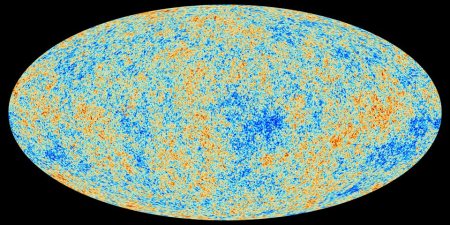
After yesterday’s decennial celebration of the launch of ESA’s Herschel and Planck missions, I noticed that this morning a new paper from the Planck Consortium has arrived on the arXiv. Coincidence?
The other 2018 `last’ papers from Planck were released last year.
Anyway, this is the long-awaited paper IX about primordial non-Gaussianity and the abstract is:
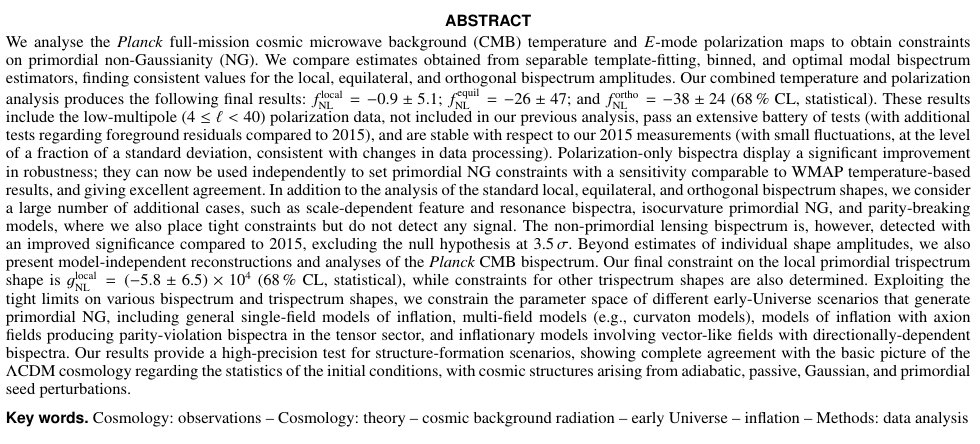
In a nutshell, there’s no evidence for primordial non-Gaussianity from the Planck observations. The paper is rather long, but well worth reading because it shows how much work has to go in to extract higher-order statistical information from CMB data. It’s far harder than the (second-order) power-spectrum, which is no doubt why this paper to so long to emerge.
Follow @telescoper In the Dark
May 15, 2019 at 11:55 am
Your opinion about how scientific result is published and documented
has been the topic of your blog on many occasion. How come you are less verbal when it comes to making your opinion public about issues concerning how the research is actually done before they get published. Are there any issue about authorship, author ordering,
acknowledging support from those who has contributed but not in the list? but, many who hasn’t are in the list? bothers you.
What do you think about the fact that the big collaborations actually operate outside the rules and norms that otherwise are mandatory in
many employment contract. Do you think that most European collaborations simply use non-European students/post.doc.s as cheap labour. Do you think funding and operation of multi-national
collaborations should be scrutinized more by external bodies.
The current landscape of scientific research is completely dominated
by few multinational collaborations. Being involved in such
projects can give long term security while career of many
others can get ruined. While gender bias in such collaborations
has recently attracted many comments but very few will
acknowledge that there are issues with career progression
of non-EU student/post.docs who has contributed from a
very early stage when such projects are not even conceived
properly only to be replaced by local graduates when
the real work actually gets done.
May 15, 2019 at 12:03 pm
As you know I was never a member of the Planck Consortium so I have no grounds to comment on authorship of these papers. I have however stated on numerous occasions that I think the authorship concept is rather silly for papers from large consortia when many of the `authors’ haven’t even read the paper never mind authored it.
In any case I’m not convinced that a person who left a collaboration ten years ago has any grounds to complain about not being an author of a new paper.
May 15, 2019 at 12:19 pm
The Euclid Consortium has a very clear policy on authorship of papers: anyone can be in the Consortium – even me! – but there’s strict control of who is on individual publications: you have to prove that you’ve contributed.
Of course the main papers are some way off in the future so we don’t really know who this will work in practice.
May 15, 2019 at 12:27 pm
I have many friends who works in such collaborations.
My comments were not about a specific project but are in general about various ongoing EU
projects where individuals don’t decide if he leaves or remains
10 years before, or 10 years after. It is decided by handful
of senior academics. The system of giving
credit can be arbitrary as well as opaque and remains in the hand of chosen few who are selected for life. Most of the hard work
is done by people who are hired from the third world, to do the dirty work in exchange of long-term stay.
As these projects mature the actual science is done by Oxbridge
graduates who take the credits and secure permanent positions.
This a new age apartheid regime.
May 15, 2019 at 6:22 pm
I have heard unconfirmed rumors that after Brexit Euclid is getting renamed as non-EUclid as it is probing mainly
the dark-sector namely the dark matter and dark energy. Is this
really true?
May 15, 2019 at 6:34 pm
It’s about as true as this comment is funny.