Voids, Galaxies and Cosmic Acceleration
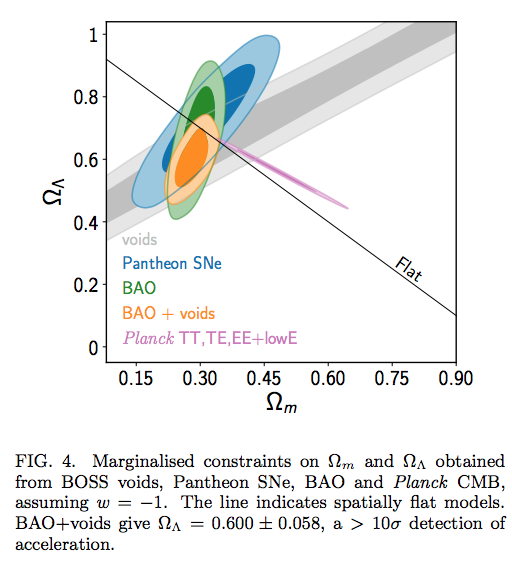
Time for a quick plug for a paper by Nadathur et al. that appeared on the arXiv recently with the title Testing low-redshift cosmic acceleration with large-scale structure. Here is the abstract:

You can make it bigger by clicking on the image. You can download a PDF of the entire paper here.
The particularly interesting thing about this result is that it gives strong evidence for models with a cosmological constant (or perhaps some other form of dark energy), in a manner that is independent of the other main cosmological constraints (i.e. the Cosmic Microwave Background or Type 1a Supernovae). This constraint is based on combining properties of void regions (underdensities) with Baryon Acoustic Oscillations (BAOs) to produce constraints that are stronger than those obtained using BAOs on their own. The data used derives largely from the BOSS survey.
As well as this there’s another intriguing result, or rather two results. First is that the the BAO+voids data from redshifts z<2 gives H0 = 72.3 ± 1.9, while, on the other hand adding, BAO information from the Lyman-alpha forest for from z>2 gives a value H0 = 69 \pm 1.2, favouring Planck over Riess. Once again, the `tension’ over the value of the Hubble constant appears to be related to using nearby rather than distant sources.
Follow @telescoper In the Dark
February 4, 2020 at 8:23 pm
really interesting…