Archive for Dark Energy

Weekly Update from the Open Journal of Astrophysics – 23/05/2026

Posted in OJAp Papers, Open Access, The Universe and Stuff with tags , , , , , , , , , , , , , , , , , , , , , , , , , , , , , , , , , , on May 23, 2026 by telescoper

It’s Saturday once again, so time for another update of activity at the Open Journal of Astrophysics. Since the last update we have published a further six papers, bringing the number in Volume 9 (2026) to 110 and the total so far published by OJAp up to 558.

I will continue to include the posts made on our Mastodon account (on Fediscience); these announcements also show the DOI for each paper.

The first paper to report this week, published on Monday 18th May in the folder Instrumentation and Methods for Astrophysics is “Edges In Coadded Images” by Erin Sheldon (Brookhaven National Laboratory, USA). This paper describes a study exploring how image discontinuities and noise impact weak gravitational lensing measurements, finding no significant biases under typical conditions. Biases occur only in extreme cases, but can be mitigated.

The overlay for this paper is here
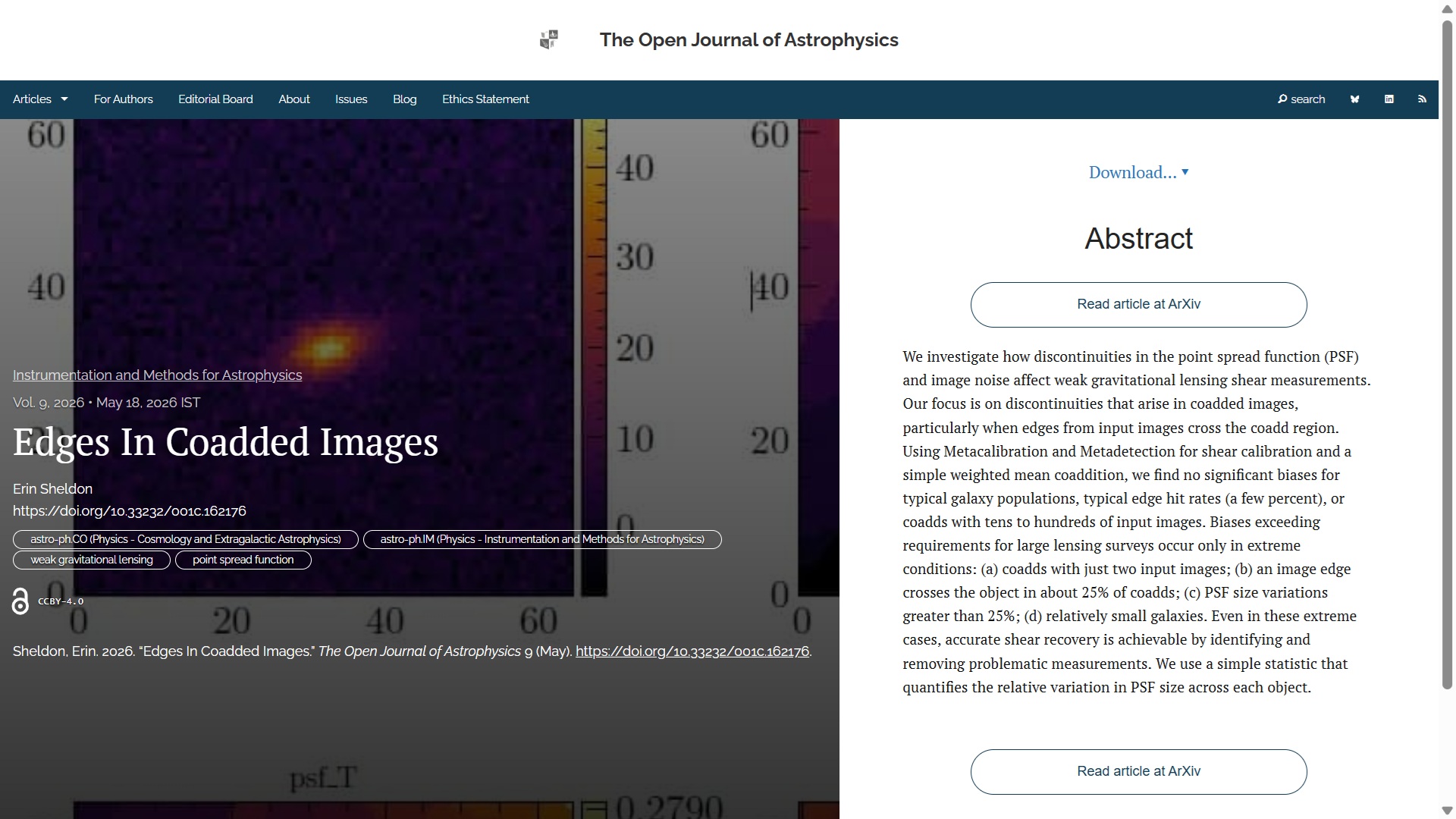
You can find the officially accepted version on arXiv here and the announcement on Fediverse here:

Open Journal of Astrophysics

New Publication at the Open Journal of Astrophysics: "Edges In Coadded Images" by Erin Sheldon (Brookhaven National Laboratory, USA)

doi.org/10.33232/001c.162176

May 18, 2026, 6:43 am 1 boosts 0 favorites

The second paper for this week, also published on Monday 18th May but in the folder Cosmology and Nongalactic Astrophysics, is “Joint cosmological fits to DESI-DR1 full-shape clustering and weak gravitational lensing in configuration space” by A. Semenaite (Swinburne Institute of Technology, Australia) and 72 other authors from all round the world. This paper presents a cosmological analysis of correlations between the DESI-DR1 Bright Galaxy Survey and Luminous Red Galaxy samples and overlapping shear measurements from various weak lensing surveys.

The overlay for this one is here:
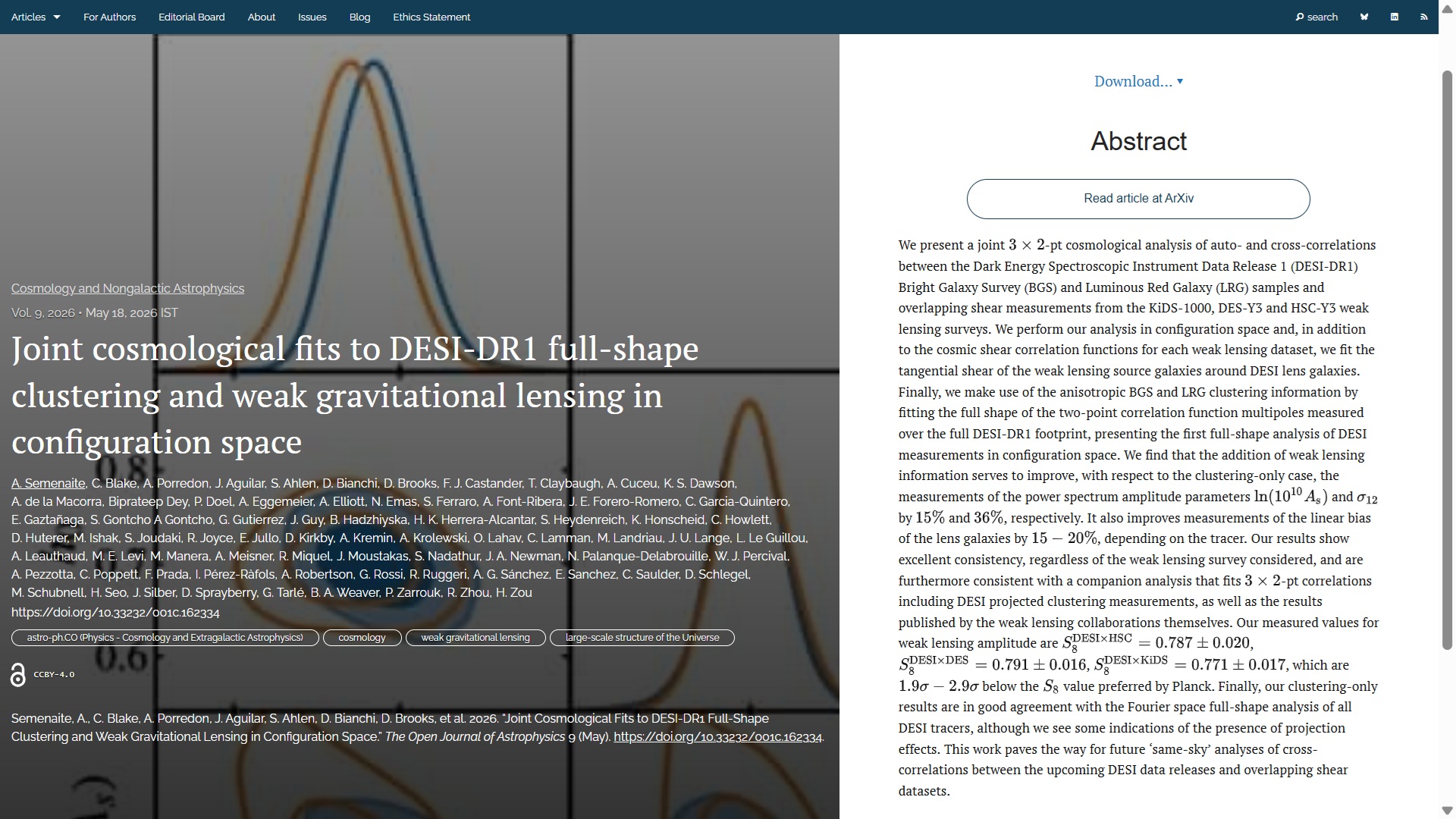
The official version of the paper can be found on arXiv here and the Fediverse announcement here:

Open Journal of Astrophysics

New Publication at the Open Journal of Astrophysics: "Joint cosmological fits to DESI-DR1 full-shape clustering and weak gravitational lensing in configuration space " by A. Semenaite (Swinburne Institute of Technology, Australia) and 72 others from all round the world.

doi.org/10.33232/001c.162334

May 18, 2026, 6:52 am 1 boosts 1 favorites

Next one up, the third paper of the week, and the third published on Monday 18th May, also published on Tuesday 12th May, and in the folder Cosmology and Nongalactic Astrophysics is “Probing Dark Energy Microphysics with kSZ Tomography” by Julius Adolff, Selim Hotinli and Neal Dalal (all of the Perimeter Institute, Canada). This paper explores how kinetic Sunyaev-Zel’dovich tomography and galaxy clustering can enhance our understanding of dark energy and its effects, potentially revealing its microphysical properties in future surveys.

The overlay for this one is here:
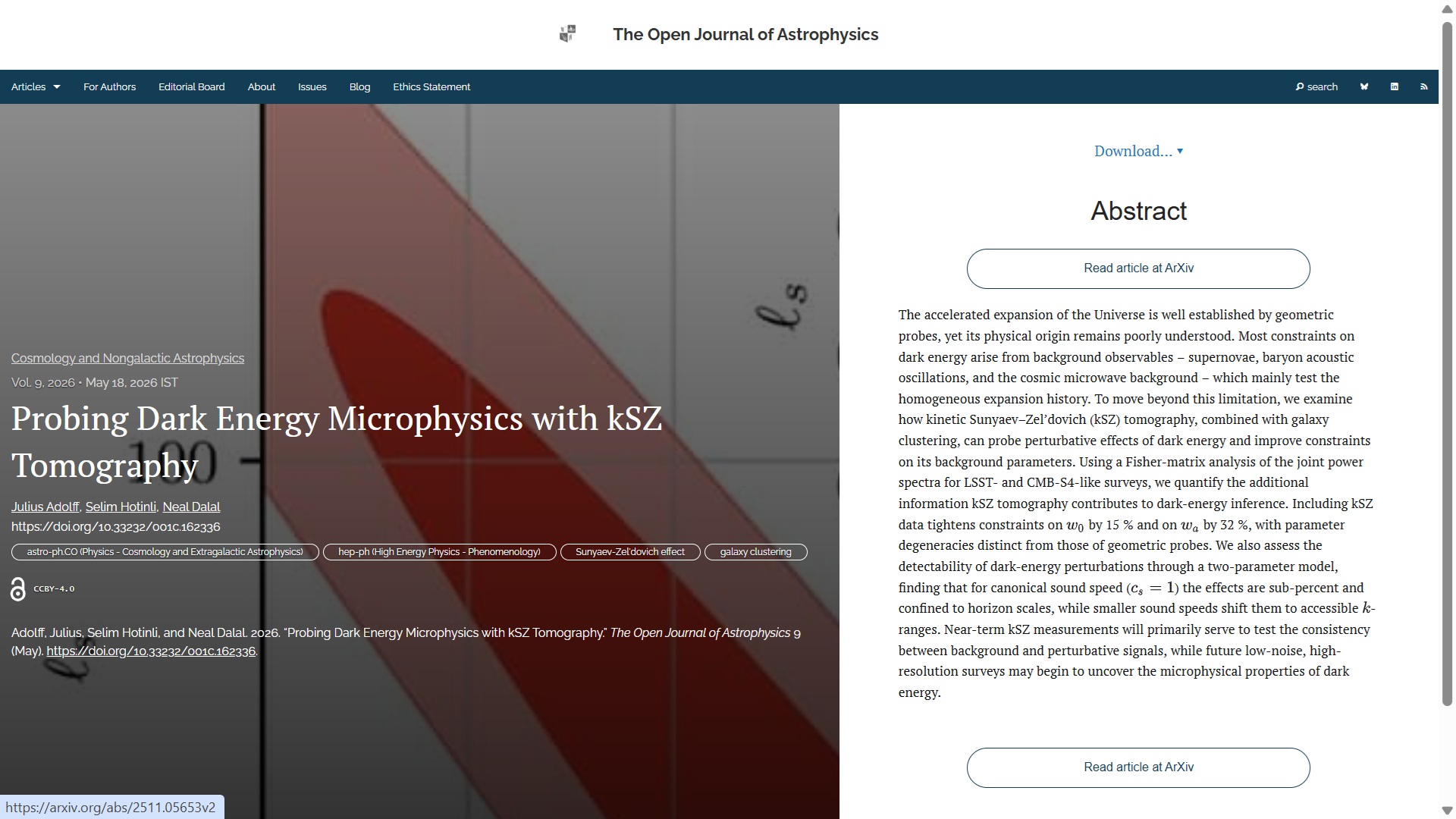
The final, accepted version can be found on arXiv here and the Mastodon announcement is here:

Open Journal of Astrophysics

New Publication at the Open Journal of Astrophysics: "Probing Dark Energy Microphysics with kSZ Tomography" by Julius Adolff, Selim Hotinli and Neal Dalal (Perimeter Institute, Canada)

doi.org/10.33232/001c.162336

May 18, 2026, 7:04 am 1 boosts 0 favorites

The fourth paper this week, published on Wednesday May 20th “A Census of Variable Radio Sources at 3 GHz” by Yjan A. Gordon, Peter S. Ferguson, Michael N. Martinez and Eric J. Hooper (all of the University of Wisconsin, USA). This article, published in the folder Astrophysics of Galaxies, uses data from the Very Large Array Sky Survey to analyze variability in the radio sky, finding most changes consistent with blazars and quasars.

The overlay is here:
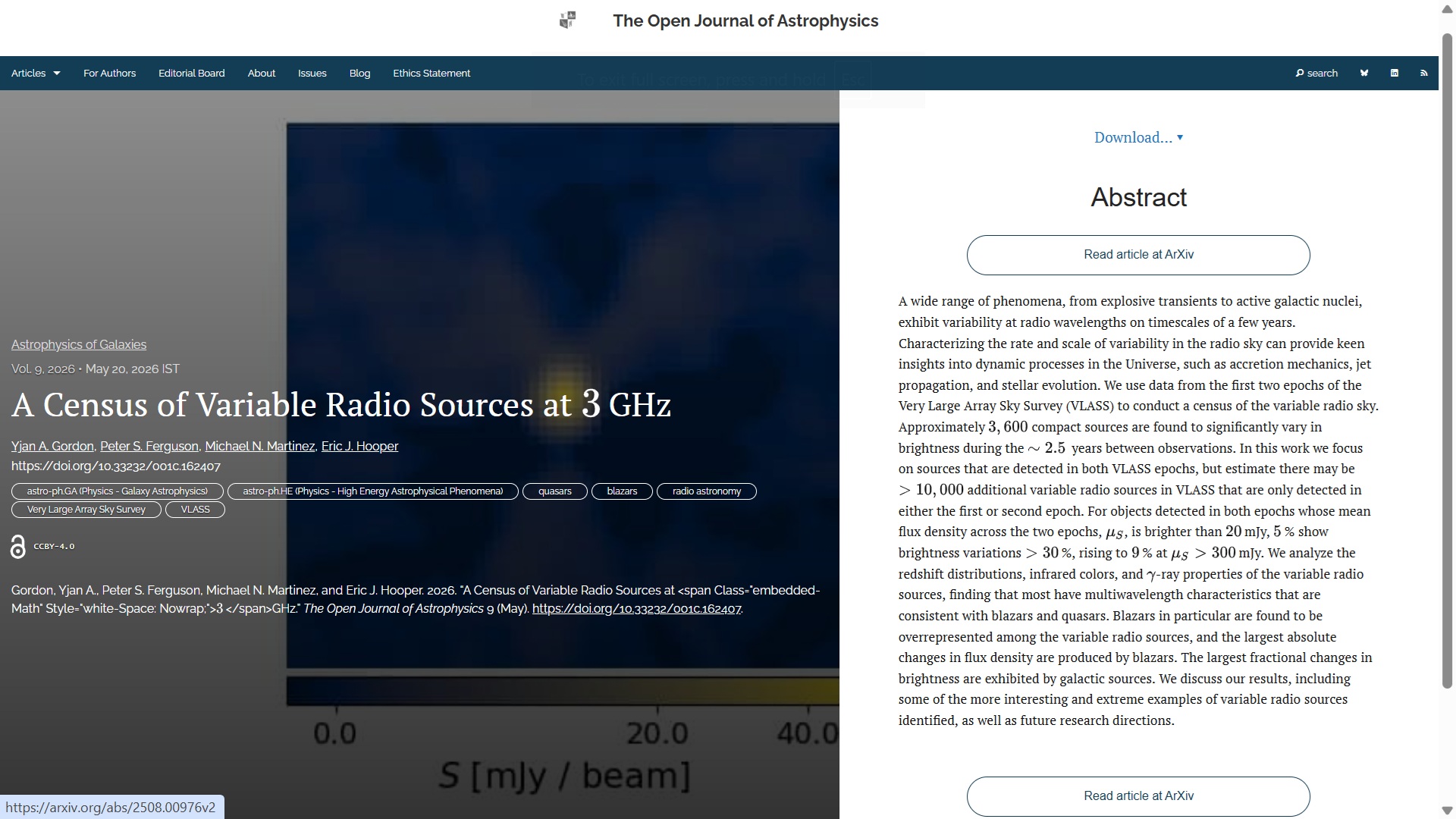
The officially accepted version can be found on arXiv here and here is the Mastodon announcement:

Open Journal of Astrophysics

New Publication at the Open Journal of Astrophysics: "A Census of Variable Radio Sources at 3 GHz" by Yjan A. Gordon, Peter S. Ferguson, Michael N. Martinez & Eric J. Hooper (U. Wisconsin, USA)

doi.org/10.33232/001c.162407

May 20, 2026, 2:52 pm 0 boosts 2 favorites

The fifth article of this week was published on Friday 22nd May in the folder Instrumentation and Methods for Astrophysics. The title is “Uncovering the Next Galactic Supernova with the Vera C. Rubin Observatory” by John Banovetz (Lawrence Berkeley Lab., USA), Claire-Alice Hebert & Peter B. Denton (Brookhaven National Lab., USA), Dan Scolnic (Duke University, USA), Anze Slosar (Brookhaven) and Chris Walter (Duke). The paper presents a study simulating how effectively the Vera C. Rubin Observatory can localize supernovae using neutrino triggers, finding a 57-97% success rate based on stellar mass density predictions.

The overlay is here:
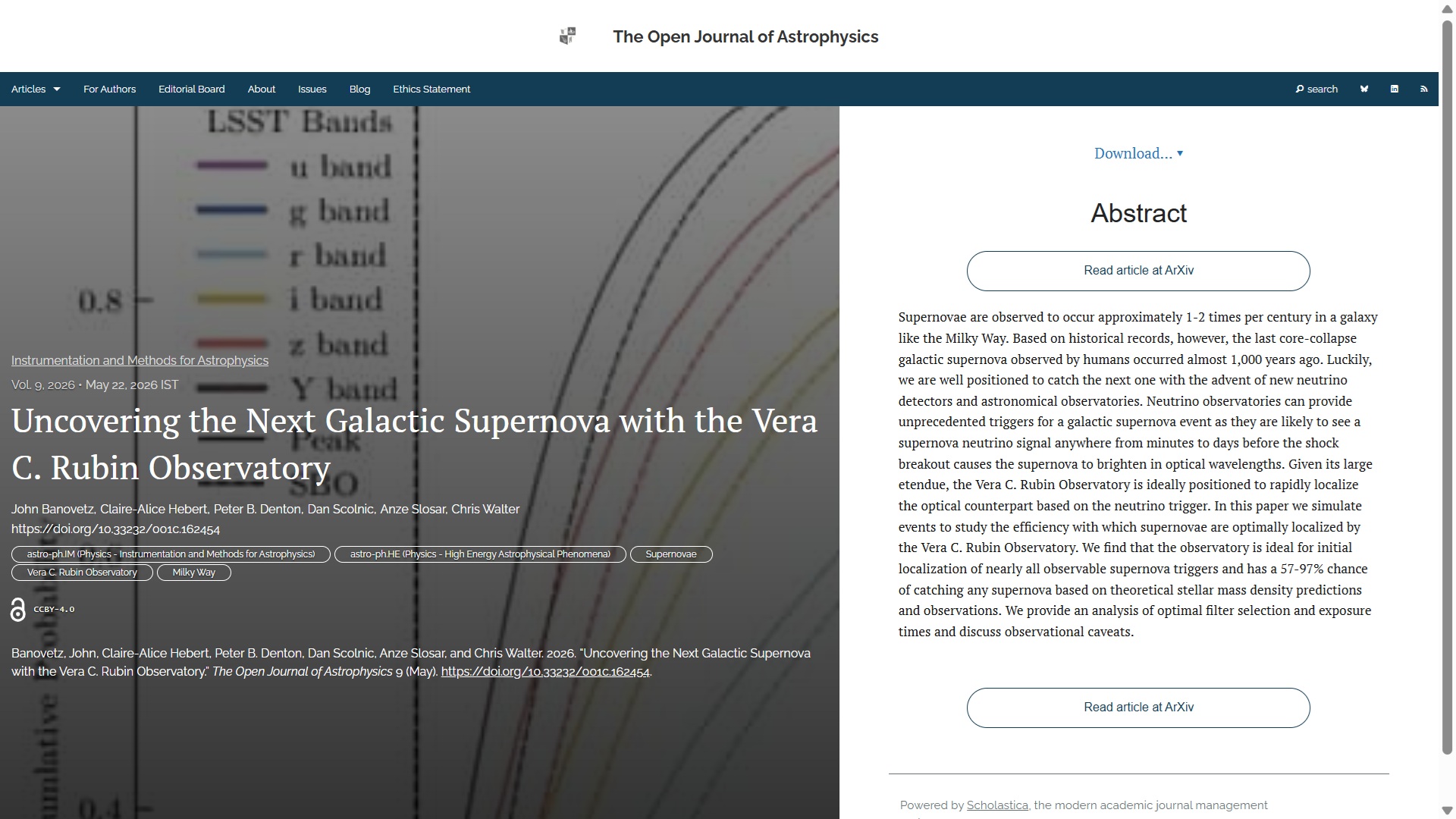
You can find the authorized version of this paper on arXiv here and the Fediverse announcement is here:

Open Journal of Astrophysics

New Publlication at the Open Journal of Astrophysics: "Uncovering the Next Galactic Supernova with the Vera C. Rubin Observatory" by John Banovetz (Lawrence Berkeley Lab., USA), Claire-Alice Hebert & Peter B. Denton (Brookhaven National Lab., USA) , Dan Scolnic (Duke U., USA) , Anze Slosar (Brookhaven), and Chris Walter (Duke)

doi.org/10.33232/001c.162454

May 22, 2026, 8:31 am 0 boosts 1 favorites

Last, but by no means least, this week we have “Pulsar timing solutions for 17 pulsars at 150 MHz from the Irish LOFAR station” by David J. McKenna (ASTRON, The Netherlands), Evan F. Keane (Trinity College Dublin, Ireland), Peter T. Gallagher (DIAS, Ireland) and Joe McCauley (Trinity). This was published on Friday 22nd May in the folder High-Energy Astrophysical Phenomena. It presents a demonstration of the use of international Low Frequency Array (LOFAR) stations in tracking and characterizing pulsars, providing new insights into these neutron stars’ emission properties.

The overlay for this one is here:
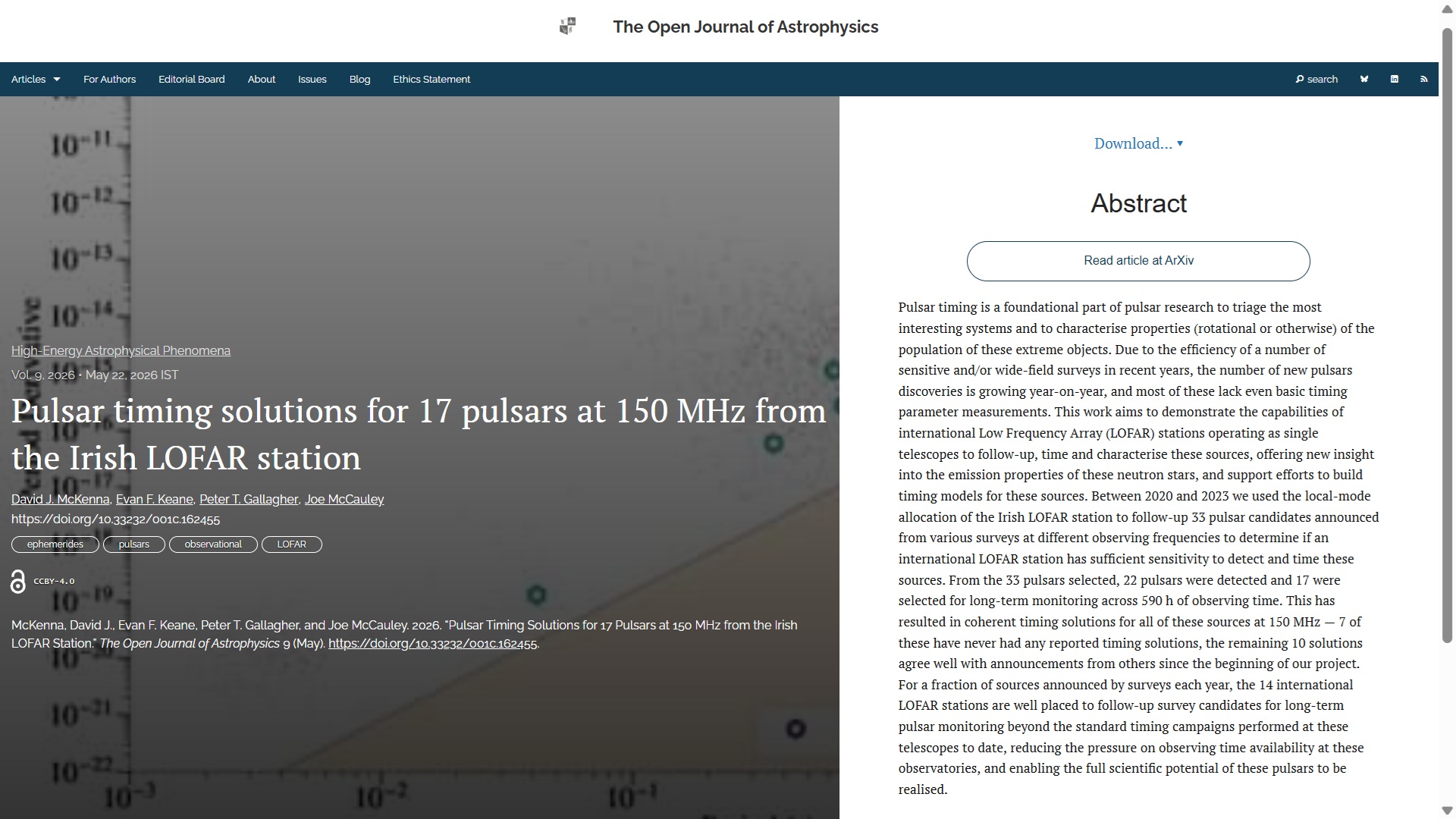
You can find the authorized version of this paper on arXiv here and the Fediverse announcement is here:

Open Journal of Astrophysics

New Publication at the Open Journal of Astrophysics: "Pulsar timing solutions for 17 pulsars at 150 MHz from the Irish LOFAR station" by David J. McKenna (ASTRON, The Netherlands), Evan F. Keane (Trinity College Dublin, Ireland), Peter T. Gallagher (DIAS, Ireland) and Joe McCauley (Trinity)

doi.org/10.33232/001c.162455

May 22, 2026, 8:59 am 0 boosts 0 favorites

And that concludes this week’s update. I’ll do another one next Saturday.
Weekly Update from the Open Journal of Astrophysics – 16/05/2026

Posted in OJAp Papers, Open Access, The Universe and Stuff with tags , , , , , , , , , , , , , , , , , , , , , , , , , , on May 16, 2026 by telescoper

It’s Saturday once again, so time for another update of activity at the Open Journal of Astrophysics. Since the last update we have published a further five papers, bringing the number in Volume 9 (2026) to 104 and the total so far published by OJAp up to 552. It took us until late July to pass 100 last year.

I will continue to include the posts made on our Mastodon account (on Fediscience) to encourage you to visit it. Mastodon is a really excellent service, and a more than adequate replacement for X/Twitter (which nobody should be using); these announcements also show the DOI for each paper.

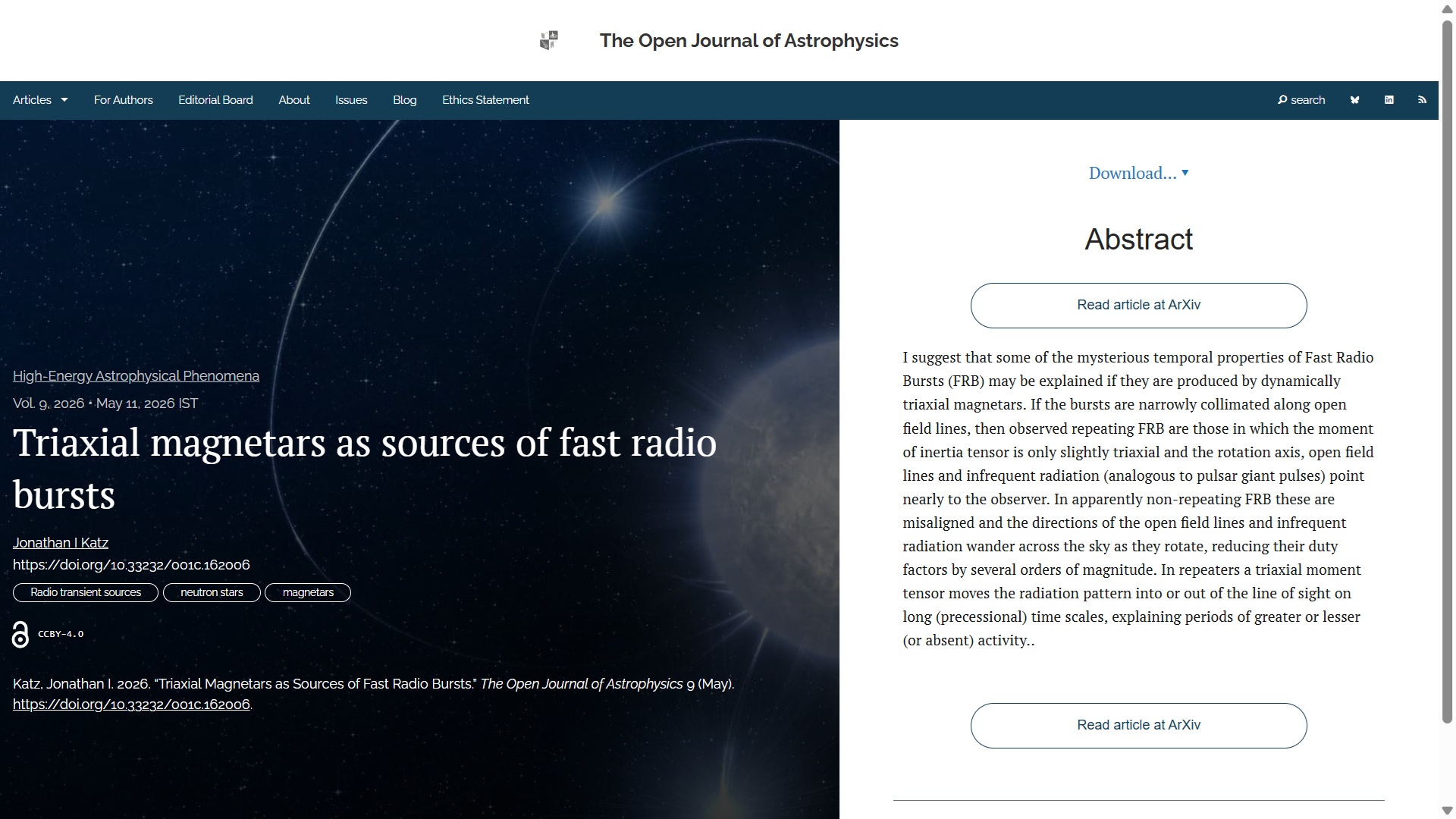
The first paper to report this week, published on Monday 11th May in the folder High-Energy Astrophysical Phenomena is “Triaxial magnetars as sources of fast radio bursts” by Jonathan I Katz (Washington University, USA). This paper suggests that the mysterious properties of Fast Radio Bursts (FRB) could be explained by triaxial magnetars, with their activity levels influenced by precessional time scales.

The overlay for this paper is here

You can find the officially accepted version on arXiv here and the announcement on Fediverse here:

Open Journal of Astrophysics

New Publication at the Open Journal of Astrophysics: "Triaxial magnetars as sources of fast radio bursts" by Jonathan I Katz (Washington University, USA)

doi.org/10.33232/001c.162006

May 11, 2026, 7:32 am 0 boosts 0 favorites

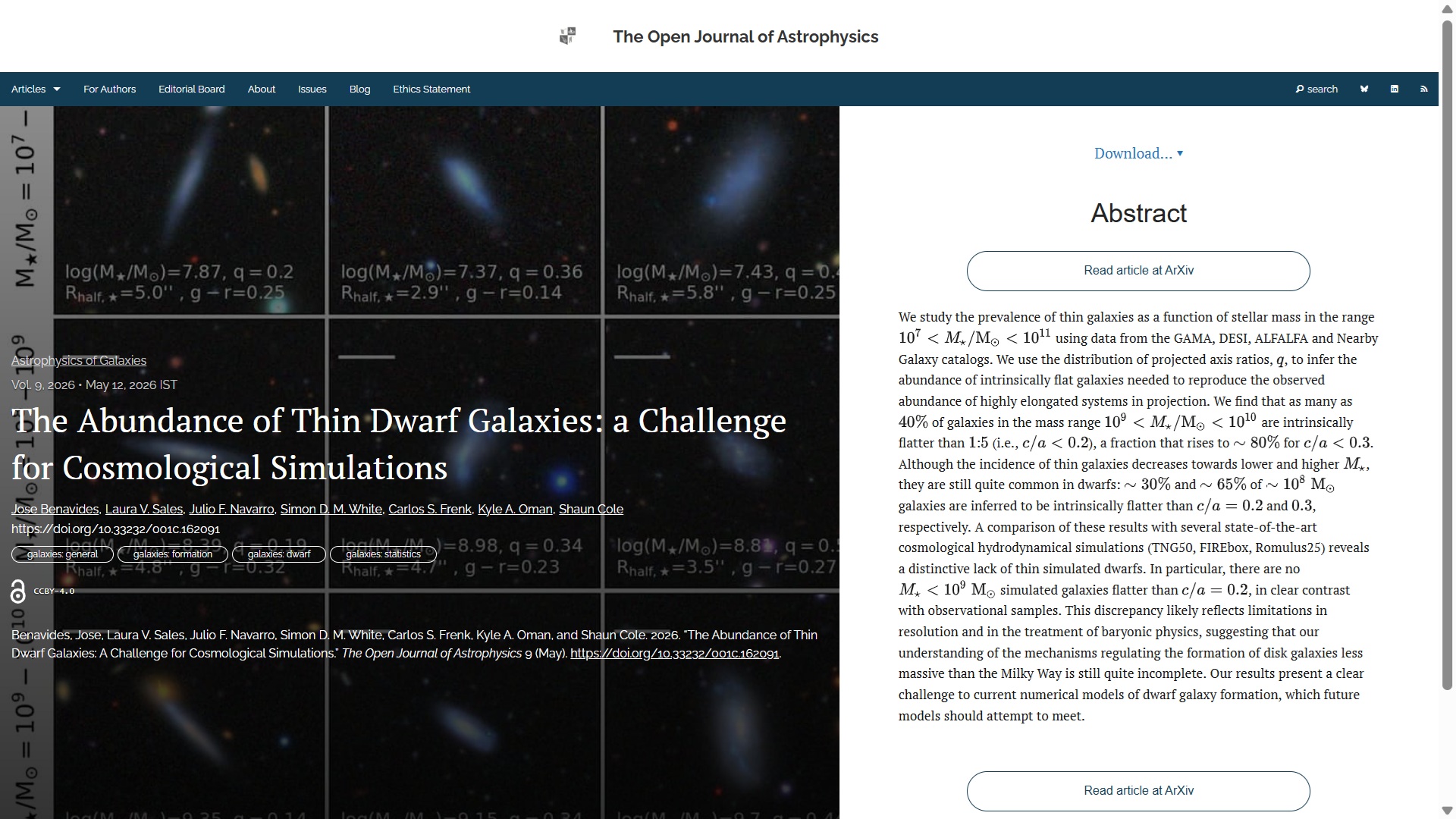
The second paper for this week, published on Tuesday 12th May in the folder Astrophysics of Galaxies, is “The Abundance of Thin Dwarf Galaxies: a Challenge for Cosmological Simulations” by Jose Benavides & Laura V. Sales (UC Riverside, USA), Julio F. Navarro (U. Victoria, Canada), Simon D. M. White (MPA Garching, Germany), and Carlos S. Frenk, Kyle A. Oman & Shaun Cole (U. Durham, UK). Depending on mass up to 40% of galaxies are intrinsically flat, a fraction that numerical models of galaxy formation struggle to reproduce suggesting the models are incomplete.

The overlay for this one is here:

The official version of the paper can be found on arXiv here and the Fediverse announcement here:

Open Journal of Astrophysics

New Publication at the Open Journal of Astrophysics: "The Abundance of Thin Dwarf Galaxies: a Challenge for Cosmological Simulations" by Jose Benavides & Laura V. Sales (UC Riverside, USA), Julio F. Navarro (U. Victoria, Canada), Simon D. M. White (MPA Garching, Germany), and Carlos S. Frenk, Kyle A. Oman & Shaun Cole (U. Durham, UK)

doi.org/10.33232/001c.162091

May 12, 2026, 6:07 am 1 boosts 3 favorites

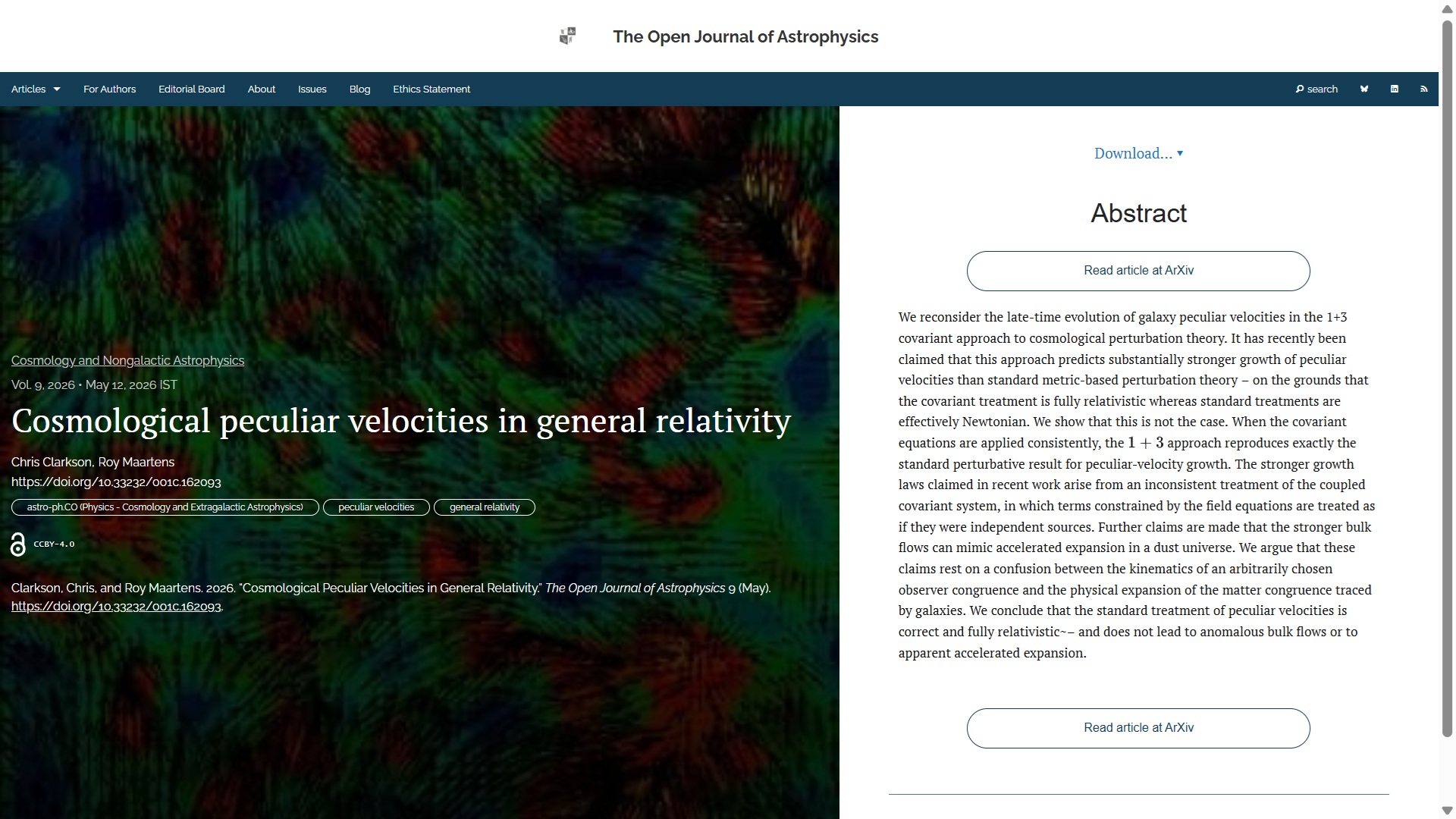
Next one up, the third paper of the week, also published on Tuesday 12th May but in the folder Cosmology and Nongalactic Astrophysics is “Cosmological peculiar velocities in general relativity” by Chris Clarkson (Queen Mary, University of London, UK) and Roy Maartens (U. Western Cape, South Africa). This paper refutes claims that the 1+3 covariant approach to cosmological perturbation theory predicts stronger growth of galaxy peculiar velocities, arguing that standard treatments are correct and fully relativistic.

The overlay for this one is here:

The final, accepted version can be found on arXiv here and the Mastodon announcement is here:

Open Journal of Astrophysics

New Publication at the Open Journal of Astrophysics: "Cosmological peculiar velocities in general relativity" by Chris Clarkson (QMUL, UK) and Roy Maartens (U. Western Cape, South Africa)

doi.org/10.33232/001c.162093

May 12, 2026, 6:37 am 1 boosts 1 favorites

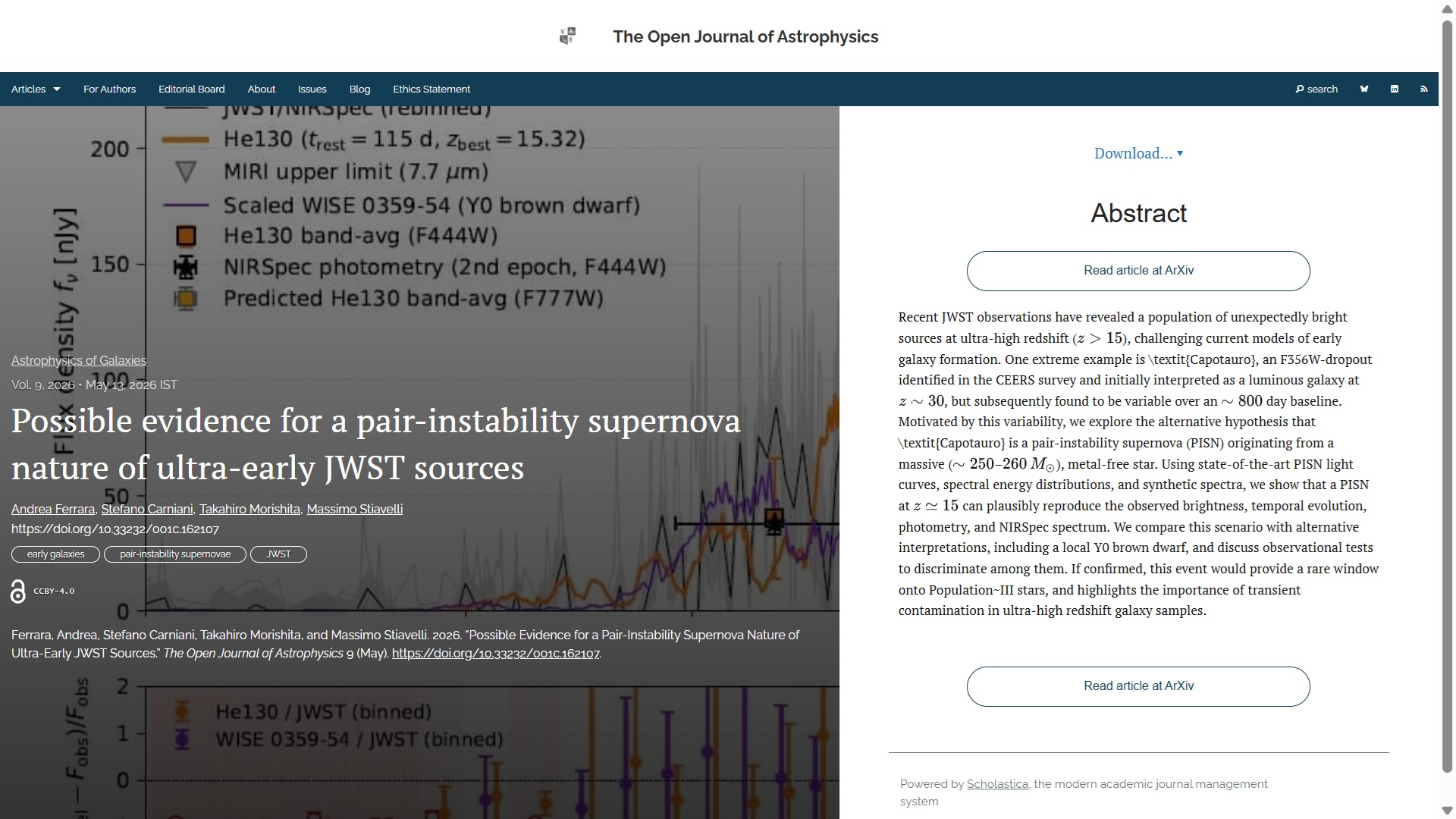
The fourth paper this week, published on Wednesday May 13th “Possible evidence for a pair-instability supernova nature of ultra-early JWST sources” by Andrea Ferrara & Stefano Carniani (Scuola Normale Superiore, Pisa, Italy), Takahiro Morishita (California Institute of Technology, USA), and Massimo Stiavelli (Space Telescope Science Institute, USA). Published in the section Astrophysics of Galaxies. This paper argues that recent observations challenge early galaxy formation models, suggesting that the bright source, Capotauro, could be a supernova from a massive, metal-free star, not a luminous galaxy as initially thought.

The overlay is here:

The officially accepted version can be found on arXiv here and here is the Mastodon announcement:

Open Journal of Astrophysics

New Publication at the Open Journal of Astrophysics: "Possible evidence for a pair-instability supernova nature of ultra-early JWST sources" by Andrea Ferrara & Stefano Carniani (Scuola Normale Superiore, Pisa, Italy), Takahiro Morishita (Caltech, USA) and Massimo Stiavelli (STScI, USA)

doi.org/10.33232/001c.162107

May 13, 2026, 7:44 am 1 boosts 1 favorites

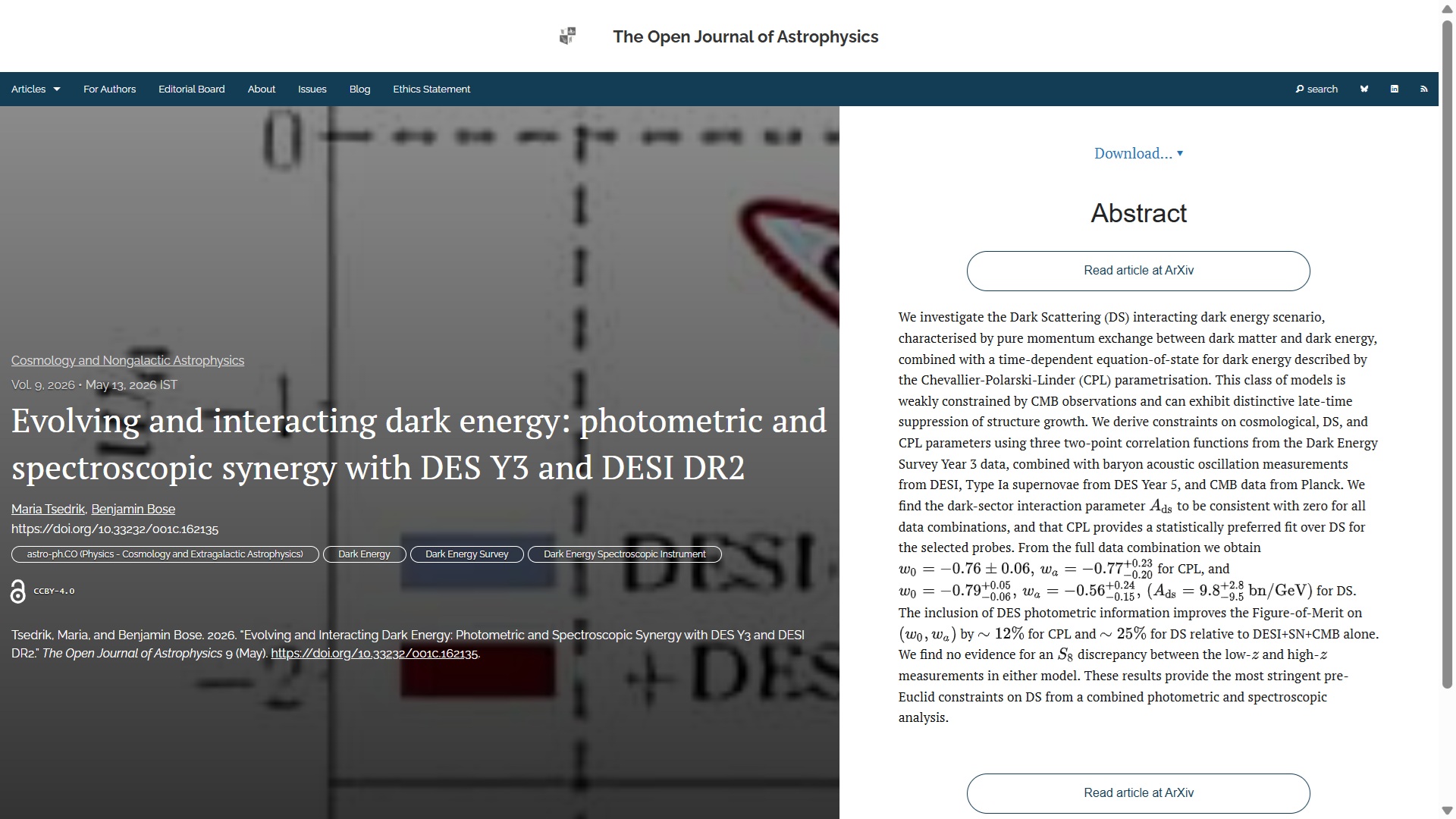
The fifth and final article of this week was also published on Wednesday 13th May but in the folder Cosmology and Nongalactic Astrophysics. The title is “Evolving and interacting dark energy: photometric and spectroscopic synergy with DES Y3 and DESI DR2” and it is by Maria Tsedrik and Benjamin Bose (University of Edinburgh, UK). The study investigates the Dark Scattering interacting dark energy scenario, using data from various sources. Results show no evidence of dark-sector interaction and a preference for the Chevallier-Polarski-Linder parametrisation.

The overlay is here:

You can find the authorized version of this paper on arXiv here and the Fediverse announcement is here:

Open Journal of Astrophysics

New Publication at the Open Journal of Astrophysics: "Evolving and interacting dark energy: photometric and spectroscopic synergy with DES Y3 and DESI DR2" by Maria Tsedrik and Benjamin Bose (University of Edinburgh, UK)

doi.org/10.33232/001c.162135

May 13, 2026, 7:48 am 1 boosts 0 favorites

And that concludes this week’s update. I’ll do another next Saturday.

A DESI Milestone

Posted in Biographical, The Universe and Stuff with tags , , , , , on April 29, 2026 by telescoper

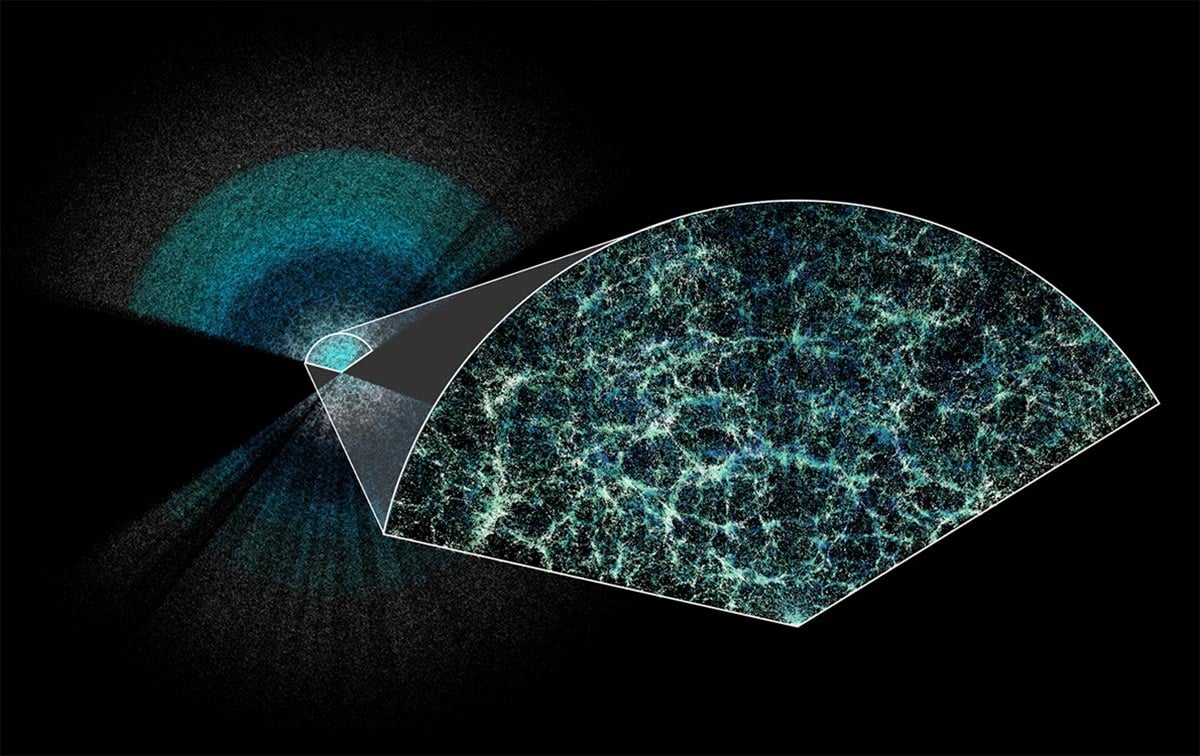
Yesterday the Open Journal of Astrophysics published a paper by Porredon et al which will feature in the usual Saturday round-up. That paper, which is based on the First Data Release from the Dark Energy Spectroscopic Instrument (DESI) reminded me that I should mention that DESI recently reached an amazing milestone – it has now mapped the positions and redshifts of 47 million galaxies and quasars! There is a full press-release about this achievement here.

Here’s a little video showing how the survey works:

There are more videos and other graphics in the press release.

Here’s a nice picture showing a thin slice through the full survey that reveals the characteristic “cosmic web” of the large-scale structure of the Universe in all its glory:

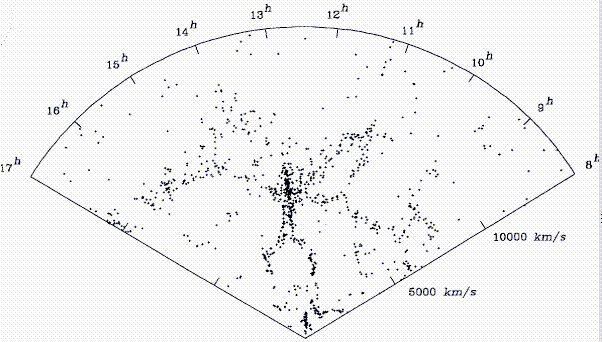
This progress is great, but it really makes me feel old. Forty years ago, in 1986, I had just started my PhD. The state-of-the-art galaxy redshift survey slice then is shown in this plot, from de Lapparent et al 1986 (ApJLett 302, L1), one of the first papers I read as a research student (I got it in 1985 as a preprint), which contains just 1,100 galaxies:

It is worth mentioning that although DESI has now covered its original target area, it will continue until 2028. You can never have too many galaxy redshifts!

Dark Energy Survey Year Y6 Results Day!

Posted in The Universe and Stuff with tags , , , , , , on January 22, 2026 by telescoper

This morning’s arXiv announcement contained a number of papers related to the Dark Energy Survey Y6 analysis. There is also a Zoom webinar later today at 10.30 Central Time (16.30 GMT; 13.30 in Greenland). Details can be found here.

You can find links to and abstracts of all the papers here, but I thought it would be useful to provide arXiv links to the latest batch here.

  • arXiv:2601.14559 Dark Energy Survey Year 6 Results: Cosmological Constraints from Galaxy Clustering and Weak Lensing – this is the key summary paper.
  • arXiv:2601.14484 Dark Energy Survey Year 6 Results: MagLim++ Lens Sample Selection and Measurements of Galaxy Clustering
  • arXiv:2601.14864 Dark Energy Survey: DESI-Independent Angular BAO Measurement
  • arXiv:2601.15175 Dark Energy Survey Year 6 Results: Galaxy-galaxy lensing
  • arXiv:2601.14833 Dark Energy Survey Year 6 Results: Magnification modeling and its impact on galaxy clustering and galaxy-galaxy lensing cosmology
  • arXiv:2601.14859 Dark Energy Survey Year 6 Results: Weak Lensing and Galaxy Clustering Cosmological Analysis Framework

A number of DES Y6 papers already published – including several in the Open Journal of Astrophysics – are listed here.

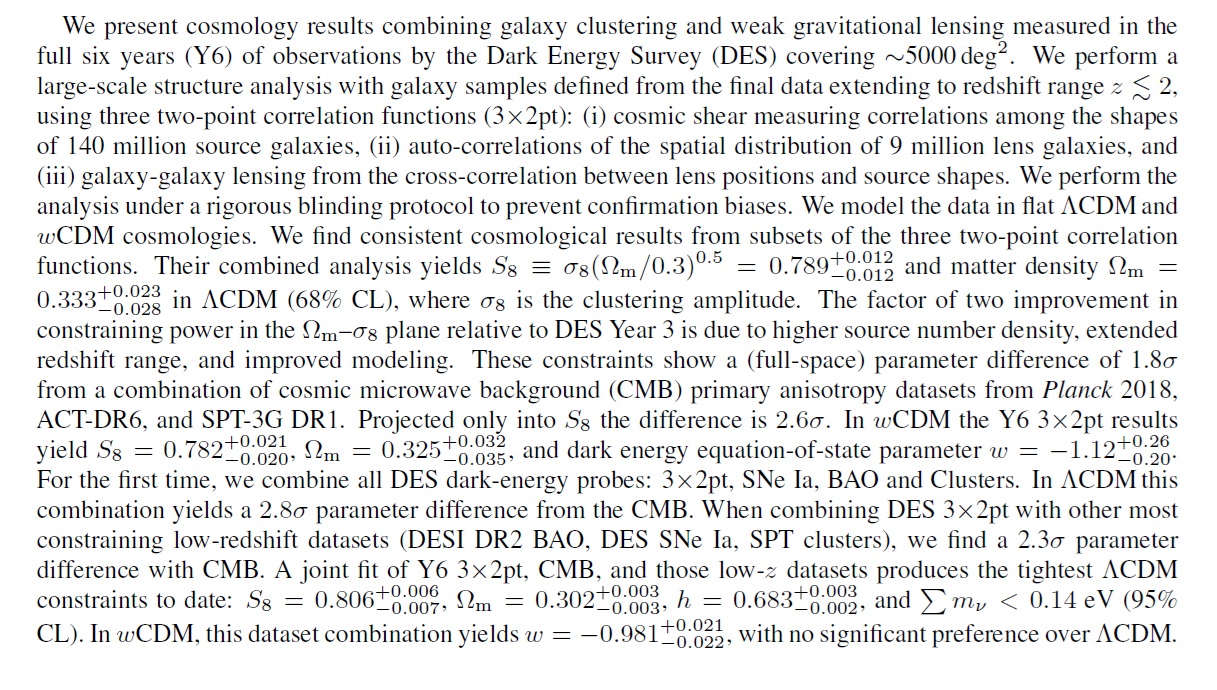
I’ll just highlight a couple of points from the first paper listed above, which uses the now standard “3x2pt” analysis, which combines three complementary two-point correlation functions: cosmic shear; galaxy-galaxy lensing and galaxy clustering. The abstract of this paper is as follows:

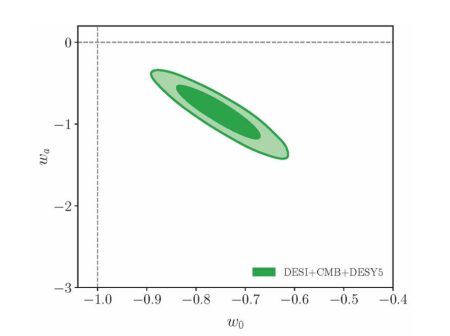
A notable result is contained in the last sentence. The simplest interpretation of dark energy is that it is a cosmological constant (usually called Λ) which – as explained here – corresponds to a perfect fluid with an equation-of-state p=wρc2 with w=-1. In this case the effective mass density  ρ of the dark energy remains constant as the universe expands. To parametrise departures from this constant behaviour, cosmologists have replaced this form with the form w(a)=w0+wa(1-a) where a(t) is the cosmic scale factor. A cosmological constant Λ would correspond to a point (w0=-1, wa=0) in the plane defined by these parameters, but the only requirement for dark energy to result in cosmic acceleration is that w<-1/3, not that w=-1. Results last year from DESI suggested values of w0 ≠-1 and wa≠0 , but the current DES results are consistent with w=-1; they do not constrain w0 and wa jointly.

For reference on the left you can find the (w0, wa) plane from DESI.

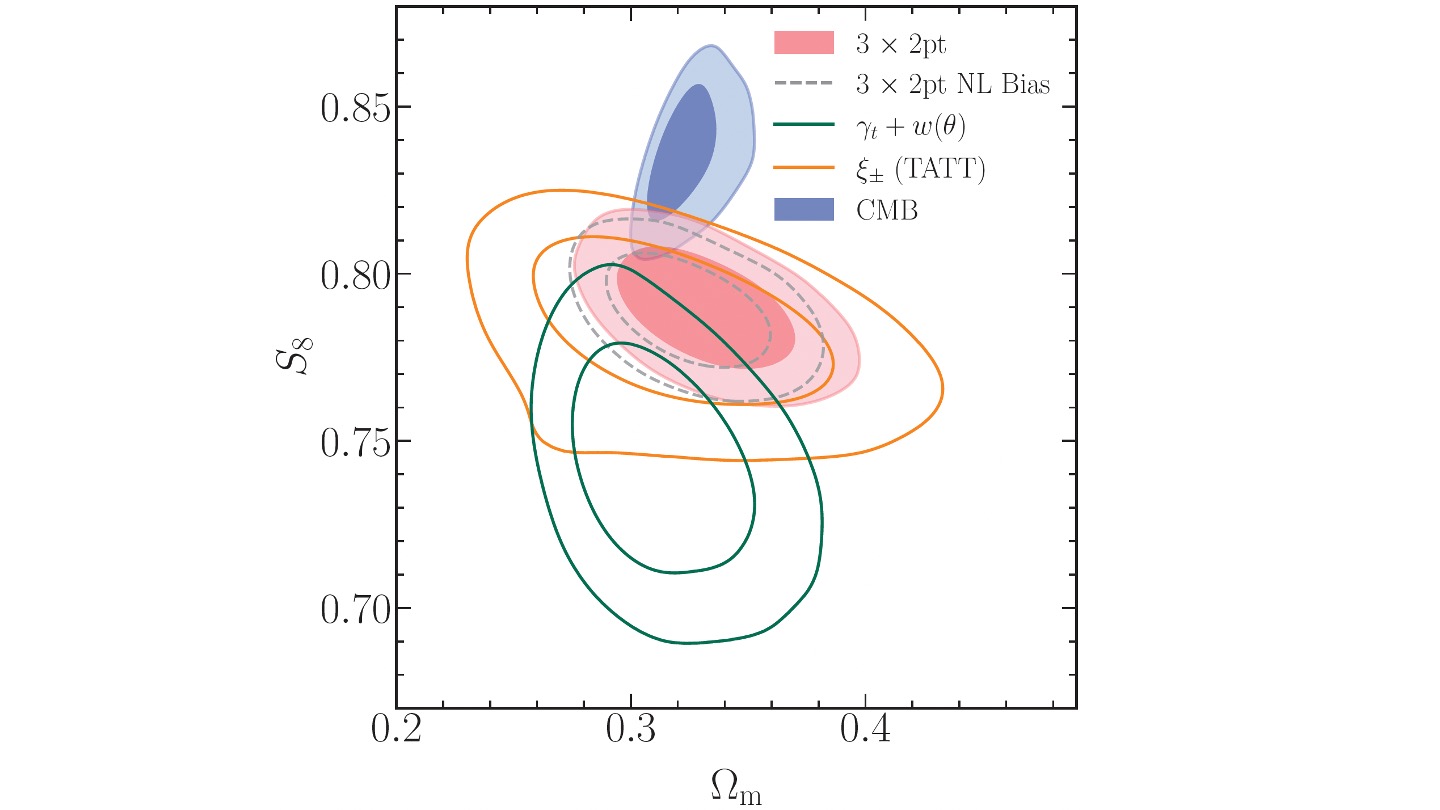
I thought I’d add one of the other cosmological contraint plots:

The results look qualitatively similar to previous plots but the contours have shifted a bit.

Weekly Update from the Open Journal of Astrophysics – 02/08/2025

Posted in OJAp Papers, Open Access, The Universe and Stuff with tags , , , , , , , , , , , , , , , , , , , , , , , , , , , , on August 2, 2025 by telescoper

It’s Saturday morning again, and it’s the start of a new month, so it’s time for an update of papers published at the Open Journal of Astrophysics. Since the last update we have published five new papers, which brings the number in Volume 8 (2025) up to 110, and the total so far published by OJAp up to 345. I expect we’ll the total number we published last year (120) sometime this month. I predict that by the end of this year we will have published around 180 papers in Volume 8 and around 400 altogether.

The papers published this week, with their overlays, are as follows. You can click on the images of the overlays to make them larger should you wish to do so.

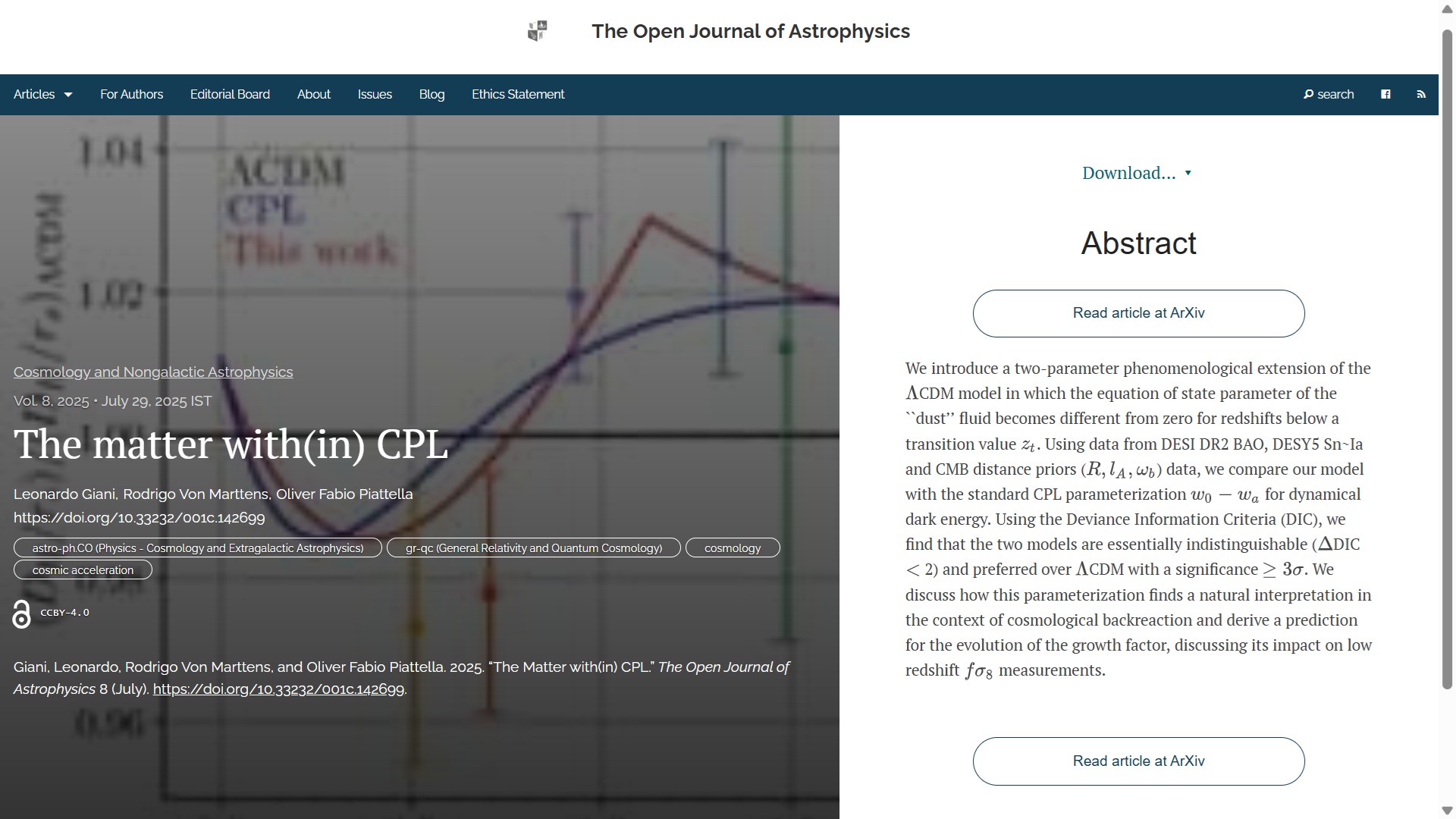
The first paper to report is “The matter with(in) CPL” by Leonardo Giani (U. Queensland, Australia), Rodrigo Von Marttens (Universidade Federal da Bahia, Brazil) and Oliver Fabio Piattella (Universita degli Studi dell’Insubria, Italy). This was published on Monday 29th July 2025 in the folder Cosmology and Nongalactic Astrophysics. This article presents a new parameterization of the standard model and its implications for the interpretation of cosmological observations.

The overlay is here:


The officially-accepted version can be found on arXiv here.

The second paper of the week, published on Tuesday 30th July in the folder Instrumentation and Methods for Astrophysics, is “An automated method for finding the most distant quasars” by Lena Lenz, Daniel Mortlock, Boris Leistedt & Rhys Barnett (Imperial College London, UK) and Paul C. Hewett (U. Cambridge, UK)”.  This paper presents an automated, reproduceable and objective high-redshift quasar selection pipeline, tested on simulations and real data from the Sloan Digital Sky Survey (SDSS) and UKIRT Infrared Deep Sky Survey (UKIDSS). The overlay is here:


You can find the officially accepted version of the paper on arXiv here.

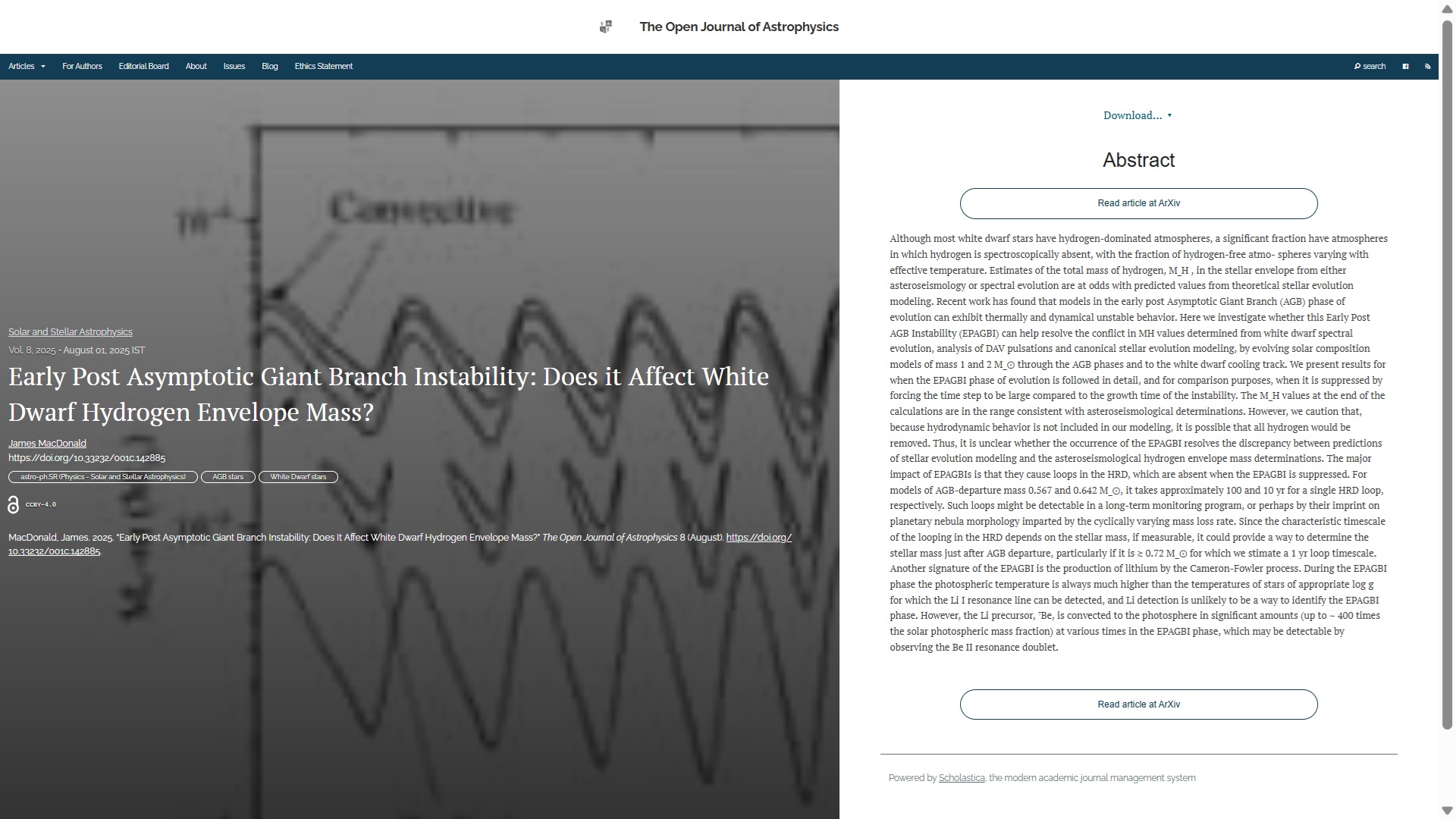
The third paper of the week is “Early Post Asymptotic Giant Branch Instability: Does it Affect White Dwarf Hydrogen Envelope Mass?” by James MacDonald (University of Delaware, USA). This one was published on Friday 1st Auguest (i.e. yesterday) in the folder Solar and Stellar Astrophysics. It is an investigation into whether Early Post AGB Instability (EPAGBI) can affect determinations of the total abundance of hydrogen in white dwarf stars.

The overlay is here:

The final version is on arXiv here.


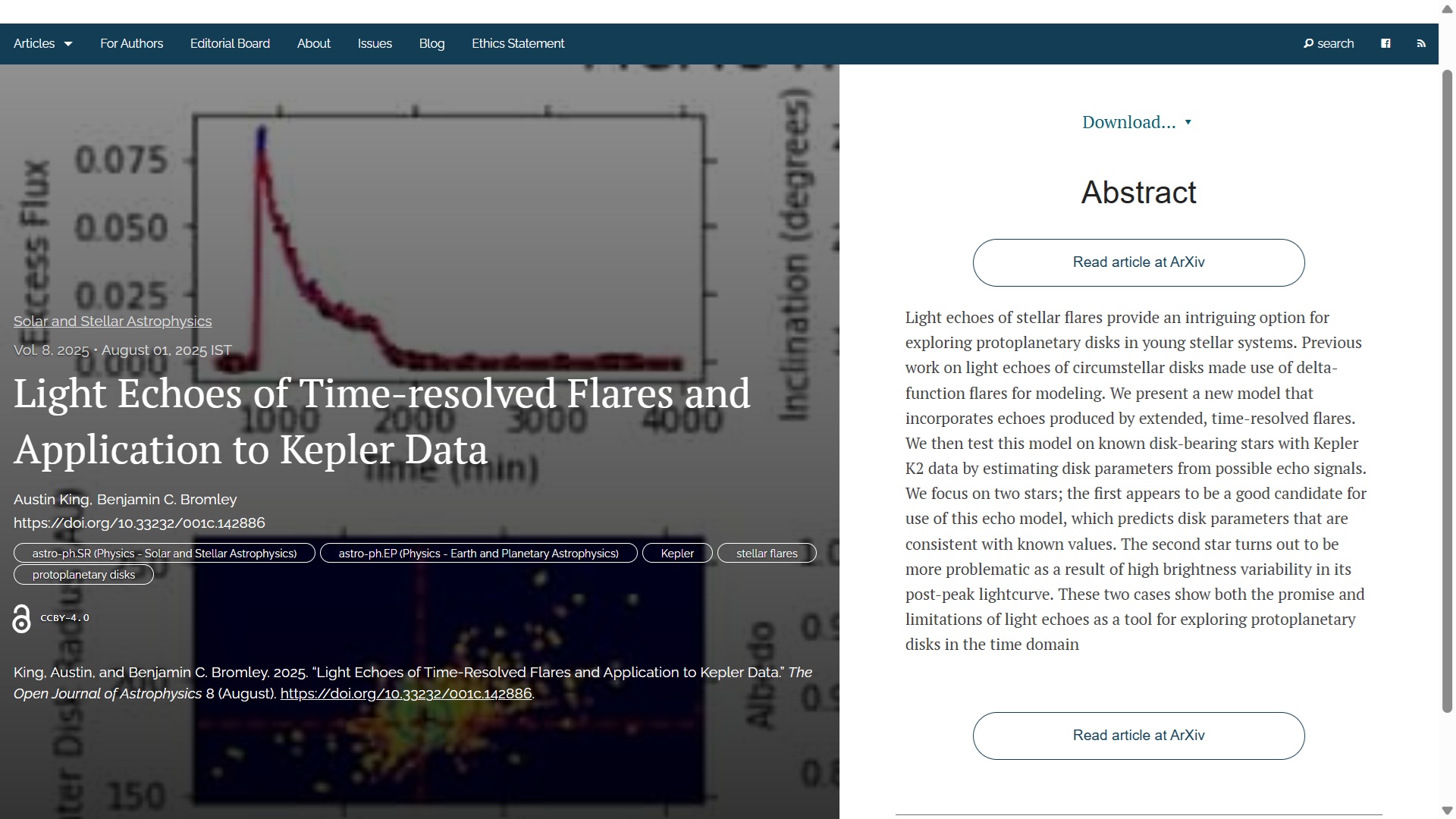
The fourth paper of the week, also published on Friday 1st August, is “Light Echoes of Time-resolved Flares and Application to Kepler Data” by Austin King and Benjamin C. Bromley (University of Utah, USA).  This describes a new model for circumstellar disks that incorporates echoes produced by extended, time-resolved flares. It is published in the folder Solar and Stellar Astrophysics. Here is the overlay:

You can find the officially-accepted version on arXiv here.


The fifth and final article published this week, also published on Friday 1st August,  is “Wide Binaries from Gaia DR3 : testing GR vs MOND with realistic triple modelling” by Charalambos Pittordis, Will Sutherland and Paul Shepherd (Queen Mary, University of London, UK). This presents a test for modified gravity from a sample of wide-binary stars from Gaia DR3, finding that (unmodified) Newtonian gravity provides a better fit to the data. It is in the folder Astrophysics of Galaxies.

The overlay is here:


You can find the officially-accepted version on arXiv here.

And that’s all the papers for this week. I’ll do another update next Saturday.

Cosmology Results from DESI

Posted in Astrohype, The Universe and Stuff with tags , , , , , , on March 20, 2025 by telescoper

Yesterday evening (10pm Irish Time) saw the release of new results from the Dark Energy Spectroscopic Instrument (DESI), completing a trio of major announcements of cosmological results in the space of two days (the Atacama Cosmology Telescope and the Euclid Q1 release being the others). I didn’t see the DESI press conference but you can read the press release here.

There were no fewer than eight DESI papers on the astro-ph section of the arXiv this morning. Here are the titles with links:

You can see from the titles that the first seven of these relate to the second data release (DR2; three years of data) from DESI; the last one listed here is a description of the first data release (DR1), which is now publicly available.

Obviously there is a lot of information to digest in these papers so here are two members of the DESI collaboration talking with Shaun Hotchkiss on Cosmology Talks about the key messages from the analysis of Baryon Acoustic Oscillations (the BAO in the titles of the new papers):

A lot has been made in the press coverage of these results about the evidence that the standard cosmological model is incomplete; see, e.g., here. Here are a few comments.

As I see it, taken on their own, the DESI BAO results are broadly consistent with the ΛCDM model as specified by the parameters determined by the Cosmic Microwave Background (CMB) inferred from Planck. Issues do emerge, however, when these results are combined with other data sets. The most intriguing of these arises with the dark energy contribution. The simplest interpretation of dark energy is that it is a cosmological constant (usually called Λ) which – as explained here – corresponds to a perfect fluid with an equation-of-state p=wρc2 with w=-1. In this case the effective mass density of the dark energy ρ remains constant as the universe expands. To parametrise departures from this constant behaviour, cosmologists have replaced this form with the form w(a)=w0+wa(1-a) where a(t) is the cosmic scale factor. A cosmological constant Λ would correspond to a point (w0=-1, wa=0) in the plane defined by these parameters, but the only requirement for dark energy to result in cosmic acceleration is that w<-1/3, not that w=-1.

The DESI team allow (w0, wa) to act as free parameters and let the DESI data constrain them, either alone or in combinations with other data sets, finding evidence for departures from the “standard values”. Here’s an example plot:

The DESI data don’t include the standard point (at the intersection of the two dashed lines) but the discrepancy gets worse when other data (such as supernovae and CMB) are folded in, as in this picture. The weight of evidence suggests a dark energy contribution which is decreasing with time.

These results are certainly intriguing, and a lot of credit is due to the DESI collaboration for working so hard to identify and remove possible systematics in the analysis (see the papers above) but what do they tell us about ΛCDM?

My view is that we’ve never known what the dark energy actually is or why it is so large that it represents 70% of the overall energy density of the Universe. The Λ in ΛCDM is really just a place-holder, not there for any compelling physical reason but because it is the simplest way of accounting for the observations. In other words, it’s what it is because of Occam’s Razor and nothing more. As with any working hypothesis, the standard cosmological model will get updated whenever new information comes to light (as it is doing now) and/or if we get new physical insights into the origin of dark energy.

Do the latest observations cast doubt on the standard model? I’d say no. We’re seeing an evolutionary change from “We have no idea what the dark energy is but we think it might be a cosmological constant” to “We still have no idea what the dark energy is but we think it might not be a cosmological constant”.

Timescape versus Dark Energy?

Posted in Astrohype, Open Access, The Universe and Stuff with tags , , , , , , , on January 2, 2025 by telescoper

Just before the Christmas break I noticed a considerable amount of press coverage claiming that Dark Energy doesn’t exist. Much of the media discussion is closely based on a press release produced by the Royal Astronomical Society. Despite the excessive hype, and consequent initial scepticism, I think the paper has some merit and raises some interesting issues.

The main focus of the discussion is a paper (available on arXiv here) by Seifert et al. with the title Supernovae evidence for foundational change to cosmological models. This paper is accompanied by a longer article called Cosmological foundations revisited with Pantheon+ (also available on arXiv) by a permutation of the same authors, which goes into more detail about the analysis of supernova observations. If you want some background, the “standard” Pantheon+ supernova analysis is described in this paper. The reanalysis presented in the recent papers is motivated an idea called the Timescape model, which is not new. It was discussed by David Wiltshire (one of the authors of the recent papers) in 2007 here and in a number of subsequent papers; there’s also a long review article by Wiltshire here (dated 2013).

So what’s all the fuss about?

Simulation of the Cosmic Web

In the standard cosmological model we assume that, when sufficiently coarse-grained, the Universe obeys the Cosmological Principle, i.e. that it is homogeneous and isotropic. This implies that the space-time is described by a Friedmann–Lemaître–Robertson–Walker metric (FLRW) metric. Of course we know that the Universe is not exactly smooth. There is a complex cosmic web of galaxies, filaments, clusters, and giant voids which comprise the large-scale structure of the Universe. In the standard cosmological model these fluctuations are treated as small perturbations on a smooth background which evolve linearly on large scales and don’t have a significant effect on the global evolution of the Universe.

This standard model is very successful in accounting for many things but only at the expense of introducing dark energy whose origin is uncertain but which accounts for about 70% of the energy density of the Universe. Among other things, this accounts for the apparent acceleration of the Universe inferred from supernovae measurements.

The standard cosmology’s energy budget

The approach taken in the Timescape model is to dispense with the FLRW metric, and the idea of separating the global evolution from the inhomogeneities. The idea instead is that the cosmic structure is essentially non-linear so there is no “background metric”. In this model, cosmological observations can not be analysed within the standard framework which relies on the FLRW assumption. Hence the need to reanalyse the supernova data. The name Timescape refers to the presence of significant gravitational time-dilation effects in this model as distinct from the standard model.

I wrote before in the context of a different paper:

….the supernovae measurements do not directly measure cosmic acceleration. If one tries to account for them with a model based on Einstein’s general relativity and the assumption that the Universe is on large-scales is homogeneous and isotropic and with certain kinds of matter and energy then the observations do imply a universe that accelerates. Any or all of those assumptions may be violated (though some possibilities are quite heavily constrained). In short we could, at least in principle, simply be interpreting these measurements within the wrong framework…

So what to make of the latest papers? I have to admit that I didn’t follow all the steps of the supernova reanalysis. I hope an expert can comment on this! I will therefore restrict myself to some general comments.

  • My attitude to the standard cosmological model is that it is simply a working hypothesis and we should not elevate it to a status any higher than that. It is based not only on the Cosmological Principle (which could be false), but on the universal applicability of general relativity (which might not be true), and on a number of other assumptions that might not be true either.
  • It is important to recognize that one of the reasons that the standard cosmology is the front-runner is that it provides a framework that enables relatively straightforward prediction and interpretation of cosmological measurements. That goes not only for supernova measurements but also for the cosmic microwave background, galaxy clustering, gravitational lensing, and so on. This is much harder to do accurately in the Timescape model simply because the equations involved are much more complex; there are few exact solutions of Einstein’s equations that can help. It is important that people work on alternatives such as this.
  • Second, the idea that inhomogeneities might be much more important than assumed in the standard model has been discussed extensively in the literature over the last twenty years or so under the heading “backreaction”. My interpretation of the current state of play is that there are many unresolved questions, largely because of technical difficulties. See, for example, work by Thomas Buchert (here and, with many other collaborators here) and papers by Green & Wald (here and here). Nick Kasiser also wrote about it here.
  • The new papers under discussion focus entirely on supernovae measurements. It must be recognized that these provide just one of the pillars supporting the standard cosmology. Over the years, many alternative models have been suggested that claim to “fix” some alleged problem with cosmology only to find that it makes other issues worse. That’s not a reason to ignore departures from the standard framework, but it is an indication that we have a huge amount of data and we’re not allowed to cherry-pick what we want. We have to fit it all. The strongest evidence in favour of the FLRW framework actually comes from the cosmic microwave background (CMB) with the supernovae provide corroboration. I would need to see a detailed prediction of the anisotropy of the CMB before being convinced.
  • The Timescape model is largely based on the non-linear expansion of cosmic voids. These are undoubtedly important, and there has been considerable observational and theoretical activity in understanding them and their evolution in the standard model. It is not at all obvious to me that the voids invoked to explain the apparent acceleration of the Universe are consistent with what we actually see in our surveys. That is something else to test.
  • Finally, the standard cosmology includes a prescription for the initial conditions from which the present inhomogeneities grew. Where does the cosmic web come from in the Timescape model?

Anyway, I’m sure there’ll be a lot of discussion of this in the next few weeks as cosmologists return to the Universe from their Christmas holidays!

Comments are welcome through the box below, especially from people who have managed to understand the cos.

Cosmology Talks: Recent DESI Power Spectrum Results

Posted in The Universe and Stuff with tags , , , , , on December 12, 2024 by telescoper

Some weeks ago I posted an item about recent results that have emerged from the DESI (Dark Energy Spectroscopic Instrument) Collaboration. I have been a bit busy since then but I just saw that there is one of those Cosmology Talks about these results which I thought I would pass on. The contributors are Arnaud de Mattia, Hector Gil-Marín and Pauline Zarrouk and they are talking about the analsysis they have done using the “full shape” of the galaxy power spectrum. It’s quite a long video, but very illuminating.

New Results from DESI

Posted in Barcelona, The Universe and Stuff with tags , , , , , , , on November 20, 2024 by telescoper
The Mayall Telescope at Kitt Peak, in which DESI is housed. This PR image was taken during a meteor shower, which is not ideal observing conditions. Picture Credit: KPNO/NOIRLab/NSF/AURA/R. Sparks

I’ve just got time between meetings to mention that a clutch of brand new papers has emerged from the DESI (Dark Energy Spectroscopic Instrument) Collaboration. There is a press release discussing the results from the Lawrence Berkeley Laboratory here and one from the ICCUB in Barcelona here; several members of the group I visited there during sabbatical are working on DESI. Congratulations to them.

I haven’t had time to read them yet, but a quick skim suggests that the results are consistent with the standard cosmological model.

The latest batch contains three Key Publications:

together with the companion supporting papers:

The links lead to the arXiv version of these papers. These articles can also be found, along with previously released publications by the DESI Collaboration, here.

Anyone who has read the latest papers is welcome to comment through the box below!

Space Week 2024: The Universe according to Euclid

Posted in Biographical, Books, Talks and Reviews, Euclid, The Universe and Stuff with tags , , , , , on October 10, 2024 by telescoper

I had a very busy day yesterday culminating in the Space Week event I blogged about a few weeks ago. There was a good attendance – lots of young kids as well as adults – and the lecture room was very full. We could probably have filled a much bigger room, actually, but had been moved to a smaller venue and had to close registrations very early to avoid having too many people. I’d guess we had about 350. My talk was the last one, and didn’t finish until 8.30 by which time I was definitely ready for a pint.

You can find the slides I used for my presentation, The Universe according to Euclid, here.

There was an official photographer there who took quite a few pictures but I haven’t seen any of them yet. I’ll post a selection if and when I get them.