A Question of Phosphine
Remember all the excitement last month about the claimed detection of phlogiston phosphine in the atmosphere of Venus?
Well, a wet blanket appears to have been thrown over it by a new paper on the arXiv by Snellen et al. Here is the abstract:
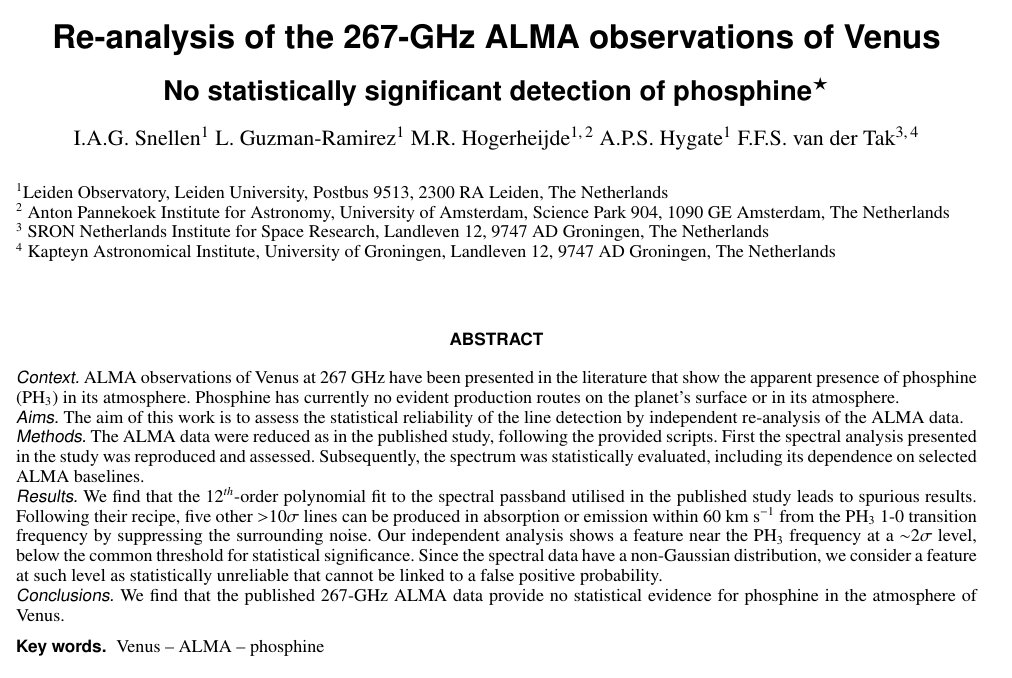
The conclusions are very clear, but the paper hasn’t been refereed yet. Let’s see what the authors of the original work have to say. For myself, I think a proper (i.e. Bayesian) analysis of the data is called for…
I should also mention in this context another paper on the arXiv from a few days ago, which uses a null detection to place an upper limit on the phosphine abundance.
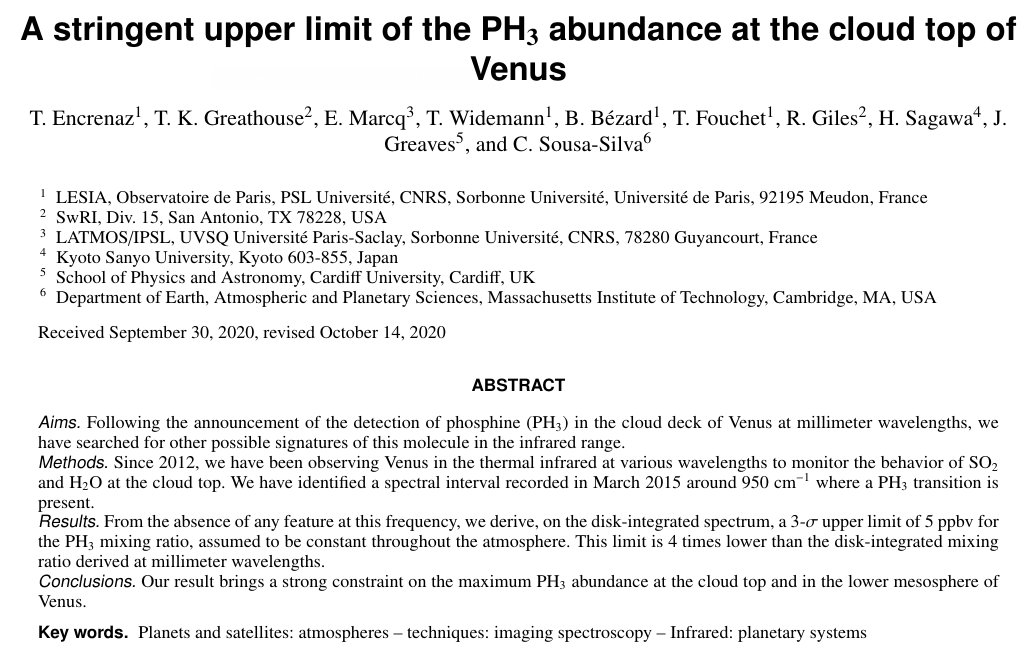
Note that one of the authors of this second paper is Jane Greaves, who was on the original discovery paper.
Follow @telescoper In the Dark
October 21, 2020 at 11:59 am
*12th order* polynomial background subtraction?!
October 21, 2020 at 5:56 pm
Quite. With 12 parameters you can fit everything but predict nothing. At least we can be confident that we are not in imminent danger of invasion by Venusians now.
William of Ockham must be turning in his (unmarked) grave.
October 21, 2020 at 12:13 pm
Hang on. This was published in Nature…with a 12th-order polynomial background subtraction that has no physical underpinning at all other than spuriously “improving” the SNR? Did none of the referees suggest that this might be a somewhat optimistic — and other words beginning with “op…” — approach to take to data analysis?
Fig. 2 of the first paper to which you refer, Peter, brings this out very nicely, but it’s hardly a staggering revelation when it comes to data treatment. That’s lazy refereeing, at best.
October 21, 2020 at 12:23 pm
As you say, it was published in Nature…
October 21, 2020 at 2:52 pm
Ouch!
October 21, 2020 at 9:01 pm
It’s not quite as bad as this: https://muircheartblog.wpcomstaging.com/2018/10/24/how-not-to-do-spectral-analysis-101/
…but it gives it a damn good run for its money.
October 21, 2020 at 8:59 pm
I’m uncomfortable with “forcing” referees to reveal their identities, Phillip. For one, it will cut down dramatically on the number of scientists willing to referee. But on the other hand, I agree that if it were the norm to put our name to our comments, the peer review system might be a little more robust.
October 21, 2020 at 10:27 pm
Nature Astronomy and Nature are not the same thing.
October 21, 2020 at 11:29 pm
Astronomy and Nature Astronomy aren’t the same thing either…
October 22, 2020 at 8:40 am
I have found the refereeing in Nature Astronomy as good as any of the major astronomy journals. I think you are wrong in attacking a journal because of what you think of a relative. As for the result, perhaps give the original authors a chance to respond?
October 22, 2020 at 2:49 pm
I very much dislike the how the Nature Publishing Group tries to force its way into more and more fields by establishing Nature this and that journals. The journals are, of course, very expensive and because of the Nature glamour at least deans and such think they’re the journals everyone should aim for.
A few years ago there was a lot of talk about boycotting Elsevier journals, but I thing the Nature Publishing Group is just as bad if not worse.
October 22, 2020 at 9:49 am
The only reason, it seems to me, is the fear that he let through a paper which was not good enough..
I agree with your arguments in the main, Philipp, but I’ll just note that referees are not exclusively male…
October 23, 2020 at 3:47 am
[…] A Question of Phosphine links to Re-analysis of the 267-GHz ALMA observations of Venus: No statistically significant detection of phosphine. This team re-analyzed the same data used in the first Phosphine gas paper, but came to the opposite conclusion. So it comes down to a very complicated question of statistical analysis. […]
October 28, 2020 at 12:57 pm
[…] continue the ongoing saga of Phosphine in the atmosphere of Venus there’s a very strongly worded paper on the arXiv […]
February 8, 2021 at 12:09 pm
[…] detection of Phosphine in the atmosphere of Venus? If you do you will remember that the claim has been contested. Now there is another paper on this matter claiming that what was interpreted as a spectral feature […]