New Publication at the Open Journal of Astrophysics
Time to announce the first publication of 2021 in the Open Journal of Astrophysics. This one was actually published a few days ago but it took a bit of time to get the metadata and DOI registered so I held off announcing it until that was done.
The latest publication is a lengthy and comprehensive review article (67 pages altogether) by Allahverdi et al. which has 26 authors from all round the world. It is entitled The First Three Seconds: a Review of Possible Expansion Histories of the Early Universe and is a study of the various possible evolutionary histories of cosmic expansion possible with a wide range of cosmological models with their implications for baryogenesis, nucleosynthesis, primordial gravitational wave production, and many other things besides.
Here is a screen grab of the overlay:
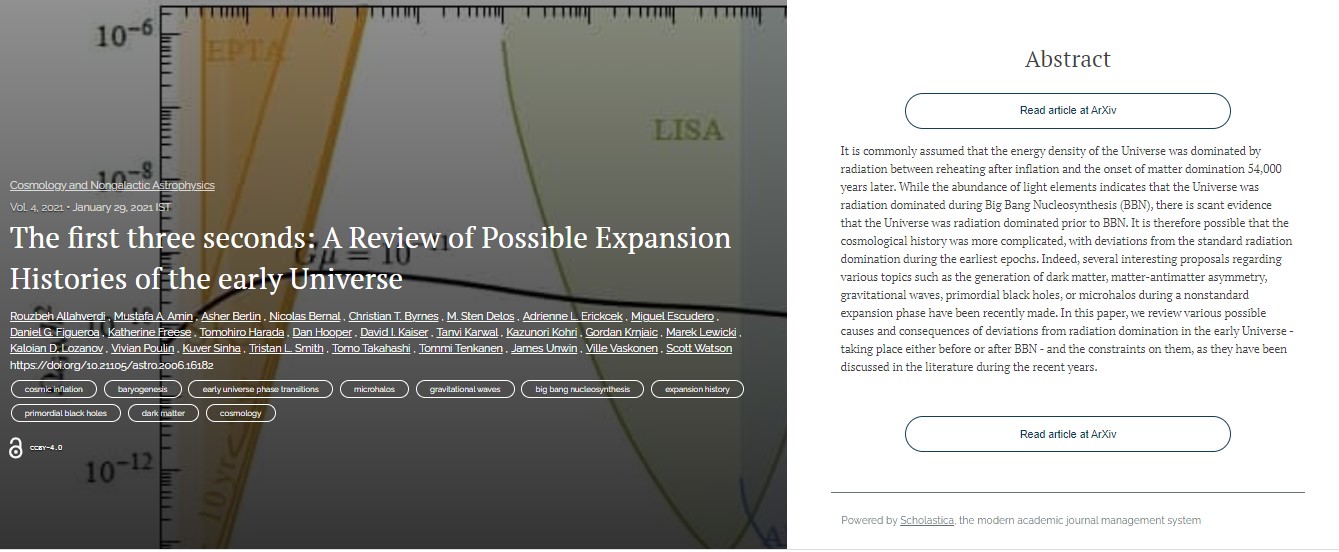
You can click on the image to make it larger should you wish to do so. You can find the arXiv version of the paper here. This is one for the Cosmology and Nongalactic Astrophysics folder.
And so Volume 4 begins. Volume 3 had 15 papers, Volume 2 had 12 , and Volume 1 just 4 so we’re growing slowly but surely! Let’s see how many we publish in 2021. I can tell you we have some very exciting papers in the pipeline…
Follow @telescoper In the Dark
February 2, 2021 at 12:33 pm
The universe is not expanding. If it were, the competition between expansion and gravitational attraction would distort galaxies and galactic clusters – e.g. fringes only weakly bound by gravity would succumb to expansion and fly away. No distortions observed. A telling text:
Sabine Hossenfelder: “The solution of general relativity that describes the expanding universe is a solution on average; it is good only on very large distances. But the solutions that describe galaxies are different – and just don’t expand. It’s not that galaxies expand unnoticeably, they just don’t. The full solution, then, is both stitched together: Expanding space between non-expanding galaxies.” http://backreaction.blogspot.bg/2017/08/you-dont-expand-just-because-universe.html
February 2, 2021 at 2:54 pm
I’m a little confused as to why you quote a source that says unambiguously that the Universe as a whole is expanding apparently to support your opinion that it isn’t.
February 2, 2021 at 6:19 pm
Her conclusion “Expanding space between non-expanding galaxies” is puzzling and, in my view, unwittingly reveals a fatal contradiction in the expansion theory. Why are galaxies and even galactic clusters not expanding at all?
February 2, 2021 at 8:31 pm
Phillip Helbig, your argument is invincible.
February 4, 2021 at 6:16 am
Peter. When will the journal get an official impact factor? Also in many Indian universities, one needs publications in Scopus indexed or web of Science journals. Many other new astrophysics journals are cataloged in Scopus. Request you to do the same for OJA (if not done) Thanks
February 4, 2021 at 9:44 pm
The impact factor is a nonsense. But if you’re really interested the impact factor for Year N, which is published in year N+1, is based on the average number of citations obtained in Year N for papers published in Years N-1 and N-2 so it requires two complete years of publishing. For the OJA, the first official IF will be published in 2022 based on the citations gained in 2021 (this year) for papers published in 2019 and 2020. Earlier years were incomplete.
As for Scopus, Elsevier decides who gets listed. All we can do is apply.
February 5, 2021 at 11:31 am
There is so much article-level bibliometric data readily available that it makes absolutely no sense to use journal-level descriptors.
February 5, 2021 at 12:16 pm
The choice of two years seems completely arbitrary to me. Note it also excludes citations to papers within two years of publication, which in fast-moving subjects can be a large number.
February 5, 2021 at 2:07 pm
Yes, both ends of the counting window are problematic.