The vaccine effect
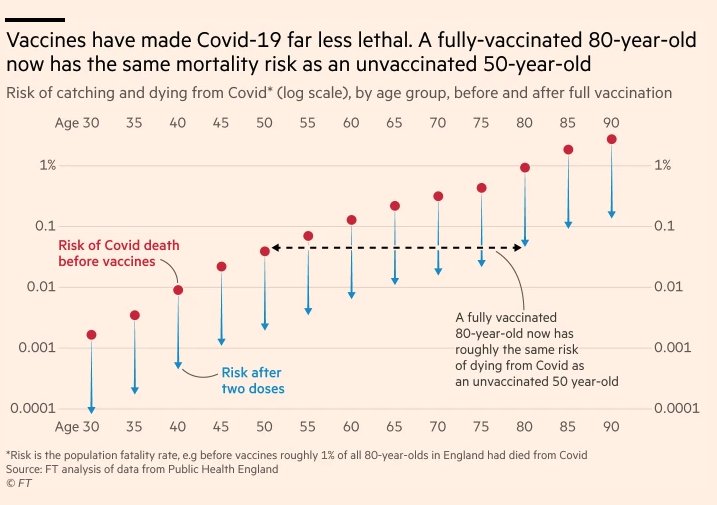
I saw this nifty graphic from the Financial Times floating around on social media and thought I would share it here. It’s a nice demonstration of the way the use of vaccines has impacted mortality rates from Covid-19. Basically the vaccines reduce the probability of a death by a factor greater than 10 (i.e. are more than 90% effective in doing this). On the logarithmic plot this appears as a downward shift in the “risk of death” that is more or less independent of age.
This behaviour is generally consistent with the observation that while infections in the UK are quite high the mortality rate is still rather low. Low is not zero, however, and there will still be some deaths if infection levels are high: a small fraction of a large number can still be significant.
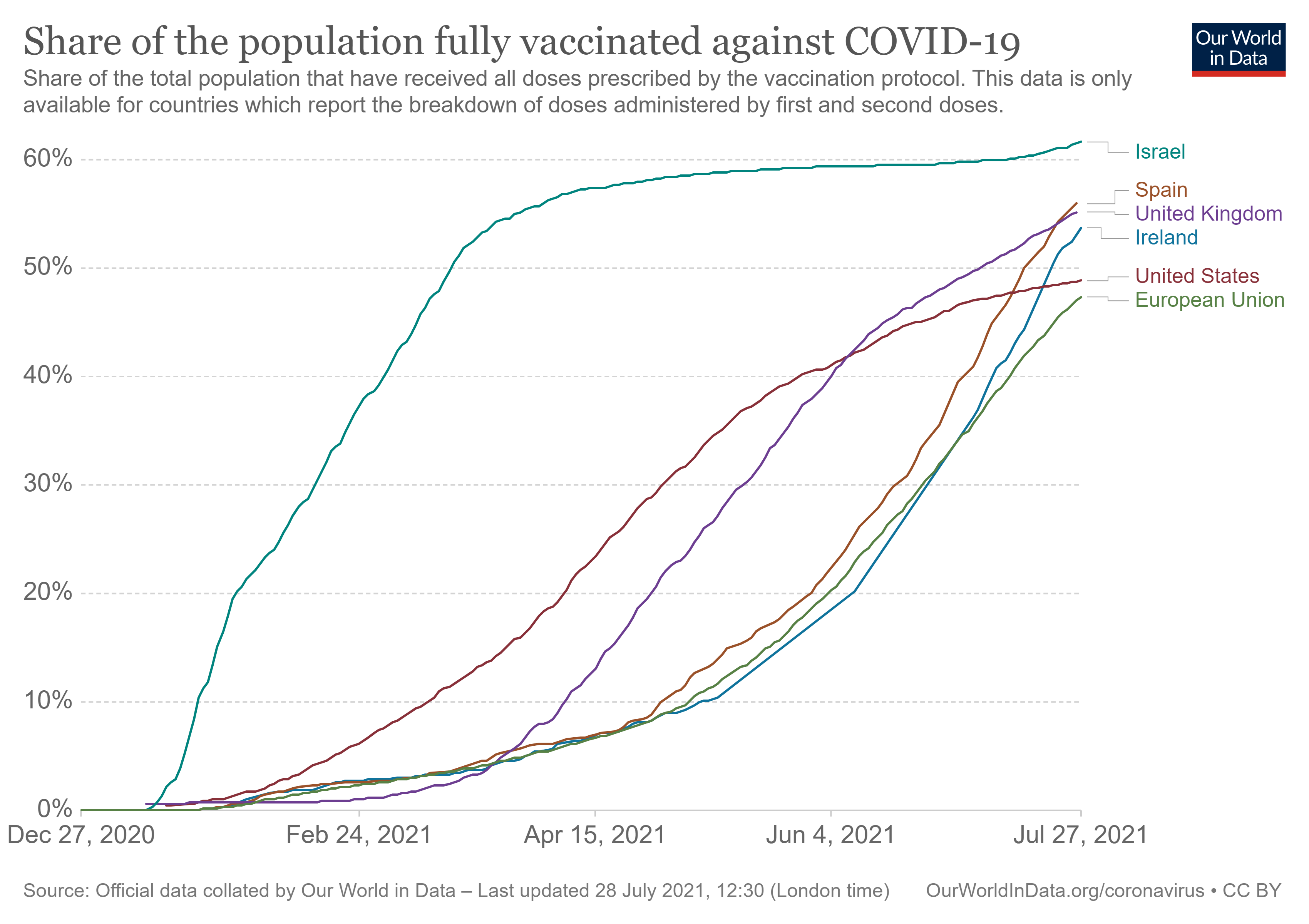
Incidentally, about 70% of the adult population of Ireland has now been vaccinated with about 80% having received partial vaccination. The fraction of the total population fully vaccinated is about 54%. On this measure Spain has just overtaken the UK in vaccinations; Ireland is well above average for the EU. The USA and Israel have both flattened out considerably.
When I got back from my break I tried my best to update the statistics relating to Ireland here. Doing so reminded me that when I first decided to plot the data on a log y-axis I got a slew of comments on Twitter complaining that I was “manipulating the data”! The backlash against anything even simple mathematics is quite extraordinary sometimes.
Anyway, the latest logarithmic plot looks like this:
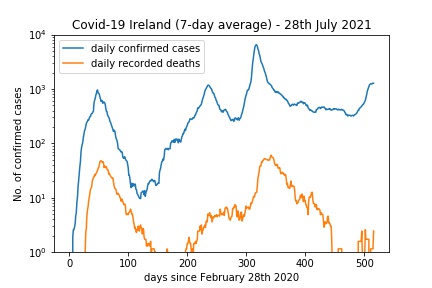
The death figures are unreliable because of the lingering effects on the ransomware attack on the Health Service Executive IT system but do seem to be much lower relative to infections than they were at earlier stages of the pandemic, even allowing for the fact that the first peak in the case curve should be higher as testing was not so extensive at this early stage. The 7-day average of new cases is currently around 1200-1300 per day.
It still fascinates me how the case numbers managed to stay roughly constant for such a long time at such a high level earlier this year…
 In the Dark
July 28, 2021 at 8:39 pm
The models were not predicting the recent fall in infections in the UK, and I reckon I know the explanation: prior immunity. The models reckoned that the entire population was liable to catch covid. But as early as last year two facts seemed incompatible: the extreme infectiousness of SARS-CoV-2, and the fact that you have a less than 1 in 3 chance of catching it from somebody you are sleeping with nightly. (Bear in mind you are infectious for about 10 days before you know you have it, so this isn’t about locking yourself in the spare room.) The only way I can see to reconcile those facts is if a considerable fraction of the population had some kind of cross-immunity to SARS-CoV-2 before this virus ever appeared. This hypothesis would instantly explain the recent unexpected and very glad fall in cases in the UK.
I am not an epidemiologist and I welcome critical comments.
July 28, 2021 at 9:02 pm
I think there are questions about testing. Some are arguing that cases numbers are higher than currently being reported, but I don’t know enough about it to comment meaningfully. If cases are falling there should be a corresponding fall in mortality pretty soon.
July 29, 2021 at 9:30 am
Don’t bet on it. I know several people who caught it in the last two weeks, and in all cases once someone in a household had it others followed. All cases are from people who were vaccinated, by the way. And it may not be as bad in vaccinated people, but that doesn’t mean it is mild.
July 29, 2021 at 10:56 am
If there is a genetic factor in immunity then persons in a household are correlated. There’s plenty we don’t know yet. How to reconcile my points (1) and (2) is what interests me, and I’ve come up with one hypothesis. I welcome others.
July 29, 2021 at 11:47 am
Couples are not genetically related. The vaccines work remarkably well and I would encourage anyone to get them. The protection is very high against life threatening illness, high against serious illness. They are not a guarantee against getting infected though. And it spreads in unexpected ways. One person I know fell ill after a driving test: perhaps the car had not been disinfected after the previous candidate.
July 29, 2021 at 6:01 pm
I said households are genetically correlated, not couples. Households often include children and parents.
At my age (64), I’m glad to be doubly jabbed. I can understand why younger persons might be reluctant, given that covid19 is generally mild to imperceptible for them, and that longterm effects of the vaccine plus repeated topups are unknown. I don’t grudge the young their reluctance despite the higher risk to me.
Changing the subject, mutations occurring within the vaccinated and then infecting others are likely to become gradually more virulent due to selection pressure. That is worrying given that we are never going to get rid of this thing (and therefore should not try to). Perhaps the longterm answer is an antiviral cocktail, as is used fairly successfully against HIV nowadays. Ivermectin tastes OK with rum, sugar and lime juice.
July 29, 2021 at 6:07 pm
Might it not mutate into a more transmissible but less dangerous form so we get collective immunity at relatively little cost? Some people think that’s what happened with the so-called Spanish Flu, but not before it killed around 50 million worldwide.
July 29, 2021 at 6:41 pm
There may be more than one mutation, and cross-immunity is not clear – after all we are talking about mutations that take place inside bodies of persons vaccinated against present strains. Marek’s disease in chickens was once mild, but was bad enough to vaccinate against, and subsequent strains now kill all chickens unless they are vaccinated:
https://covidcandy.net/coronavirus/a-new-mutation-threatens-a-fragile-recovery/
*If* this is the case then it won’t matter for a few winters, but we had better switch to antivirals within a few years.
July 29, 2021 at 10:37 pm
Sorry Anton, I should have clarified that the cases I referred to include couples catching it from each other. You mention ivermectin: that is dangerous. It is unproven against covid, not approved for human use, has side effects and can lead to death in case of an overdose. Don’t.
July 30, 2021 at 12:15 am
Ivermectin not approved for human use? Not here, but over 3 billion doses of it have been given as a dewormer to humans in the 3rd World in the last 30 years after it had passed all Western safety tests, and nothing harmful has turned up. Subject to the dosage being similar, it is merely about repurposing it against covid19, and the only question then is how good it is. Please read the following link for powerful anecdotal info, and also for an explanation of why Western national drug licensing agencies are soooo slow at looking at it even though it is working well in the 3rd World:
Click to access The-Drug-that-Cracked-Covid-by-Michael-Capuzzo.pdf
Several peer-reviewed meta-analyses can be had of its efficacy against SARS-CoV-2 if you care to google – and, although meta-analysis is iffy, the onward references to individual studies are provided in the references, and more studies continue to come in. Or go to the FLCCC website and rummage there. Their protocol against long covid was the first thing I found online after months of googling that spoke of Raynaud’s syndrome as a complication of long covid, and since that is what long covid gave me I am impressed.
A specific question: what is your source that ivermectin is unsafe? Please cite peer-reviewed studies that found damage to humans or animals.
July 30, 2021 at 8:29 am
https://medlineplus.gov/druginfo/meds/a607069.html
There is a very vocal group advertising this drug but it is not approved by any health authority for use against covid. FDA warns against it. WHO has called for trials and says that the published evidence is inconclusive. The papers I saw were small samples, dodgy statistics and incomplete reporting and analysis. It is not advisable to do medical experiments in yourself. I am glad to hear you are vaccinated.
July 30, 2021 at 9:43 am
You have not engaged with my point that ivermectin long ago passed all Western-standard safety trials for use in humans, who have received over 3 billion doses of it. The body does not know whether it is being repurposed for use against covid19 rather than against intestinal parasites, does it?
Evidence of its efficacy against covid19 on a case-by-case basis is still emerging, but place after place in the Third World where the vaccines haven’t reached is finding it works well.
And I repeat my request: Please cite peer-reviewed studies that found damage to humans or animals. That shouldn’t be too hard if people have received 3 billion doses and it is in routine veterinary use, should it? It is not even a prescription-only veterinary drug, which tells you something.
July 31, 2021 at 10:41 am
Will you accept the FDA? ‘Taking large doses of this drug is dangerous and can cause serious harm’. The warning is for overdosing and is especially against the animal version, presumably because of the dosing. No efficacy has been shown of ivermectin for any viral disease where it has been tried (NIH: ‘no clinical trials have reported a clinical benefit for ivermectin in patients with these viruses)’, so why push it? And when it doesn’t work, isn’t it likely that people will take more?
July 31, 2021 at 10:11 pm
What do you mean, the animal version?
You can overdose on *anything*. I asked for a peer-reviewed study showing damage. I would hate to think that the FDA was basing its advice on anything less.