A Dress Code for Physics?
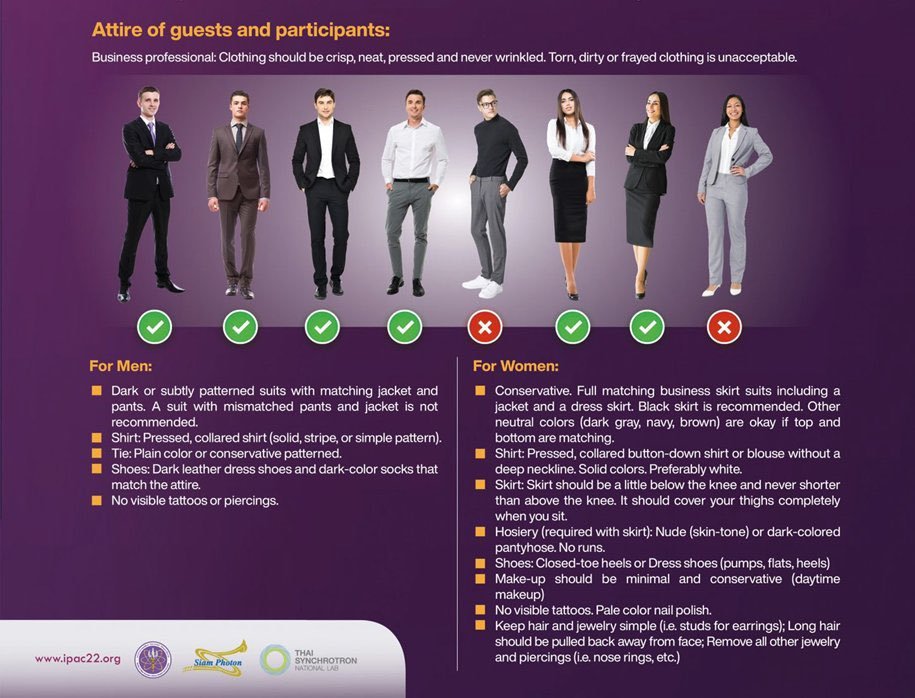
This image has been doing the rounds on Physics Twitter recently, accompanied by a mixture of incredulous, amused and angry comments. It’s from the instructions from the 13th International Particle Accelerator Conference (IPAC2022) which takes place in Thailand next month.
To be fair I think this dress code is only for delegates wishing to attend a special event at which the Thai Royal Family will be present, but that it is strange that it should be so “Westernized”. It seems nobody wearing more traditional formal clothing from African or Asian countries, or even Thailand itself would be allowed.
Aside from that, the highly gendered instructions would make many attendees uncomfortable. Women must wear skirts, not trousers for example. Why? I wonder if they’d allow a Scotsman wearing a kilt? It’s all very silly and not at all inclusive. I suspect this nonsense has put off a number of potential attendees.
Speaking for myself, I don’t mind dressing up a bit for special social occasions that have a dress code. At the RAS Club Dinners at the Athenaeum the dress code for men is, amusingly, “jacket and tie”. Trousers are apparently not allowed and there’s no restriction that I know of on female dress. As a matter of fact I find it a relief when the dress code for a function is formal (e.g. “black tie”) because a male person such as me then doesn’t have to think about what to put on. IG wouldn’t like to have a dress code imposed on me at work, though.
The instruction that clothing must be “crisp, neat, pressed and never wrinkled” would represent an impossible standard for most of my colleagues in physics who for the most part dress in a manner that’s more “scruffy academic” than “business professional”. I have however worked with physicists who dress at work in a wide variety of ways. One I remember always wore a three-piece suit (even at the height of summer) and another was full Goth, neither style made any difference to their ability to do research.
I have sometimes been asked by junior researchers about how to dress for things like interviews or conference talks. I wrote about this before, here.
In brief the idea of of dressing up for job interviews in academia has always seemed rather odd to me. The default style of dress for academics is “scruffy”, so it’s a bit odd that we all seem to pretend that it’s otherwise for interviews. I suppose it’s just to emphasize that it’s a formal occasion from the point of view of the interview panel, and to show that the candidates are taking it seriously. I don’t really pay much attention to what interviewees wear, other than that if they look like they’ve just been dragged through a hedge one might infer that they’re a bit too disorganized even to be a member of the academic staff at a University or that they’re not really putting enough effort into the whole thing.
On the other hand, some people feel so uncomfortable in anything other than jeans and a T-shirt that putting on a suit would either be an unbearable ordeal for them or conflict with their self-image in some fundamental way. Neither of these are intended, so if that’s going to be the case for you, just dress as you normally do (but preferably with something reasonably clean).
I sometimes get asked whether a (male) candidate for a PhD place should wear a suit and tie forsuch an interview. Having conducted interview days for many years at a number of different institutions, my experience is that a smaller proportion do dress formally for PhD interviews than for job interviews. My advice to students asking about this is just to say that they should try to look reasonably presentable, but suit–and-tie are definitely not compulsory. I would say “smart casual” is a good guide, though I have to say I don’t really know what that is. In any case it’s unlikely the staff interviewing you will be dressed formally…
Anyway, in writing this I started to think that the world would be a better place if “business professionals” were made to dress like academics, rather than the other way round.
 In the Dark
May 2, 2022 at 8:13 pm
As I understand it, the Thai royal family is treated as deities, so any criticism or dress that might be considered blasphemous is an extremely serious offence. Probably best to avoid the event!
On the domestic question, the thing about a suit and ties is that it is always OK – even a scruffy academic interviewer won’t mark you down for a suit, whereas a smartly dressed interviewer might (consciously or subconsciously) mark down someone in jeans and T shirt.
Business meetings raise similar problems – especially international ones where one party is an elegantly dressed Mediterranean in a pastel blazer. Again, a suit is safe.
The thing to consider is what outcome you want, rather than what is sensible!
May 4, 2022 at 10:10 am
Great last sentence – as with Peter’s item above!
Never trust a profession which is required to wear a tie.
May 4, 2022 at 10:25 am
There’s an old joke that goes:
Q: “What do you call a [insert name of University] graduate who’s wearing a tie?
A: “The Accused”…
May 3, 2022 at 10:35 am
I see that the dress code for women is far longer than the one for men….
My advice for people being interviewed for a job or PhD viva is to look presentable. I used to advise a shirt and tie (for men) but that was based on the male panel members wearing shirts and ties. Fewer and fewer do. I recall when I was an undergraduate, all of the (male) lecturing staff would wear shirts and ties, and many would wear suits. (All had trousers).
I always wear black jacket, trousers, white shirt and tie – mostly because I don’t then have to think about what to wear (like Seth Brundle in The Fly….)