Characterization of JWST science performance from commissioning
I don’t suppose it will take very long for science papers based on the first data from JWST to start appearing on arXiv but I haven’t seen any yet. There is however a very important with an uncountable number of authors, led by Jane Rigby, that describes the commissioning process. Uncountable by me, that is.
Here is the abstract:
This document characterizes the actual science performance of the James Webb Space Telescope (JWST), as known on 12 July 2022. Following six months of commissioning to prepare JWST for science operations, the observatory is now fully capable of achieving the discoveries for which it was built. A key part of commissioning activities was characterizing the on-orbit performance of the observatory. Here we summarize how the performance of the spacecraft, telescope, science instruments, and ground system differ from pre-launch expectations. Almost across the board, the science performance of JWST is better than expected. In most cases, JWST will go deeper faster than expected. The telescope and instrument suite have demonstrated the sensitivity, stability, image quality, and spectral range that are necessary to transform our understanding of the cosmos through observations spanning from near-earth asteroids to the most distant galaxies.
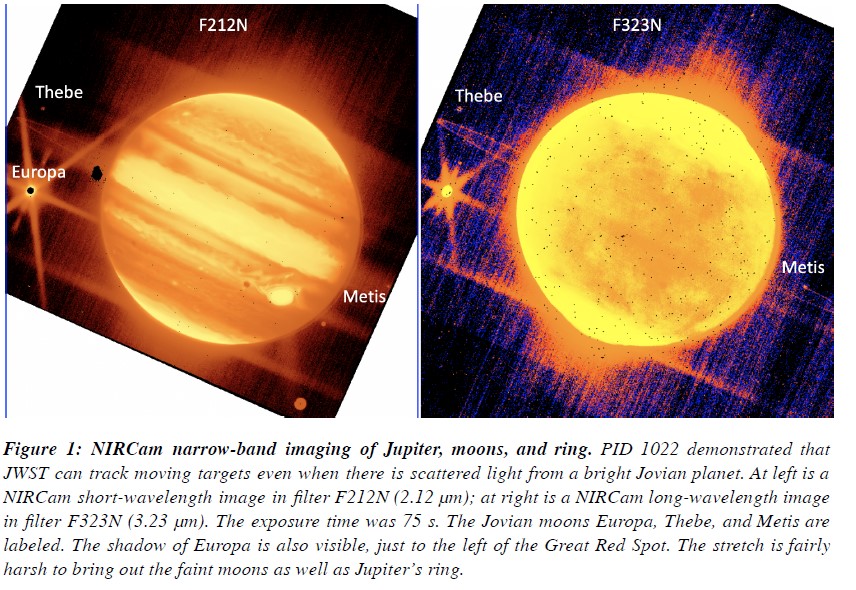
Although it’s very long (60 pages) it’s well worth reading for an account of how meticulously the various calibrations etc were done. Various objects make cameo appearances, including Jupiter:
 In the Dark
July 15, 2022 at 8:34 pm
I’m not an astrophysicist, and have only oddly-spaced pockets of knowledge here and there e.g. I know what wave front errors and Strehl ratios are, and why they matter. But I’ve had to mark it up extensively, with lots of ‘look this up’, etc., notes.
I can’t image too many people are printing a 60 page doc, so what mark-up tools do professionals use? I use KDE Okular, but then I don’t have a need to share work in progress.