New Publication at the Open Journal of Astrophysics
I’m delighted to be able to announce the 10000th paper this year, and 1000000th publication overall, at the Open Journal of Astrophysics!
That is counting in binary, of course. In base ten the new paper at the 16th paper in Volume 5 (2022) as well as the 64th in all.
The latest publication is entitled “Evolution of Cosmic Voids in the Schrödinger-Poisson Formalism” and the authors are Aoibhinn Gallagher and Peter Coles (Who he? Ed) both of the Department of Theoretical Physics at Maynooth University. Obviously as author I played no role in the selection of referees or any other aspect of the editorial process.
Aoibhinn Gallagher – bonus marks for pronouncing both names correctly – is my first Maynooth PhD student and this is her first paper, of many I hope (and expect)! We’re already working on extensions of this approach to other aspects of large-scale structure. You can find some discussion of this general approach here.
Anyway, here is a screen grab of the overlay which includes the abstract:
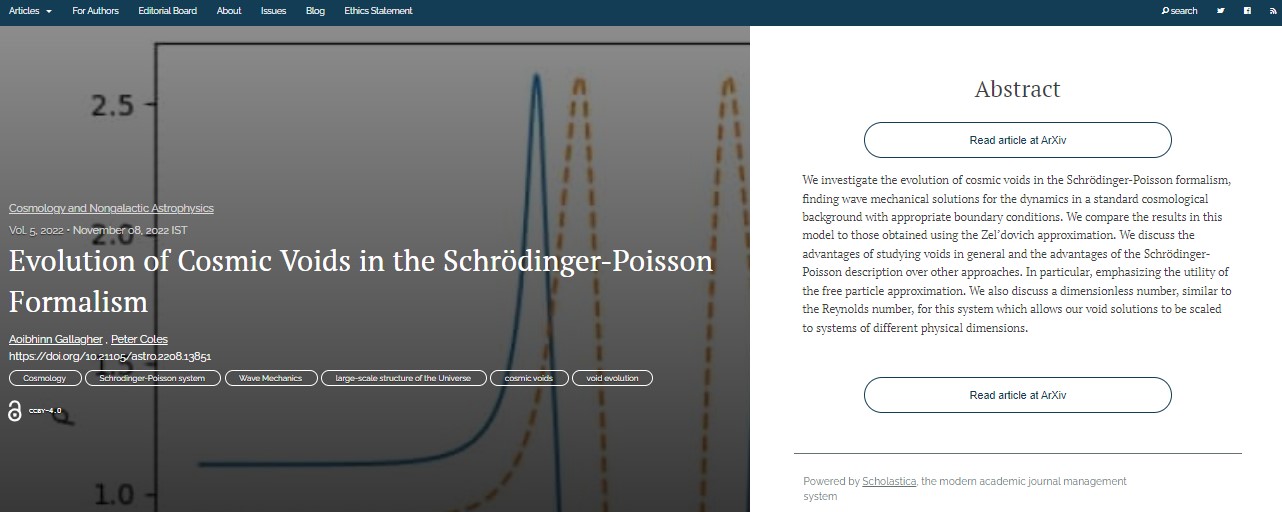
You can click on the image to make it larger should you wish to do so. You can find the officially accepted version of the paper on the arXiv here.
Here is a nice animated version of Figure 5 of the paper showing, for a 1D slice, the radial expansion of a spherically symmetric void (i.e. underdense region) using periodic boundary conditions:
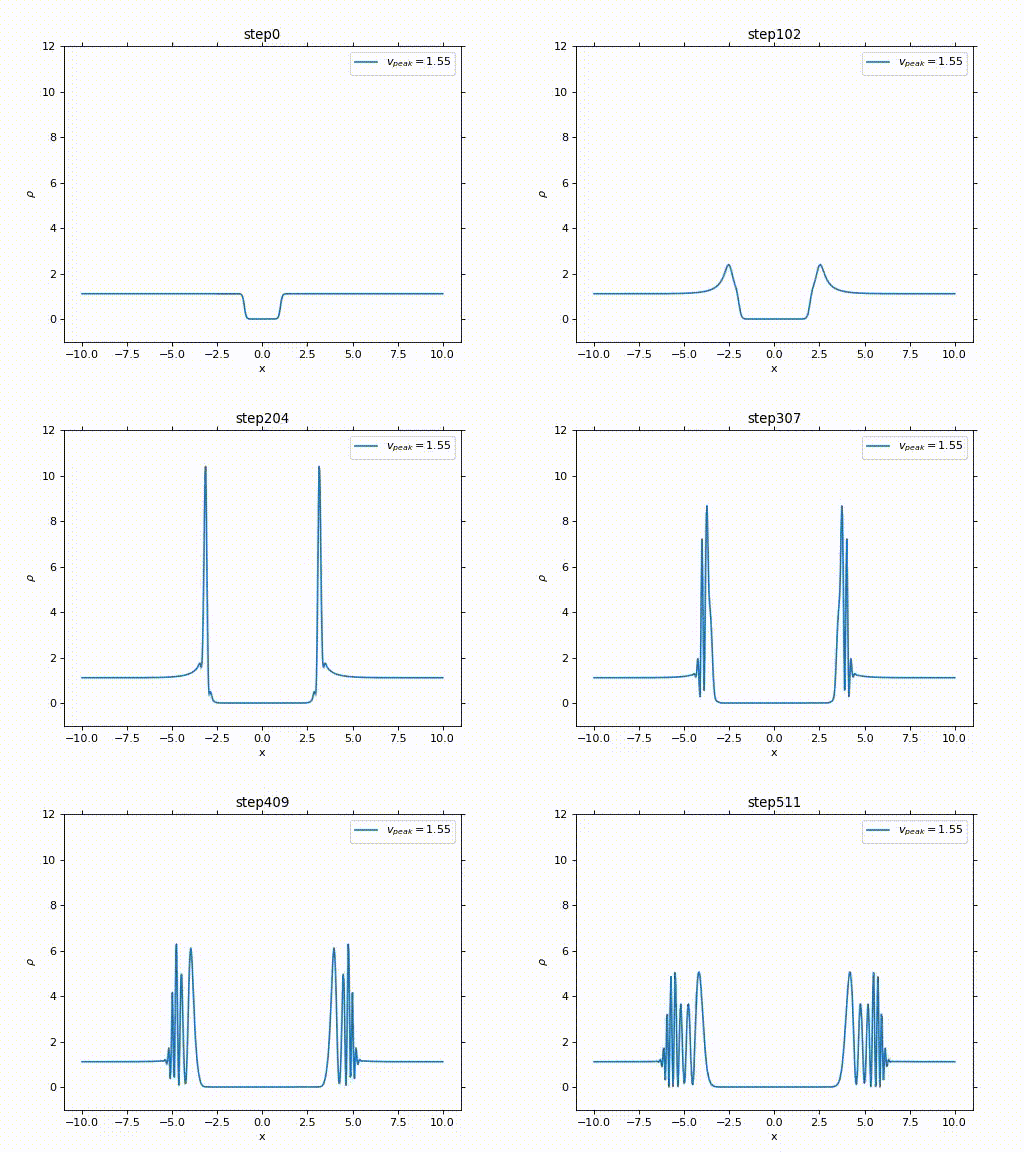
The x-axis is in (scaled) comoving coordinates, i.e. expanding with the cosmological background, so that the global expansion is removed. You can see that the void expands in these coordinates, so is expanding more quickly than the background, initially pushing matter into a dense ring around the rim of the empty void. That part of the evolution is just the same as for “normal” matter but in this case the wave-mechanical behaviour of the matter prevents it from being confined to a strongly-localized structure as well as affecting the subsequent expansion rate.
Of course in the real Universe, voids are not isolated like this but instead tend to push into each other, but we felt it was worth studying the single void case to understand the dynamics!
Follow @telescoper In the Dark
November 10, 2022 at 12:52 pm
If you lived in a culture committed to base 2 then it would be quite difficult to say so because you wouldn’t have a symbol for ‘2’; you’d have to invent one for the purpose of the discussion.
November 10, 2022 at 1:00 pm
You could still write base 10 though…
November 10, 2022 at 1:50 pm
For my wife’s 64th birthday party I had a cake with Happy 1,000,000 birthday on it and that she was one in a million. I explained to the assembled audience about binary notation and how 64 was a special number. The audience was not impressed….
November 12, 2022 at 3:24 pm
I’m guessing the pronunciation is something like ee-vin Galla-her. Am I close?
May 26, 2025 at 4:29 pm
[…] P.S. You can get an idea of some of the content of Aoibhinn’s thesis here. […]
July 16, 2025 at 12:50 pm
[…] is based on work that his in her now-completed PhD thesis, along with another paper mentioned here. I have been interested for many years in the Schrödinger-Newton system (or, more specifically, […]