The First Room-Temperature Superconductor?
This is outside my usual areas, but there’s a new paper on arXiv which, if verified, could be extremely important. It’s called The First Room-Temperature Ambient-Pressure Superconductor and it is written by three scientists based in Korea. High temperature superconductivity has been, er, a hot topic for some years. One must be cautious because (as far as I am aware) the article has not yet been refereed, but is this a breakthrough?
Here is the abstract:
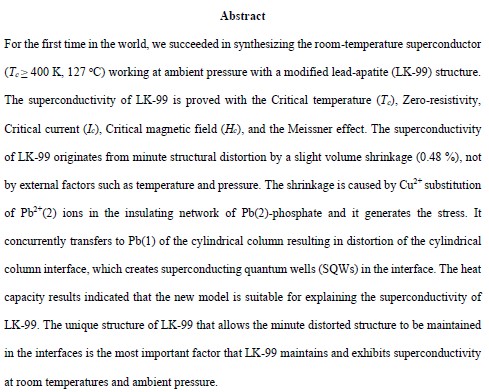
It seems to me that 400K is a bit hot for a room, but the point is that the material behaves as a superconductor (i.e. zero resistivity) for T < Tc so cooler rooms would do! The current definition of “high temperature” is Tc > 77K which is much lower than the Tc = 400 K stated here.
Here’s part of a figure from the paper showing (right) the material LK-99 and its structure (left):
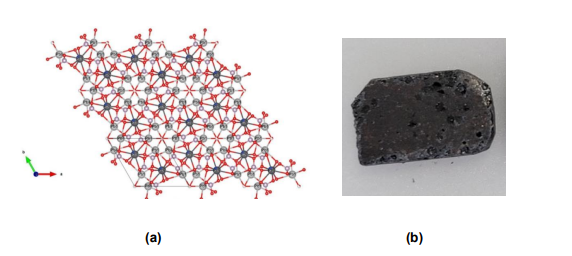
I’m not an expert, but it looks like the material involved is neither particularly expensive nor particularly complicated so it should be relatively easy to determine whether these results are reproducible.
Comments from experts are welcome!
 In the Dark
July 25, 2023 at 8:41 pm
Not only room temperature but room pressure (good old STP)! I recall being impressed to read that hydrogen might be a room temperature superconductor but only at staggeringly high pressures. I look forward very much indeed to tests of replication.
July 26, 2023 at 12:43 am
Some consider this toxic, so do not proceed if you are easily offended.
So finally, lead (STILL ALL THESE YEARS) inside waterpipes in most US cities will be so valuable that someone will do something about it.
July 26, 2023 at 9:53 am
Looks intriguing. The difficult part will be replication, sounds like there are several complex steps much like conventional LN2 superconductors. If this team want to be taken seriously then they should provide samples to interested researchers under NDA
July 26, 2023 at 11:07 am
Rightly, such a claim from a genuine physics laboratory is already taken seriously. The question is whether it is true. Perhaps they already have provided samples. But true replication involves being totally hands-off from other laboratories and simply giving them all details necessary for replication, including sample fabrication.
I notice that they got superconductivity only in an almost 2-dimensional sample, and claim that the non-zero albeit very low resistivity in 3D samples is due to grain boundaries, dislocations etc. I see no reason to disbelieve them but the next step in their laboratory, at least, is obvious.
Peter, I’m not on Twitter or any of its clones. Is this creating a huge fuss? There was nothing on the IOP/Physics Word website last night, and it’s years since I’ve been in a departmental tea room.
July 26, 2023 at 11:32 am
This paper is getting a lot of interest on social media, most of it is somewhat sceptical, but this is fairly indicative:
This little blog post of mine has generated about 3000 hits overnight, which is a lot by my standards.
July 26, 2023 at 8:08 pm
I’m a physicist, but not a condensed matter expert. The synthesis technique that they describe in the paper is very, very simple for a properly equipped laboratory, and the measurements that they performed are also extremely simple. I expect replication or debunking very soon — on a timescale of weeks. There are several ways that this could be pathological science or wrong, but the world will know that very soon. The material they have is made up of extremely common and boring elements, so there would not be a scramble for rare-earth compounds. This would be amazing, if true.
July 27, 2023 at 10:15 am
The section of the Wikipedia article on high-temperature superconductivity devoted to theory is confusing, even for a research physicist in another field.
https://en.wikipedia.org/wiki/High-temperature_superconductivity#Theoretical_models
The secdtion opens with a long paragraph describing two competing theories for the effect, which it calls weak coupling and interlayer coupling; then there are subsections for D-symmetry in YBCO and for the spin-fluctuation mechanism. These were obviously not written by the same hand as that opening paragraph, and the relation between them needs clarification. This Anglo-Irish experiment also deserves to be fitted in:
https://physicsworld.com/a/quantum-microscopy-sheds-light-on-high-temperature-superconductivity/
July 28, 2023 at 1:37 pm
So, DC mains in the distant future? And a great facilitation of the magnetic-field-generating coils in trial fusion toruses (although the superconducting transition temperature reduces with current)?
July 29, 2023 at 9:14 am
I’m surprised that the preprint didn’t make the front pages of the Guardian/Telegraph/Times.
August 1, 2023 at 11:28 am
This fairly dynamic Wikipedia page about the material involved is the place to keep up to date at:
https://en.wikipedia.org/wiki/LK-99
August 2, 2023 at 3:22 pm
Here is an interesting update:
https://www.science.org/content/blog-post/room-temperature-superconductor-new-developments
August 2, 2023 at 10:58 pm
I’m surprised that LK-99 isn’t just ordinary LK with a chocolate flake stuck in it.
August 2, 2023 at 11:14 pm
The name is because they say they discovered it in 1999. So, why 24 years to test it for superconductivity? Perhaps the name applies to a generic class, and the member of that class claimed to superconduct is novel.
If it is superfluid too then sticking a flake in it would be interesting.
August 8, 2023 at 7:35 pm
I’m hearing that the claim that LK-99 is a superconductor is encountering some resistance.
August 8, 2023 at 8:27 pm
We’re not ohm yet.
August 8, 2023 at 10:45 pm
It’s…
superconductivityexpialidocious.
August 12, 2023 at 11:56 am
Update:
https://arxiv.org/abs/2308.03544