Yet more high-z galaxies from JWST…
I noticed a paper on arXiv yesterday, by Robertson et al., with the abstract:
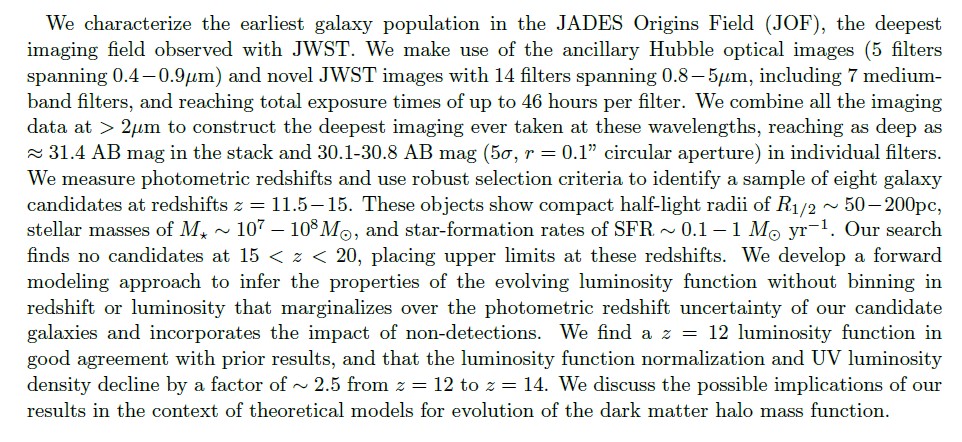
You can click on this to make it larger if you find it difficult to read.
This is the latest in a number of studies by the JWST Advanced Deep Extragalactic Survey (JADES), which is aiming to detect galaxies that formed in the very early Universe; for a previous example see here. The latest batch can be seen in this figure:
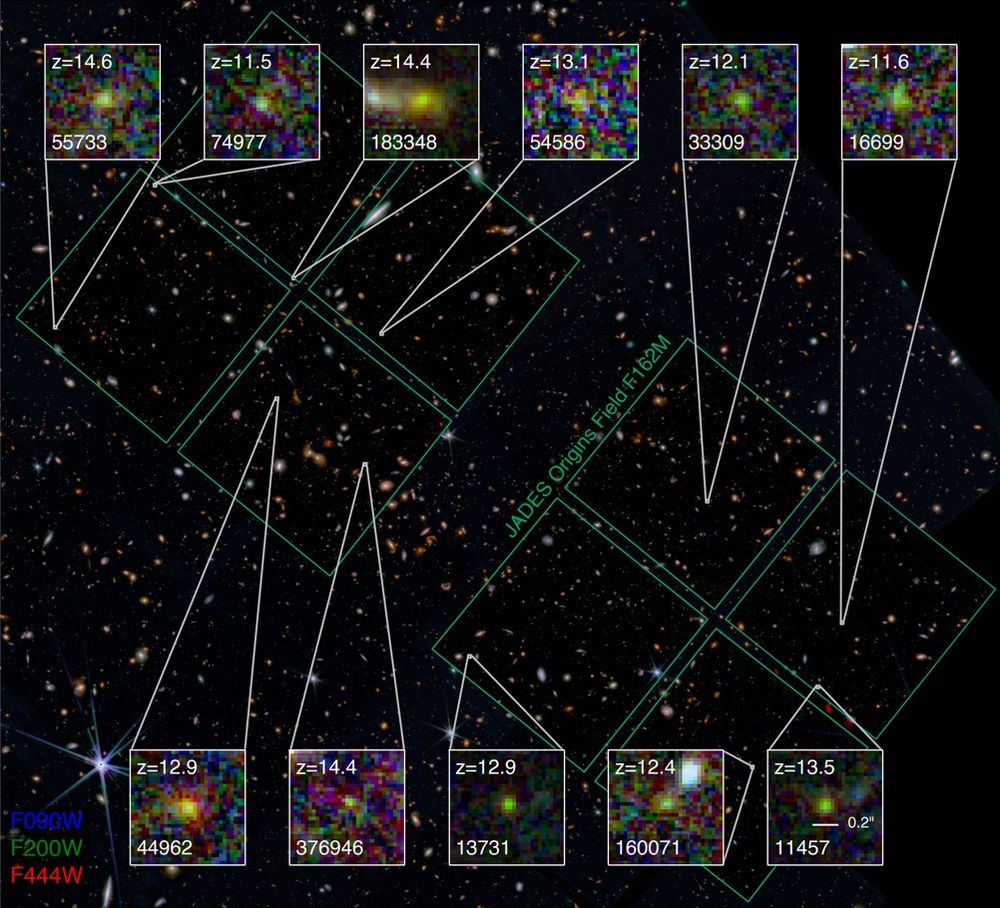
There is an important caveat here, which is that these are photometric redshifts, based on the overall shape of the spectrum of the galaxy rather than on spectral lines which give a more accurate result. Follow-up spectroscopy is needed to firmly identify the redshift of the sources. Past experience suggests that some of these candidates may not actually be at as high a redshift as is claimed. If confirmed, however, the existence of large galaxies at redshifts of order 15 will put greater pressure on models of galaxy formation. A recent OJAp publication has shown that galaxies at redshift 10 are consistent with current theoretical ideas, but much larger will increase the tension on theorists. I can imagine quite a few people around the world replotting their graphs right now!
 In the Dark
December 19, 2023 at 11:36 am
It’s long seemed to me a basic problem with using Einstein’s concept of spacetime, the physical basis for Relativity, to explain why redshift increases proportional to distance in all directions, is that if space were to expand, the speed of light should increase proportionally, in order to remain constant.
Yet two metrics are being derived from the same light. One based on the speed and one based on the spectrum.
If the speed were being used as the numerator, it would be a tired light theory, but as an expanding space theory, the speed is still the explicit denominator. The essential ruler used to measure this expansion.
In discussing it over the decades, it does seem Big Bang Theory can only be patched, never falsified.
Here is an essay, discussing this, back in the days of the Hubble;
https://www.americanscientist.org/article/modern-cosmology-science-or-folktale
Here is a paper I came across, pointing out that one way spectrums do redshift over distance, is as multi spectrum “packets,” as the higher frequencies dissipate faster;
http://fqxi.org/data/forum-attachments/2008CChristov_WaveMotion_45_154_EvolutionWavePackets.pdf Yet if that is the case, it would mean we are sampling a wave front, not detecting individual photons of light, traveling billions of lightyears, so the quantification of light would be an artifact of its detection, a loading, or threshold theory.
Here is another paper, arguing just that;
Click to access Reiter_challenge2.pdf
December 19, 2023 at 11:47 am
I’m afraid these comments make no sense to me. The speed of light in vacuum is a constant (c) in general relativity and in theories derived from it, such as the standard version of the Big Bang.
December 20, 2023 at 11:01 pm
Would you consider intergalactic space a vacuum? Apparently it expands at a rate that is not constant to the light crossing it.
What is the vacuum in which the speed of light is a constant, if it is not intergalactic space?
It seems there are two metrics. One based on the speed and one based on the spectrum, of this intergalactic light.
December 20, 2023 at 11:35 pm
The speed of light is constant and there is only one metric. An elementary undergraduate cosmology textbook would explain this to you.
December 20, 2023 at 11:53 pm
It seems all the descriptions I’ve read, over the decades, is that the universe is expanding, while light remains constant. Such that eventually we won’t be able to see those distant galaxies, as the light won’t reach us.
I see diagrams posted, showing the waves being stretched, but the light doesn’t speed up.
The inchworm crawling on a expanding balloon analogy, where the balloon expands, but the inchworm doesn’t speed up.
December 19, 2023 at 11:45 am
I don’t get it. Why do results like this get reported as high z before it is confirmed by spectroscopy?
December 19, 2023 at 11:49 am
Some of them probably are high z. I suspect the answer to your question is that somebody has a grant review coming up!