The Big Ring Circus
At the annual AAS Meeting in New Orleans last week there was an announcement of a result that made headlines in the media (see, e.g., here and here). There is also a press release from the University of Central Lancashire.
Here is a video of the press conference:
I was busy last week so didn’t have time to read the details so refrained from commenting on this issue at the time of the announcement. Now that I am back in circulation, I have time to read the details, but unfortunately was unable to find even a preprint describing this “discovery”. The press conference doesn’t contain much detail either so it’s impossible to say anything much about the significance of the result, which is claimed (without explanation) to be 5.2σ (after “doing some statistics”). I see the “Big Ring” now has its own wikipedia page, the only references on which are to press reports, not peer-reviewed scientific papers or even preprints.
So is this structure “so big it challenges our understanding of the universe”?
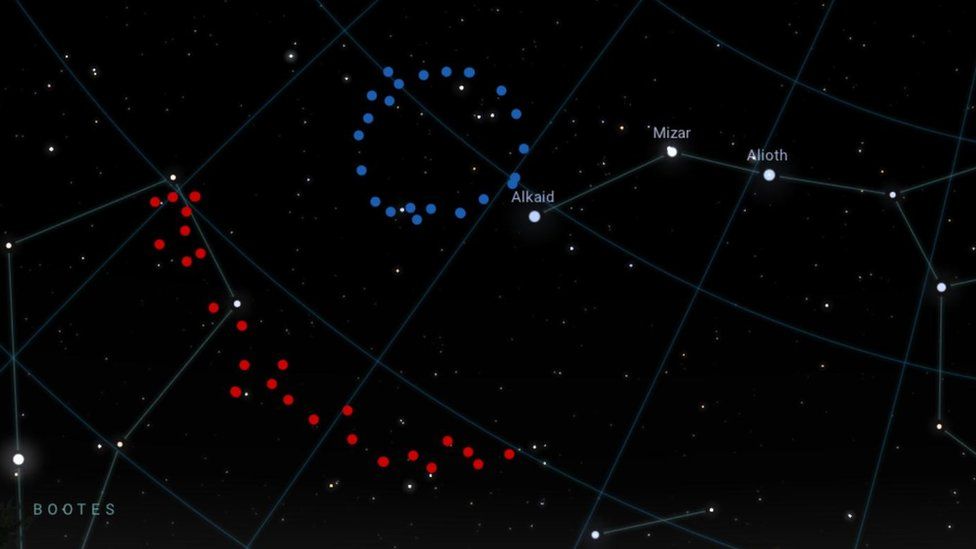
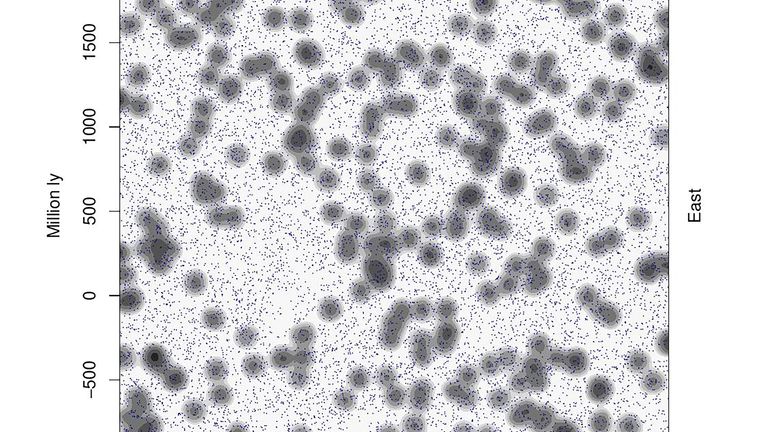
Based on the available information it is impossible to say. The large-scale structure of the Universe comprises a complex network of walls and filaments known as the cosmic web which I have written about numerous times on this blog. This structure is so vast and complicated that it is very easy to find strange shapes in it but very hard to determine whether or not they indicate anything other than an over-active imagination.
To assess the significance of the Big Ring or other structures in a proper scientific fashion, one has to calculate how probable that structure is given a model. We have a standard model that can be used for this purpose, but to simulate very structures is not straightforward because it requires a lot of computing power even to simulate just the mass distribution. In this case one also has to understand how to embed Magnesium absorption too, something which may turn out to trace the mass in a very biased way. Moreover, one has to simulate the observational selection process too, so one is doing a fair comparison between observations and predictions.
I have seen no evidence that this has been done in this case. When it is, I’ll comment on the details. I’m not optimistic however, as the description given in the media accounts contains numerous falsehoods. For example, quoting the lead author:
The Cosmological Principle assumes that the part of the universe we can see is viewed as a ‘fair sample’ of what we expect the rest of the universe to be like. We expect matter to be evenly distributed everywhere in space when we view the universe on a large scale, so there should be no noticeable irregularities above a certain size.
https://www.uclan.ac.uk/news/big-ring-in-the-sky
This just isn’t correct. The standard cosmology has fluctuations on all scales. Although the fluctuation amplitude decreases with scale, there is no scale at which the Universe is completely smooth. See the discussion, for example, here. We can see correlations on very large angular scales in the cosmic microwave background which would be absent if the Universe were completely smooth on those scales. The observed structure is about 400 Mpc in size, which does not seem to be to be particularly impressive.
I suspect that the 5.2σ figure mentioned above comes from some sort of comparison between the observed structure and a completely uniform background, in which case it is meaningless.
My main comment on this episode is that I think it’s very poor practice to go hunting headlines when there isn’t even a preprint describing the results. That’s not the sort of thing PhD supervisors should be allowing their PhD students to do. As I have mentioned before on this blog, there is an increasing tendency for university press offices to see themselves entirely as marketing agencies instead of informing and/or educating the public. Press releases about scientific research nowadays rarely make any attempt at accuracy – they are just designed to get the institution concerned into the headlines. In other words, research is just a marketing tool.
In the long run, this kind of media circus, driven by hype rather than science, does nobody any good.
P.S. I was going to joke that ring-like structures can be easily explained by circular reasoning, but decided not to.
 In the Dark
January 15, 2024 at 1:50 pm
There’s no preprint, but the story seems to be based on similar work to this: https://arxiv.org/abs/2201.06875. And if you look at https://arxiv.org/abs/1209.5659 then you will see that such structures are not surprising in the standard model of structure formation (even if at first sight they seem to be much larger than the characteristic 10-Mpc scale of nonlinearity). That 2012 paper not only performed detailed simulations to assess the significance of the ‘Sloan Wall’, but it even predicted that larger such features would be seen in deeper surveys. So there’s a case that the headline might have been “astronomers find something that was predicted”. But of course the idea that scientists might have any idea what they are doing is not considered to be a good story.
January 15, 2024 at 2:01 pm
That earlier paper discusses the arc seen in red in the the picture in the post. I suspect the numbers are arrived at in a similarly unconvincing fashion.
January 15, 2024 at 7:15 pm
Just to be clear, the problem here is the science journalists (in at least the BBC and the Guardian) who were willing to write a sensationalist story without being able to point to a preprint of the actual work, much less anything peer-reviewed, and who didn’t contact anyone in the field who might have pointed them to relevant background such as the papers I listed above. I feel sorry for the student concerned, who has not been well served by being made the subject of such lazy journalism.
January 15, 2024 at 9:28 pm
[…] Big Ring on the Sky mit Press Releases hier, hier und hier, Bildern hier und hier und Artikeln hier (der Kritik anmeldet und s.a. hier bzw. hier), hier, hier, hier, hier, hier und hier. Ein früheres […]
January 16, 2024 at 12:40 pm
I
January 16, 2024 at 12:44 pm
(WP – issue..) Anyway, wanted to say to keep the student in mind. We should encourage students. This ring is interesting regardless of the rather overinterpretation in the press. I actually think it is a sign of a promising student to recognize the unexpected in the data
January 16, 2024 at 12:57 pm
I totally agree that students should be encouraged (to do good science). I also think the press is largely to blame, as well as the press office at UCLAN, and the PhD supervisor. I do think however when people go public with incorrect or misleading statements (see the press conference and the press release) then they should expect to be criticized in public too.
I still find it shocking that there isn’t even a preprint of this work.
January 16, 2024 at 9:48 pm
I wouldn’t blame the university press office very much. If a professor comes to them and tells of some significant (in their mind) new finding, it would be very hard for the press office to not write up the story and I would be very surprised if the researchers weren’t given a chance to comment on the press release before its publication. I would put the blame for hyping mostly on the researchers themselves. Other science journalists should of course also ask some experts who are not involved in the study instead of blindly repeating the press release.
When the research has been done by a student, the supervisor should handle everything a lot more carefully Press always gets more excited when there’s also a “young genius” side to the story. Though I also know of a couple of cases where an overly excited student hyped up their research to press against the advice from their supervisor with very embarrassing results…
January 16, 2024 at 4:25 pm
We agree on that! I don’t know how this happened. It may have come from press at the AAS meeting. But I would happily hire a student with the curiosity to notice and speculate about the unexpected in their data! Whether someone could have toned down the release – I would have thought so. The UCLAN press office may need to be a bit more careful. The science journalists I know are very good at handling such releases and understand where the uncertainties and overstatements are.
February 14, 2024 at 9:00 am
[…] month ago I wrote a piece about observations of an apparent “Big Ring” of absorption systems that was claimed to be inconsistent with the Cosmological Principle and hence […]
February 14, 2024 at 9:55 am
Not being in active research for decades now, so can only be called a reasonably educated laymen. What struck me was something massive had been “discovered” which hadn’t be seen before, so the pretty pictures were presumably interpreted data. In that case what was the raw data, and what was the error bars in the raw data. The press release didn’t have any clues about answering these questions. When do, can move on to how the data was interpreted etc.
February 7, 2025 at 8:34 am
[…] a year ago I wrote a couple of articles (here and here) in response to the discovery of a very large structure (“The Big Ring“) and […]