The Reinvention of Science
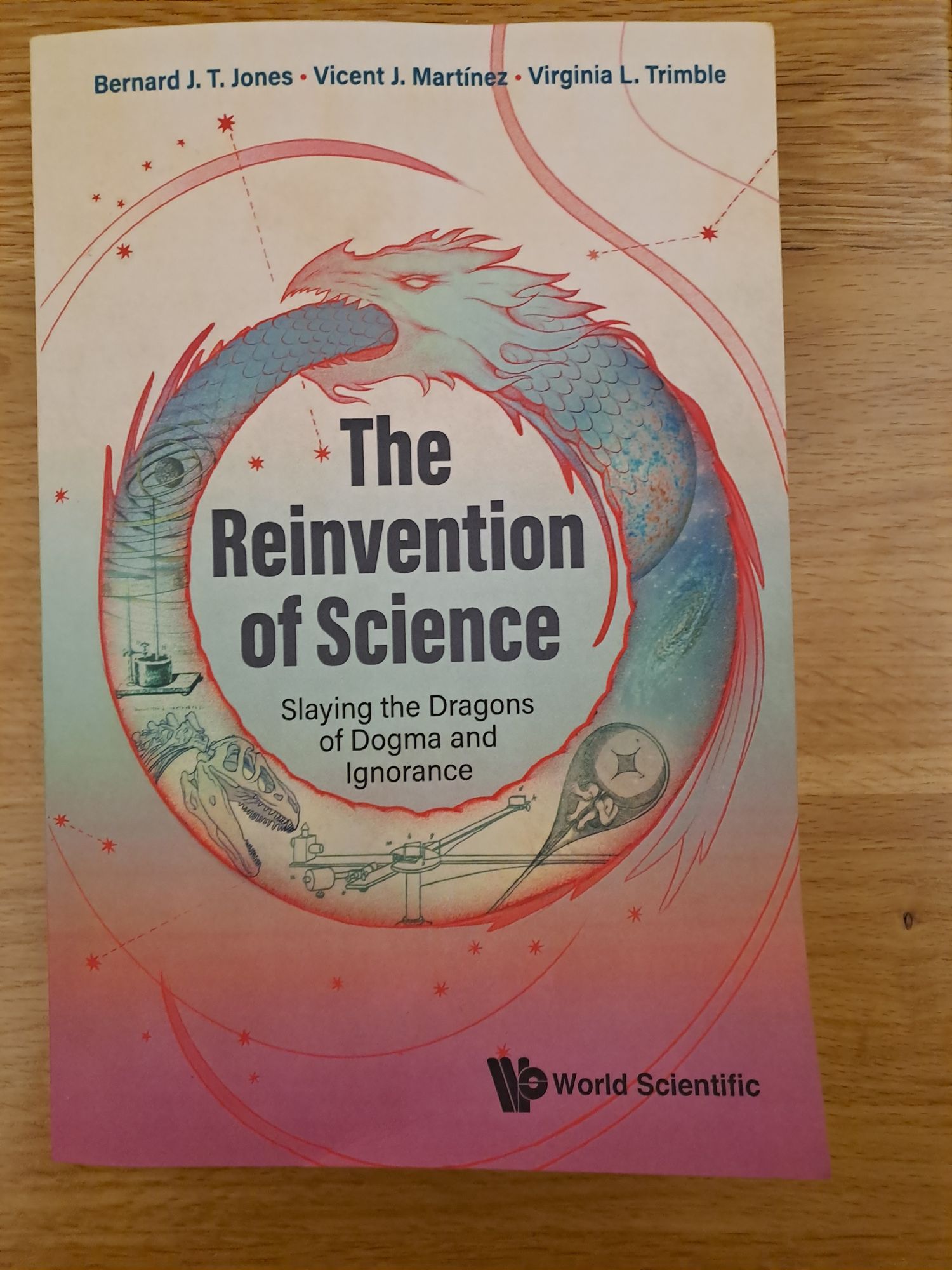
I’ve known about the existence of this new book for quite a long time – the first two of the authors are former collaborators of mine and I’m still in fairly regular touch with them – but I only received a copy a few weeks ago. Had I been less busy when it was in proof stage I might have been in a position to add to the many generous comments on the back cover from such luminaries as Martin Rees, Jim Peebles, Alan Heavens and, my hosts in Barcelona, Licia Verde and Raúl Jiménez. Anyway, now that I’ve read it I’m happy to endorse their enthusiastic comments and to give the book a plug on this blog.
One can summarize The Reinvention of Science as a journey through the history of science from ancient times to modern, signposted by mistakes, fallacies and dogma that have hindered rather than facilitated progress. These are, in other words, not so much milestones as stumbling blocks. Examples include the luminiferous aether and phlogiston to name but two. These and many other case studies are used to illustrate, for example, how supposedly rational scientists sometimes hold very irrational beliefs and act accordingly on them. The book presents a view of the evolution of science in spite of the suppression of heterodox ideas and the desire of establishment thinkers to maintain the status quo.
The volume covers a vast territory, not limited to astrophysics and cosmology (in which fields the authors specialize). It is a very well-written and enjoyable read that is strong on accuracy as well as being accessible and pedagogical. I congratulate the authors on a really excellent book.
P.S. I am of course sufficiently vain that I looked in the index before reading the book to see if I got a mention and was delighted to see my name listed not once but twice. The first time is in connection with the coverage of the BICEP2 controversy on this very blog, e.g. here. I am pleased because I did feel I was sticking my head above the parapet at the time, but was subsequently vindicated. The second mention is to do with this article which the authors describe as “beautiful”. And I didn’t even pay them! I’m truly flattered.
 In the Dark
January 28, 2024 at 11:04 pm
Are you claiming that phlogiston and aether were irrational beliefs? That would seem a pretty ahistorical, whiggish view of science.
January 29, 2024 at 9:38 am
No. Neither does the book (which I didn’t write). It does make the point, though, that both of these did turn out to be mistakes. The fact remains that some people did, and do, cling to such ideas even when the evidence is against them.
January 29, 2024 at 10:46 am
ps. I think dark matter could be the supersymmetric counterpart of the phlogiston, i.e. the phlogistino.
August 7, 2024 at 3:33 pm
Phlogging a dead horse?
August 7, 2024 at 7:12 pm
Nearly all the cosmologists I know think dark matter is a defect of our gravitation theory. I do too, but the objects I’ve studied end at about Z=7…
August 7, 2024 at 9:15 pm
It’s by no means ruled out that our understanding of gravity is incomplete on cosmological scales, but I don’t see any compelling alternative theories right now. That’s of course why it is so much fun being in the field!
August 8, 2024 at 1:00 pm
I regard the gauge theories of gravity, in which fermion spin induces and feels torsion of spacetime, as worth another look in this regard. The associated boson masses ar nonzero and, although they would not explain dark matter, there would be a further transition in the early universe, and extra physics involved in unification strategies that just might.
August 28, 2024 at 9:46 am
Well we know our gravitation theory is wrong, because it isn’t renormalisable. I’m not squemish about postulating further particles that feel gravity only and not the electroweak or strong forces. The interesting question is: might gravity cause these to clump?
January 31, 2024 at 9:39 am
I first encountered the word Ether in chemistry, not physics, and was perplexed when I read that Victorian scientists believed the universe was pervaded by the stuff. It was an anaesthetic, after all, so why didn’t it send us to sleep? Why couldn’t we smell it – or, thinking more deeply, why could we?
January 31, 2024 at 9:40 am
You say ether and I say aether….
January 31, 2024 at 10:29 am
For consistency I should have said anesthetic…
August 7, 2024 at 7:00 pm
I’ve recently read this book – and thanks to Steve Gull (whom I recently visited) for it. I wish to write about it, and this is the obvious place.
Most of it is a very good history of astronomy/astrophysics/cosmology from earliest times to the present, combined with lucid advanced lay-level explanations. The book grew out of an essay which aimed to show how wrong ideas can hold up science; these are the dragons of its subtitle. The ordering of the material is somewhat idiosyncratic (Newton’s achievement appears in detail only in the final chapter), and I’m surprised that Laplace’s multi-volume Mécanique Céleste doesn’t get a mention. There are also quite a few typos, and in the early chapters some historical infelicities: the use of the dated term ‘Great Schism’ (p23) for the period of rival Popes in Rome and Avignon during 1378-1417 (now called the Western Schism, whereas ‘Great Schism’ refers to the falling-out in 1054 of the Latin and Greek-liturgy churches of Rome and Constantinople); the statement (p34) that the Thirty Years War ended the Holy Roman Empire, when it merely limited it to the Germanic states that remained Catholic (the Holy Roman Empire was definitively ended by Napoleon’s eastward invasion in 1805); the statement that the English Puritans “believed that the Church of England should be purified of all remnants of its Catholic heritage that were not in the Bible” (p40) when they mostly wanted to be free to worship using their own protestant liturgies outside the Church of England; the statement (p82) that the ‘High Middle Ages’ ran roughly 1000-1300 (p82) when they were far more accurately 1100-1300.
The main reservation I have is the claim that science as we know it got going in ancient Greece before grinding to a halt and then resuming in the Renaissance in Western Europe. I believe science began in the Renaissance. I define science – carefully – as a dialectic between designed interventionist experiment and theoretical understanding. The Greeks had no idea of designed interventionist experiment. Only their astronomy flourished, and that was for two reasons: (1) they believed that the heavens were ordered and so might be comprehended, unlike the chaos they saw on earth (Jones et al correctly understand this dichotomy in ancient Greek thought, which Isaac Newton healed by applying the same law of gravity to planetary orbits and falling apples); and (2) astronomy involves only observation, not intervention. A solid state physicist as a co-author might have helped.
A question that the authors don’t tackle is why science (in the sense I mean) did not begin any earlier. I’d like to add some suggestions not in the book. You have first to believe that laws of nature exist if you are going to seek them, and pagan cultures tend to suppose that everything on earth is motivated by disembodied spirits pushing things around. Physical science is never going to get going in such circumstances. In contrast the cultures that accept the Book of Genesis, with its claim that the universe was created by a divinity who put order into it – order that humans might comprehend – are going to go hunting for that order. That’s the Jews, then the Roman Empire from the fourth century, then the Muslims. But ancient Judaism was an agrarian culture, and a critical mass of scholars never aggregated in the Holy Land; eventually Jewish civilisation dwindled under the Roman ravaging of the first and second centuries. Western Europe, next, fell into a Dark Age (a term historians avoid today, but I’m willing to defend it) soon after going institutionally Christian, so science wasn’t going to kick off there and then. Jones et al laud Islamic science, but it really didn’t do a great deal more than preserve Greek thought; certainly it never took the step of advocating heliocentricity, which could only come via a revolution in thinking, not any evolution. Nor am I singling out Islamic culture for criticism, for Copernicanism – and science generally – also failed to take off at that time in another culture that was equally wealthy, powerful and Genesis-influenced: Byzantine civilisation, centred on Constantinople.
So, why did science – a dialectic between designed interventionist experiment and theoretical understanding – get going in Western Europe once it had got its mojo working again after the Dark Ages, but not in Byzantine or Islamic civilisation, even though all three accepted the message of Genesis that ordering principles ran through the world which humans might comprehend?
Every scientific experiment begins as a gedankexperiment to which scholars don’t know the answer, and cannot figure it out. In order to get science going, then, you need to be accomplished at visualisation. Here I recommend a paper by Jim Franklin, an Australian mathematician and historian of thought, called Diagrammatic reasoning and modelling in the imagination: The secret weapons of the scientific revolution (published in the book 1543 and All That: Image and Word, Change and Continuity in the Proto-Scientific Revolution, eds. G. Freeland and A. Corones). It turns out that Western Europe looked diagrammatically at many things shortly before the scientific take-off. Geometry is one obvious source of diagrammatics, shared with the other cultures; likewise maps. But the invention of perspective in painting was another, unique to the West (Islamic culture did not promote representational art), and the availability of paper helped. Genealogies boosted the notion of tree diagrams. Is a greater emphasis on the mind’s eye the true source of the scientific revolution in Renaissance Europe?
August 8, 2024 at 12:19 pm
That’s a good point about the benefits of visualisation. It could be pointed out that geometry generally was in ahead of and driving science: in the ancient world, not only in astronomy but in optics and statics (e.g. Archimedes’ law of the lever). For the next leap you needed, as Anton says, interventionist experiment as opposed to just “experience”. That’s just post-Renaissance: Galileo and Bacon.
August 9, 2024 at 10:09 am
The more I think about it, the more I think the falling cost of paper was a crucial factor. Every rreserach pyscist experiences the constructive interplay of writing, doodling and thinking.
August 24, 2024 at 11:07 pm
Also, for physics you need mathematics, and if you don’t have enough mathematics then your physics is severely limited. The history of the two must be taken together in the era under question
.