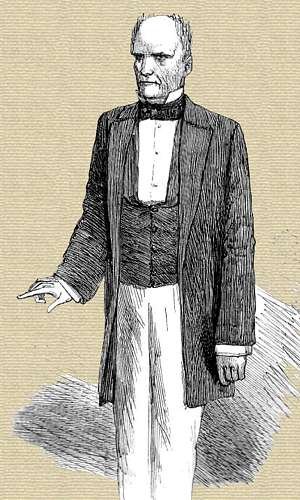
The above picture shows fascist thug and career criminal Daniel Thomas (a.k.a. Danny Tommo) leading a “protest” of uniformed knuckleheads (those on the right of the picture, in short trousers) outside the Daily Mail offices in London.
Fans of P.G. Wodehouse will recall Roderick Spode, the 7th Earl of Sidcup, who leads a fascist group called the “Saviours of Britain” also known as the Black Shorts. He is of course a parody of Oswald Mosley and his group a parody of Mosley’s Black Shirts (aka the British Union of Fascists).
The trouble with you, Spode, is that just because you have succeeded in inducing a handful of half-wits to disfigure the London scene by going about in black shorts, you think you’re someone. You hear them shouting “Heil, Spode!” and you imagine it is the Voice of the People.
How prescient was that?
Incidentally, fans of historical trivia might be interested to know that the grandson of Oswald Mosley (founder of the British Union of Fascists) and Diane Mitford (a friend of Adolf Hitler, who married Oswald Mosley at the home of Joseph Goebbels) is Louis Mosley, CEO of Palantir UK.
Coincidentally, Nigel Farage went to the same school as P.G. Wodehouse, Dulwich College.
When I moved to Ireland, almost nine years ago, one of the words I discovered had a usage with which I was unfamiliar was grind. My first encounter with this was after a lecture on vector calculus when a student asked if I knew of anyone who could offer him grinds. I didn’t know what he meant but was sure it wasn’t the meaning that sprang first into my mind so I just said no, I had just arrived in Ireland so didn’t know of anyone. I resisted the temptation to suggest he try finding an appropriate person via Grindr.
I only found out later that grinds are a form of private tuition and they are quite a big industry in Ireland, particularly at secondary school level. School students whose parents can afford it often take grinds in particular subjects to improve their performance on the Leaving Certificate. It seems to be less common for third level students to pay for grinds, but it does happen. More frequently, university students actually offer grinds to local schoolkids as a kind of part-time employment to help them through college.
The word grind can also refer to a private tutor, i.e. you can have a maths grind. It can also be used as a verb, in which sense it means `to instil or teach by persistent repetition’.
This sense of the word grind may be in use in the United Kingdom but I have never come across it before, and it seems to me to be specific to Ireland at least in current usage. A colleague sent me a link to an article about Carew Arthur Meredith, who worked at Trinity College Dublin from 1943 to 1964 but who was previously at Cambridge University and lived there until 1939:
After graduating, Meredith married Sybil Clark and settled down to what was to be for many years his occupation: that of university coach or “grinder.”
This establishes a possible conduit for the transfer of the word “grinder” from England to Ireland and it inspired me to look at the trusty online Oxford English dictionary which includes examples of usage. In fact the OED gives as examples of “grind” as a transitive or intransitive verbs and as a noun as well as the verbal noun “grinding” and the deverbal noun “grinder”. Here are some pertinent quotes. The first below, incidentally, is from a book of American college slang, demonstrating that the word had crossed the Atlantic by 1851.
Here are the most relevant examples, some of them hilariously susceptible to a double entendre.
n. Steady hard work; labour of a monotonous kind, esp. close and hard study; an instance of this, a dull and laborious task.
1851 Grind, an exaction; an oppressive action. Students speak of a very long lesson which they are required to learn, or of anything which is very unpleasant or difficult to perform as a grind. B. H. Hall, Collection of College Words
1857 A medical student would have told him, that a ‘Grind’ meant the reading up for an examination under the tuition of one who was familiarly termed ‘a Grinder’—a process which Mr. Verdant Green’s friends would phrase as ‘Coaching’ under ‘a Coach’. ‘C. Bede’, Mr. Verdant Green Married xi. 93
vi. To work hard at a subject of study under the direction of a tutor or ‘grinder’.
1835 I am obliged to ‘grind’..that is, undergo a private examination with an authorized teacher or tutor. E. Forbes in G. Wilson & A. Geikie, Memoir of Edward Forbes (1861) vi. 176
1870 After grinding with private-tutor Mylius the requisite time, Lessing entered the school of Camenz. J. R. Lowell, Among my Books (1873) 1st Series 308
vt. To teach (a subject) in a steady laborious manner; also, to prepare (a pupil) in a subject.
1815 implied in: Perhaps when Tom leaves Oxford..we may contrive some gainful grinding [i.e. tutorial] scheme between us. [at grinding n.] J. Keble, Letter to Coleridge in Mem. (1869) iv. 63
1848 A pack of humbugs, and quacks, that weren’t fit to get their living but by grinding Latin and Greek. W. M. Thackeray, Vanity Fair: A Novel Without a Hero lvi. 502
1859 [Dr. Bennett] undertook to grind him in anatomy and physiology. G. Wilson & A. Geikie, Memoir of Edward Forbes vi. 180
In Hard Times by Charles Dickens there is a character by the name of Mr Thomas Gradgrind, a grimly utilitarain school superintendent who insisted on teaching only facts. Hard Times was published in 1854 which is after some of the quotations above so Dickens did not originate the use of “grind” in teaching. He may have amplified it, of course.
This demonstrates that these terms were established in 19th Century England, but does not explain how their usage died out there but still flourishes in Ireland. Can anyone shed light on this? First recorded usages of grind, etc in Irish literature would be most helpful!
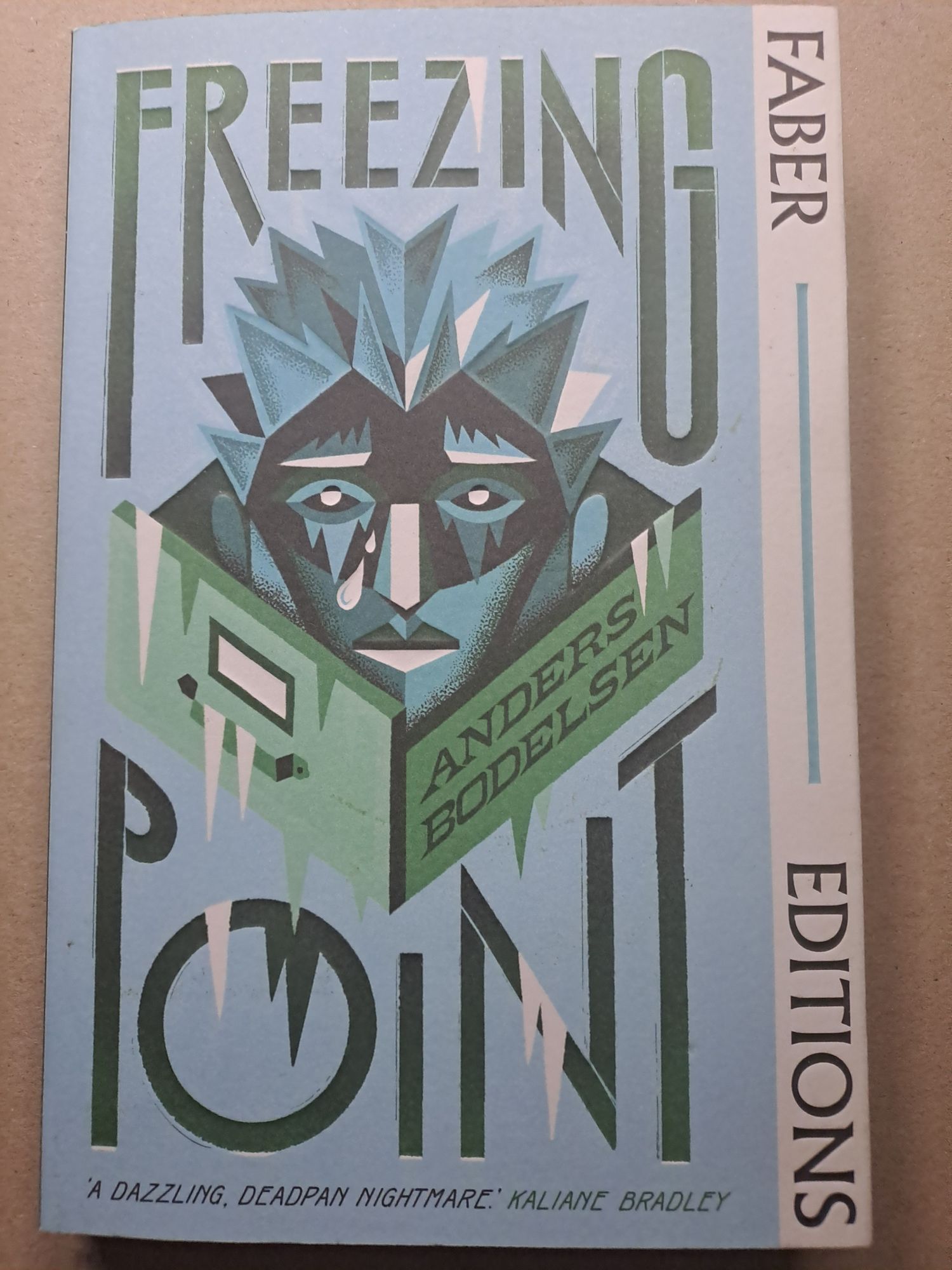
Freezing Point, by Anders Bodelsen was first published in 1969 in Danish with the title Frysepunktet and then in English in 1971. I think it was inspired by the case of Professor James Bedford who, died in 1967 but whose body was medically frozen in the hope he could be revived at some future date. Freezing point is a essentially a work of dystopian science fiction, a genre which doesn’t always last very well but this one was reissued in 2025 because the theme of using cryogenics to avoid death has stayed with us. The book explores some of the deep questions about ageing, death and what life might be like if it went on forever.
The story is centred on a character named Bruno who is a magazine editor. It begins in 1973 when Bruno discovers that he has an incurable cancer. Just after receiving the news he meets a young ballerina, Jenny, and they have an affair. He is offered the chance to be one of the first to be frozen down, the idea being that he would be thawed out again when a cure for his illness is found. He agrees to the procedure and is put to sleep, waking in 1995. He has not physically aged, but the society he wakes up in has changed dramatically. Medical cryogenics is now ubiquitous, and there is a lucrative market in human organs. Doctors effectively rule society, which has become divided between those who opt for “all-life”, which means something approaching immortality, and those who choose “now-life”, where they can live an affluent life as mortals by mortgaging their vital organs. The stability of this society is under constant threat from imbalance of supply and demand. Its regime has become repressive, engaging in mass surveillance and control of access to books and magazines.
In 1995 Bruno finds out that Jenny has been frozen down after suffering a spinal injury that meant she could no longer dance. He also finds out that she had a son, also called Bruno, from their encounter. After struggling to readjust he pleads to be frozen down again so that he can be reunited with Jenny when a cure for her spine is available.
The last part of the book is set in 2022. It is clear that the Brave New World is now falling apart. Repeated freezings and thawings are having drastic side effects on those affected. Jenny’s new spine isn’t working as it was supposed to and even the doctors are showing signs of mental illness, constantly repeating themselves, amid frequent power cuts. In the midst of all this Bruno just wants to die. But will that be allowed?
It’s a bit corny to describe this book as a “chiller” but that’s exactly what it is. The story is told in a dry, impassive voice which makes it all the more bleak, though with enough dark humour for it to qualify as a black comedy.
Against that time, if ever that time come,
When I shall see thee frown on my defects,
When as thy love hath cast his utmost sum,
Call’d to that audit by advis'd respects;
Against that time when thou shalt strangely pass
And scarcely greet me with that sun, thine eye,
When love, converted from the thing it was,
Shall reasons find of settled gravity,—
Against that time do I ensconce me here
Within the knowledge of mine own desert,
And this my hand against myself uprear,
To guard the lawful reasons on thy part:
    To leave poor me thou hast the strength of laws,
    Since why to love I can allege no cause.
I read the terrible news about the death of Jason Arday on Friday evening. The first thing I want to do is express heartfelt condolences to his family – especially his wife and two children – and his friends and former colleagues and my hope that the media who hounded Prof. Arday to his death will at least give them some space to mourn his loss.
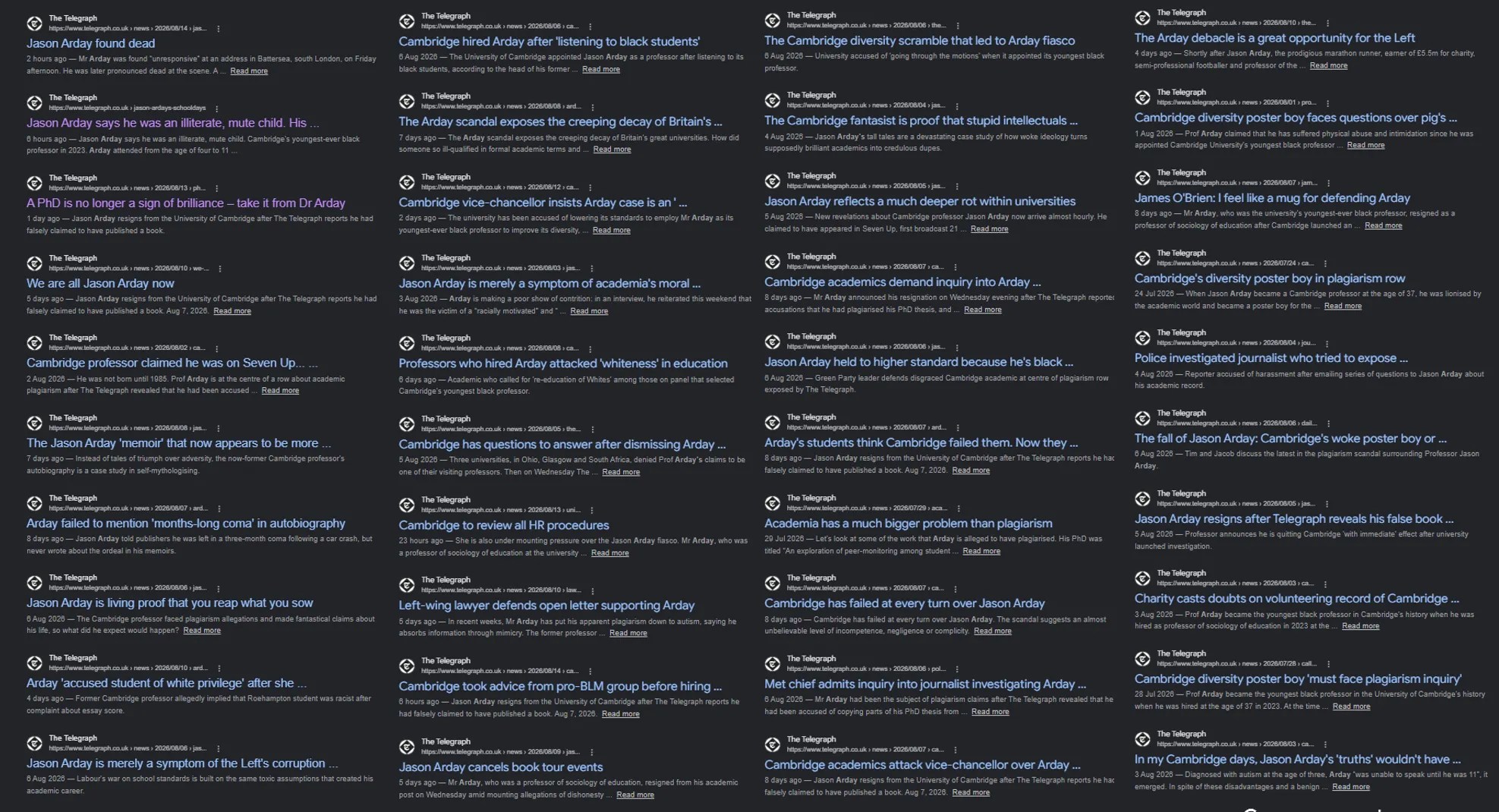
The word “tragedy” is often misused, applied to any event that is sad which this certainly is. The case of Jason Arday is a true tragedy in the sense arising from Greek drama: the central protagonists are always flawed characters who makes bad decisions, but are propelled relentlessly towards their fate by forces entirely beyond their control. Once the right-wing media lynch mob got hold of this story they were never going to back off. This is just some of the coverage from one newspaper, The Daily Telegraph.
Yes, Arday did bad things, but the media attention was utterly disproportionate. Nobody could be expected to withstand such treatment. How did the people churning out these articles think this would end?
I find this whole saga bleaker than anything Sophocles wrote, because nobody comes out of it with any credit at all. Not Arday himself, nor Cambridge University, nor the press, nor Nathan Cofnas, the white supremacist blogger who brought everything out into the open. The latter may have exposed academic misconduct, but his motivation was rooted in his racist views and undoubtedly malicious.
Of course academic misconduct is wrong, but it does not warrant a death sentence. And where was the media furore when a (white) History professor at Cambridge, William O’Reilly, was found to have plagiarised his own students essays? Professor O’Reilly, incidentally, remains in post. That’s just one example. I’m sure there are dozens more that we know nothing about, because they couldn’t be used to further racist ends. If standards are not applied equally then they can be used to reinforce prejudice, as they have in this case. It’s called hypocrisy.
The usual Culture Warmongers are using this case to further their agenda against the principles of Equity, Diversity and Inclusion which are supposed to be adopted in universities and other institutions. For myself, this tragedy demonstrates that EDI* principles are not satisfied by mere tokenism, a facile form of window-dressing that does nothing to change the culture within the organisation.
(*For any Americans reading this I use the UK/European EDI in preference to the DEI used in the States which reminds me too much of OPUS DEI.)
In a slightly different context, this is why I have become cynical about the “widening participation” efforts by many higher-education institutions to recruit students from disadvantaged backgrounds. These may succeed in bringing more such students into courses – and hence greater income to the university – but they are rarely backed up by the support needed to enable them to succeed. Many institutions do not even track the outcomes of these students, not because they can’t but because The Management doesn’t care: once they’re in through the door that’s “job done”.
I came from what some people would call a disadvantaged background, although I don’t think of it that way. That I have had a career in academia is a result of an enormous amount of luck, starting way back in primary school. I would dearly like to see a system in which luck wasn’t so important, but what is being done now is not the way to achieve that. If we’re going to do EDI – and we should – let’s do it properly.
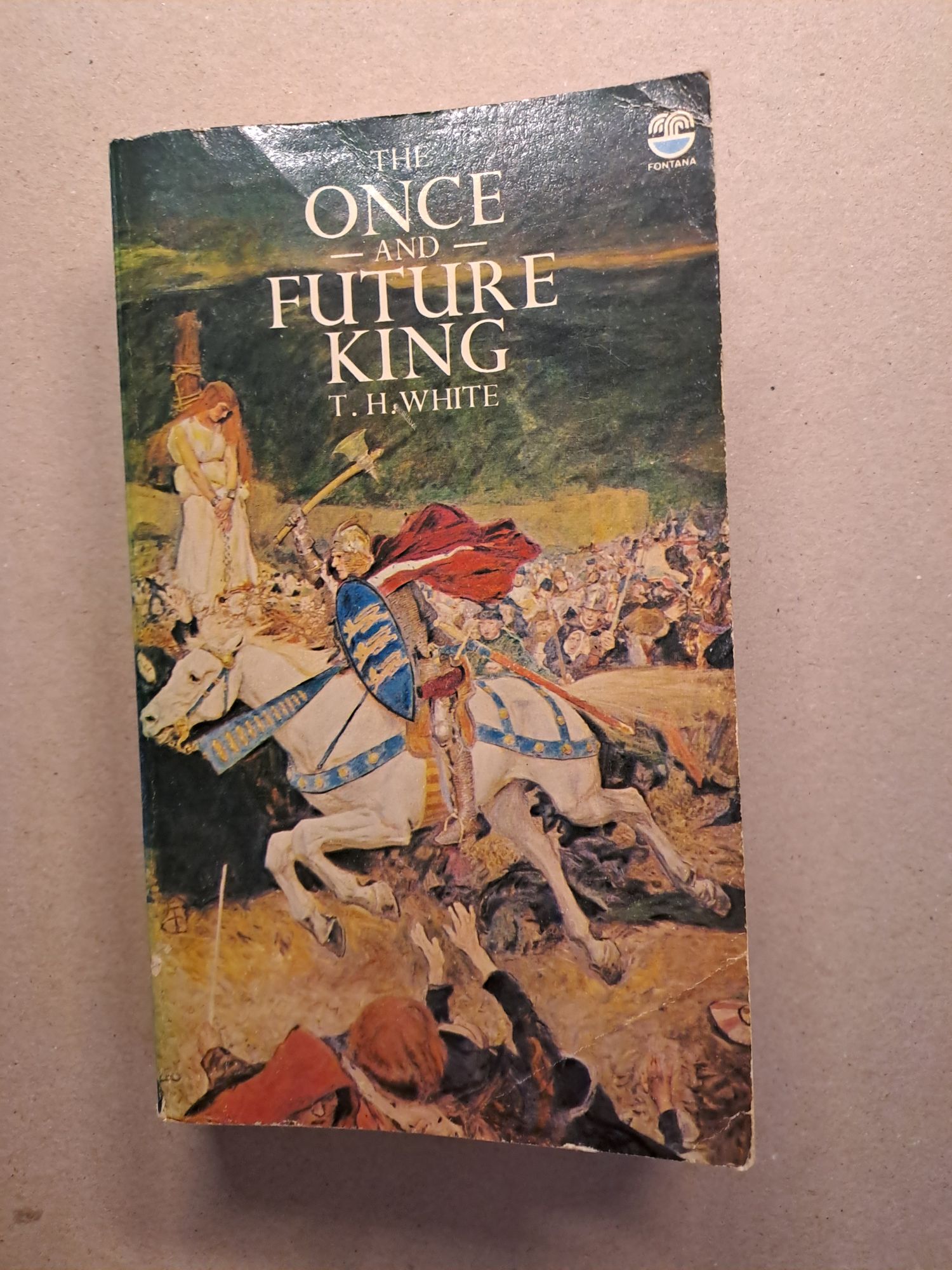
I was tidying up today and came across my copy (right) of The Once and Future King by T.H. White. This comprises four novels and is a sort of re-telling of the Arthurian legends. I remember buying it when I was at school, at which time I was reading a lot of fantasy novels of the swords-and-sorcery type, but although it is a fantasy, this book was not at all what I anticipated. It’s very funny in places and also full of anachronisms. White uses the legend of King Arthur as a kind of metaphor or political allegory and his novels are only loosely based on the familar stories of Thomas Malory’s Morte D’Arthur. The first novel was first published as a standalone book in 1938…
Anyway, I kept this book intending to read it again but never got around to doing that. The edition I bought is in quite small type so I might find it a struggle now! I’ve kept it to one side, though, as I know a certain person whom I think will enjoy it and is young enough to still have good eyesight. I will give it to him when we next meet.
The other day somebody shared the following (wonderful) extract from the first novel, The Sword in the Stone, which is largely about the education of the young Arthur (known by his nickname “Wart”) by the wizard Merlyn. The quote remains extremely relevant today as an expression of the joy – which I wish more people shared – of learning for learning’s sake.
“The best thing for being sad,” replied Merlyn, beginning to puff and blow, “is to learn something. That is the only thing that never fails. You may grow old and trembling in your anatomies, you may lie awake at night listening to the disorder of your veins, you may miss your only love, you may see the world about you devastated by evil lunatics, or know your honour trampled in the sewers of baser minds. There is only one thing for it then—to learn. Learn why the world wags and what wags it. That is the only thing which the mind can never exhaust, never alienate, never be tortured by, never fear or distrust, and never dream of regretting. Learning is the thing for you. Look at what a lot of things there are to learn—pure science, the only purity there is. You can learn astronomy in a lifetime, natural history in three, literature in six. And then, after you have exhausted a milliard lifetimes in biology and medicine and theo-criticism and geography and history and economics—why, you can start to make a cartwheel out of the appropriate wood, or spend fifty years learning to begin to learn to beat your adversary at fencing. After that you can start again on mathematics, until it is time to learn to plough.”
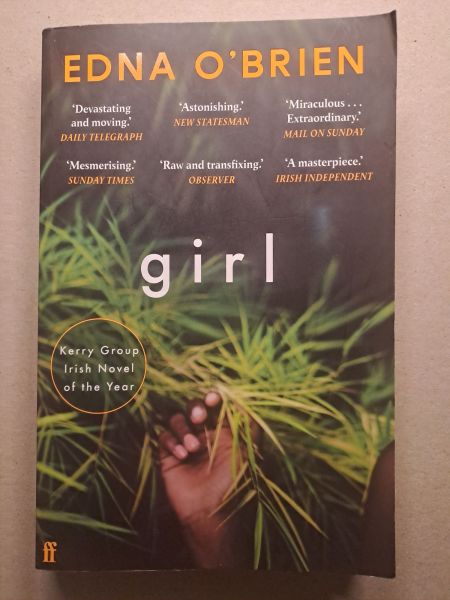
Irish novelist Edna O’Brien passed away two years ago. When I read of her death I didn’t know anything about her writing except that her first novel, Country Girls, had been banned in Ireland. That made me decide to read some of her work. As it happens the first book by her that I came across was the last she wrote, in 2019, which I bought over a year ago and has been sitting on my coffee table ever since. I started reading it this evening and found it so compelling that I couldn’t put it down until I had finished it.
Girl is set in Nigeria and is told in the voice of Maryam, a young girl who is kidnapped, along with her schoolmates, by the jihadists of Boko Haram. Maryam and the other schoolgirls are subjected to appaling horror and degradation described in unflinching detail. Eventually Maryam is given as a prize to a Boko Haram soldier Mahmoud, and bears his baby (simply called Babby). Maryam escapes with Babby with another girl, and drifts into and out of danger. Upon eventually returning home she is punished by her family, but the book ends on an optimistic note as she finds sanctuary.
The story is grim but O’Brien clearly had a great gift for storytelling, with subtle shifts in style as Maryam’s mental state shifts between horror, to relief, to sad reminiscence of happier times. In her acknowledgements at the end, the author explains that Maryam’s tale is actually a synthesis of accounts of various ordeals experienced by real-life women, to whom she spoke to in two visits to Nigeria, where she also learned something of the linguistic mannerisms of Maryam’s people. It is quite an achievement for an Irish woman in her late eighties to find a convincing voice for a young Nigerian girl subjected to pains surely beyond imagination. I think it’s a brilliantly moving book.
Girl has been criticised for O’Brien’s appropriation of the voice of a different culture, which (it has been claimed) makes it feel like an artificial exercise. A book of this kind by a Nigerian author would no doubt be more “authentic” in many important respects, but what I took from it (apart from the beautiful prose) is the emotional authenticity of the emotional tone and her desire to celebrate the strength of the many women whose struggles come together in the story of Maryam. The violent oppression of women is widespread in this world, so Maryam is a universal figure – a survivor.
There will come soft rains and the smell of the ground,
And swallows circling with their shimmering sound;
And frogs in the pools, singing at night,
And wild plum trees in tremulous white,
Robins will wear their feathery fire,
Whistling their whims on a low fence-wire;
And not one will know of the war, not one
Will care at last when it is done.
Not one would mind, neither bird nor tree,
If mankind perished utterly;
And Spring herself, when she woke at dawn,
Would scarcely know that we were gone.
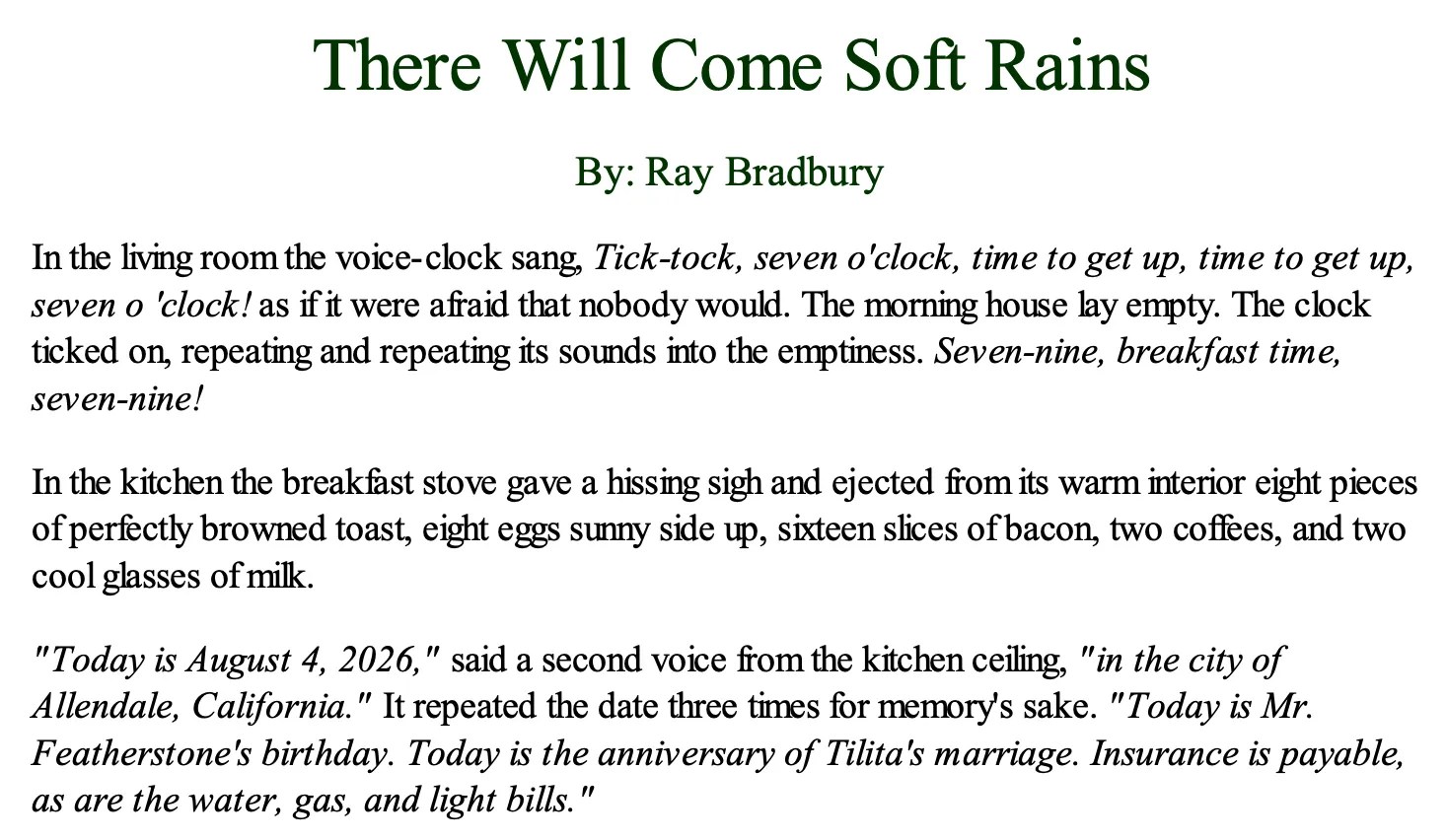
The Ray Bradbury story is set in the (then) distant future and describes, in a typically eery and unsettling way, the aftermath of a nuclear holocaust. One house, in Allendale Carlifornia, fully automated to provide for the comfort of its owners, carries on functioning after the owners are both vapourised by a nuclear blast. Beds continue to be made, meals prepared, floors cleaned, and dishes washed, by systems oblivious to the fact the owners are no more. The house recites to the ladyof the house one of her favoruite poems, There Will Come Soft Rains by Sara Teasdale. Then a fire starts by accident and the house burns to the ground.
I was reminded today that the date of the story (in the original version) is August 4, 2026. I looked for my copy of The Martian Chronicles when I got home but couldn’t find it. Here, however, are the opening few paragraphs:
The full text of the story can be found here (among a number of other places). It’s out of copyright.
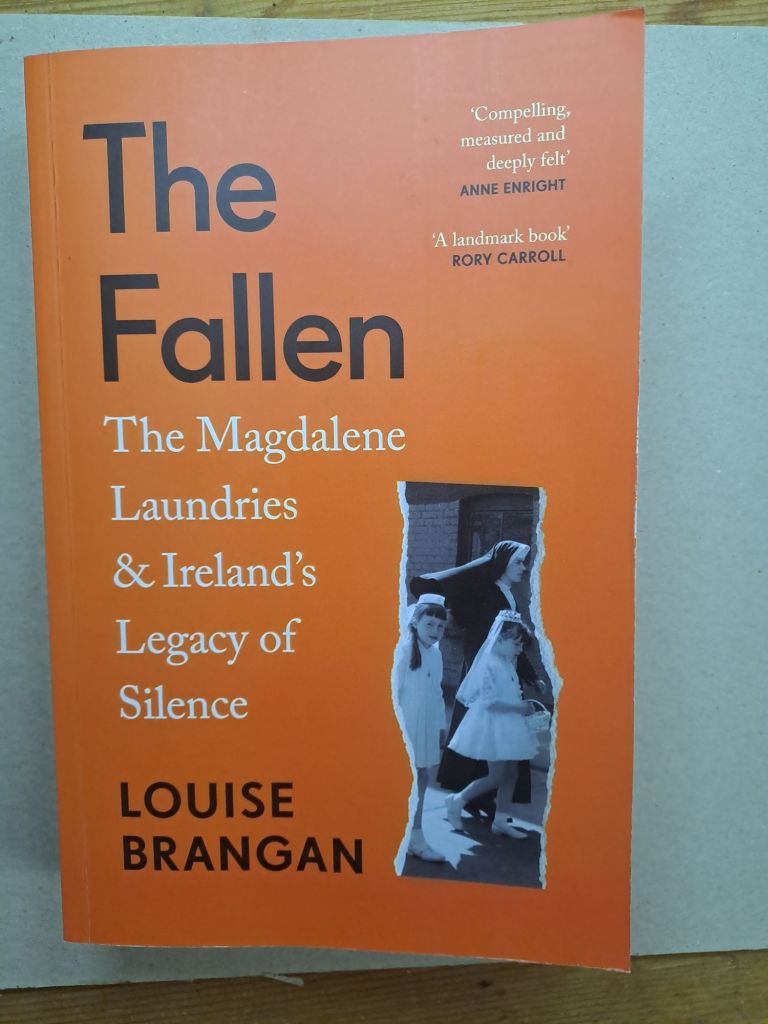
I’ve just finished reading The Fallen: The Magdalene Laundries & Ireland’s Legacy of Shame by Louise Brangan, which I bought a couple of months ago. This tells the shocking story of Ireland’s Magdalene Laundries, institutions run by a variety of religious orders designed to accommodate “fallen” women and girls. Also known as “Penitents”, the inmates of these institutions were a mixture of the poor and unwanted, orphans, disabled, those who had suffered familial abuse, and those who simply didn’t conform to Ireland’s self-image of a virtuous Roman Catholic state.
After Independence in 1922 these institutions, which had already been in existence for over a century, became a sort of dumping ground for inconvenient woman of all kinds. Once inside, the Penitents – most of whom hadn’t really done anything wrong – were stripped of what meagre possessions they had, had their hair shorn, their names were erased, and they were put to hard menial labour washing and drying clothes. They were fed and housed – after a fashion – but conditions were damp and unsanitary and they were forbidden to make friendships with their companions, or even talk to them. They were locked inside and forbidden to leave unless and until the nuns decided they could, which was often never. The Magdalene Laundries were prisons in which every inmate was serving an indefinite sentence of hard labour.
Not surprisingly, the result of this soul-destroying regime was that many of the Penitents became completely institutionalised, some living our their days in a man-made purgatory. Perhaps the most shocking thing of all is the last of these terrible places – which was on what is now Sean McDermott Street in North Dublin – didn’t close until 1996. This book was published to mark the 30th anniversary of this event.
The book is a scholarly work, woven around the oral testimonies of several women, measured in tone but with an unmistakeable undertone of righteous indignitation. It also sets the story of the Magdalene Laundries in the context of 20th Century Irish history, especially the rise of the Catholic theocracy under de Valera and it subsequent fall in the wake of major scandals, of which the Magdalene Laundries were one. As a relative newcomer to Ireland, I was unaware of the true nature of these places and found this book educational as well as deeply moving.
Some comments cut very much to the bone. Here is a paragraph concerning a woman known in the book as Carmel who had been taken to Sunday’s Well for reasons she was never told to find that many of the other women there were quite elderly and infirm:
Going to bed that first night, Carmel had thought that she had been sent to Sunday’s Well to care for the old women. Gradually, she had come to realise, like many others before her, that she had been sent to the Laundry not to look after these women but to become one of them.
Another passage that hit me hard was about the disinterment, in 1993, of 133 bodies from a mass grave when the Sisters of Our Lady of Charity decided to sell the land to a property developer. The graves of the women, who had died while incarcerated at a Magdalene Laundry, were unmarked; another 22 were found later. Shamefully, only 75 death certificates had ever been registered. It is against the law in Ireland to bury someone without registering their death so 80 crimes had been committed over the years. No action was ever taken.
In recent years there has been a redress scheme for the survivors of these institutions, but what financial compensation can possibly be adequate for a lifetime of penal servitude? The most important message of this book is that stories like this have to be told. Ireland must confront the dark side of its recent past. Silence can be the worst form of dishonesty.
Who were they, what lonely men
Imposed upon the fact of night
The fiction of constellations
And made commensurable
The distances between
Themselves their loves and their doubt
Of government and nations;
Who made the dark stable

When the light was not? Now
We receive the blind codes
Of spaces beyond the span
Of our myths, and a long dead star
May only echo how
There are no loves nor gods
Men can invent to explain
How lonely all men are.
This poem is from a collection called “The World I See”, by Patric Dickinson, which was published in 1960. The poem was inspired by a visit to Jodrell Bank observatory. I have posted it before, but it seems apt to post it again now.
The views presented here are personal and not necessarily those of my employer (or anyone else for that matter).
Feel free to comment on any of the posts on this blog but comments may be moderated; anonymous comments and any considered by me to be vexatious and/or abusive and/or defamatory will not be accepted. I do not necessarily endorse, support, sanction, encourage, verify or agree with the opinions or statements of any information or other content in the comments on this site and do not in any way guarantee their accuracy or reliability.