Debussy, McNeff & Rachmaninov at the NCH
Last night was my first trip of the year to the National Concert Hall in Dublin. I had planned to go on 17th January but by the time I got around to buying a ticket it was sold out. Fortunately, it was broadcast live on the radio and is still available on the RTÉ Player. I had a ticket for last Friday’s concert but bottled out of going because of transport worries about Storm Éowyn. That concert went ahead, apparently, but wasn’t broadcast so I missed it. Last night was third time lucky, and I’m very glad I got there!

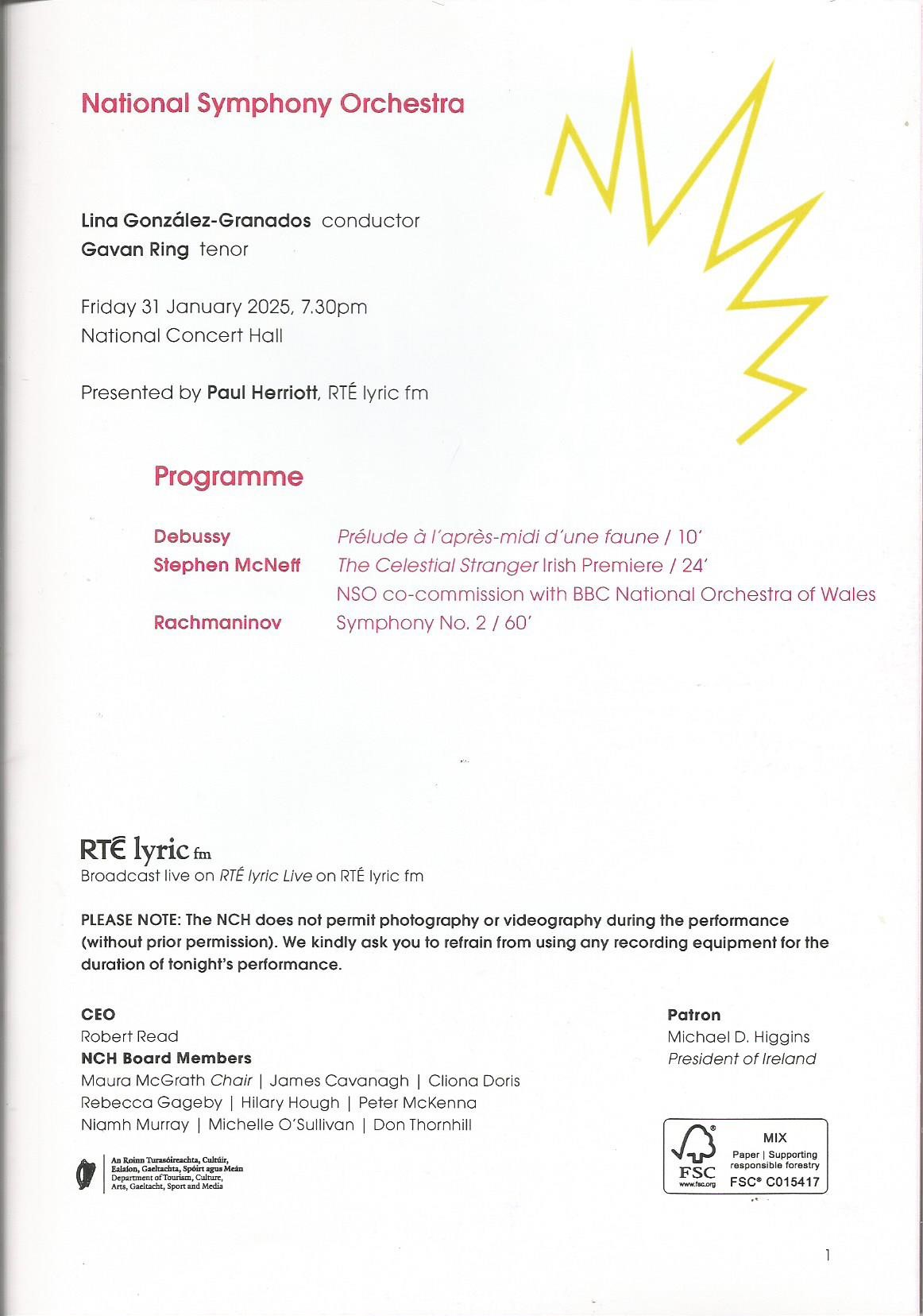
The conductor of the National Symphony Orchestra for last night’s performance was Columbian-born Lina González-Granados in what I believe to have been her first appearance with the NSO. I certainly hope she comes back as she was very good indeed. I think the members of the orchestra enjoyed themselves as much as the audience!
As you can see from the programme, the concert opened with a very familiar piece, Prélude à l’après-midi d’un faune by Claude Debussy, which was performed with all the shimmering sensuality it demands. Some very lush playing by the strings on this one, and lovely work by the woodwinds made it sound very fresh although I’ve heard it many times.
After that tenor Gavan Ring joined the orchestra to perform the Irish Premiere of The Celestial Stranger, a song cycle composed by Belfast born composer Stephen McNeff. This consists of settings of five poems, two by Thomas Traherne (including the one that gives its name to the collection, a remarkable work that I will post in its entirety later on). The next poem is by Walt Whitman and is titled As The Time Draws Nigh in the programme, but is not the well-known Whitman poem of that title but seems to have been adapted from various texts, including Years of the Modern. After that is a famous poem by Dylan Thomas, The hand that signed the paper and the cycle concludes with an adaptation of Farewell to Thee, written by Liliʻuokalani (former monarch of Hawaii). It’s a varied collection but there is a narrative behind the choice: a visitor from outerspace (the Celestial Stranger) arrives on Earth and reacts joyfully to begin with. As time goes on, however, he finds out more about war and and death and finally takes his leave.
The music is as varied as the choice of verse. I felt some influence of Britten in the first piece, but the rest is very different. Gavan Ring was in fine voice and the orchestra responded very well to the very different demands of this work compared to the first.
After the interval it was time for the main course of the evening, Rachmaninov’s Second Symphony. It’s a remarkable work because it’s not only a “proper” symphony in its construction and development but also the best part of an hour of one glorious melody after another. It’s a gorgeous work altogether, but the third movement (Adagio) is especially beautiful. I love the way Rachmaninov starts this movement one of his big romantic tunes, but then hides it while passages develop through a solo clarinet and strings. You know the tune is coming back though, and when it does the emotional impact brought the audience to a collective swoon. This is romantic music in all senses of the word, just the ticket for a cole January evening. It was a very fine performance, not least because you could see how much both conductor and orchestra were enjoying themselves. Hats off to Lina González-Granados who had just the right balance of control and expressiveness. She look quite exhauasted at the end, actually. She had worked hard to earn her standing ovation.
 In the Dark
February 1, 2025 at 9:08 pm
It’s good that an Irish orchestra performs compositions by a contemporary Irish musician.
I adore Rachmaninov’s Second Symphony, but I have a confession to make. Many years ago I imagined it to be an overly nice piece of music, with lush, pleasant tunes that appealed to a mass audience, but a piece that lacked substance. I went to a concert in St David’s Hall in Cardiff with some piece in the first half I particularly wanted to hear, and Rachmaninov’s Second Symphony after the interval. After the interval, Mark Wigglesworth began conducting the BBC National Orchestra of Wales in the symphony. Slowly, I had all my preconceptions overturned. The symphony had a magnificently conceived structure. It had the lovely tunes, but it also had a masterfully created large structure. The whole work had an emotional climax at one point in the adagio, with a build up through two and three quarter movements up to that point, and a retreat over one and a quarter. This, with an emotional pinnacle in the adagio, had parallels for me with Bruckner’s Seventh Symphony. In my defence, the symphony used to be performed with major cuts, and it may have been performances of pruned versions that had led me to being dismissive of the piece. It’s a great piece of music.
February 1, 2025 at 9:17 pm
Yes, I think it’s a piece that you appreciate more and more every time you listen to it. Everything is very cleverly woven together, with elements appearing in different guise at various points. I still think the Adagio is really the centrepiece, though, structurally as well as melodically.
February 1, 2025 at 9:22 pm
P.S. The Celestial Stranger was a joint commission between the NSO of Ireland and the National Orchestra of Wales. The world premiere was last May in Cardiff. The composer attended the performance last night.
February 1, 2025 at 10:03 pm
I just wish Rachmaninov had written more symphonies around the period he wrote the Second Symphony.
It’s good that orchestras are collaborating in commissioning new works.
February 1, 2025 at 10:06 pm
Yes, almost 20 years elapsed before his 3rd Symphony.
February 2, 2025 at 2:13 pm
[…] A blog about the Universe, and all that surrounds it « Debussy, McNeff & Rachmaninov at the NCH […]
March 1, 2025 at 4:51 pm
[…] On this day I usually post a poem. This, by Dylan Thomas, which was published in 1936 and seems to me to be rather topical, featured in the concert I went to about a month ago. […]